


Python Articles
Freelancing as a Python Developer: Getting Your First Client
Common Python Mistakes Beginners Make And How to Fix Them
Python Best Practices: Writing Clean, Maintainable Code Like a Pro
How to Build a Python Developer Portfolio That Gets You Hired


Get In Touch For Details! Request More Information
Have you ever wondered how Python knows whether it should add two values, join them, or throw an error altogether? Every Python program works with data, but the way that data behaves depends entirely on its data type. Without data types, Python would have no way to understand how values should be stored, processed, or manipulated.
Continue through this guide to understand how Python data types work, why they matter, and how they shape real-world programs from simple scripts to large applications.
Quick Answer: Python data types define how values are stored, evaluated, and manipulated at runtime. They control memory allocation, valid operations, mutability, control flow, and error handling. Understanding built-in, collection, and special types helps developers write clearer logic, avoid bugs, and build reliable, scalable Python applications.
Table of contents
- What Does “Data Type” Mean in Python?
- Importance of Data Types in Python
- Mutability and Immutability in Data Types
- Built-In Data Types in Python
- Numeric Data Types
- Text Data Type
- Boolean Data Type
- Collection Data Types in Python
- List
- Tuple
- Set
- Dictionary
- List vs Tuple vs Set vs Dictionary: Comparison at a Glance
- Special Data Types in Python
- Checking and Converting Data Types in Python
- Common Beginner Mistakes with Data Types
- Practical Examples of Data Types in Action
- Conclusion
- FAQs
- How do data types influence performance in Python programs?
- Can a single Python variable hold different data types over time?
- How do data types affect function design and APIs in Python?
What Does “Data Type” Mean in Python?
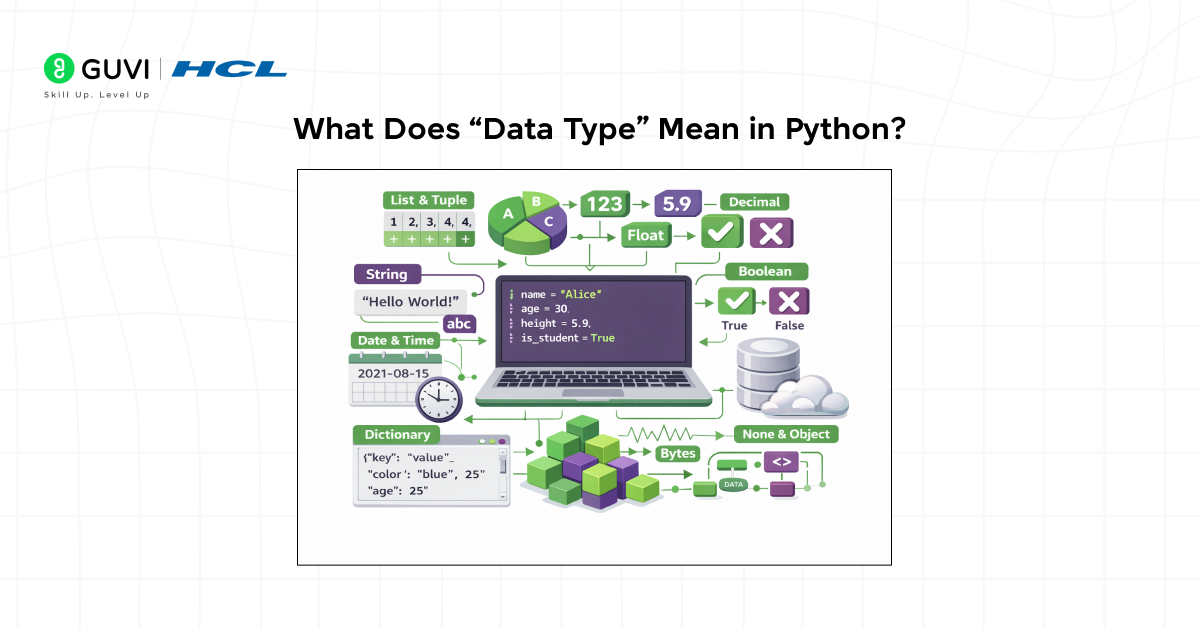
Data represents information encoded as numeric values, textual symbols, logical states, or structured collections of related elements in programming. Python relies on data types to determine memory allocation strategies, internal storage representation, and the set of operations that can be safely applied to a value.
Data types directly control arithmetic behavior, comparison semantics, control-flow evaluation, and how values interact during execution. Python follows a dynamic typing model, where variables are not bound to a fixed type. Instead, the interpreter infers the data type at runtime from the assigned value and enforces type-specific behavior as the program executes.
Importance of Data Types in Python
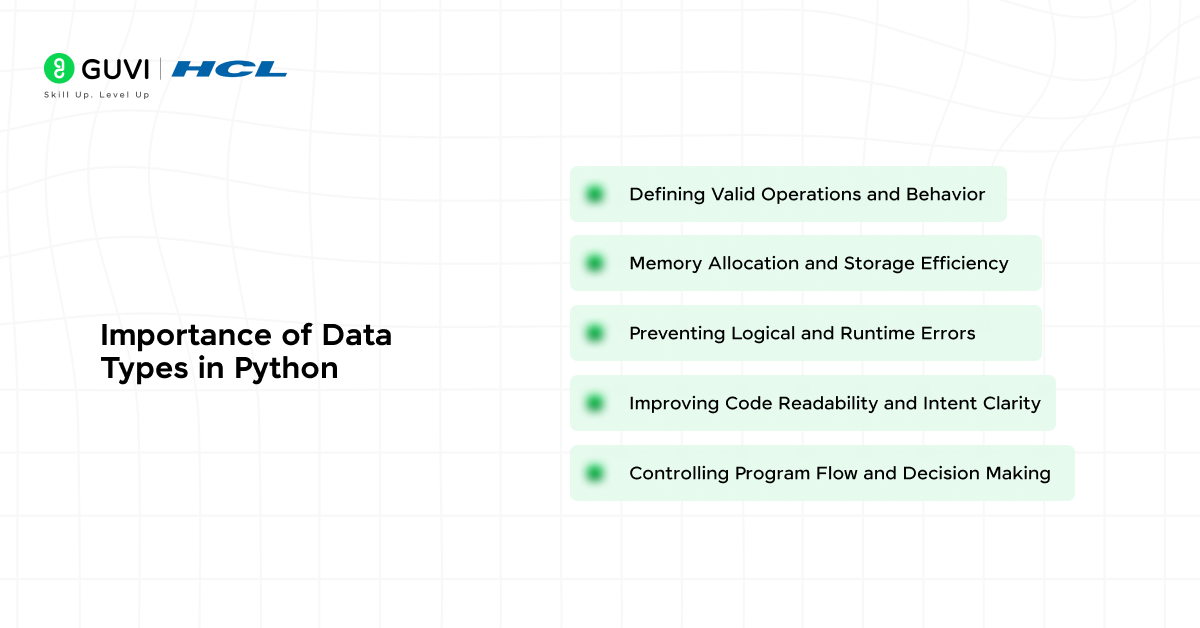
- Defining Valid Operations and Behavior: Data types determine which operations can be performed on a value and how those operations behave. Arithmetic operators, comparisons, and logical expressions are evaluated differently depending on the underlying data type, which ensures that computations follow predictable and correct rules.
- Memory Allocation and Storage Efficiency: Python programming uses data types to decide how values are stored in memory, including size, layout, and reference handling. Immutable types such as integers and strings are stored differently from mutable collections, which affects memory reuse, performance, and garbage collection behavior.
- Preventing Logical and Runtime Errors: A clear understanding of data types helps avoid invalid operations, such as adding numeric values to strings or applying sequence operations to non-iterable objects. Type awareness reduces runtime exceptions and prevents subtle logic errors that may not be immediately visible.
- Improving Code Readability and Intent Clarity: The choice of data type communicates intent to both the interpreter and other developers. Using appropriate types makes code easier to understand, reason about, and maintain, especially in larger applications where data flows across multiple components.
- Controlling Program Flow and Decision Making: Conditional statements and loops rely heavily on data types such as booleans, collections, and numeric values. Data types influence truth evaluation, loop execution, and branching logic, which directly affects how programs respond to different inputs.
Mutability and Immutability in Data Types
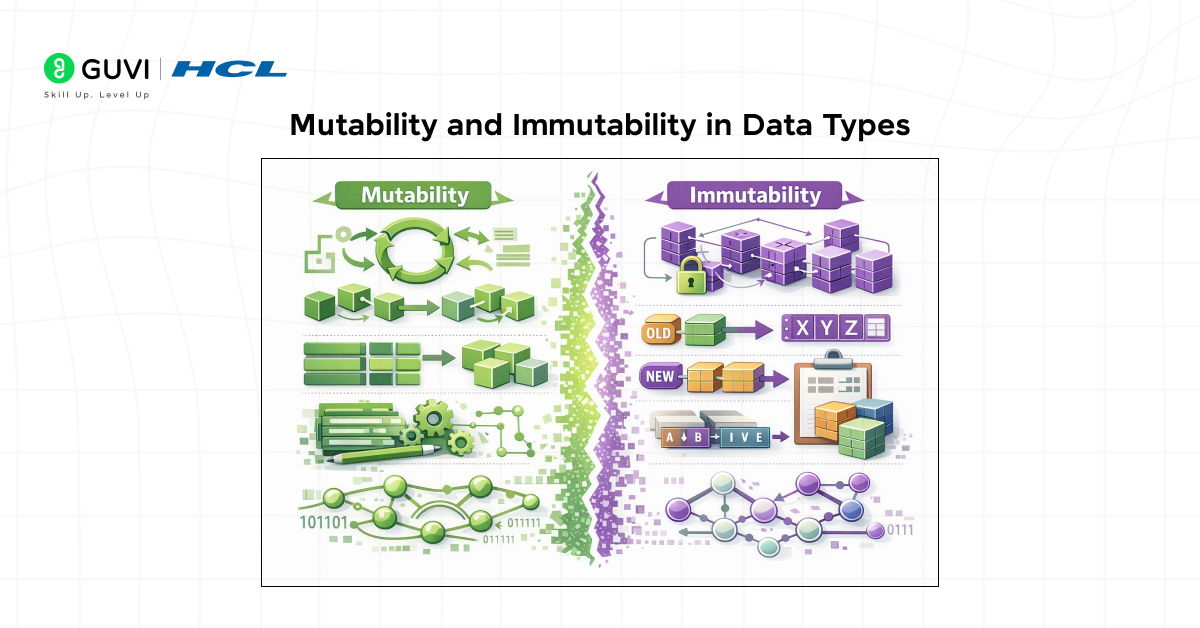
Mutability and immutability define whether a Python object’s state can be modified after it is created, and this distinction has deep implications for memory behavior, performance, and program correctness. Mutable data types allow in-place changes without creating a new object. Examples include list, dict, set, and bytearray. When a list element is updated or a dictionary key is modified, Python changes the internal state of the existing object while preserving its identity in memory. This makes mutable types efficient for incremental updates but also introduces risks when objects are shared across multiple references, such as unintended side effects in function arguments or shared data structures.
Immutable data types, on the other hand, cannot be altered once created. Common immutable types include int, float, bool, str, tuple, frozenset, and bytes. Any operation that appears to modify an immutable object actually creates a new object with a different memory identity. For example, concatenating strings or adding two integers produces a new object rather than changing the original. Immutability enables safer sharing of objects, predictable behavior, and use as dictionary keys or set elements because their hash values remain stable.
Built-In Data Types in Python
Built-in data types define how Python represents values internally, how operations are evaluated by the interpreter, and how objects behave in memory. For a Python developer, understanding these types is essential because every value in Python is an object, and each object carries type information that governs valid operations and storage behavior.
1. Numeric Data Types
Numeric data types represent quantitative values and are implemented as immutable objects in Python.
- Integer (int)
The int type represents whole numbers with unlimited precision. Python dynamically allocates memory for integers based on size, removing the risk of overflow common in lower-level languages.
Internally, integers are immutable objects. Any arithmetic operation on an integer produces a new object rather than modifying the original value. Integers support bitwise operations, which makes them useful for flags, masks, and low-level computations.
- Floating-Point Number (float)
The float type represents real numbers using IEEE 754 double-precision format. Floats store values in binary form, which can introduce rounding errors for certain decimal fractions.
Floating-point arithmetic is optimized for performance but should be used cautiously when precision is critical. Comparisons between floats often require tolerance-based checks rather than direct equality.
- Complex Number (complex)
The complex type stores numbers with real and imaginary components as separate floating-point values. Complex numbers are immutable and support mathematical operations such as magnitude calculation and conjugation.
Complex numbers are not compatible with ordering comparisons and are primarily used in specialized computational domains.
- Common Use Cases and Operations
Numeric types are used for counters, measurements, financial values, scientific calculations, and algorithmic logic. Python automatically performs type promotion when operations mix numeric types, following well-defined coercion rules.
2. Text Data Type
Textual data is handled using Unicode-aware string objects that support internationalization and symbol representation.
- String (str)
The str type represents an immutable sequence of Unicode code points. Python stores strings efficiently and performs internal optimizations for small and repeated strings.
Because strings are immutable, operations like concatenation create new string objects, which has performance implications in tight loops.
- Creating Strings
Strings can be defined using single, double, or triple quotes. Triple-quoted strings preserve line breaks and are commonly used for documentation strings and multi-line text blocks.
Formatted string literals allow expressions to be evaluated inline, improving readability and reducing formatting errors.
- Indexing and Slicing Basics
Strings support zero-based indexing and slicing. Indexing retrieves a single-character string, while slicing returns a new string object containing the selected range.
Negative indexing allows access relative to the end of the string, and slicing operations never modify the original string.
- Common String Operations
Strings support comparison, membership testing, splitting, joining, formatting, and transformation operations. Many built-in methods return new strings rather than altering existing ones, reinforcing immutability.
3. Boolean Data Type
Boolean values control decision-making and flow control in Python programs.
- Boolean (bool)
The bool type represents truth values and is implemented as a subclass of int. This allows booleans to participate in numeric expressions while retaining logical meaning.
Boolean objects are immutable and are frequently created implicitly as the result of comparisons or logical evaluations.
- True and False
Boolean values must be written using exact capitalization. Python treats certain values as truthy or falsy in boolean contexts, even if they are not explicitly boolean.
- Boolean Expressions and Conditions
Boolean expressions combine comparisons, function results, and logical operators. These expressions are evaluated lazily, meaning evaluation stops as soon as the result is determined.
- Logical Operators
Logical operators follow short-circuit behavior. This allows expressions to be written safely by preventing evaluation of unsafe or unnecessary operations.
Want to strengthen your Python fundamentals beyond data types? Explore HCL GUVI’s Python Hub to build clarity on core concepts, understand how Python handles data in real programs, and develop a strong base for writing reliable, real-world Python code.
Collection Data Types in Python
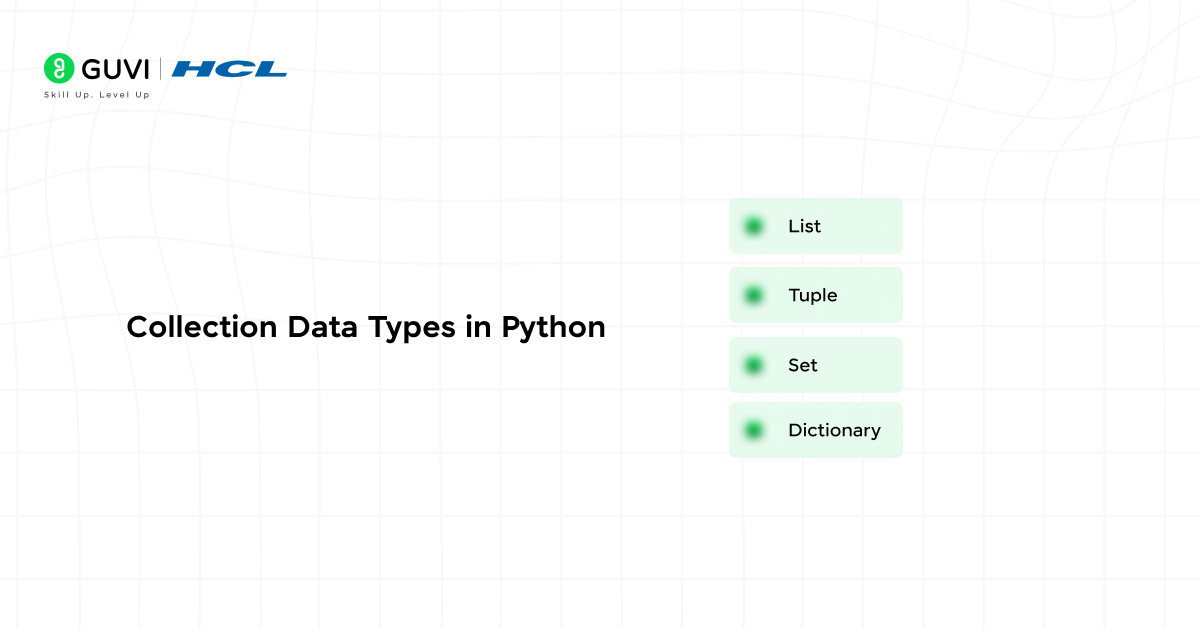
Collection data types store multiple objects within a single container and define how elements are ordered, accessed, stored in memory, and modified during execution. Each collection type implements a different internal structure, which directly affects performance, mutability, and valid operations.
1. List
- Ordered and Mutable Collection
Lists store references to objects in a contiguous, array-like structure managed internally by Python. This layout enables fast indexed access with constant-time complexity for reads. When elements are appended beyond the current capacity, Python resizes the underlying array by allocating additional memory and copying references, which introduces occasional overhead.
Lists are mutable, meaning elements, order, and length can be modified in place. Mutability allows lists to grow, shrink, and reorder dynamically during program execution.
- Use Cases for Lists
Lists are well-suited for data that changes frequently or grows dynamically. Common use cases include task queues, collections of user input, iterative data processing pipelines, and scenarios where ordering matters and elements need to be updated or replaced over time. Lists are also commonly used as intermediate data structures during transformations and aggregations.
- Accessing and Modifying Elements
List elements are accessed using zero-based indexing and slicing. Slicing returns a new list containing references to the selected elements, while index access returns a single object reference.
Python features provides a rich set of list methods for modification, including insertion, removal, sorting, reversing, and iteration. All these operations act on the same list object, which means changes are visible wherever the list reference is shared.
2. Tuple
- Ordered and Immutable Collection
Tuples store ordered references to objects but do not allow modification after creation. Their immutability guarantees that the structure and contents remain constant for the lifetime of the object.
This immutability enables Python to apply memory and performance optimizations, such as storing tuples more compactly and allowing safe reuse in certain execution contexts.
- Differences Between List and Tuple
Tuples generally consume less memory than lists because they do not require space for dynamic resizing metadata. Since tuples are immutable, they can be safely hashed if all contained elements are also immutable. This allows tuples to be used as dictionary keys or elements of sets, which is not possible with lists due to their mutability.
- When Immutability Matters?
Tuples are appropriate for representing fixed records, structured data points, function return values with multiple components, and constants that should not change accidentally.
They are also useful when passing data between functions to ensure the receiving code cannot modify the original structure.
3. Set
- Unordered Collection of Unique Elements
Sets are implemented using hash tables, which allows fast average-case performance for membership checks, insertion, and deletion. Sets automatically enforce uniqueness, meaning duplicate values are eliminated at insertion time.
All elements stored in a set must be hashable and immutable, ensuring stable hashing behavior throughout the set’s lifetime.
- Removing Duplicates
Sets are commonly used to remove duplicates from collections efficiently. Converting a list to a set eliminates repeated values in linear time relative to input size, making it suitable for large datasets where uniqueness matters more than order.

Because sets are unordered, the original sequence order is not preserved during deduplication.
- Set Operations Like Union and Intersection
Python supports mathematical set operations such as union, intersection, difference, and symmetric difference. These operations are implemented in optimized C code within the interpreter, making them significantly faster and more expressive than equivalent manual loops.
Set operations are frequently used in filtering, comparison of datasets, permission modeling, and rule-based logic.
4. Dictionary
- Key-Value Pair Storage
Dictionaries in Python store data as key-value pairs using a hash table internally. This design provides average constant-time complexity for lookups, insertions, and updates.
Keys must be immutable and hashable to ensure consistent mapping, while values can be of any data type, including other collections.
- Accessing Values Using Keys
Dictionary values are retrieved using keys rather than positional indices. This allows direct, semantic access to data based on identifiers instead of numeric positions.
Dictionaries support dynamic updates, including adding new entries, modifying existing values, and deleting keys, all without affecting unrelated entries.
- Real-World Use Cases
Dictionaries are widely used to represent structured records, configuration settings, lookup tables, caches, and mappings between identifiers and data. They form the foundation of many data interchange formats, including JSON, and are heavily used in APIs, configuration management, and application state handling.
List vs Tuple vs Set vs Dictionary: Comparison at a Glance
| Feature | List | Set | Dictionary | |
| Ordering | Ordered | Ordered | Unordered | Ordered by insertion |
| Mutability | Mutable | Immutable | Mutable | Mutable |
| Duplicate elements | Allowed | Allowed | Not allowed | Keys not allowed |
| Access method | Index-based | Index-based | Membership-based | Key-based |
| Element uniqueness | Not enforced | Not enforced | Enforced | Keys enforced |
| Memory usage | Moderate | Lower than list | Moderate | Higher due to key-value storage |
| Lookup performance | Linear search | Linear search | Constant-time average | Constant-time average |
| Modification allowed | Yes | No | Yes | Yes |
| Hashable | No | Yes, if elements are immutable | No | No |
| Typical use cases | Dynamic sequences | Fixed records | Deduplication, membership tests | Structured data, mappings |
Special Data Types in Python
- NoneType and the None Value
NoneType is a built-in Python type with a single instance, None, which represents the explicit absence of a value. Internally, None is implemented as a singleton object, meaning Python guarantees that only one None object exists throughout the runtime. Because of this, identity comparison using is and is not is the correct way to check for None, rather than equality comparison using ==.
None evaluates as false in Boolean contexts but remains distinct from other falsy values. It does not support arithmetic, indexing, iteration, or attribute access, which enforces clear failure modes when logic incorrectly assumes the presence of data.
- When and Why None Is Used
None is commonly used to signal missing, optional, or intentionally undefined data. It is frequently returned by functions that perform side effects rather than producing results, such as file writes or in-place modifications. In function definitions, None is often used as a default parameter value to safely initialize mutable objects inside the function body, avoiding shared state across calls.
In data-processing pipelines, None is used to represent unavailable fields, failed lookups, or conditional computation paths. This explicit representation allows programs to distinguish between missing data and valid but empty values, which is critical for validation and control flow.
- Difference Between None and Empty Values
Empty values such as “”, [], {}, or () represent valid objects with zero length. They occupy memory, have a defined type, and support type-specific operations. None, in contrast, represents the absence of any value and does not support container or numeric operations.
In conditional logic, both None and empty values evaluate to false, but they convey different semantic meaning. Treating them interchangeably can lead to incorrect assumptions, especially in data validation, API responses, and function return handling. Clear distinction between None and empty objects improves correctness and intent clarity.
Checking and Converting Data Types in Python
- Using type() to Identify a Data Type
The type() function returns the exact class of an object at runtime, revealing how Python interprets the value internally. Since Python uses dynamic typing, type information is attached to objects rather than variables. This allows variables to be rebound to values of different types during execution.
For production-grade checks, isinstance() is preferred over type() because it respects inheritance and polymorphism. This distinction becomes important when working with subclasses, custom data types, or abstract base classes.
- Type Conversion and Type Casting
Type conversion transforms a value from one data type to another by creating a new object. Python provides built-in constructors such as int(), float(), str(), list(), tuple(), set(), and dict() for explicit casting. These conversions succeed only when the source value has a compatible internal representation.
Type casting does not modify the original object, as most built-in data types are immutable. Instead, Python allocates new memory for the converted value and updates references accordingly. Understanding this behavior is important for performance-sensitive code and memory-aware programming.
- Implicit vs Explicit Conversion
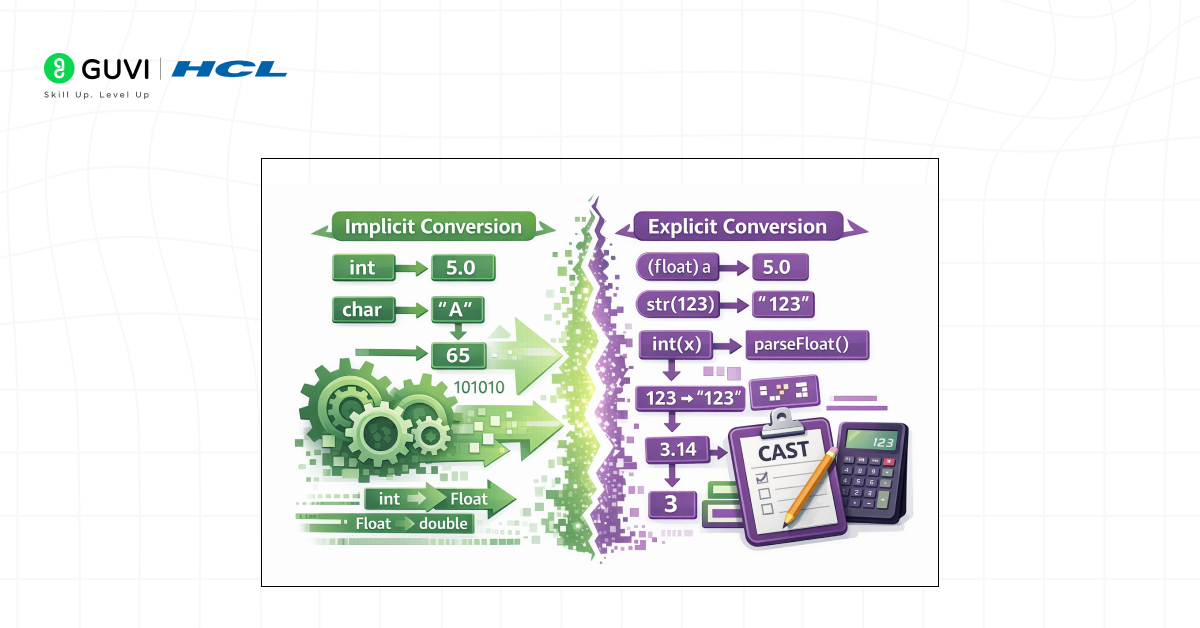
Implicit conversion occurs automatically when Python promotes a value to a compatible type during an operation. A common example is integer-to-float promotion in mixed arithmetic expressions. Implicit conversion follows strict rules to avoid data loss, but it can still lead to unintended results if assumptions are incorrect.
Explicit conversion requires deliberate casting by the developer and provides precise control over data representation. Explicit conversion improves readability, predictability, and error handling, especially when dealing with external inputs, file data, or API responses.
- Common Conversion Patterns and Pitfalls
User input is always received as a string and must be explicitly converted before numerical or logical operations. Boolean conversion relies on truthiness rules rather than strict type checks, which means many non-boolean objects can influence control flow. Collection conversions are often used to enforce uniqueness, ordering, or immutability, but they may change data semantics if applied carelessly.
Failed conversions raise runtime exceptions such as ValueError or TypeError, which should be handled explicitly in robust programs. Awareness of conversion boundaries and failure modes is essential for writing safe and predictable Python code.
Common Beginner Mistakes with Data Types
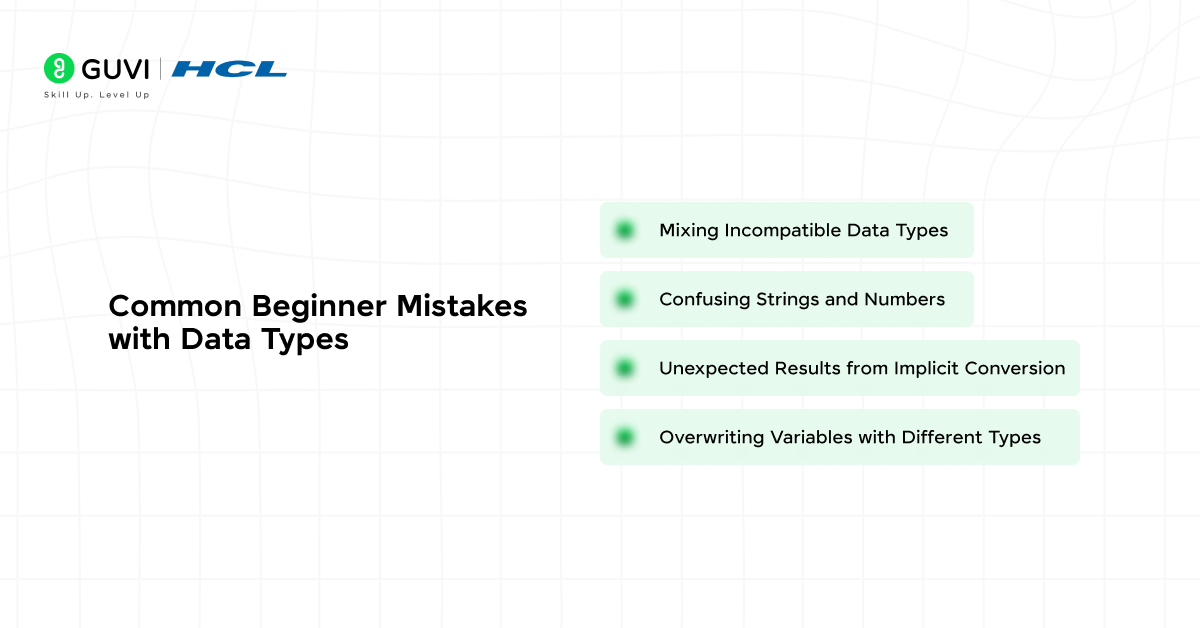
- Mixing Incompatible Data Types: Beginners often attempt operations between incompatible types, such as adding a string to an integer or comparing numbers with strings. Python raises TypeError in these cases because the operations are undefined. Understanding which operations are valid for each data type prevents avoidable runtime failures.
- Confusing Strings and Numbers: User input is always read as a string, even when it looks numeric. Treating “10” as 10 leads to incorrect calculations, string concatenation instead of arithmetic, or faulty comparisons. Explicit conversion using int() or float() is required before numeric operations.
- Unexpected Results from Implicit Conversion: Python performs implicit type conversion in certain expressions, such as converting int to float during arithmetic. This can lead to precision issues or unexpected results if developers assume strict type preservation. Awareness of type promotion rules is essential for accurate calculations.
- Overwriting Variables with Different Types: Reassigning a variable to a value of a different type can introduce subtle bugs later in the program. A variable that initially stores a list and later stores a string may cause failures when list-specific operations are expected. Consistent type usage improves predictability and readability.
Ready to move from understanding Python data types to writing confident, real-world code? Join HCL GUVI’s Python course to learn through 100 percent online and self-paced modules, get full lifetime access to all content, clear doubts via dedicated forum support, and practise hands-on using four gamified practice platforms that strengthen your core Python foundations.
Practical Examples of Data Types in Action
- Storing User Input: User input is captured as strings and often converted into appropriate data types for further processing. For example, converting input into integers enables numerical calculations, while keeping input as strings supports validation and formatting logic.
- Performing Calculations: Numeric data types such as int and float are used to compute totals, averages, percentages, and measurements. Choosing the correct numeric type affects precision, performance, and correctness, especially in financial or scientific contexts.
- Organizing Related Data: Collections such as lists, tuples, sets, and dictionaries structure related data efficiently. Lists store ordered records, tuples represent fixed data groups, sets enforce uniqueness, and dictionaries map meaningful keys to values in real-world data models.
- Using Conditions and Loops with Different Data Types: Boolean values control decision-making in conditional statements, while collections drive iteration in loops. Combining data types correctly allows programs to branch logic, repeat operations, and process structured data reliably across different execution paths.
Conclusion
Data types are the foundation of how Python understands, stores, and processes information. They govern valid operations, memory behavior, and program flow, from simple calculations to complex data structures. Mastering Python data types, along with mutability and conversion rules, enables clearer logic, fewer errors, and more reliable programs as code scales from small scripts to real-world applications.
FAQs
1. How do data types influence performance in Python programs?
Data types determine memory layout, mutability, and internal operations. Choosing efficient types, such as using tuples instead of lists for fixed data or sets for fast membership checks, can significantly improve performance and reduce memory overhead.
2. Can a single Python variable hold different data types over time?
Yes. Python allows variables to be rebound to values of different data types during execution. While this flexibility is powerful, inconsistent reassignment can reduce code clarity and introduce hard-to-detect bugs.
3. How do data types affect function design and APIs in Python?
Data types define what inputs a function can safely process and what outputs it guarantees. Clear type expectations improve function reliability, simplify debugging, and make APIs easier to understand and integrate in larger systems.
Success Stories

About the Author
Vaishali
I'm a seasoned writer with four years of experience across technical, non-technical, and just about every genre or niche you can imagine. Adaptable and curious, I enjoy exploring new topics and making information engaging and easy to understand. Fueled by a steady stream of tea, I approach each project with creativity, reliability, and genuine enthusiasm for storytelling.
View all posts by Vaishali
Connect with me @














Did you enjoy this article?