


Career Articles
Capgemini Exceller Technical Assessment 2026: AI + Technical - Best Guide
Cognizant GenC Elevate Exam Pattern & Syllabus for Freshers 2026 - Best Guide
Capgemini Exceller Placement Papers and Solutions 2026 - Best Guide
How to Pass the Accenture Recruitment Process 2026/27: The Complete Guide


Get In Touch For Details! Request More Information

How to Know it’s the Right Time to Make a Career Change: A Complete Guide
Jul 15, 2026 7 Min Read 1206 Views
(Last Updated)
Feeling uncertain about a career change? You’re not alone. By the time you reach age 50, you’ll likely have held 12 different jobs in search of the right fit. In fact, experts say most people change careers an average of three or more times during their lifetimes.
Whether you’re feeling burned out, undervalued, or simply craving something new, recognizing the signs it’s time to change career paths is crucial for your professional satisfaction. As of April 2024, approximately 3.5 million workers made the leap to new career options, demonstrating how common this transition has become.
This guide will help you identify the clear indicators that it’s time for a change, assess if you’ve outgrown your current role, and provide practical steps on how to make a career change the right way. After all, most of us spend more hours at work than we do at home—your work should inspire you, not drain you. Let’s begin!
Quick Answer:
You’ll know it’s the right time to change careers when your work consistently leaves you drained, unmotivated, undervalued, or misaligned with your values, and when the idea of a new path feels more relieving than intimidating.
Table of contents
- Clear Signs It’s Time For a Career Change
- a) You feel burned out or emotionally drained
- b) You're bored and unmotivated at work
- c) You dread Mondays and live for weekends
- d) You feel jealous of others' jobs
- e) You're physically affected by work stress
- You've Outgrown Your Current Role
- a) No room for growth or learning
- b) You've achieved all your goals
- c) You're no longer challenged
- d) You feel your skills are underused
- Your Values and Work No Longer Align
- a) You feel disconnected from the company mission
- b) You're uncomfortable with leadership decisions
- c) You crave more purpose in your work
- You're Already Thinking About a Career Change
- a) You browse job boards during work hours
- b) You fantasize about quitting
- c) You've talked to friends about leaving
- d) You're asking: 'Should I change careers?'
- How to Make a Career Change the Right Way
- a) Start with honest self-reflection
- b) Identify your passions and strengths
- c) Explore roles that align with your values
- d) Assess skill gaps and learning needs
- e) Build a financial safety net
- f) Start networking and testing new paths
- Concluding Thoughts…
- FAQs
- Q1. How do I know if it's time for a career change?
- Q2. At what age do most people change careers?
- Q3. How can I prepare for a career change?
- Q4. Is it normal to feel uncertain about changing careers?
- Q5. How long does a career transition typically take?
1. Clear Signs It’s Time For a Career Change
Recognizing when you’re ready for a career change is about paying attention to your daily experiences and emotional responses to work. Here are five unmistakable signs that might indicate it’s time to explore new professional horizons.
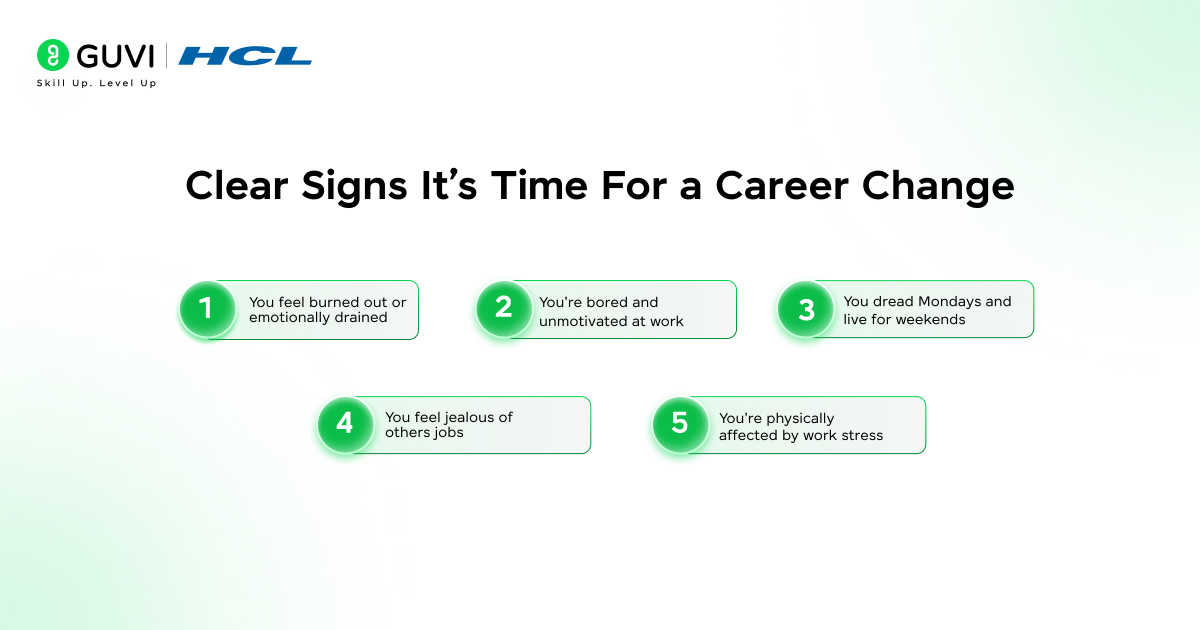
a) You feel burned out or emotionally drained
Burnout isn’t just being tired—it’s a state of chronic exhaustion that doesn’t improve with regular rest. You might notice you’re emotionally depleted, cynical about your job, and experiencing reduced professional efficacy.
Signs of burnout include:
- Feeling constantly exhausted regardless of how much you rest
- Becoming increasingly detached from your work
- Finding it difficult to concentrate on tasks
- Lacking the energy to be consistently productive
Essentially, when the thought of your work triggers anxiety instead of excitement, it’s often a signal that your current career path may no longer serve your well-being.
b) You’re bored and unmotivated at work
- When you find yourself clock-watching and struggling to focus, boredom has likely set in. This isn’t about having an occasional dull day—it’s a persistent feeling that your work lacks meaning or challenge.
- Notice if you’re finding it harder to start projects or if tasks that once engaged you now seem mundane. A survey of Indian professionals found that 67% of employees who changed careers cited lack of motivation as a primary reason for making the switch.
c) You dread Mondays and live for weekends
- That sinking feeling on Sunday evenings as you anticipate the work week ahead is particularly telling. While most people enjoy weekends, consistently counting down hours until Friday signals something deeper.
- Ask yourself: Do you spend Monday through Friday just getting through to the weekend? This “survival mode” mentality suggests your career isn’t bringing fulfillment. Furthermore, when your happiness depends entirely on time away from work, it’s worth considering whether a career change might better align with your life satisfaction.
d) You feel jealous of others’ jobs
- Pay attention if you find yourself consistently envious when friends describe their work. This jealousy often points to unfulfilled aspirations in your own career.
- This envy isn’t about wanting someone else’s exact position—rather, it’s about recognizing elements missing from your own professional life: perhaps autonomy, creativity, purpose, or recognition. Your envy actually provides valuable clues about what you’re seeking in a career change.
e) You’re physically affected by work stress
Your body often recognizes career dissatisfaction before your mind fully acknowledges it. Physical symptoms might include:
- Persistent headaches or migraines
- Digestive problems
- Sleep disturbances or insomnia
- Unexplained fatigue
- Frequent illnesses due to lowered immunity
According to health studies in India, approximately 46% of professionals experiencing chronic work-related stress report physical symptoms that diminish once they transition to more suitable career paths.
When these signs appear consistently over months rather than as temporary responses to challenging projects, they often indicate it’s time for a career pivot. Remember that changing careers isn’t admitting failure—it’s recognizing your professional needs have evolved.
2. You’ve Outgrown Your Current Role
Professional stagnation often signals it’s time for a career pivot. Unlike temporary frustrations, outgrowing your role creates a persistent feeling that you’ve hit a ceiling professionally. Let’s explore the telltale signs that you’ve expanded beyond your current position.
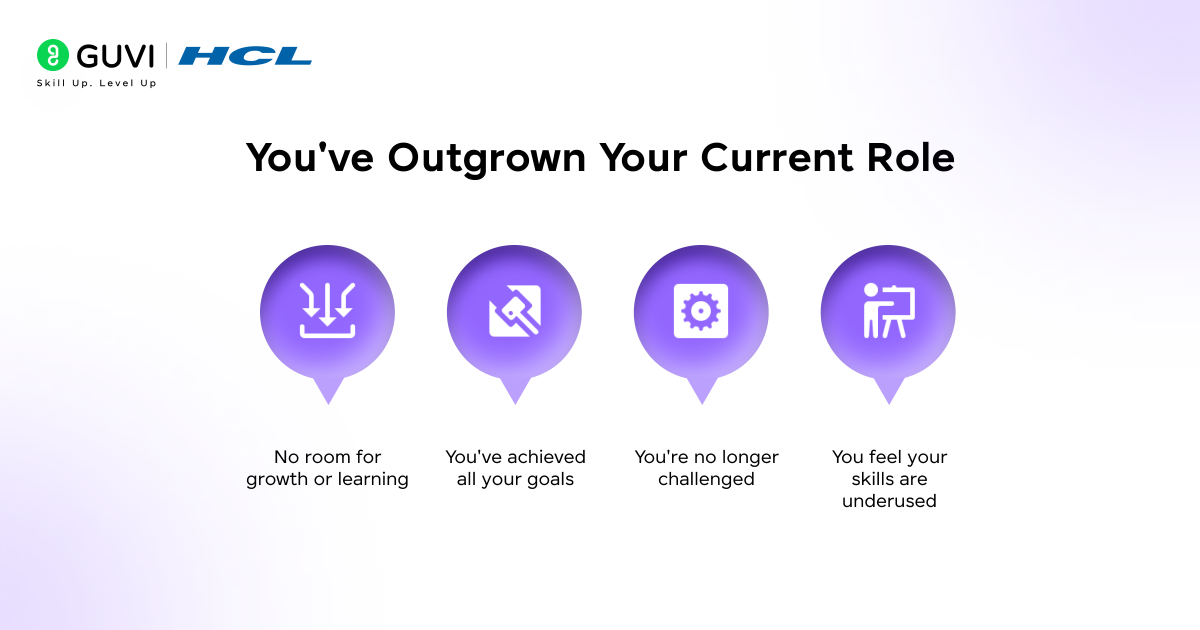
a) No room for growth or learning
Career advancement opportunities matter significantly in job satisfaction. Consider these warning signs:
- Your company lacks a clear promotion pathway
- You’ve requested additional responsibilities but been denied
- Professional development programs are non-existent or inaccessible
- Your manager seems threatened by your growth
Moreover, if you’re constantly teaching others but never learning anything new yourself, you’ve likely reached the limits of growth in your current position. This situation is especially problematic since continuous learning ranks as the top factor in workplace happiness for 76% of Indian professionals.
b) You’ve achieved all your goals
- Success should feel satisfying, but when you’ve conquered every challenge your position offers, boredom quickly follows. Look back at your career objectives from when you started this role. Have you accomplished everything you set out to do?
- Subsequently, if you’re struggling to identify meaningful milestones ahead, you’re probably ready for a career change. Many professionals who successfully transition to new careers report that goal completion was their primary motivation for seeking new opportunities.
c) You’re no longer challenged
Remember the nervous excitement when starting your current role? That healthy stress indicates growth. Nevertheless, comfort zones eventually become stagnation zones.
Signs you’re no longer challenged include:
- Completing tasks on autopilot
- Knowing exactly what each day will bring
- Finding your work predictable and routine
- Feeling mentally unchallenged for months
A surprising study of Indian mid-career professionals found that 64% cited “lack of intellectual stimulation” as a key factor in their decision to change careers.
d) You feel your skills are underused
- Underutilization is a clear indicator that you’ve outgrown your role. Perhaps you’ve developed advanced skills through side projects, certifications, or personal interests that remain unused at work. Alternatively, your natural talents might be ignored in favor of more mundane tasks.
- Likewise, if you find yourself handling primarily administrative work despite having strategic capabilities, or if junior team members are assigned projects you could execute more effectively, these are strong indicators of underutilization.
- This mismatch between your abilities and responsibilities creates profound dissatisfaction. Among professionals who recently made successful career changes in India, approximately 58% reported skill underutilization as their primary motivation.
Career growth involves continuous evolution. When your current role no longer supports that evolution, it may indeed be time to explore new professional horizons. Remember that recognizing you’ve outgrown your position isn’t a failure—it’s a sign of professional maturity and self-awareness.
Explore: 8 Steps to Switch Career to Machine Learning
3. Your Values and Work No Longer Align
Values serve as your internal compass guiding career satisfaction. When your personal beliefs no longer match your workplace reality, it creates a fundamental disconnect that often signals a need for career change.
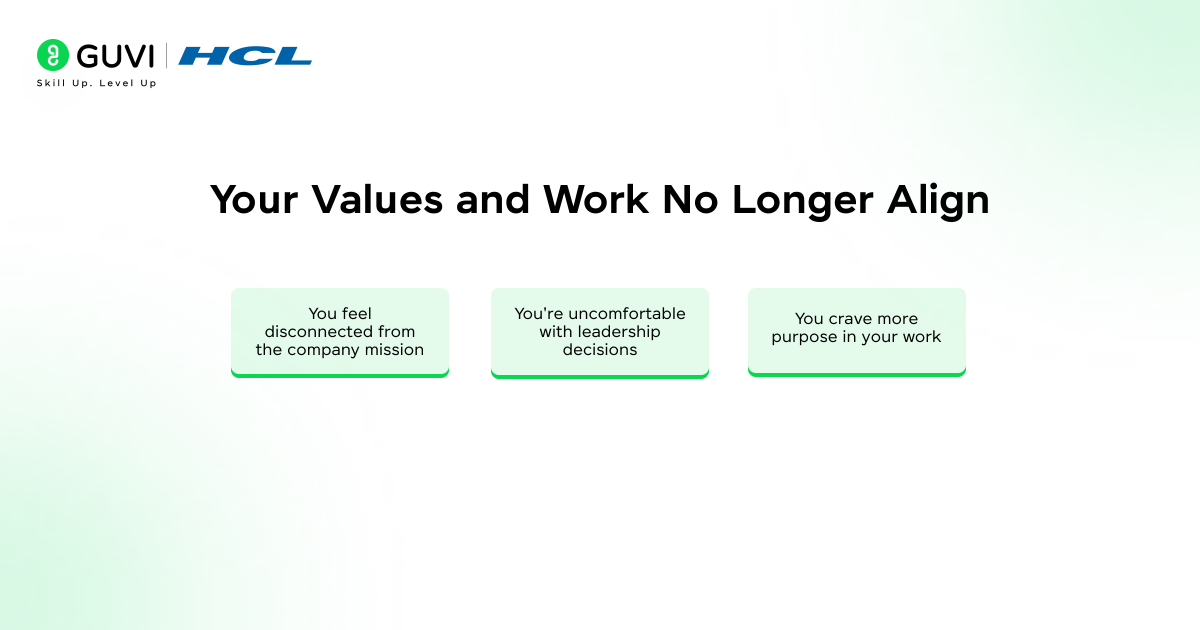
a) You feel disconnected from the company mission
Connection to company mission has reached a record low, dropping from 38% in March 2021 to just 30% by February 2024. This “Great Detachment” phenomenon leaves many professionals feeling adrift in their roles.
Signs you’re experiencing mission disconnection include:
- You struggle to explain your company’s purpose to others
- You cannot see how your daily tasks contribute to larger goals
- You feel embarrassed about your organization’s actions or direction
- Your motivation continues declining regardless of incentives
This disconnection particularly affects younger employees, remote workers, and front-line staff. As a result, even with good pay or benefits, you might find yourself browsing job listings during work hours—a clear indicator it’s time to consider a career change.
b) You’re uncomfortable with leadership decisions
- Values misalignment often manifests as discomfort with leadership choices. When there’s a gap between stated company values and lived experiences, trust erodes and cynicism grows.
- This disconnect can feel deeply personal—like the “opposite of what you believe in”. Consider how frequently you find yourself thinking, “This doesn’t feel right” about decisions from above.
- Additionally, ongoing values conflicts create what experts call “values-based burnout” or “misalignment burnout”, which shares symptoms with regular burnout but stems specifically from this values clash. For many Indian professionals, this discomfort eventually leads to career changes once it reaches a tipping point where they can no longer reconcile personal ethics with company direction.
c) You crave more purpose in your work
- Finding mission and purpose provides intrinsic motivation for high performance—most people want their work to matter. Consequently, when employees feel disconnected from broader objectives, their work becomes “a mere series of tasks devoid of intrinsic meaning”.
- On the contrary, choosing a career path that matches your values creates better long-term satisfaction. Important to realize is that values often change throughout your career journey as you gain experience and self-confidence. For this reason, periodically reassessing your values-work alignment becomes essential.
- Many professionals make the mistake of searching for purpose outside themselves—looking at job titles or descriptions rather than internal values. In any event, the question “Who do I want to be?” often provides more clarity than “What do I want to do?”
Given these points, if you consistently find yourself questioning the meaning of your work or envying others with more purposeful careers, it might indicate you’re ready for a change. The declining sense of ownership and initiative at your current job combined with persistent values misalignment usually confirms it’s the right time to explore new career opportunities aligned with who you truly want to be.
Career transitions are far more common than most people imagine. Here are a couple of interesting insights about switching careers:
People Change Careers More Often Than Jobs: While the average person holds 12 different jobs in their lifetime, research shows that they also switch career paths an average of three or more times, showing how normal it is to seek better alignment with your goals.
Midlife Career Changes Are Rising: In recent years, professionals in their late 30s and 40s have become the fastest-growing group of career changers, driven by shifting values, burnout, and the desire for meaningful work.
These facts reinforce that career changes aren’t unusual—they’re a natural part of evolving professionally and personally.

4. You’re Already Thinking About a Career Change
Sometimes your subconscious mind makes decisions before you consciously acknowledge them. Your actions often reveal what you truly want long before you formally decide to make a career change.
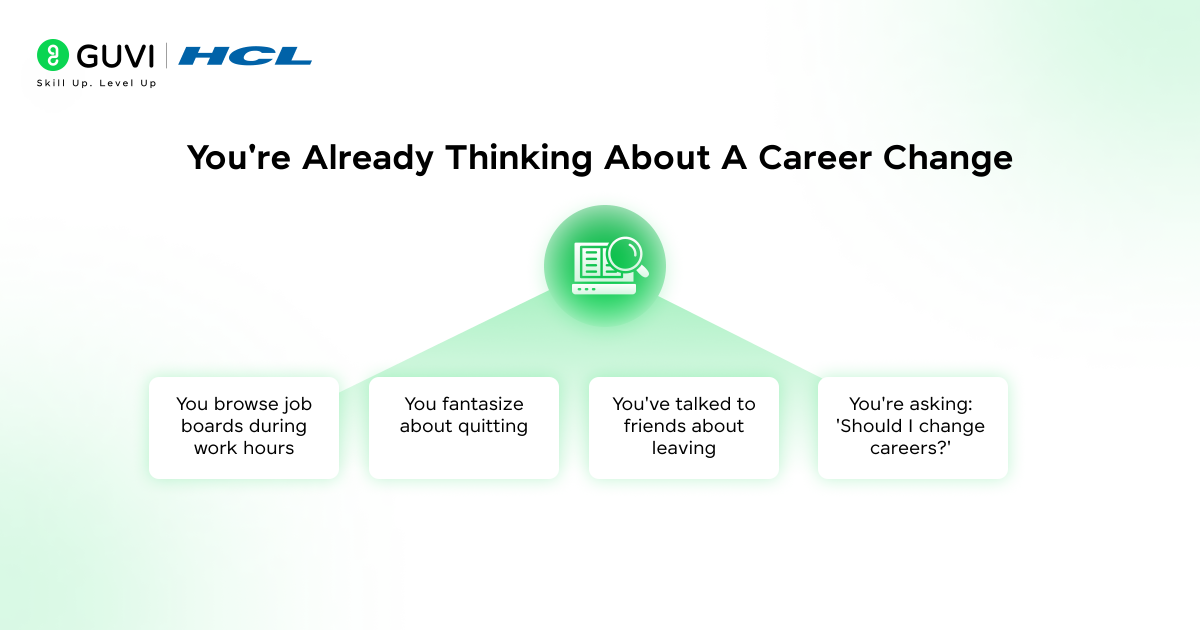
a) You browse job boards during work hours
- The clearest sign you’re mentally preparing for a career change is regularly checking job listings while at your current job. This behavior indicates your mind has already started the transition process.
- As a matter of fact, a survey found that 70% of professionals who eventually changed careers had been browsing job sites during work hours for at least three months prior to making the switch.
- Notice how much time you spend exploring other opportunities. Are you bookmarking positions that differ significantly from your current role? This exploration phase often reveals the direction your professional interests are heading.
b) You fantasize about quitting
- Daydreaming about dramatic resignation scenarios or imagining life without your current job indicates your mind is processing an exit. These fantasies serve as mental rehearsals for change.
- To begin with, occasional daydreams are normal, but when these thoughts become persistent, they signal readiness for transformation. Pay attention to whether these fantasies bring feelings of relief or anxiety—relief typically indicates you’re emotionally prepared for the change.
c) You’ve talked to friends about leaving
- Vocalizing your career dissatisfaction to others represents a significant step. By sharing your thoughts, you’re testing ideas and seeking validation.
- In this case, notice the language you use—phrases like “I’m thinking about leaving” versus “If things don’t improve” reveal how close you are to making a decision. Coupled with increased conversations about alternative careers, this verbal processing often precedes actual career changes by 3-6 months.
d) You’re asking: ‘Should I change careers?’
At this point, actively seeking career change advice shows you’ve moved beyond casual consideration to serious contemplation. The very act of researching “signs it’s time to change career” or reading this article suggests you’re mentally preparing for a transition.
Common questions that indicate readiness include:
- What skills can I transfer to a new field?
- How long will a career transition take?
- Will I need additional education?
- Can I afford a potential salary adjustment during transition?
In brief, if you find yourself regularly engaging with these behaviors and thoughts, your subconscious has likely already decided. Above all, recognize that these signs aren’t evidence of failure but confirmation that you’re growing. Your awareness of these patterns can help transform uncertainty into purposeful action toward a more fulfilling career path.
5. How to Make a Career Change the Right Way
Once you’ve identified the need for a career shift, taking strategic actions becomes crucial. Here’s how to navigate this transition effectively:
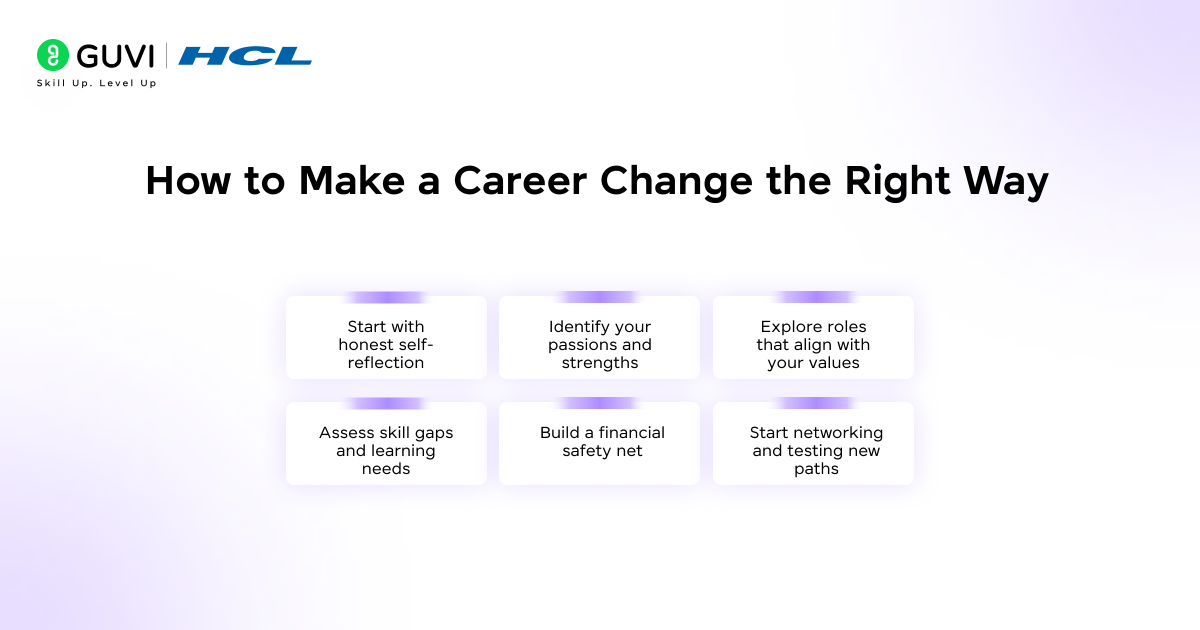
a) Start with honest self-reflection
- Taking time for self-reflection creates clarity about your career direction. Temporarily disconnect from digital distractions—leave your phone at home or turn it off occasionally to create mental space for introspection.
- Ask yourself what activities make you lose track of time or what work environments make you feel most fulfilled. This process helps you understand your core nature and facilitates personal growth.
b) Identify your passions and strengths
Use self-assessment tools to discover your innate talents:
- Self-reflection: Consider tasks you excel at and enjoy
- Assessment tools: Try StrengthsFinder, Myers-Briggs, or VIA Survey
- External feedback: Ask trusted peers about your perceived strengths
- Past achievements: Analyze your resume for patterns of success
Looking at what naturally excites you often reveals your strengths—people typically enjoy activities they’re good at.
c) Explore roles that align with your values
Values serve as your career compass. Being in a workplace that honors your core beliefs leads to greater job satisfaction and lower burnout risk. Common work values include salary, location, work-life balance, creativity, and social impact. Create a values list by writing down 20 key values, then progressively eliminate less important ones until you identify your top five priorities.
d) Assess skill gaps and learning needs
Conduct a personal skills gap analysis by comparing your current abilities with those required in your target field. Review job postings to identify common requirements, then honestly evaluate where you stand. This analysis helps you develop a focused learning plan that might include courses, certifications, or hands-on experience.
e) Build a financial safety net
Career transitions often involve temporary income fluctuations. Financial experts recommend saving three to six months of living expenses in an emergency fund. Additionally, managing high-interest debt and securing appropriate insurance coverage provides stability during your transition. Automating savings helps build this safety net consistently.
f) Start networking and testing new paths
Networking is perhaps the most powerful tool for career changers. Instead of relying solely on job boards, focus on connecting with people in your target field through informational interviews. These conversations provide insider knowledge that job descriptions can’t offer. Furthermore, test your new direction through side projects, volunteering, or part-time work before making a full leap.
Accelerating a career change? HCL GUVI’s Full Stack Development Course gives you 300+ hours of industry-level training, 4 certifications, and hands-on Gen-AI + full-stack projects. A perfect fast-track path to move confidently into high-growth tech roles.
Concluding Thoughts…
Changing careers represents a significant life decision, yet it often becomes necessary for professional fulfillment and personal wellbeing. After all, recognizing the right time to make this change saves you from years of dissatisfaction and stagnation.
Throughout this guide, you’ve discovered several clear indicators that signal career change readiness. Trust your instincts when multiple signs point toward change. While fear might tempt you to stay in a familiar but unfulfilling role, your long-term satisfaction depends on alignment between your work and your authentic self.
Career changes may seem daunting at first glance, but with proper planning and self-knowledge, they often lead to the professional fulfillment you truly deserve. Good Luck!
FAQs
Q1. How do I know if it’s time for a career change?
Signs include feeling burned out, bored, or unmotivated at work, dreading Mondays, feeling jealous of others’ jobs, and experiencing physical stress symptoms. If you’ve outgrown your current role or your values no longer align with your work, it may be time for a change.
Q2. At what age do most people change careers?
While there’s no set age for career changes, many people make significant shifts in their late 30s to early 40s. The average age for mid-career job changers is around 39 years old. However, career transitions can happen at any stage of life.
Q3. How can I prepare for a career change?
Start with honest self-reflection to identify your passions and strengths. Explore roles that align with your values, assess any skill gaps, and create a learning plan. Build a financial safety net and start networking in your desired field. Consider informational interviews to gain insights into potential new careers.
Q4. Is it normal to feel uncertain about changing careers?
Yes, it’s completely normal to feel uncertain. Career changes are significant life decisions that often involve leaving your comfort zone. It’s important to thoroughly research your options, assess your motivations, and consider seeking advice from a career coach or mentor to help navigate the transition.
Q5. How long does a career transition typically take?
The duration of a career transition can vary widely depending on factors such as the field you’re entering, your existing skills, and any additional education or training required. On average, a successful career change can take anywhere from 6 months to 2 years. It’s important to be patient and persistent throughout the process.
Success Stories

About the Author
Jaishree Tomar
A recent CS Graduate with a quirk for writing and coding, a Data Science and Machine Learning enthusiast trying to pave my own way with tech. I have worked as a freelancer with a UK-based Digital Marketing firm writing various tech blogs, articles, and code snippets. Now, working as a Technical Writer at GUVI writing to my heart’s content!
View all posts by Jaishree Tomar
Connect with me @















Did you enjoy this article?