


Career Articles
Accountant vs Data Analyst Salary in India After Switching Careers - Best Guide
Finance Managers: Could Data Science Be Your Next Career Move?
Insurance Claims Executive to Data Analyst: Is It a Good Switch?
Banking Executive (Loans, KYC) to Data Analyst: Skills and Career Path


Get In Touch For Details! Request More Information

How to Start Your Career at 35: A Practical Guide
Jul 07, 2026 7 Min Read 6586 Views
(Last Updated)
Are you considering a start career at 35 guide to help navigate this significant life change? You’re not alone. According to the U.S. Bureau of Labor Statistics, the average person switches careers 10 to 15 times during their working life. In fact, a recent survey found that 58 percent of workers in 2023 planned to make a major job change in 2026.
Starting a new career at 35 has become increasingly acceptable in today’s workplace. Surprisingly, 38% of workers believe switching industries is now more positively viewed by employers.
This guide will tell you everything you must know and provide you with actionable insights to help you start your career at 35 confidently. Let’s begin!
Quick Answer:
Yes, starting a new career at 35 is completely realistic—and often advantageous—because you bring maturity, transferable skills, and clearer career goals that many employers actively value.

Table of contents
- Why 35 is a Great Time to Start a New Career
- 1) You bring valuable life and work experience
- 2) You have more clarity about your goals
- 3) You may have better financial stability
- How to Know You’re Ready for a Career Change
- 1) Signs it's time to move on
- 2) Questions to ask yourself
- 3) How to assess your current skills and interests
- Best Careers to Start at 35
- Project Manager
- UX/UI Designer
- Digital Marketer
- Data Analyst
- Web Developer
- Real Estate Agent
- Steps to Start Your Career at 35
- Identify your transferable skills
- Research growing industries
- Take online courses or certifications
- Build a portfolio or side project
- Update your resume and LinkedIn
- Start applying and networking
- Overcoming Common Challenges When Starting a Career at 35
- 1) Dealing with fear and self-doubt
- 2) Managing financial risks
- 3) Handling rejection and staying motivated
- Concluding Thoughts…
- FAQs
- Q1. What are some fulfilling career options to consider at age 35?
- Q2. How can I identify the right career path for me at this stage?
- Q3. What are the key steps to transition into a new career field?
- Q4. How can I overcome fears and doubts about making a career change?
- Q5. Is it realistic to find passion and purpose through work alone?
Why 35 is a Great Time to Start a New Career
Thinking of changing your professional path? Despite common misconceptions, your mid-30s might be the perfect time to embark on a new career journey. Instead of viewing your age as a limitation, consider it your greatest asset as you navigate this transition.
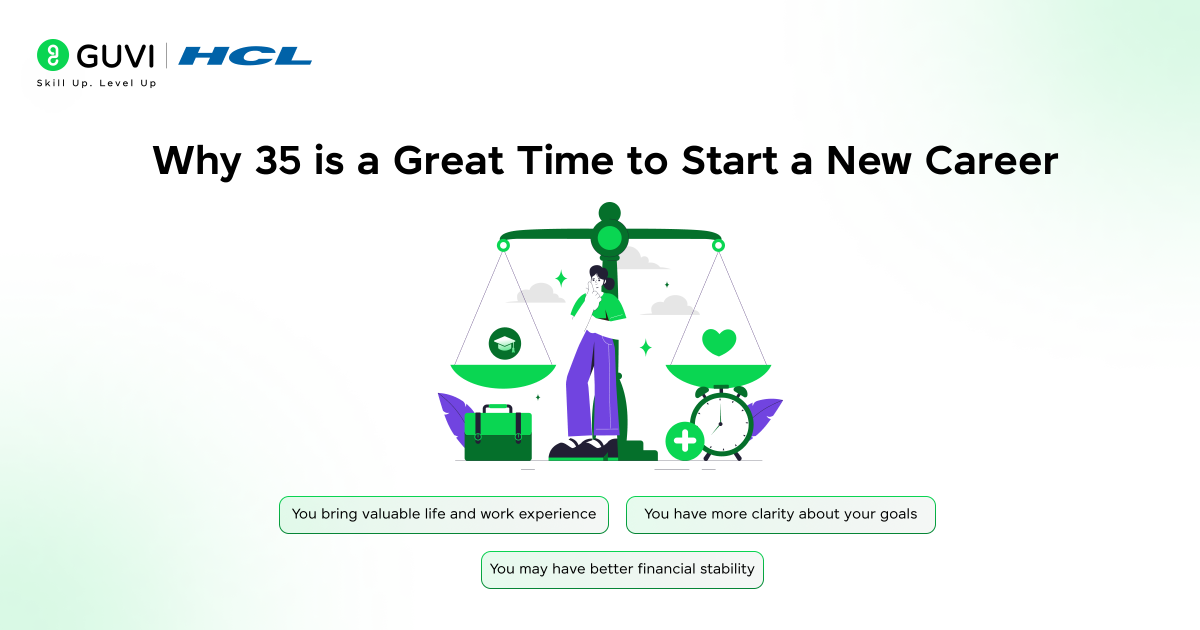
1) You bring valuable life and work experience
By 35, you’ve likely spent over a decade in the workforce, accumulating skills that younger professionals simply haven’t had time to develop. These aren’t just technical capabilities but valuable transferable skills that employers increasingly value:
- Problem-solving and critical thinking abilities
- Leadership and communication expertise
- Professional maturity and emotional intelligence
- Real-world experience with workplace dynamics
Your extensive experience means you’re not starting from zero—you’re simply redirecting your established professional foundation toward a new path.
2) You have more clarity about your goals
- Perhaps the most significant advantage of starting a new career at 35 is self-awareness. You now have a much clearer understanding of what energizes you—and what drains you. This self-knowledge makes identifying fulfilling career options considerably easier.
- By mid-30s, many professionals reach an important realization: the ladder they’ve been climbing might be leaning against the wrong wall. What once motivated you—titles, promotions, packed calendars—might no longer feel satisfying. This natural evolution of priorities allows you to make career decisions aligned with your current values rather than outdated expectations.
- Moreover, data from the AARP Global Employee Survey reveals that over 50% of workers who voluntarily changed jobs reported improvements in mental health, flexibility, and work-life balance. This suggests that a career change at 35 isn’t just professionally rewarding but personally transformative as well.
3) You may have better financial stability
Unlike career changes in your twenties, transitions at 35 often come with financial advantages. You’ve likely built some financial security that provides flexibility when making career moves. This stability might allow you to:
- Take calculated risks that weren’t possible earlier
- Invest in courses or certifications (typically ₹30,000-₹1,00,000 in India)
- Build a transition fund while exploring options
- Consider roles with growth potential over immediate salary
Financial experts recommend saving 3-6 months of living expenses before making a career leap. While you might face a temporary income reduction, your established financial foundation makes this manageable. Additionally, you may have developed a support system that helps navigate transitions without extreme financial strain.
Remember, financial considerations extend beyond immediate salary. Many mid-career professionals accept temporary pay reductions to enter fields with better long-term growth potential, knowing their experience will eventually translate into higher earnings.
The combination of valuable experience, self-awareness, and financial stability creates a powerful foundation for career transitions at 35. These advantages don’t eliminate challenges, but they certainly provide you with resources that younger professionals haven’t yet developed.
How to Know You’re Ready for a Career Change
Recognizing when it’s time for a career shift at 35 is about tuning into your internal signals and external circumstances. This awareness forms the foundation of your start career at 35 guide and helps ensure you’re making this significant change for the right reasons.

1) Signs it’s time to move on
Your body and mind often signal when your current career no longer serves you. Pay attention if you notice these warning signs:
- You dread going to work most days
- You feel constantly exhausted even after adequate rest
- Your work no longer challenges or excites you
- You find yourself envying people in other careers
- You’ve hit a ceiling with limited growth opportunities
- Your values no longer align with your company or industry
- You often think, “I could do something more meaningful.”
These signals aren’t simply bad days—they represent deeper dissatisfaction that shouldn’t be ignored. Research indicates that 60% of professionals who successfully changed careers after 35 reported experiencing at least four of these signs before making their move.
2) Questions to ask yourself
Before jumping into a new career at 35, honest self-reflection is essential. Consider these questions carefully:
- What would I do if money weren’t a concern? This reveals your genuine interests separated from financial pressures.
- Which parts of my current work energize me? Identifying these elements helps target careers with similar satisfying components.
- What skills do I enjoy using most? Your answer highlights abilities worth transferring to a new field.
- How does my ideal workday look? This visualization helps identify work environments and schedules that align with your preferences.
- What legacy do I want to create? At 35, you have potentially 25+ years of work ahead—making this question especially relevant.
- What sacrifices am I willing to make? Career transitions often require temporary steps backward in position or salary (typically a 15-20% reduction initially in India, ranging from ₹5,000-₹20,000 monthly depending on industry).
Record your answers somewhere you can revisit them throughout your transition journey. These reflections serve as anchors when challenges arise.
3) How to assess your current skills and interests
Understanding what you bring to a new career starts with a thorough skills inventory:
- List your hard skills – These include technical abilities, certifications, and specific knowledge areas from your current career.
- Identify transferable skills – Skills like project management, communication, problem-solving, and leadership are valuable across industries.
- Take a skills assessment – Free online tools like SkillScan or MyNextMove can provide objective insights about your strengths.
- Examine your performance reviews – Past feedback often reveals patterns about your strongest capabilities.
For interest assessment, consider these approaches:
- Activity tracking – For two weeks, note activities that make you lose track of time.
- Interest clusters – Group your interests into categories (creative, analytical, service-oriented) to identify patterns.
- Informational interviews – Speaking with professionals in fields that interest you provides realistic perspectives.
- Career counseling – Professional guidance in India typically costs between ₹3,000-₹7,000 per session but offers a structured assessment.
The intersection between your transferable skills and genuine interests often reveals promising career directions for starting a new career at 35. This intersection becomes your strategic advantage when making this significant life transition.
Want to switch careers without quitting your current job? Explore flexible, beginner-friendly tech courses, live mentorship, and real-world projects on HCL GUVI Learn Hub
Best Careers to Start at 35
Looking for promising career options at 35? The job market offers several rewarding paths that value your existing experience and transferable skills. Here’s a comprehensive breakdown of six excellent careers to consider when making a mid-career pivot.
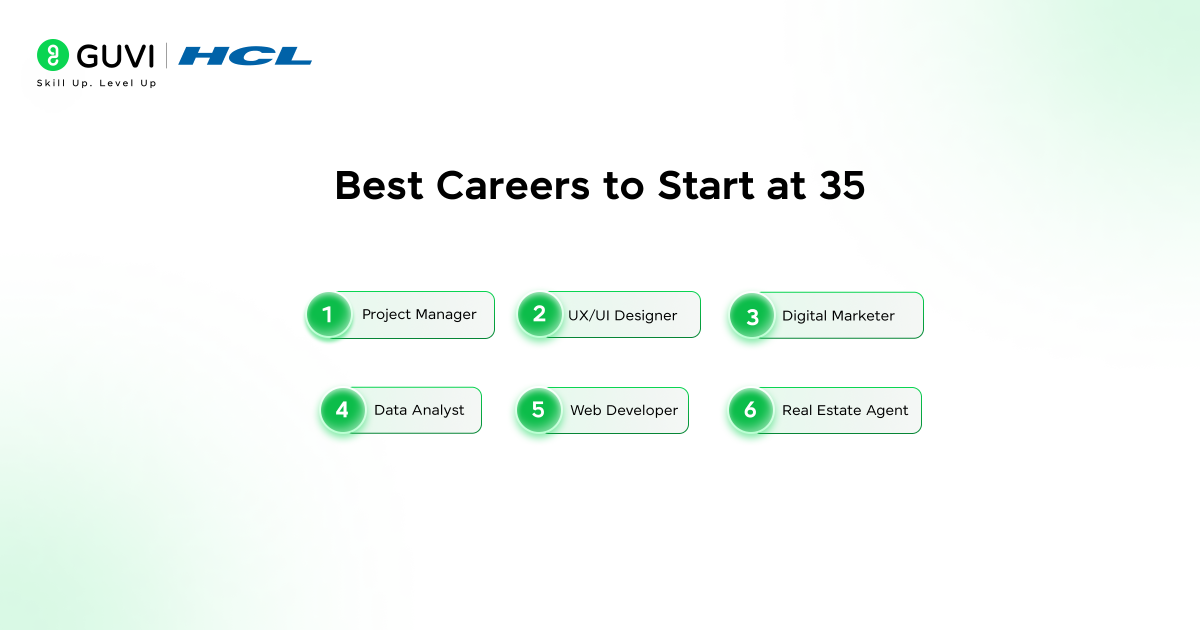
1. Project Manager
Project management offers substantial growth potential for professionals transitioning careers at 35. The industry projects a need for 88 million project management professionals by 2027 globally. This role leverages your organizational skills and professional maturity.
- Why it’s ideal at 35: Your previous work experience becomes an advantage as employers value your leadership capabilities and understanding of workplace dynamics.
- Skills needed: Organization, communication, problem-solving, and leadership abilities.
- Earning potential: Project management specialists earn significantly higher than average salaries—about 60% higher than national averages in many countries.
2. UX/UI Designer
Design careers welcome professionals of all ages, making UX/UI design particularly suitable for career changers at 35.
- Why it’s ideal at 35: Companies value your diverse perspectives and experiences in creating user-friendly designs.
- Skills needed: Design thinking, user research abilities, and creative problem-solving.
- Advantage: Many successful UX designers have transitioned to this field in their mid-30s after working in completely unrelated professions for 15+ years.
3. Digital Marketer
Digital marketing offers excellent flexibility and growth potential for mid-career changers.
- Why it’s ideal at 35: Every successful business now requires digital marketing expertise, creating consistent demand for skilled professionals.
- Skills needed: Content creation, SEO knowledge, social media management, and data analysis capabilities.
- Key benefit: Digital marketing roles frequently offer remote or hybrid work opportunities, providing the work-life balance many professionals seek when changing careers at 35.
4. Data Analyst
Data analysis has become essential across industries, creating numerous opportunities for career changers.
- Why it’s ideal at 35: The field welcomes professionals from diverse backgrounds, valuing your previous experience and unique perspective.
- Skills needed: Analytical thinking, attention to detail, and basic technical abilities.
- Growth potential: Data analysis serves as an excellent stepping stone toward data science roles, offering clear career progression paths.
5. Web Developer
Web development presents an accessible path for career changers with technical interests.
- Why it’s ideal at 35: The field values problem-solving abilities over age, with many developers successfully transitioning in their 30s and 40s.
- Skills needed: HTML/CSS fundamentals, JavaScript knowledge, and logical thinking.
- Advantage: Web development skills are in high demand across virtually every industry, allowing you to leverage domain knowledge from your previous career.
6. Real Estate Agent
Real estate offers a promising career option that often favors more mature professionals.
- Why it’s ideal at 35: Clients typically prefer “seasoned” agents, giving you an immediate advantage over younger entrants.
- Skills needed: Communication, negotiation, and networking abilities.
- Industry insight: According to the National Association of Realtors, the average successful realtor is 55 years old, suggesting that starting at 35 positions you are well within the industry’s demographic.
Coupled with the right approach and commitment to learning, these six career paths offer promising opportunities for professionals looking to make a significant change at 35. Each leverages different aspects of your existing experience while opening doors to new challenges and growth.
Thinking of restarting your career at 35? Here are a few lesser-known insights that might surprise you:
Most Career Changes Happen Mid-Life: Research shows that people between 30 and 40 are the most likely to change industries because they finally understand what they truly want from work.
Your Experience Gives You an Edge: Employers often report that candidates in their mid-30s show higher reliability, stronger problem-solving abilities, and better communication skills than younger applicants—making them highly competitive career switchers.
These facts highlight that starting over at 35 is not a setback but a strategic move backed by experience, clarity, and confidence.

Steps to Start Your Career at 35
Now that you’ve decided to embark on a new professional journey at 35, let’s explore the practical steps to make it happen. Following this start career at 35 guide will help you navigate the transition methodically.
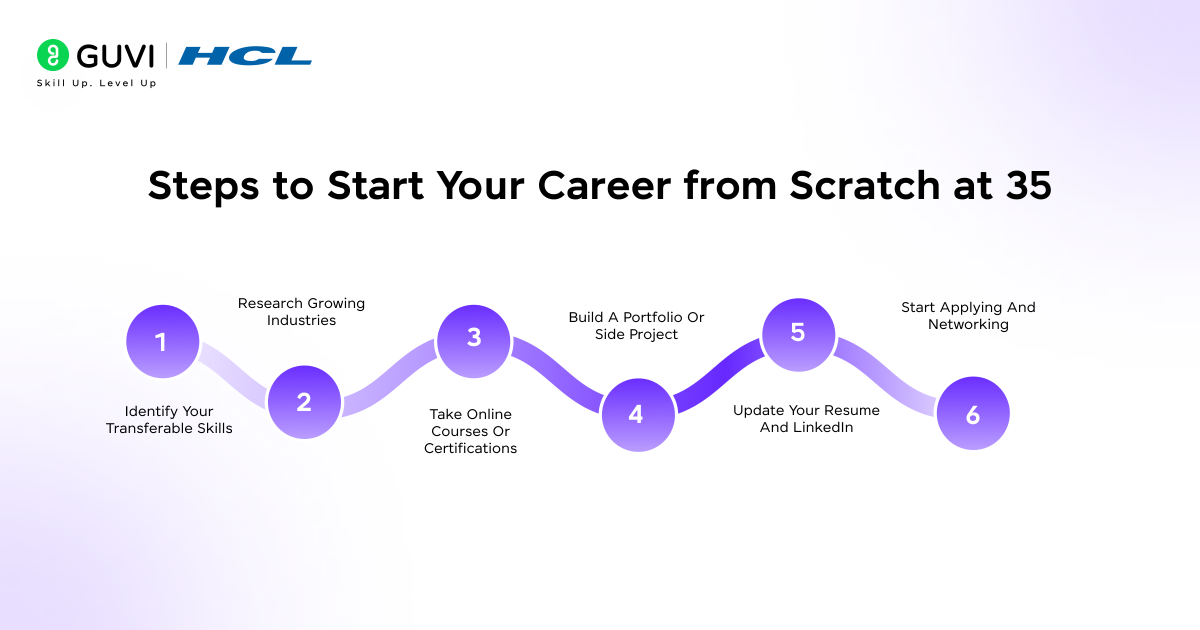
1. Identify your transferable skills
Begin by creating a “skills inventory” of all your career experiences. Identify which abilities can move with you regardless of industry:
- Communication skills: Written, verbal, and listening abilities
- Critical thinking: Analysis, problem-solving, and strategic planning
- Self-management: Organization, motivation, and reliability
- Interpersonal skills: Diplomacy, discretion, and assertiveness
Focus on highlighting these transferable skills both in your resume and during job interviews. According to career development experts, these skills are essential as they apply across different roles and industries.
2. Research growing industries
Focus your efforts on sectors with consistent demand and growth potential. The fastest-growing fields include:
- Healthcare (projected to grow faster than average, with 1.9 million openings annually)
- Technology (particularly in cybersecurity, growing at 33%)
- Education (postsecondary teaching growing at 8%)
- Professional and technical services (increasing by 10.5%)
Use job reports and LinkedIn job filters to identify regional hiring hotspots that maximize your opportunities.
3. Take online courses or certifications
Upskill through part-time study or self-paced online courses that fit your schedule. Platforms like HCL GUVI, Coursera, Udemy, and LinkedIn Learning offer affordable options without requiring you to quit your current job.
You can also enroll in HCL GUVI’s Full Stack Development Course with AI Tools, a beginner-friendly program designed for career switchers. Its flexible, industry-aligned curriculum makes it ideal for starting a tech career from scratch at 35.
Certificates can boost your resume with some descriptions of your academic achievements when you have limited professional experience in your new field.
4. Build a portfolio or side project
Create a career portfolio to showcase your professional accomplishments and capabilities. Include:
- Writing samples or class projects
- Certifications and awards
- Photographs of your work
- Documentation of relevant accomplishments
This serves as a marketing tool, offering employers a preview of your potential performance. Consider taking on freelance work or volunteer opportunities to add real-world examples to your portfolio.
5. Update your resume and LinkedIn
For career changers, focus on skills rather than work history. Structure your resume with:
- An objective aligned with your target role
- A bulleted skills summary highlighting key qualifications
- Work experience showcasing relevant transferable skills
Remember, research shows that hiring managers scan a CV for only six seconds before deciding if you’re appropriate for the job.
6. Start applying and networking
Networking is particularly critical for career changers, allowing you to acquire valuable advice from people outside your field. Start by:
- Leveraging your existing network to practice explaining your transition
- Preparing a concise transition statement explaining your career change
- Joining professional groups and industry organizations
- Providing value to your connections through sharing articles or making introductions
Remember that effective networking is always a two-way relationship focused on building authentic connections over time.
Build a strong portfolio with real-world projects, capstone assignments, and practical coding experience through HCL GUVI Zen Class
Overcoming Common Challenges When Starting a Career at 35
Beginning your start career at 35 guide journey comes with unique challenges that require strategic approaches. Facing these obstacles head-on will help you navigate your transition more smoothly.
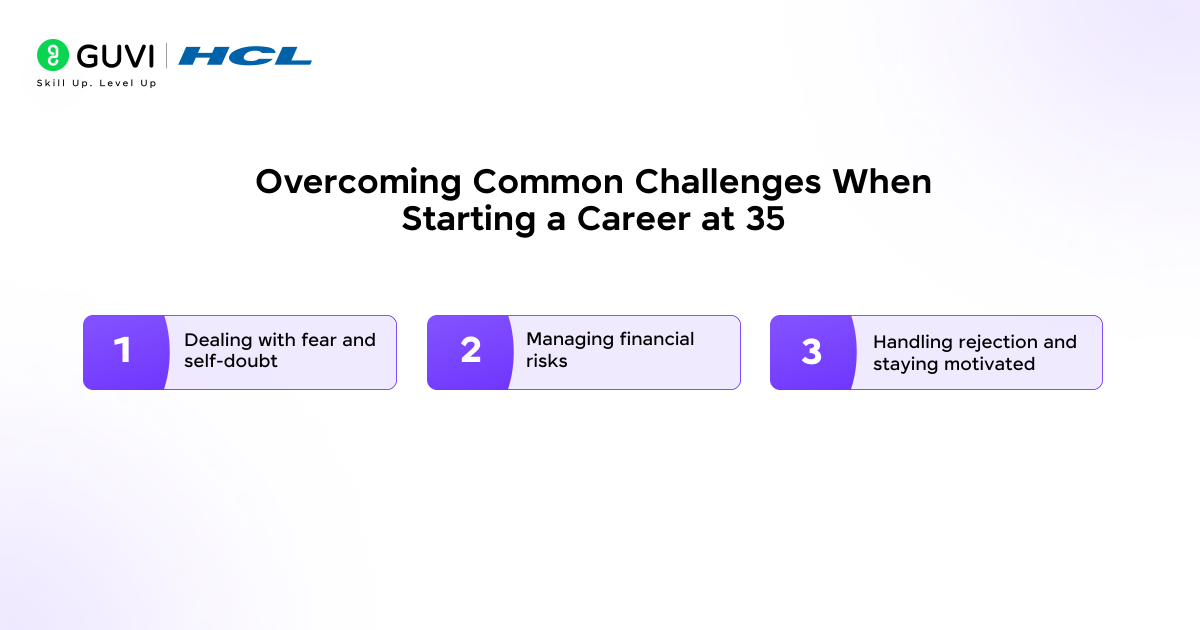
1) Dealing with fear and self-doubt
Fear is natural when changing careers—your brain is wired to protect you from the unknown. Many mid-career professionals experience imposter syndrome and thoughts like “I’m too old to start over”.
To overcome self-doubt:
- Acknowledge your feelings as normal parts of the journey
- Break big goals into smaller, manageable steps
- Focus on what you could gain rather than what might go wrong
- Reframe your mindset from “What if I fail?” to “What if I succeed?”
2) Managing financial risks
- Financial preparation is crucial before making any big career change. Build a cushion of 3-6 months of living expenses to provide security as you adjust to potential income gaps.
- Consider creating a detailed budget that identifies areas where you can cut discretionary spending. Healthcare coverage is another critical consideration—explore options like COBRA coverage or joining a spouse’s plan to avoid costly gaps.
3) Handling rejection and staying motivated
- Rejection in job hunting triggers the same neural pathways as physical pain, making it particularly challenging. Adopt the 24-Hour Rule: allow yourself one day to process disappointment fully, then purposefully shift into analytical mode.
- Stay motivated through consistency—small regular efforts (25 minutes, three times weekly) are more effective than occasional marathon sessions. Build a support system including mentors and like-minded individuals who can provide guidance when challenges arise.
- Remember that rejection often redirects you toward better-aligned opportunities. Your ability to persevere through inevitable low periods will ultimately determine your success.
Your experience is not a limitation, it’s your advantage. Start building in-demand tech skills and confidently transition into a future-ready career with HCL GUVI Zen Class
Concluding Thoughts…
Starting a fresh career at 35 might seem daunting at first glance. Nevertheless, your mid-thirties actually offer unique advantages that younger professionals simply don’t possess. Your accumulated work experience, clearer life goals, and relatively stable finances create a solid foundation for this transition.
Rejection and self-doubt will undoubtedly appear during your journey. Therefore, surrounding yourself with supportive mentors and like-minded individuals becomes crucial for maintaining momentum. Your ability to persevere through challenges ultimately determines your success.
Above all, remember that starting a career at 35 isn’t starting from zero—it’s redirecting your established professional foundation toward a more fulfilling path. Your age isn’t a limitation but rather your greatest asset in this exciting new chapter. With proper planning, realistic expectations, and consistent effort, your career change at 35 can lead to greater professional satisfaction and personal growth for decades to come. Good Luck!
FAQs
Q1. What are some fulfilling career options to consider at age 35?
Some promising careers to start at 35 include project management, UX/UI design, digital marketing, data analysis, web development, and real estate. These fields value transferable skills like problem-solving, communication, and your diverse professional experience.
Q2. How can I identify the right career path for me at this stage?
Reflect on your interests, values, and the aspects of work that energize you. Take skills assessments, try new activities, and conduct informational interviews in fields you’re curious about. The goal is to find a path that aligns with your current priorities.
Q3. What are the key steps to transition into a new career field?
Identify your transferable skills, research growing industries, take courses or get certifications, build a portfolio, update your resume and LinkedIn, and start networking. Having a financial cushion can provide security during this transition period.
Q4. How can I overcome fears and doubts about making a career change?
Acknowledge that fear is natural when facing the unknown. Break big goals into smaller steps, focus on potential gains, reframe self-doubting thoughts, and build a support system. Consistent effort is key to maintaining motivation.
Q5. Is it realistic to find passion and purpose through work alone?
While some find fulfillment through their careers, it’s not a requirement. Many reserve passion for hobbies outside of work. The key is finding a career that aligns with your values and allows you to live a satisfying life overall.
Success Stories

About the Author
Jaishree Tomar
A recent CS Graduate with a quirk for writing and coding, a Data Science and Machine Learning enthusiast trying to pave my own way with tech. I have worked as a freelancer with a UK-based Digital Marketing firm writing various tech blogs, articles, and code snippets. Now, working as a Technical Writer at GUVI writing to my heart’s content!
View all posts by Jaishree Tomar
Connect with me @
















Did you enjoy this article?