


Software Development Articles
How to Read and Understand System Design Diagrams?
System Engineer Roles and Responsibilities: 12 Proven Duties for Growth
SAP Consultant Roles and Responsibilities: 12 Proven Duties for Growth and Success
Network Engineer Roles and Responsibilities: 12 Essential Duties for Success


Get In Touch For Details! Request More Information
Difference between Time Sharing and Real-Time Operating System
Sep 29, 2026 7 Min Read 3642 Views
(Last Updated)
Every computer relies on an Operating System (OS) to manage hardware, run processes, and allocate system resources. Among the major OS types, time-sharing operating systems and real-time operating systems are designed for very different goals.
A time-sharing OS focuses on sharing CPU time fairly across multiple users or processes. A real-time OS focuses on completing critical tasks within strict timing limits, where even a small delay may affect system performance.
In this blog, you will learn the difference between time-sharing and real-time operating systems, how each works, their key features, advantages, limitations, real-world examples, and a detailed comparison to help you understand when each type is used.
Table of contents
- Quick Answer
- What is a Time Sharing Operating System?
- Key Features of Time-Sharing Operating Systems
- Limitations of Time-Sharing Operating Systems
- Time-Sharing OS Examples and Their Role in Modern Cloud Systems
- What is a Real-time Operating System (RTOS)?
- Key Features of a Real-time Operating System
- Hard vs Soft vs Firm Real-Time Operating Systems
- Latency, Jitter, and Determinism in Real-Time Operating Systems
- Limitations of Real-time Operating Systems
- Real-Time OS Examples in Embedded Systems and Robotics
- Difference between Time Sharing and Real-time Operating System
- Scheduling Algorithms in Time-Sharing OS vs RTOS
- RTOS vs GPOS (General Purpose OS) Exam Question Explained
- Wrapping It Up
- FAQs
- What is the difference between a time-sharing operating system and a real-time operating system?
- What are examples of time-sharing and real-time operating systems?
- Which scheduling algorithms are used in time-sharing OS and RTOS?
- What are hard, soft, and firm real-time operating systems?
- When should you use a time-sharing OS instead of an RTOS?
- Is a real-time operating system faster than a time-sharing operating system?
- Can Linux be used as a real-time operating system?
Quick Answer
Time-sharing operating systems focus on fair CPU access for multiple users, while real-time operating systems focus on completing critical tasks within strict deadlines.
- Main Goal: Time-sharing prioritizes fairness and responsiveness, while RTOS prioritizes predictable timing.
- Scheduling: Time-sharing commonly uses time slicing, while RTOS uses priority-based or deadline-driven scheduling.
- Response Time: Time-sharing offers fast responses, but RTOS is designed for deterministic execution.
- Best Use Cases: Time-sharing suits shared systems and servers, while RTOS suits robotics, automotive, medical, and industrial systems.
- Core Difference: Time-sharing asks who gets CPU time next, while RTOS asks which task must finish before its deadline.
What is a Time Sharing Operating System?
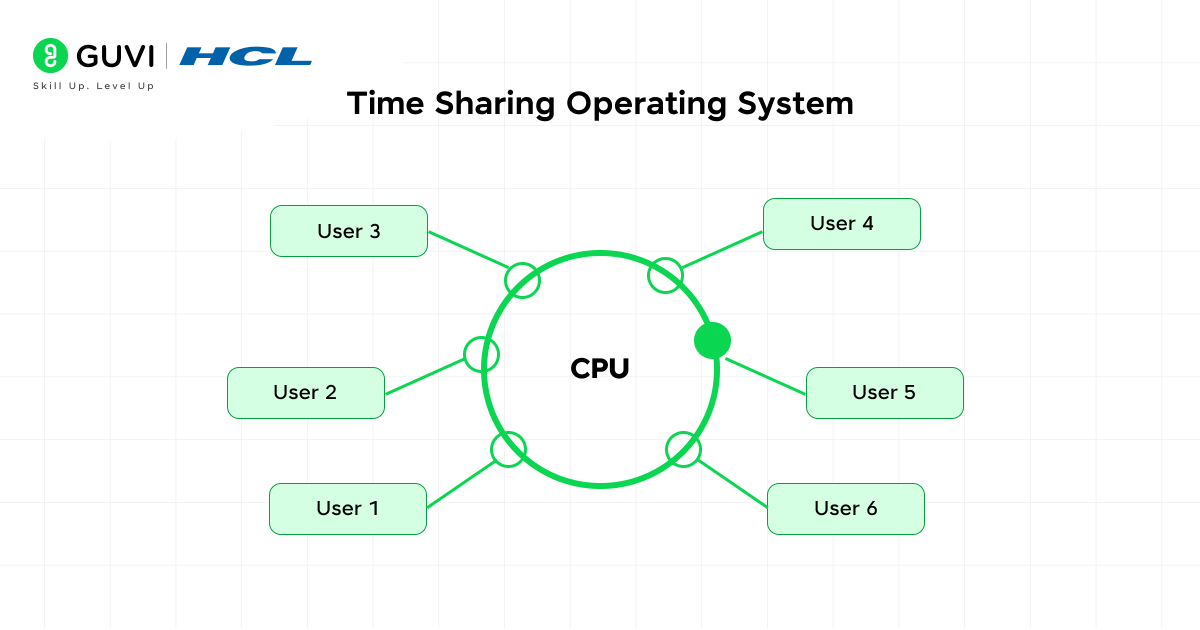
A Time Sharing Operating System is able to allow multiple users to simultaneously use the computer system. The time on the CPU is shared among each user and each process so that each process has a small time window.
Also read: Introduction to Operating Systems
A time-sharing operating system creates the experience of simultaneous computing by dividing CPU time into very small intervals and rapidly switching between active processes.
How it works
- Time Slice Allocation: Each active process receives a short CPU time slice, also called a time quantum.
- Context Switching: When that time slice ends, the operating system saves the current process state and switches the CPU to another ready process.
- Rapid Rotation: This switching happens so quickly that multiple users or programs appear to run at the same time.
- Fair CPU Access: Scheduling helps prevent one process from using the CPU continuously while others wait.
- Interactive Response: Because each process gets CPU time repeatedly, users receive fast responses even when several programs are active.
Example
Suppose 20 students are connected to the same university server and running programs remotely. The CPU may execute Student A’s process for a few milliseconds, then Student B’s, then Student C’s, and continue rotating through the queue. Each student receives repeated CPU access, so all 20 experience the system as if their programs are running simultaneously.
Common examples associated with time-sharing systems include UNIX, MULTICS, and multi-user Linux systems.
Key Features of Time-Sharing Operating Systems
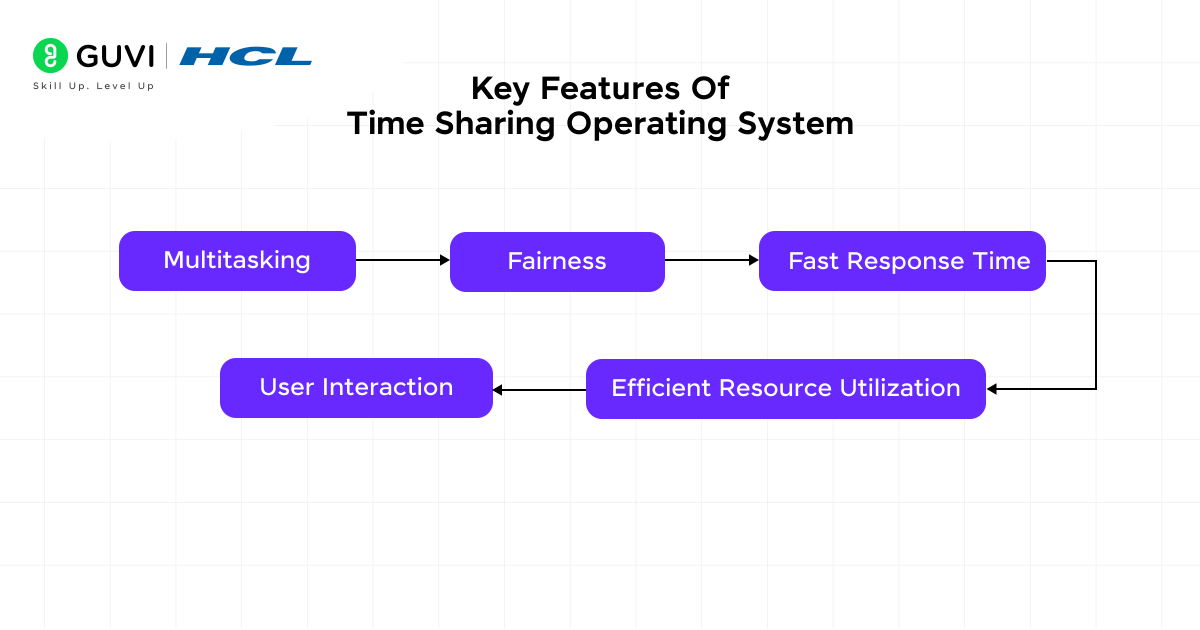
- Multitasking: A Time Sharing Operating System allows for multiple programs to run simultaneously by allocating a short period of CPU time for each process. This allows the user to complete various tasks without excessive waiting.
- Fairness: It guarantees fairness by providing each user or program an equal portion of CPU time. It is impossible for another user or program to take control and become dominant on the system, and this keeps the performance fair and consistent.
- Fast Response Time: Regardless of the number of users or tasks on the system, the response time is still rapid. The processes switch between each other so quickly that it gives the impression that every user or program is executing in parallel.
- Efficient Resource Utilization: The CPU, memory, and I/O devices are utilized with no idle time. This helps the overall performance and reliability of the system improve.
- User Interaction: It allows multiple users to work at the same time, making it a perfect arrangement for a shared system. Each user is able to feel as though they have their own personal computer.
Also read: Components of an Operating System
Limitations of Time-Sharing Operating Systems
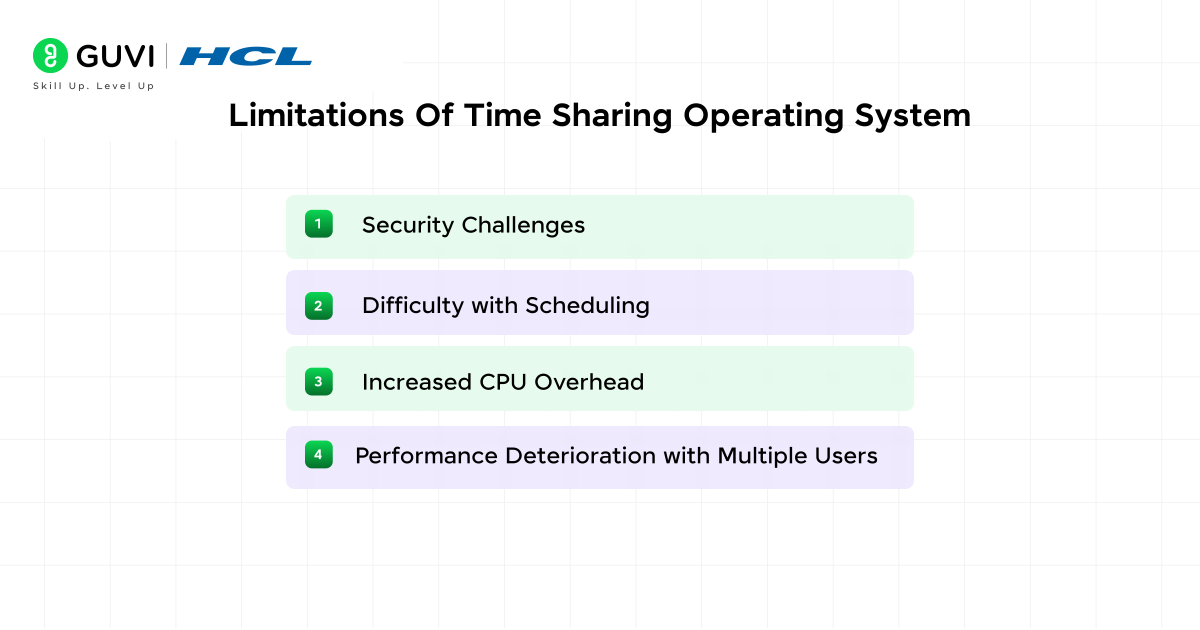
- Security Challenges: As multiple users have access to the same system, the chance of a security breach or unauthorized access increases. Security protocols must be implemented to safeguard user data and system capabilities from this risk.
- Difficulty with Scheduling: Managing multiple processes complicates scheduling due to the number of context switches that occur. And this increases the workload and it causes delays in task scheduling.
- Increased CPU Overhead: The process of managing multiple queues and switching between users uses additional CPU time. This overhead will deteriorate performance when processes are scheduled simultaneously.
- Performance Deterioration with Multiple Users: Too many users accessing the system at any time reduces available CPU time per process. This leads to a decrease in response time, and system performance will decline under increased use.
Time-Sharing OS Examples and Their Role in Modern Cloud Systems
Time-sharing began with systems such as MULTICS and UNIX, where many users connected to one mainframe and received small slices of CPU time. Modern computing uses the same scheduling principle at a much larger scale.
- Virtual Machines: A physical cloud server can run multiple virtual machines. The hypervisor and host operating system schedule CPU time across these VMs so several workloads can share the same processor without one workload taking complete control.
- Containers and Kubernetes Pods: Containers running on the same host share the underlying CPU. Linux schedulers divide processor time among containerized workloads, while Kubernetes manages how those workloads are distributed across available machines.
- Multi-Tenant SaaS Platforms: SaaS applications often serve many customers from shared infrastructure. CPU, memory, and I/O resources are allocated across multiple users or tenants so each receives responsive service.
- Linux Servers: Modern Linux systems still use time-sharing scheduling concepts to manage hundreds or thousands of processes competing for CPU time on the same machine.
- Cloud Resource Sharing: Services such as virtual servers, shared hosting, and container platforms depend on controlled resource allocation to keep multiple workloads running efficiently on common hardware.
The core idea has not changed. Earlier systems shared one mainframe among many terminal users. Modern cloud systems share physical computing resources across virtual machines, containers, applications, and customers while using scheduling to keep those workloads responsive.
Also read: 3 Ways to Install Linux on a Windows Machine
What is a Real-time Operating System (RTOS)?
A real-time operating system (RTOS) is designed to execute time-sensitive tasks within defined timing constraints. Unlike a time-sharing OS, its priority is not fair CPU access across users, but predictable and timely task execution.
In an RTOS, correctness depends on both the result and when that result is produced. A task that finishes too late may be considered unsuccessful, especially in safety-critical systems such as robotics, automotive control, and medical devices.
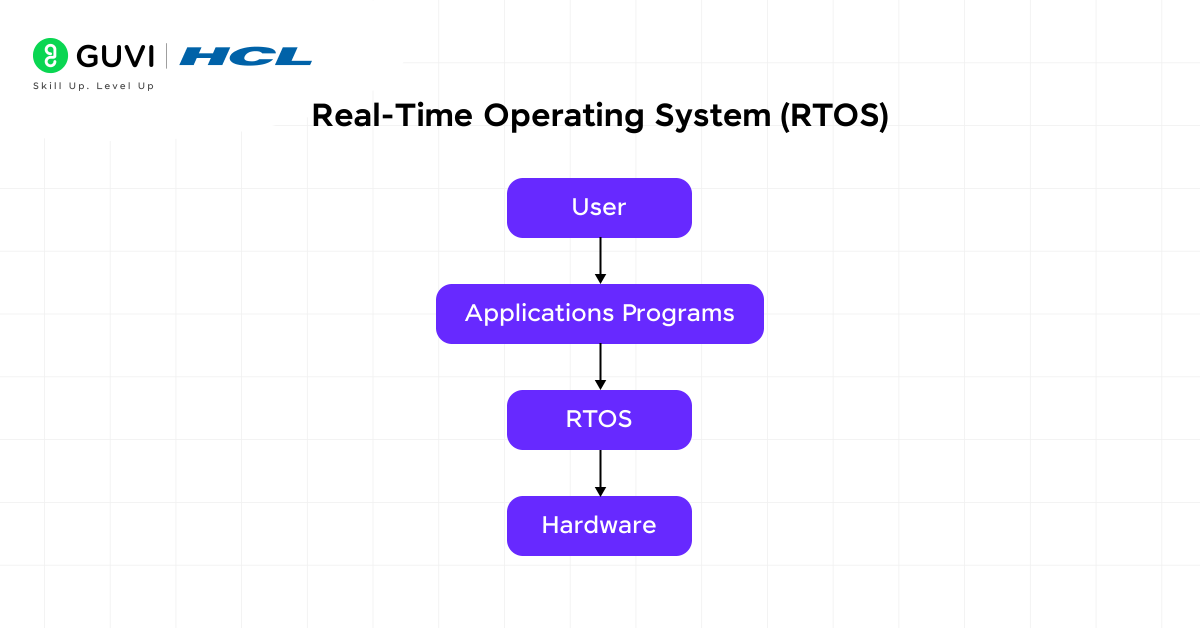
How It Works
- RTOS uses a scheduling approach based on priority.
- A deadline is set for tasks and the system ensures it’s completed before the time runs out.
- This prevents tasks from taking longer than the deadline and also prevents tasks from interrupting one another.
Also read: Functions of Operating System: A Beginner’s Guide 2025
Key Features of a Real-time Operating System
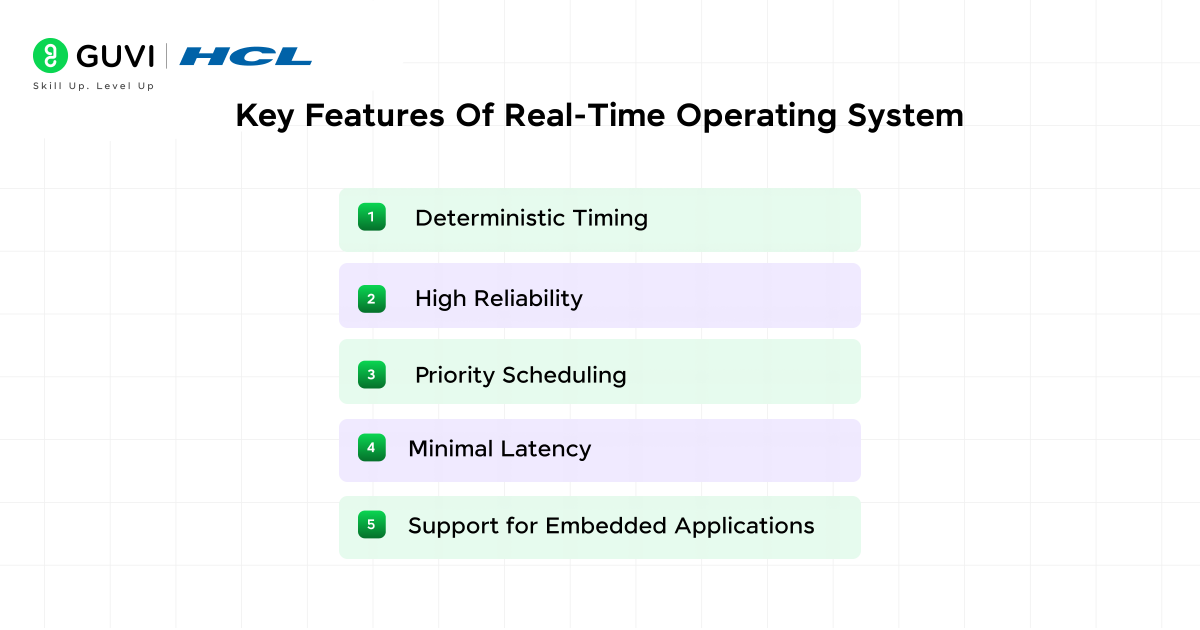
- Deterministic Timing: A Real-time Operating System guarantees that each task will finish within a defined time constraint. Predictable timing is paramount in models where the system cannot accept delays.
- High Reliability: An RTOS is designed to handle critical operations with no failure. An RTOS can run for long periods with a high rate of stability and reliability, suitable for use in medical systems or industrial systems.
- Priority Scheduling: Each task is prioritized, with the most important tasks being run first. Consequently, critical tasks are never delayed by less critical tasks.
- Minimal Latency: An RTOS reacts to inputs and events nearly instantaneously. This reaction time is critical to maintain for any real-time application, especially in systems such as robotics or automated control.
- Support for Embedded Applications: Most Real-time Operating Systems are designed for embedded applications, with a small footprint and low memory or processing requirements, providing reliable, time-constrained performance.
Also read: Operating System Commands: The Ultimate Beginner’s Guide (2025)
Hard vs Soft vs Firm Real-Time Operating Systems
Not every real-time system treats a missed deadline the same way. RTOS applications are generally classified as hard, soft, or firm real-time systems based on what happens when a task finishes late.
- Hard Real-Time Systems: Missing a deadline can cause system failure or serious consequences. These systems require highly predictable response times. Aircraft control systems, industrial safety systems, and some medical devices are common examples.
- Soft Real-Time Systems: Deadlines are important, but an occasional delay does not cause complete system failure. Performance or user experience may simply decline. Video streaming and multimedia processing are common examples.
- Firm Real-Time Systems: A late result has little or no value once its deadline has passed, but occasional deadline misses may still be tolerated. Certain monitoring and automated inspection systems can fall into this category.
- Main Difference: Hard real-time systems cannot tolerate deadline misses, firm systems discard late results, and soft real-time systems can tolerate occasional delays.
- Why It Matters: Choosing the correct RTOS design depends on how critical timing is to the application, not simply on how fast the system runs.
Latency, Jitter, and Determinism in Real-Time Operating Systems
RTOS performance cannot be judged only by CPU speed. Three important concepts, latency, jitter, and determinism, determine whether the system can respond predictably to real-world events.
- Latency: The delay between an event occurring and the system beginning to respond. Lower latency is important in applications such as motor control, robotics, and industrial automation.
- Interrupt Latency: The time between a hardware interrupt being generated and the RTOS beginning to execute the corresponding interrupt handler.
- Scheduling Latency: The time required for the operating system to switch from the currently running task to a higher-priority task that is ready to execute.
- Jitter: Variation in response or execution time between repeated events. A system may be fast on average but unsuitable for real-time use if its timing varies significantly.
- Determinism: The ability to produce predictable timing behavior. An RTOS is designed so developers can estimate how long critical operations will take under defined conditions.
- Why It Matters: A predictable 5-millisecond response can be more useful in a real-time system than an average 1-millisecond response that occasionally jumps to 50 milliseconds.

Limitations of Real-time Operating Systems
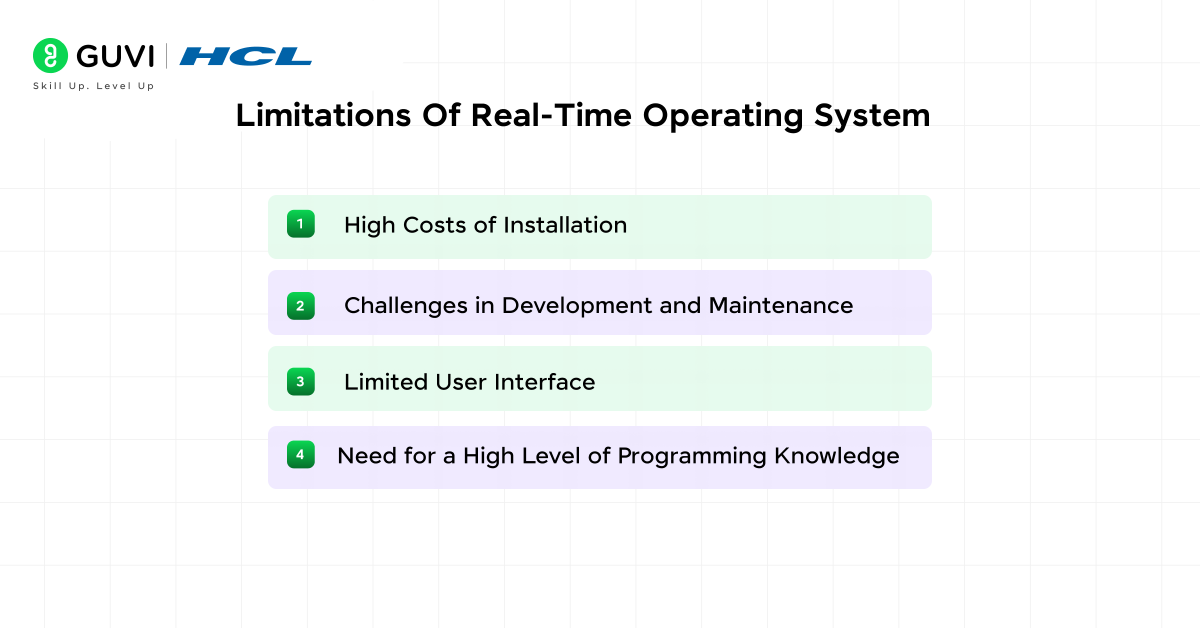
- High Costs of Installation: Real-time operating systems frequently require unique hardware and software to ensure precise timing. This complexity causes the development costs and maintenance to be higher than an equivalent system.
- Challenges in Development and Maintenance: RTOS must be accurately specified and designed to process tasks and address issues under specific time constraints. The slightest error, even with a correct specification, may have serious consequences, making maintenance and upgrading procedures cumbersome.
- Limited User Interface: RTOS focuses on processing speed and accuracy, and thus has a basic interface. It prioritizes performance over visual design or user interaction.
- Need for a High Level of Programming Knowledge: The processes involved in working with an RTOS require a more important level of technical knowledge in the area of system-level programming. Developers must grasp critical concepts such as interrupts, scheduling, and communication with hardware to create robust systems.
Real-Time OS Examples in Embedded Systems and Robotics
Real-time operating systems are widely used in embedded systems where timing, stability, and predictable performance matter.
- FreeRTOS: A lightweight, open-source RTOS commonly used in IoT devices, sensors, microcontrollers, and small embedded systems.
- VxWorks: Used in aerospace, defence, industrial automation, and other mission-critical systems that require highly reliable real-time performance.
- QNX: A microkernel-based RTOS widely used in automotive systems, infotainment platforms, and industrial applications. Its architecture is designed to improve fault isolation and system stability.
- Zephyr OS: An open-source RTOS built for resource-constrained devices such as wearables, IoT products, sensors, and embedded controllers.
- ROS With Real-Time Layers: Robotics systems may combine Robot Operating System (ROS) middleware with real-time Linux extensions or an RTOS to handle time-sensitive tasks such as motor control, sensor processing, and motion coordination.
The key requirement is predictability. In applications such as robotics, drones, medical devices, and industrial control, even a small delay can affect safety or system performance. That is why RTOS platforms are preferred when tasks must be completed within strict timing limits.
Also read: 3 Easy Methods for the Installation of an Operating System
- The concept of Time Sharing Operating Systems first appeared in the 1960s, revolutionizing computing by allowing multiple users to access a single mainframe simultaneously — a massive leap from batch processing!
- Real-Time Operating Systems (RTOS) power life-critical technologies like aircraft flight control, pacemakers, and even NASA’s Mars rovers — where a delay of just one millisecond can make all the difference.
- Modern versions of Linux can be optimized into Real-Time OS setups, offering developers both open-source flexibility and precise timing performance.
- Some RTOS kernels are smaller than 10 KB, yet they seamlessly power complex devices like drones, medical instruments, and smartwatches — proving that true power can come in small packages.
🚀 These systems aren’t just fast — they define the standard for precision and reliability in modern computing!
Difference between Time Sharing and Real-time Operating System
| Feature | Time Sharing Operating System | Real-time Operating System |
| Definition | Allows multiple users to share CPU time simultaneously. | Executes tasks immediately when triggered by an event. |
| Main Goal | To provide fairness and quick response for all users. | To ensure timely and predictable task execution. |
| Response Time | Generally fast, but not guaranteed. | Always predictable and deterministic. |
| User Interaction | Designed for multi-user interaction. | Usually runs in embedded systems with minimal user input. |
| Scheduling | Round-Robin or Fair-share scheduling. | Priority-based or deadline-driven scheduling. |
| Criticality | Delay is acceptable. | Delay may cause system failure. |
| Examples | UNIX, Linux, MULTICS. | QNX, VxWorks, FreeRTOS. |
| Application Areas | Office systems, universities, general servers. | Robotics, automotive systems, medical devices. |
| Cost | Generally low. | High due to precision requirements. |
| Accuracy | Depends on CPU time allocation. | Depends on meeting deadlines precisely. |
If you’re excited to master the fundamentals of Operating Systems and understand how real-time systems power today’s technology, explore the AI Software Development Course by HCL GUVI, IITM Pravartak, MongoDB, a 9-month industry-ready program covering Java, System Design, Generative AI, 15+ hands-on projects, and 4 globally recognized certifications.
Scheduling Algorithms in Time-Sharing OS vs RTOS
Scheduling is one of the biggest technical differences between a time-sharing operating system and a real-time operating system. Both decide which process gets CPU time, but they optimize for different outcomes.
- Round-Robin Scheduling: Common in time-sharing systems. Every ready process receives a small CPU time slice before the scheduler moves to the next process.
- Fair-Share Scheduling: CPU resources are distributed among users or groups so that one workload does not consume all available processing time.
- Priority-Based Scheduling: Common in RTOS environments. Higher-priority tasks can execute before less critical tasks when immediate response is required.
- Rate Monotonic Scheduling (RMS): Gives higher priority to periodic tasks that run more frequently. It is widely studied in fixed-priority real-time scheduling.
- Earliest Deadline First (EDF): Dynamically gives CPU priority to the task whose deadline is closest.
- Core Difference: Time-sharing schedulers optimize fairness and responsiveness, while real-time schedulers focus on predictability and meeting deadlines.
RTOS vs GPOS (General Purpose OS) Exam Question Explained
A GPOS (General Purpose OS) like Windows, standard Linux, or macOS is designed for versatility across many kinds of applications, not for guaranteed timing. An RTOS is designed specifically so that critical tasks complete within a guaranteed time window.
| Aspect | RTOS | GPOS |
|---|---|---|
| Design priority | Deterministic, on-time task completion | Versatility and general usability |
| Scheduling | Priority/deadline-driven, preemptive | Fairness-oriented (round-robin, multilevel queues) |
| Typical footprint | Small, minimal (often under a few hundred KB) | Large, feature-rich |
| Example | FreeRTOS, VxWorks, QNX | Windows, standard Linux distributions, macOS |
| Best suited for | Embedded, mission-critical, timing-sensitive systems | Desktops, servers, general-purpose computing |
Wrapping It Up
Time-sharing and real-time operating systems may both manage CPU resources, but they are built for very different priorities.
A time-sharing OS focuses on fairness, responsiveness, and allowing multiple users or processes to share computing resources efficiently. An RTOS focuses on predictability, low latency, and completing critical tasks within strict deadlines.
The right choice depends on the workload. General-purpose servers, shared systems, and cloud environments benefit from time-sharing, while robotics, automotive systems, industrial control, and medical devices often require real-time performance.
Understanding the difference between time-sharing and real-time operating systems makes it easier to see how scheduling, latency, deadlines, and reliability shape the way modern operating systems are designed.
FAQs
What is the difference between a time-sharing operating system and a real-time operating system?
A time-sharing operating system distributes CPU time among multiple users or processes, while a real-time operating system focuses on completing time-sensitive tasks within defined deadlines.
What are examples of time-sharing and real-time operating systems?
Common time-sharing operating system examples include UNIX, MULTICS, and multi-user Linux systems. Popular RTOS examples include FreeRTOS, VxWorks, QNX, and Zephyr OS.
Which scheduling algorithms are used in time-sharing OS and RTOS?
Time-sharing systems commonly use round-robin and fair-share scheduling. RTOS platforms often use priority-based scheduling, Rate Monotonic Scheduling, and Earliest Deadline First.
What are hard, soft, and firm real-time operating systems?
Hard real-time systems cannot tolerate missed deadlines, soft real-time systems can tolerate occasional delays, and firm real-time systems may allow some deadline misses but treat late results as having little or no value.
When should you use a time-sharing OS instead of an RTOS?
Use a time-sharing OS for shared servers, multi-user systems, and general computing where fairness and responsiveness matter. Use an RTOS for robotics, automotive systems, industrial control, medical devices, and other applications where predictable timing is critical.
Is a real-time operating system faster than a time-sharing operating system?
Not necessarily. An RTOS is designed for predictable and deadline-bound responses, while a time-sharing OS focuses on fair CPU allocation and responsiveness across multiple users or processes.
Can Linux be used as a real-time operating system?
Yes. Standard Linux is generally a general-purpose operating system, but real-time Linux configurations and extensions can reduce latency and improve deterministic behaviour for time-sensitive applications.
Success Stories

About the Author
Vaishali
I'm a seasoned writer with four years of experience across technical, non-technical, and just about every genre or niche you can imagine. Adaptable and curious, I enjoy exploring new topics and making information engaging and easy to understand. Fueled by a steady stream of tea, I approach each project with creativity, reliability, and genuine enthusiasm for storytelling.
View all posts by Vaishali
Connect with me @










Did you enjoy this article?