


Data Structure Articles
Sliding Window Technique: Explained with Examples
Two Pointer Technique: Problems and Applications


Get In Touch For Details! Request More Information
What is a Subsequence in DSA? A Beginner-Friendly Guide
Sep 14, 2026 7 Min Read 3421 Views
(Last Updated)
What makes a sequence of values meaningful in algorithms, order, or connection? That’s where the idea of a subsequence in DSA comes in. Unlike substrings that require elements to sit side by side, a subsequence in DSA simply asks you to keep the original order, even if you skip over some values.
A subsequence in DSA is a new sequence formed by deleting zero or more elements from an original sequence, without changing the order of what’s left. It’s a small shift in definition, but one that shows up constantly in LCS, LIS, and sequence pattern matching.
If you’ve ever wondered why some solutions use dynamic programming while others go with a greedy scan, understanding subsequence in DSA will start to make those decisions click. That is what you are going to learn in-depth about in this article. Let us get started!
Table of contents
- TL;DR Summary
- What is a Subsequence in DSA?
- Properties of Subsequence in DSA
- Working with Subsequences: Algorithms and Code
- Generating All Instances of a Subsequence in DSA
- Checking If One String is a Subsequence of Another
- Longest Increasing Subsequence (LIS): A Classic Subsequence in DSA Problem
- Longest Common Subsequence (LCS): A Worked Example
- Subsequence vs Substring
- Applications of Subsequences
- Common Mistakes When Solving Subsequence Problems
- Conclusion
- FAQs
- What is a subsequence?
- How is a subsequence different from a substring?
- How do you check if one string is a subsequence of another?
- What is the Longest Common Subsequence (LCS)?
- How many subsequences does a sequence of length n have?
TL;DR Summary
- What it is: a new sequence made by deleting zero or more elements while keeping the remaining order intact
- Key rule: order is preserved, but elements don’t need to be contiguous, that’s what separates it from a substring
- How many exist: a sequence of length n has 2^n possible subsequences, including the empty one
- Where it matters most: LCS, LIS, DNA analysis, diff tools, and pattern matching
- Time complexity to know: generating all subsequences is O(2^n); checking if one string is a subsequence of another is O(n+m)
What is a Subsequence in DSA?
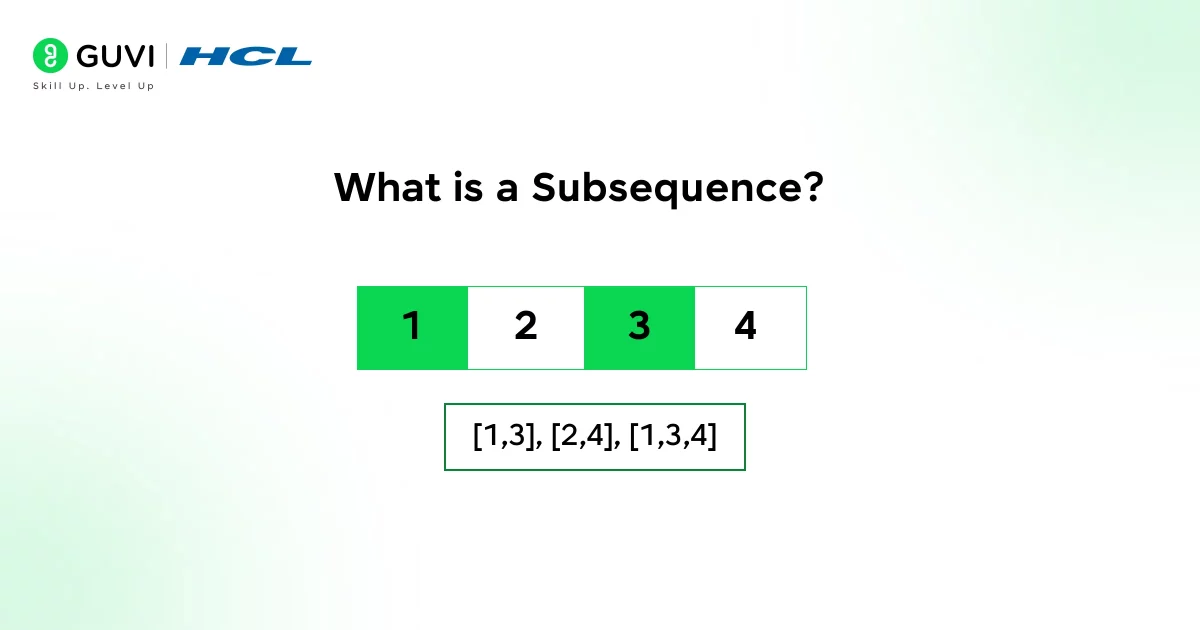
Think of a subsequence in DSA as a “filtered” version of a sequence where you keep the remaining elements in the same order. You simply pick some elements (possibly all or none) and delete the others, but never reorder the picks. Formally:
- Definition: A subsequence in DSA is defined as: a new sequence obtained by deleting zero or more elements without changing the relative order of the remaining elements.
- Example: Given the sequence ⟨A,B,C,D,E,F⟩, one subsequence is ⟨A,B,D⟩ (by deleting C, E, F). In strings, if your string is “ABCDE”, subsequences include “ACE”, “BD”, “ABCDE” (the whole string), and even the empty string “”. For instance, “geeks” has subsequences like “gks”, “ees”, “geeks” (itself), and “”
- How to think about it: Imagine scanning through the original sequence and deciding for each element to either include it or skip it. Whatever you include (in order) becomes your subsequence. For example, if you start with “abcdef” and choose to keep a, c, e, you end up with the subsequence “ace”.
Properties of Subsequence in DSA
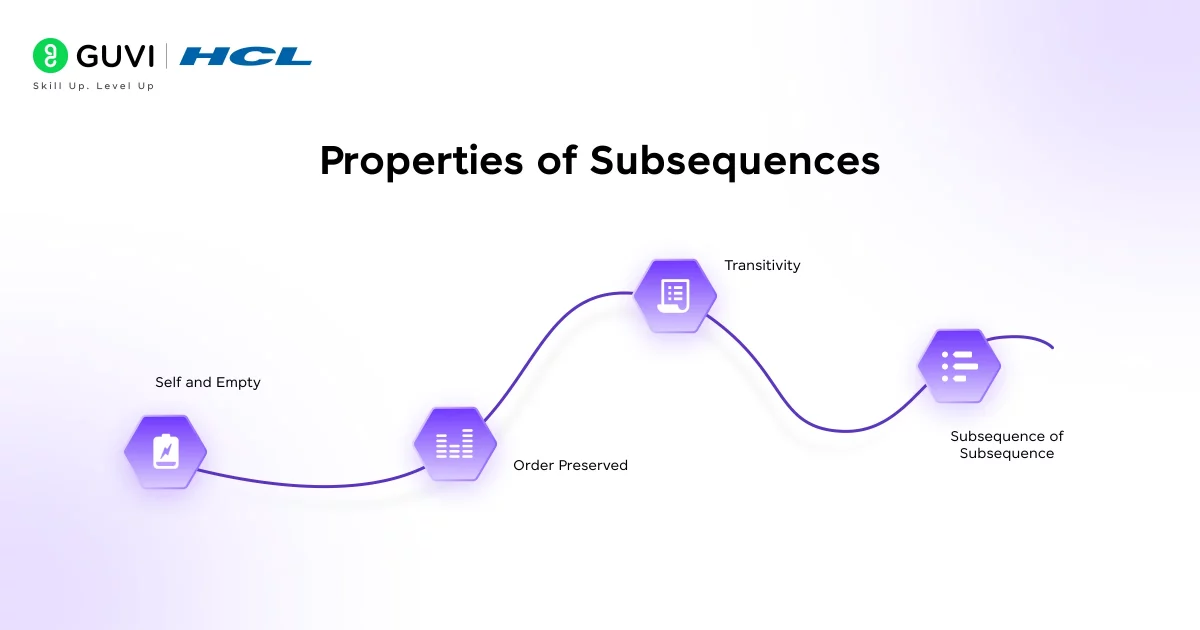
Here are some fundamental facts about a subsequence in DSA that often come up in Data Structures and Algorithms:
- Self and Empty: Any sequence is trivially a subsequence of itself (keep all elements). Also, the empty sequence (no elements) is a subsequence of every sequence (just delete everything).
- Order Preserved: A subsequence must preserve original order. You cannot reorder elements; you can only drop them. For instance, from <A,B,A>, <A,A> is a valid subsequence (we kept the two A’s in order), but <A,A,B> is not (it changes the order).
- Transitivity: If X is a subsequence of Y, and Y is a subsequence of Z, then X is a subsequence of Z (deletions compose).
- Subsequence of Subsequence: If you take a subsequence and then take a subsequence of that, you still have a subsequence of the original sequence.
These properties highlight that a subsequence in DSA is more general than substrings or subarrays (you can skip elements freely).
If you want to read more about how DSA paves the way for effective coding and its use cases, consider reading HCL GUVI’s Free Ebook: The Complete Data Structures and Algorithms Handbook.
It covers the key concepts of Data Structures and Algorithms, including essential concepts, problem-solving techniques, and real MNC questions.
Working with Subsequences: Algorithms and Code
In practice, we often need to generate a subsequence in DSA problems, test subsequence relationships, or solve problems like LCS/LIS. Below are some common algorithms and examples.
1. Generating All Instances of a Subsequence in DSA
One common task is to list all subsequences of a string or array. The straightforward method is a backtracking (pick/don’t pick) recursion:
- Idea: For each element of the sequence, you have two choices: include it in the current subsequence or skip it. Recurse on the next element with both choices.
Example (Python code): The function below prints all subsequences of a string:
def generate_subsequences(s, index=0, current=""):
    if index == len(s):
        print(f"'{current}'")
        return
    # Include s[index] in the subsequence
    generate_subsequences(s, index+1, current + s[index])
    # Exclude s[index]
    generate_subsequences(s, index+1, current)

# Example usage:
generate_subsequences("ab")

# Actual output:
# 'ab', 'a', 'b', ''- For input “ab”, this subsequence in DSA function prints ‘ab’, ‘a’, ‘b’, and ” (empty). The function always explores the “include” branch first, which is why the full string appears before the empty string in the output.
- Explanation: In the above code, current accumulates the chosen characters. On reaching the end (index == len(s)), we have one complete subsequence. We backtrack by choosing not to include the current character as well.
- Time Complexity: This method runs in O(2^n) time (and space) because it explores all subsequence combinations. It’s only practical for relatively small n.
2. Checking If One String is a Subsequence of Another
Another common problem in subsequence in DSA work is: given strings s1 and s2, check if s1 is a subsequence of s2. A classic linear-time solution uses two pointers:
This is one of the most common subsequence in DSA interview questions.
- Two-pointer approach: let i point into s1 (the smaller string) and j into s2 (the larger). Traverse s2 with j. Whenever s1[i] == s2[j], advance i. Always advance j. At the end, if i has reached the length of s1, all its characters were matched in order, so s1 is a subsequence. Otherwise, it’s not.
Example (Python code):
def is_subsequence(small, large):
    i = 0
    for ch in large:
        if i < len(small) and small[i] == ch:
            i += 1
    return i == len(small)

# Example usage:
print(is_subsequence("AXY", "ADXCPY"))  # True
print(is_subsequence("AXY", "YADXCP"))  # False
This example shows the two-pointer approach to a subsequence in DSA check in action.
All characters of “AXY” appear in “ADXCPY” in order, so it returns True; in the second, although all characters exist, their order is broken, so it returns False.
- Complexity: This runs in O(n+m) time (where n,m are string lengths) and O(1) extra space, which is optimal for this check.
3. Longest Increasing Subsequence (LIS): A Classic Subsequence in DSA Problem
The Longest Increasing Subsequence problem finds a subsequence of a sequence of numbers that is strictly increasing and as long as possible. For example, in the array [3, 10, 2, 1, 20], the LIS is [3, 10, 20] of length 3.
A simple DP solution for this subsequence in DSA problem (length O(n^2)) is:
def LIS_length(arr):
    n = len(arr)
    dp = [1]*n  # dp[i] = length of LIS ending at i
    for i in range(n):
        for j in range(i):
            if arr[j] < arr[i]:
                dp[i] = max(dp[i], dp[j] + 1)
    return max(dp) if arr else 0
For [3, 10, 2, 1, 20], this subsequence in DSA solution would compute dp = [1,2,1,1,3] and return 3. (There are more efficient O(n log n) solutions, but the DP idea is straightforward.)
4. Longest Common Subsequence (LCS): A Worked Example
LCS comes up so often in this article, and in real interviews, that it’s worth seeing the actual code, not just the definition. Given two strings, LCS finds the longest sequence that appears as a subsequence in both of them.
def LCS_length(s1, s2):
    m, n = len(s1), len(s2)
    dp = [[0] * (n + 1) for _ in range(m + 1)]
    for i in range(1, m + 1):
        for j in range(1, n + 1):
            if s1[i-1] == s2[j-1]:
                dp[i][j] = dp[i-1][j-1] + 1
            else:
                dp[i][j] = max(dp[i-1][j], dp[i][j-1])
    return dp[m][n]

# Example usage:
print(LCS_length("ABCBDAB", "BDCABA"))  # 4
print(LCS_length("AGGTAB", "GXTXAYB"))   # 4
Explanation: dp[i][j] holds the LCS length using the first i characters of s1 and the first j characters of s2. If the current characters match, extend the previous diagonal result by one. If they don’t match, take whichever direction (skipping a character from either string) gives the longer result.

Complexity: this runs in O(m×n) time and space, a big improvement over trying every possible subsequence combination, which would take exponential time.
Subsequence vs Substring
It’s important to distinguish a subsequence in DSA from substrings (or subarrays). The key difference is contiguity.
| Factor | Subsequence | Substring/Subarray |
|---|---|---|
| Contiguity required? | No, elements can be skipped | Yes, must be a contiguous run |
| Order preserved? | Yes | Yes |
| Example from “abcdef” | “ace” is valid | “bcd” is valid, “ace” is not |
| Count for length n | 2^n possible subsequences | n(n+1)/2 possible substrings |
| Common problems | LCS, LIS | Longest common substring, sliding window |
The short version, and a useful one to remember for any subsequence in DSA interview question: every substring is technically also a subsequence, but not every subsequence is a substring. A subsequence in DSA is the more general, more flexible concept of the two.
Applications of Subsequences
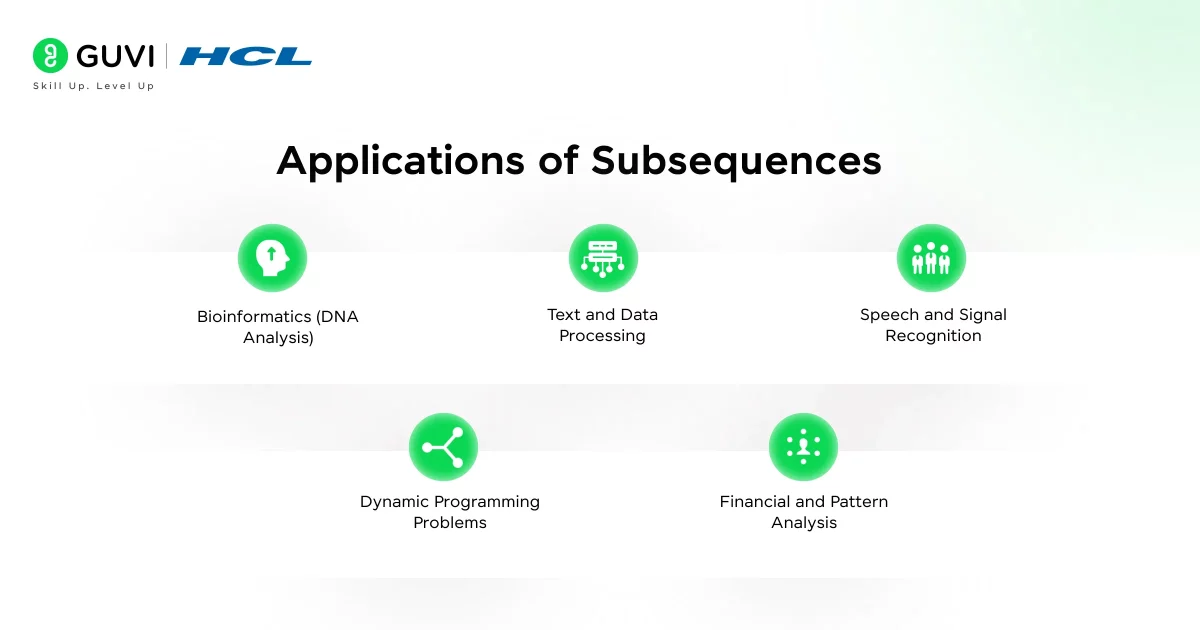
Subsequences pop up in many areas of computer science and real-world problems. Here are a few applications and domains that rely on this concept:
- Bioinformatics (DNA Analysis): In genetics, DNA sequences are long strings of nucleotides. Researchers look for certain subsequences (motifs or genes) within genomes. Since DNA motifs need not be contiguous (there can be intervening bases), a subsequence search is useful.
- Text and Data Processing: Subsequence matching helps in text search and pattern recognition, useful for finding non-contiguous word patterns in sentences or logs, including extracting meaningful phrases in NLP applications.
- Speech and Signal Recognition: Audio or video signals can use subsequences to identify patterns. In speech recognition, phonemes (sound units) appear in order but can have background noise or gaps, so subsequence matching helps.
- Dynamic Programming Problems: Many classic algorithm problems are about a subsequence in DSA specifically. The Longest Common Subsequence (LCS) problem finds the longest sequence common to two strings. The Longest Increasing Subsequence (LIS) problem finds the longest increasing sequence within a sequence of numbers. Both problems preserve order but allow gaps, so they are subsequence problems. In fact, in DSA interviews and challenges, LCS and LIS are very common.
- Financial and Pattern Analysis: Subsequence techniques can identify patterns in financial time-series or stock data (searching for trends). Similarly, pattern recognition in images often looks for subsequence-like patterns of features.
Overall, whenever you need to identify ordered patterns within larger data (strings, arrays, signals) but don’t require them to be contiguous, a subsequence in DSA is the concept to use.
If you want a platform that actually teaches DSA in a structured, beginner-friendly way while also giving you practical coding experience, consider enrolling in HCL GUVI’s DSA for Programmers Course that is designed specifically for learners who want clarity instead of confusion. It explains concepts in simple terms and guides you from basics to advanced topics step-by-step.
Subsequences form a fundamental concept that appears in many basic algorithms and problems in DSA. Whenever you need to reason about maintaining order but allowing gaps (like matching patterns or finding order-respecting subsets), you are in the realm of subsequences.
If you’re serious about mastering DSA in software development and want to apply it in real-world scenarios, don’t miss the chance to enroll in HCL GUVI’s IITM Pravartak and MongoDB Certified Online AI Software Development Course. Endorsed with NSDC certification, this course adds a globally recognized credential to your resume, a powerful edge that sets you apart in the competitive job market.
Common Mistakes When Solving Subsequence Problems
A handful of recurring mistakes trip up most people the first time they work through a subsequence in DSA problem.
- Confusing subsequence with substring. This is the single most common mix-up. Remember: a subsequence can skip elements, a substring can’t.
- Trying to brute-force large inputs. Generating all subsequences is O(2^n), which becomes impossibly slow past roughly n=25-30. Reach for dynamic programming instead once the input grows.
- Forgetting the empty subsequence. It’s a valid subsequence of everything, and many DP base cases depend on counting it correctly.
- Mixing up LIS and LCS. LIS looks for an increasing pattern within one sequence; LCS looks for a shared pattern between two sequences. They’re solved differently, and it’s easy to reach for the wrong one under interview pressure.
- Off-by-one errors in DP table indexing. The LCS solution above uses 1-indexed loops against 0-indexed strings specifically to avoid this; get the indexing wrong and the whole table shifts silently.
Conclusion
In conclusion, subsequence in DSA is a simple concept with high leverage. They let you reason about ordered patterns, move from brute force to efficient two-pointer or DP solutions, and form the basis of classic problems like LCS and LIS.
If you take away two things from the article, let them be these: (1) subsequence ≠ substring, and (2) practice the two-pointer check and a DP LCS/LIS implementation to see the idea in code. That small investment will pay off whenever you face sequence problems in DSA. The key is to remember the order-preserving rule and that many efficient algorithms (like DP for LCS/LIS) rely on this property.
FAQs
1. What is a subsequence?
A subsequence is any sequence you can get by deleting zero or more characters/elements from the original while keeping the remaining items in the same order. It preserves order but not contiguity.
2. How is a subsequence different from a substring?
A substring (or subarray) must be contiguous; a subsequence can skip elements as long as the order stays the same. So every substring is a subsequence, but not every subsequence is a substring.
3. How do you check if one string is a subsequence of another?
Use a two-pointer scan: advance the pointer on the larger string and move the pointer on the smaller string only when characters match. If the smaller pointer reaches the end, it’s a subsequence — O(n+m) time.
4. What is the Longest Common Subsequence (LCS)?
LCS is the longest sequence that appears as a subsequence in two given sequences. It’s commonly solved with dynamic programming in O(m×n) time and used in diff tools and bioinformatics.
5. How many subsequences does a sequence of length n have?
There are 2^n subsequences in total (including the empty subsequence) because each element can be either kept or dropped. This exponential growth makes brute-force enumeration practical only for small n.
Success Stories

About the Author
Jebasta
I translate the language of data into stories that anyone can understand. As a writer with a data science background, I simplify analytics, AI, and decision-making so beginners and enthusiasts can confidently explore the world of data.
View all posts by Jebasta
Connect with me @







Did you enjoy this article?