


Project Articles
Automated Resume Screener: NLP-Based Python Project with Source Code
Business Analysis in Digital Transformation Projects - Best Guide
Build No-Code AI Agents with Flowise AI: Step-by-Step Beginner Guide


Get In Touch For Details! Request More Information
Top 10 Spring Project Ideas [With Source Codes]
Oct 15, 2025 6 Min Read 7760 Views
(Last Updated)
Have you ever wondered why some developers secure high-paying roles more quickly, while others struggle to stand out? The difference often lies in practical experience. Spring projects provide that hands-on exposure by combining real business logic and security patterns into a working application. They teach developers how to structure code in layers, build REST APIs, manage transactions, and integrate modern tools.
Choosing the right project helps you grow gradually from basic CRUD operations to advanced concepts such as microservices and real-time communication. This list of beginner, intermediate, and advanced projects, along with their source code, provides a clear roadmap for building a strong portfolio and mastering enterprise-level development skills. Keep reading to learn more:
Table of contents
- What is Spring and its Importance?
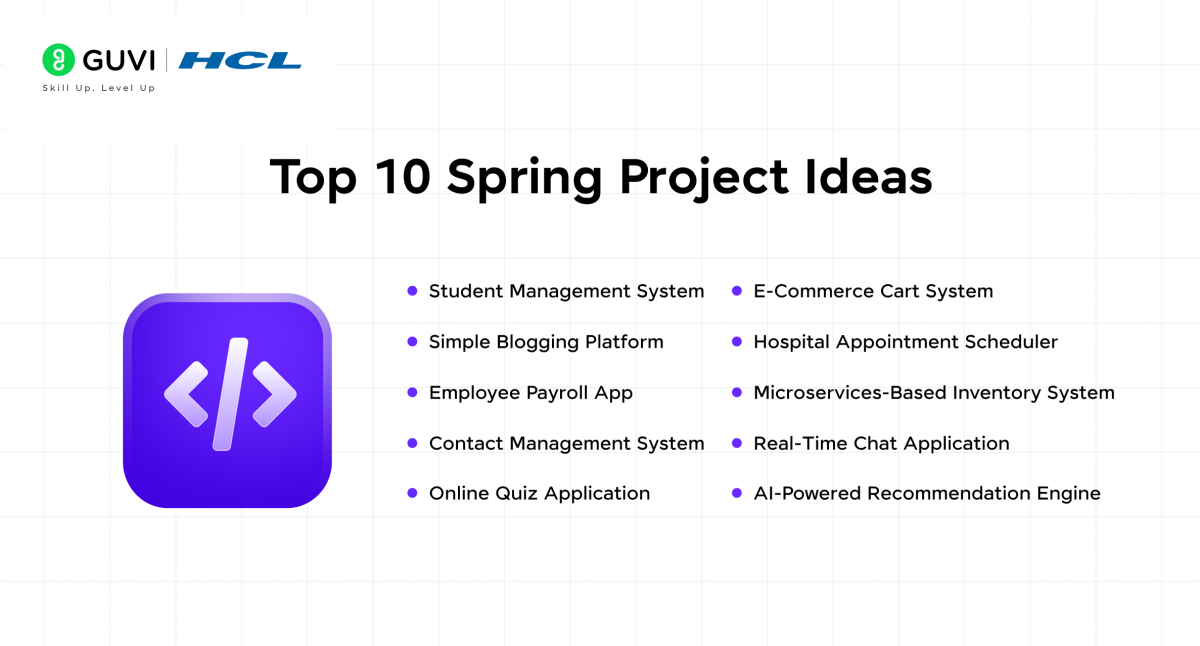
- 10 Spring Project Ideas [With Source Codes]
- Beginner-Level Spring Projects
- Intermediate-Level Spring Projects
- Advanced-Level Spring Projects
- Why Choosing the Right Spring Project Ideas Is Essential?
- Final Words
- FAQs
- Q1: How do Spring projects help in learning enterprise development?
- Q2: Which Spring project is best for beginners with limited coding experience?
- Q3: Can these projects improve job readiness for Java developers?
What is Spring and its Importance?
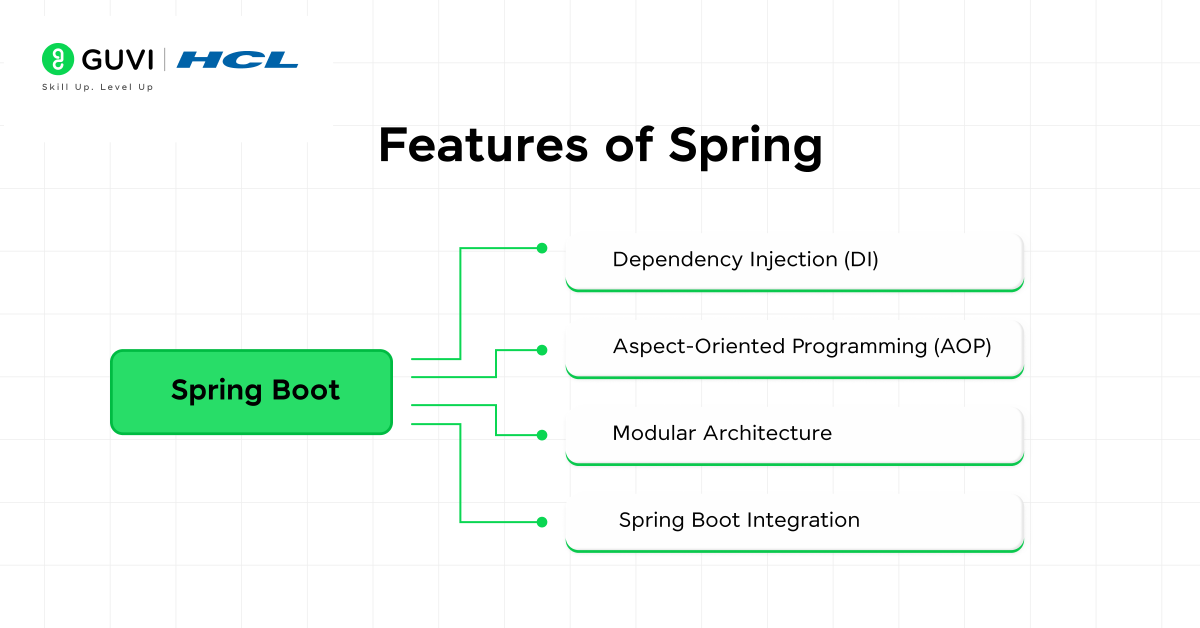
Spring is a powerful framework for building Java applications. It is significant as it offers a comprehensive programming and configuration model that supports enterprise-level development. Developers use Spring to manage application components through dependency injection, which creates modular and testable code.
Spring Boot, an extension of the framework, simplifies project setup and accelerates application deployment through preconfigured defaults. Its architecture encourages layered design which improves maintainability over time.
10 Spring Project Ideas [With Source Codes]
Beginner-Level Spring Projects
1. Student Management System
We begin with the Student Management System project, which is a perfect introduction to Spring MVC and database connectivity. This application allows adding students, assigning them to courses, updating grades, and generating reports. It also supports role-based access, so teachers and students see only what is relevant to them. This project helps beginners understand how a request moves through controllers, services and repositories before reaching the database.
- Skills Required:
• Role-based access control and permissions
• Controller and service layer creation in Spring MVC
• Hibernate and JPA entity mapping for students and courses
• Implementing validations for input fields
- Tools & Technologies:
• Spring Boot with Spring MVC and Spring Data JPA
• Hibernate ORM with MySQL or H2 database
• Thymeleaf templates for web views
• Maven for build and dependency management
- Benefits:
• Builds a solid foundation for CRUD operations
• Strengthens knowledge of layered architecture
• Adds a practical full-stack project to a portfolio
Source Code: Student Management System
2. Simple Blogging Platform
The next project is the Simple Blogging Platform, which introduces user authentication and content management. It allows users to register, log in, create posts, edit or delete them and leave comments on other posts. The project enforces security rules so users can modify only their own content. This is a great way to learn Spring Security and relational mapping between posts, users and comments.
- Skills Required:
• Designing REST APIs for posts and comments
• Configuring Spring Security for authentication and authorization
• Creating one-to-many and many-to-one relationships in JPA
• Handling exceptions for missing posts or invalid input
- Tools & Technologies:
• Spring Boot with Spring Security
• Hibernate and JPA for persistence
• Thymeleaf or React for the user interface
• MySQL or H2 database
- Benefits:
• Provides real-world experience with secure CRUD operations
• Reinforces knowledge of JPA entity relationships
• Creates a blog application suitable as a showcase project
Source Code: Simple Blogging Platform
Also, read: Ace Your Interview: Top 50+ Spring Boot Questions and Answers
3. Employee Payroll App
Another beginner-friendly project is the Employee Payroll App, which focuses on core business logic. The application allows adding employees, calculating salaries, applying tax deductions, and generating payslips in PDF format. A scheduling feature can trigger payroll runs at the end of each month. This project introduces developers to report generation and automated tasks in Spring.
- Skills Required:
• Designing entities for employees, salaries and deductions
• Writing service layer methods for salary computation
• Using JasperReports for PDF generation
• Implementing scheduled tasks with Spring Scheduler
- Tools & Technologies:
• Spring Boot with JPA and Hibernate
• JasperReports for payslip creation
• MySQL or Oracle Database for data storage
• REST endpoints for retrieving payroll data
- Benefits:
• Strengthens skills in applying business logic
• Teaches reporting and scheduling techniques
• Produces a professional HR-related project
Source Code: Employee Payroll App
4. Contact Management System
The next project is the Contact Management System, an ideal choice to practice REST API development with pagination and search. The application supports adding, editing, deleting, and searching contacts, with validation to prevent duplicate entries. This project builds confidence in API design and testing.
- Skills Required:
• Creating repository interfaces with Spring Data JPA
• Implementing pagination and sorting in endpoints
• Writing exception handlers for invalid data
• Testing APIs with Postman or Swagger
- Tools & Technologies:
• Spring Boot with JPA and Hibernate
• H2 Database for quick development setup
• Swagger for documentation and testing
• Postman for manual API testing
- Benefits:
• Reinforces CRUD concepts with search and filter functionality
• Demonstrates proper API structure and response handling
• Adds a clean, testable micro-project to a developer portfolio
Source Code: Contact Management System
Intermediate-Level Spring Projects
5. Online Quiz Application
The first intermediate project is the Online Quiz Application, which introduces session handling and role-based access control. This app allows users to take quizzes, view results instantly, and track progress. Admin users can create question banks, assign categories, and manage difficulty levels. This project helps developers practice authentication, REST API design, and random question selection logic.
- Skills Required:
• Building secured REST APIs with Spring Security
• Creating session logic for quiz progress tracking
• Using JPA for question and category relationships
• Implementing scoring and result calculation logic
- Tools & Technologies:
• Spring Boot with Spring Security
• Spring Data JPA and Hibernate
• MySQL or PostgreSQL for storing questions and scores
• Thymeleaf or React for front-end quiz interface
- Benefits:
• Teaches role-based access for admins and users
• Builds skills in randomization and session management
• Produces a full-stack project suitable for portfolio use
Source Code: Online Quiz Application
6. E-Commerce Cart System
The next project is the E-Commerce Cart System, which takes CRUD knowledge to a higher level by combining product management, cart operations, and order checkout. Users can browse products, add or remove items from the cart, update quantities, and confirm orders. Admin users can add new products or update inventory levels. This project is excellent for practicing transactions and payment integration.
- Skills Required:
• Designing product, cart and order entities with relationships
• Handling transactions to maintain order consistency
• Creating REST controllers for cart and order management
• Integrating payment gateway APIs such as Stripe or PayPal
- Tools & Technologies:
• Spring Boot with Spring Data JPA
• Hibernate ORM and MySQL database
• Thymeleaf templates for product catalog and cart pages
• Spring Security for user authentication
- Benefits:
• Strengthens understanding of transactional behavior
• Provides end-to-end knowledge of e-commerce workflows
• Adds a realistic online shopping project to a developer’s portfolio
Source Code: E-Commerce Cart System
7. Hospital Appointment Scheduler
Another intermediate project is the Hospital Appointment Scheduler, which simulates a real-world healthcare booking system. Patients can register, book appointments, cancel or reschedule, and receive email confirmations. Doctors can manage their availability, and admins can view appointment statistics. This project is ideal for practicing scheduling logic, validation and notification workflows.
- Skills Required:
• Designing appointment entities with date and time validations
• Implementing scheduling APIs and conflict prevention logic
• Using Spring Mail for sending confirmation emails
• Exception handling for duplicate or invalid bookings

- Tools & Technologies:
• Spring Boot with Spring Data JPA
• Hibernate ORM and MySQL database
• Spring Mail for notifications
• Angular or React for front-end appointment booking
- Benefits:
• Provides hands-on experience with calendar-based systems
• Strengthens validation and exception-handling skills
• Creates a portfolio-ready healthcare management solution
Source Code: Hospital Appointment Scheduler
Advanced-Level Spring Projects
8. Microservices-Based Inventory System
We begin the advanced section with the Microservices-Based Inventory System, which is perfect for developers who want to move beyond monolithic applications. This project breaks functionality into separate services for inventory, orders and payments.
Each service runs independently and communicates through REST APIs or message brokers. Service discovery and load balancing ensure resilience and scalability. This project helps you gain hands-on experience with Spring Cloud components and distributed application design.
- Skills Required:
• Designing and deploying independent microservices
• Using Eureka for service discovery and Feign clients for inter-service calls
• Configuring API Gateway for routing and security
• Implementing distributed tracing with Sleuth and Zipkin
- Tools & Technologies:
• Spring Boot with Spring Cloud Netflix stack
• RabbitMQ or Kafka for asynchronous communication
• Docker for containerization and local orchestration
• Spring Cloud Config for centralized configuration management
- Benefits:
• Builds real-world experience with distributed systems
• Prepares developers for enterprise-scale architectures
• Demonstrates resilience, fault tolerance and modular design
Source Code: Microservices-Based Inventory System
9. Real-Time Chat Application
The next project is the Real-Time Chat Application, which highlights event-driven programming and persistent messaging. Users can register, create chat rooms and send direct or group messages. WebSocket connections keep conversations live without page refresh. Message history can be stored for later retrieval, and typing indicators can be implemented for an enhanced user experience.
- Skills Required:
• Configuring Spring WebSocket endpoints
• Using STOMP protocol for messaging
• Managing user sessions and chat rooms
• Storing message history in Redis or a database
- Tools & Technologies:
• Spring Boot with WebSocket support
• STOMP over WebSocket for communication
• Redis for real-time message storage
• Spring Security for user authentication
- Benefits:
• Demonstrates ability to build low-latency real-time systems
• Strengthens understanding of event-driven architecture
• Adds an interactive project that is ideal for showing live demos
Source Code: Real-Time Chat Application
10. AI-Powered Recommendation Engine
Another advanced project is the AI-Powered Recommendation Engine, which integrates machine learning predictions into a Spring Boot application. This project consumes data from user interactions, processes it, and provides recommendations such as product suggestions or content personalization. It can call an external ML service or work with a pre-trained model hosted on TensorFlow Serving.
- Skills Required:
• Consuming REST APIs from ML models
• Applying filtering and ranking algorithms
• Designing recommendation endpoints and caching results
• Building dashboards to display personalized suggestions
- Tools & Technologies:
• Spring Boot and Spring Data
• TensorFlow Serving API or MLflow models
• PostgreSQL or MongoDB for data storage
• React or Angular for visualization layer
- Benefits:
• Combines Spring development with applied machine learning
• Shows ability to deliver intelligent features in production apps
• Demonstrates data-driven decision-making capabilities
Source Code: AI-Powered Recommendation Engine
Elevate your skills with our Java Full Stack Development Course. Build full-stack applications using Spring Boot, REST APIs, front-end frameworks, secure access, and real-world project experience. With hands-on portfolio projects, mentorship, and industry-aligned training, this course gets you ready for Java developer roles tackling enterprise challenges.
Why Choosing the Right Spring Project Ideas Is Essential?
Selecting the right project idea shapes how quickly developers gain confidence and build practical skills. The decision impacts learning outcomes, portfolio strength and future opportunities. Here are the key reasons why it matters:
- Structured Skill Growth: Choosing projects that match your current level helps you build core concepts before moving to advanced techniques. This keeps learning organized and reduces frustration.
- Portfolio Quality: Well-chosen projects show recruiters your ability to work on real-world problems. A strong portfolio highlights both technical depth and understanding of business needs.
- Efficient Use of Time: Projects that align with your goals save time by focusing on relevant tools and patterns. This creates a direct path to mastering technologies you will use professionally.
- Exposure to Industry Practices: Good project choices introduce concepts like layered architecture, security, API design and microservices, which prepares you for enterprise-level development roles.
- Better Interview Preparation: Projects built on solid ideas give you concrete examples to discuss during interviews, which helps demonstrate problem-solving skills and technical decision-making.
Build more than just projects; build your future with our Spring Boot Course. Learn to design enterprise-level applications, master REST APIs, secure your apps with Spring Security, and gain hands-on experience with microservices. With real-world projects, personalized mentorship, and job-focused training, this course helps you stand out as a skilled Java developer ready for high-demand roles.
Final Words
Building Spring projects is one of the most effective ways to turn theoretical knowledge into real-world skills. Each project in this list takes you a step closer to writing production-ready code, understanding enterprise architecture and gaining confidence with Spring Boot. Completing them gives you practical examples to showcase in interviews and strengthens your ability to solve business problems through code. Start with a beginner project, progress to intermediate ones and finally attempt advanced solutions to create a portfolio that reflects growth and technical depth.
FAQs
Q1: How do Spring projects help in learning enterprise development?
Spring projects simulate real-world workflows like data persistence, user authentication, and transaction management. Working on them allows developers to practice building layered architectures and integrating APIs, which builds a strong foundation for enterprise-level applications.
Q2: Which Spring project is best for beginners with limited coding experience?
A Student Management System or Contact Management System is ideal for beginners. These projects focus on CRUD operations and simple database relationships, which make them easy to implement while teaching essential Spring Boot fundamentals.
Q3: Can these projects improve job readiness for Java developers?
Yes. Building well-structured projects with Spring Boot gives developers practical examples to discuss during interviews. Employers value candidates who can explain design decisions, show code quality and relate their projects to real business use cases.
Success Stories

About the Author
Vaishali
I'm a seasoned writer with four years of experience across technical, non-technical, and just about every genre or niche you can imagine. Adaptable and curious, I enjoy exploring new topics and making information engaging and easy to understand. Fueled by a steady stream of tea, I approach each project with creativity, reliability, and genuine enthusiasm for storytelling.
View all posts by Vaishali
Connect with me @









Did you enjoy this article?