


Artificial Intelligence and Machine Learning Articles
Finance Manager to Data Analytics: Career Growth, Salary and Seniority
How to Evaluate LLM Outputs in Production Deployments
AI/ML Skills Gap 2026: Why Companies Can't Find Job-Ready Talent
20 AI/ML Interview Questions Recruiters Can Use Without a Tech Background - Best Guide
Get In Touch For Details! Request More Information
The Ultimate Guide: What is Edge AI and Why It Matters Now
Feb 17, 2026 5 Min Read 2769 Views
(Last Updated)
We live in an age of artificial intelligence. It helps us navigate our cities, powers our virtual assistants, and suggests movies for us to watch. The cloud, which is the central component of our smart devices and consists of enormous data centers with enormous computational power, has been the subject of the AI story for many years. When you ask Siri or Alexa a question, you send your voice to one of those data centers, it gets processed, and the answer comes back. But what if you needed the answer right now? What if you are not connected to the internet? And what about the privacy of the data you just sent?
These questions are at the start of probably the biggest shift in technology that we are currently experiencing, the shift from the cloud to the “edge.”
This blog will help you through the new and exciting universe of Edge Artificial Intelligence. We will define what is edge AI, how it differs from cloud-based AI, and provide real-life examples of Edge AI that are already reshaping our lives.
Table of contents
- How Does Edge AI Technology Work?
- Edge AI vs Cloud AI
- Key Benefits of Edge AI
- Edge AI Applications Across Industries
- Consumer Electronics and Smart Homes
- Edge AI in IoT (The Internet of Things)
- Automotive and Transportation
- Healthcare
- Retail
- The Future of Edge AI
- Final thoughts..
- Is Edge AI the same as edge computing?
- What industries are adopting Edge AI the fastest?
- Does Edge AI need internet connectivity?
- What is the biggest challenge in Edge AI adoption?
How Does Edge AI Technology Work?
The magic of Edge AI technology happens through a process that blends hardware and software seamlessly.
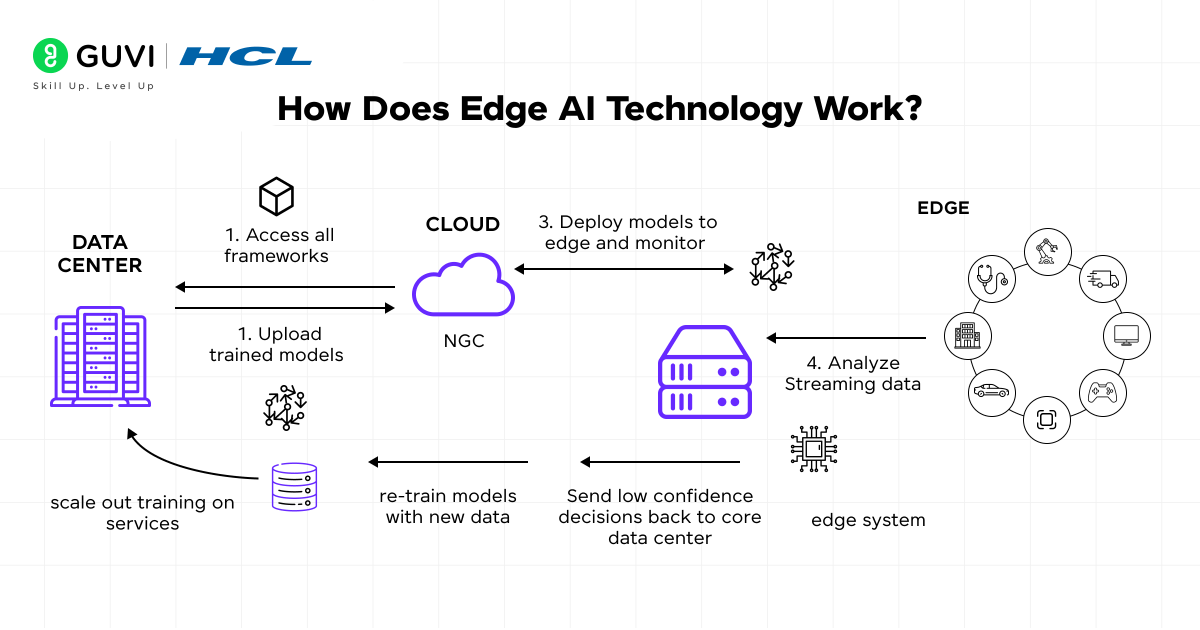
- Model Training (In the Cloud): First, a complex AI model is developed and trained on massive datasets in a cloud environment. This training process requires immense computational power, which the cloud provides efficiently. For example, an AI model learns to identify cats by analyzing millions of cat pictures on a powerful cloud server.
- Model Optimization (Compression): The trained model is often too large and resource-intensive to run on a small device. It undergoes a process called optimization or compression. This technique, which is like quantization (reducing the precision of the numbers in the model) and minimizing (removing unnecessary parts of the network), shrinks the model’s size with minimal loss of accuracy.
- Deployment (At the Edge): This streamlined, efficient model is then deployed directly onto an Edge AI device. These devices are equipped with specialized processors like GPUs (Graphics Processing Units), TPUs (Tensor Processing Units), NPUs (Neural Processing Units), or low-power microcontrollers designed specifically for running AI inference tasks.
- Inference (Real-Time Processing): Once deployed, the device can now perform inference. It takes in new data from its sensors (e.g., a live video feed), processes it through the onboard AI model, and generates an immediate result (e.g., “cat detected”) without ever needing to contact the cloud.
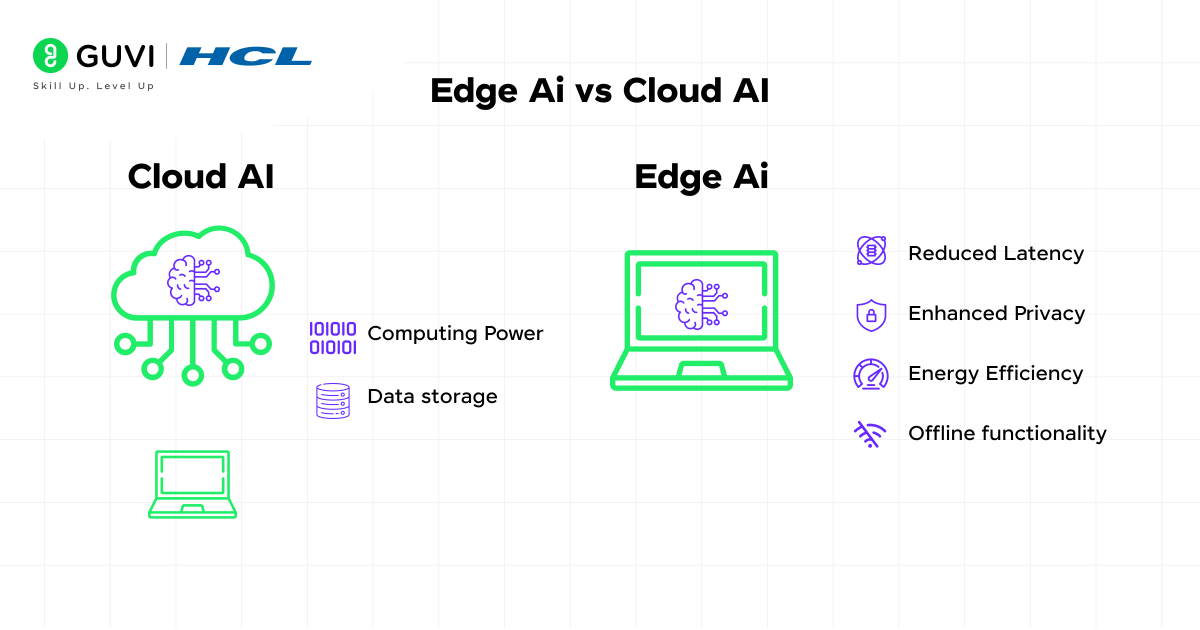
Edge AI vs Cloud AI
| Feature | Edge AI | Cloud AI |
| Latency | Ultra-low, near-instant processing | Higher due to data transmission |
| Connectivity Need | Works offline or with limited internet | Data stored and processed in a remote cloud |
| Scalability | Limited to device hardware | Highly scalable with cloud infrastructure |
| Data Privacy | Local data processing = higher privacy | Data stored and processed in remote cloud |
| Cost | Hardware-dependent, lower bandwidth cost | Subscription/usage fees for cloud storage |
Key Benefits of Edge AI
- Ultra-Low Latency: This is the main advantage of Edge AI. Instead of the decision going back and forth to the cloud, the decision is made in milliseconds. This is critical for applications like autonomous vehicles that must react to a person who steps onto the road in real-time.
- Better Data Security and Privacy: Because it is processed locally, sensitive data (such as IP, industrial, and video sent from your home to a friend’s home) never leaves the device. Even though our bank data is protected from possible theft and appropriation while it travels over the internet, sensitive information can still be obtained by someone claiming to be the owner of the data or, of course, by breaking into a company’s firewall.
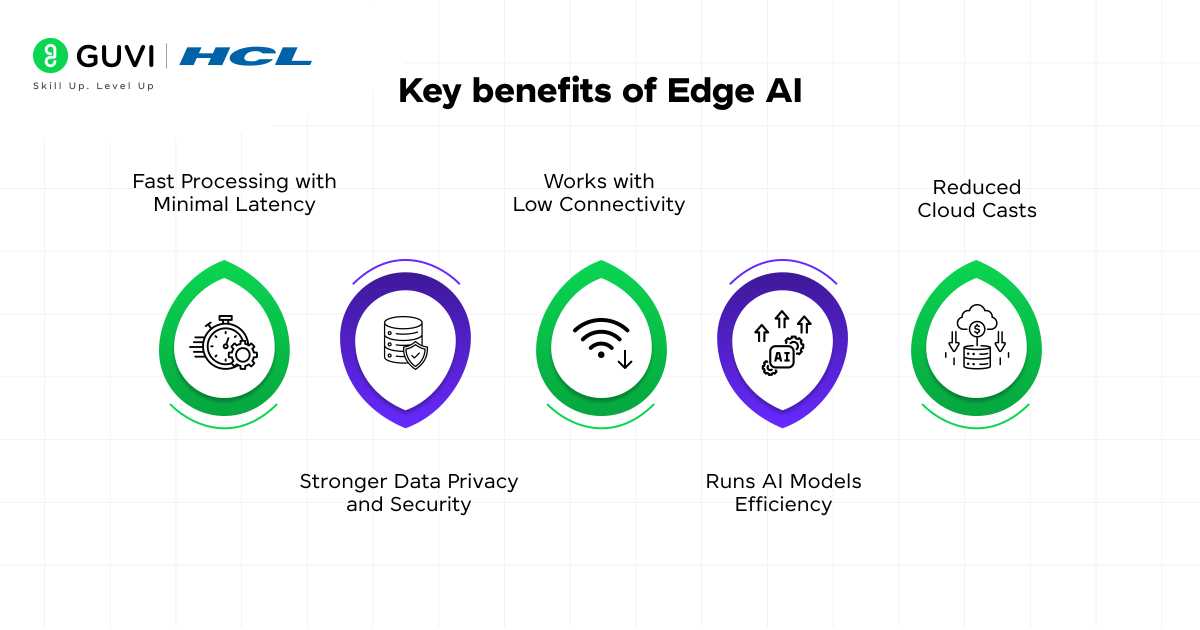
- Massive Bandwidth Reduction: It is expensive and creates too much latency to send continuous high-resolution video or sensor data to the cloud from thousands of devices. These data streams contain far more information than is practical. In addition to drastically cutting bandwidth (some by over 99% with Edge AI), Edge AI only provides us with insightful information (e.g., “machine part X is going to fail”), which is what drives dataverse storage and network data flow fees.
- Reliability and Offline Capabilities: Edge devices are less dependent on a steady network connection. An Edge AI-enabled robotics device that acts intelligently might not require a factory’s or business’s network or internet. Edge AI made it possible for the automation to continue operating in situations where the factory’s internet or local network went down. It also ensured that the automation would be consistently productive during the transition period when it wasn’t connected to a larger data source.
- Scalability: Developing a system with intelligent devices may be less expensive and risky in some circumstances than developing a cloud infrastructure that cannot handle multiple streams of raw data coming from all devices at once.
- By 2030, Edge AI devices are expected to outnumber cloud AI devices by 10 to 1, making it the default way we interact with smart technology in our homes, cars, and workplaces.
- Your smartphone already uses Edge AI for Face ID, predictive text, and real-time photo enhancementsall happening instantly on your device without sending data to the cloud.
- Edge AI can cut data transfer costs by up to 99% since only insights, not raw data, need to be shared with the cloud, making it faster and more secure.
Edge AI Applications Across Industries
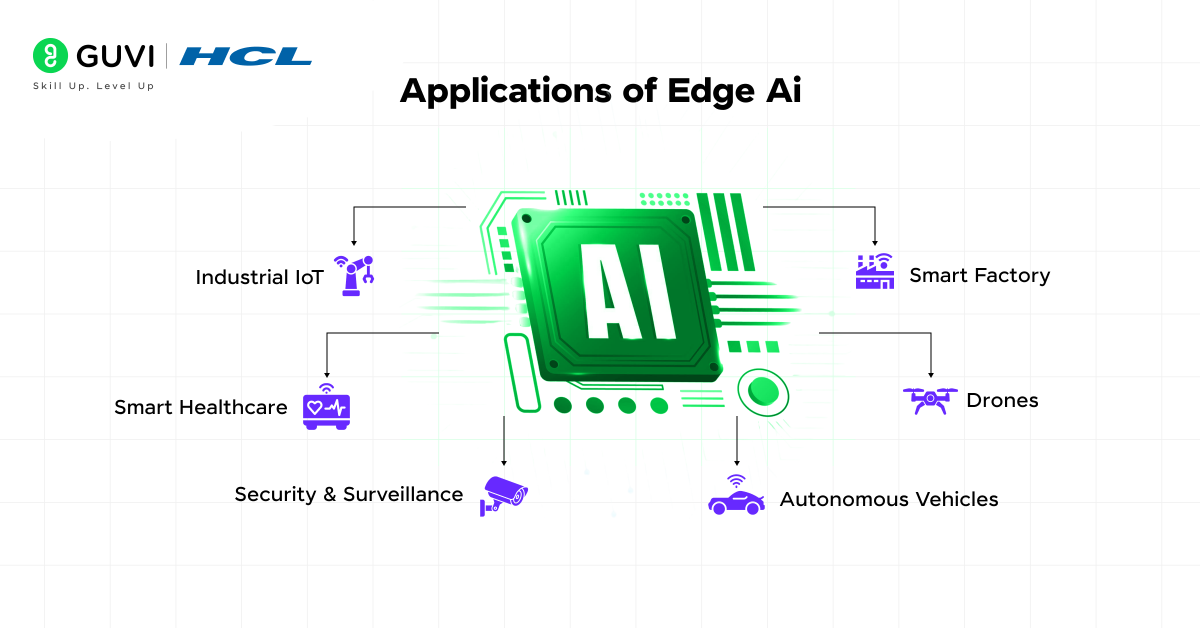
The theoretical benefits are impressive, but the true power of Edge AI is visible in its rapidly growing number of practical applications. You are likely using Edge AI examples every day without even realizing it. These Edge AI use cases span nearly every industry.
Consumer Electronics and Smart Homes
- Smartphones: This is the most common Edge AI device. Features like Face ID, real-time language translation, voice-to-text dictation, and the computational photography that makes your pictures look stunning all run on specialized AI chips within your phone.
- Smart Speakers & Assistants: When you say “Hey, Alexa” or “Okay, Google,” a small AI model for “wake word” detection is always listening on the device itself. This is Edge AI. Only after it hears the wake word does it stream your command to the cloud for further processing.
- Home Security: Modern cameras use Edge AI to perform person detection, package detection, or even recognize familiar faces, reducing false alarms from rustling leaves or passing cars and only notifying you of genuinely important events.

Edge AI in IoT (The Internet of Things)
The synergy between Edge AI in IoT is perhaps the most powerful combination. IoT devices generate a torrent of data, and Edge AI gives them the intelligence to act on it.
- Smart Homes: Voice assistants that can process commands without an internet connection, smart thermostats that learn your habits locally, and cameras that recognize family members on-device.
- Wearables: Smartwatches and fitness trackers that analyze your health metrics (like detecting an irregular heartbeat) directly on the device, providing instant feedback and ensuring your personal health data remains private.
Automotive and Transportation
The modern car is a powerful edge computing device on wheels.
- Advanced Driver-Assistance Systems (ADAS): Features like lane-keeping assist, automatic emergency braking, and adaptive cruise control rely on Edge AI to process data from cameras and sensors in real-time to keep the driver safe.
- In-Cabin Monitoring: Edge AI can monitor the driver for signs of drowsiness or distraction and issue an alert, improving road safety.
Healthcare
- Wearable Devices: Smartwatches and health monitors use Edge AI to analyze your heart rate, detect irregularities like atrial fibrillation, or sense a hard fall and automatically call for help. This on-device analysis ensures immediate alerts and privacy for sensitive health data.
- Medical Imaging: Portable ultrasound devices can use Edge AI to provide preliminary analysis of images in remote clinics, helping doctors make faster diagnoses without needing a constant connection to a hospital’s central server.
Retail
- Automated Checkout: Stores like Amazon Go use a complex system of cameras and sensors with Edge AI to track what shoppers pick up, allowing them to just walk out and have their account billed automatically.
- Inventory Management: AI-powered cameras can monitor shelves in real time to detect when items are running low and automatically trigger a re-stocking order.
The Future of Edge AI
The future of edge AI is bright and should continue to see rapid development in both hardware and software. Research shows that the global edge AI market is forecasted to grow exponentially over the next 10 years.
Some trends to watch are:
- 5G integration: Faster and more reliable networks will enable edge AI applications to run at light speed.
- Smarter IoT devices: Edge AI will soon be embedded into billions of autonomous connected devices.
- AI chips: new forms of processors will be more powerful and efficient.
- Edge-cloud proportionality: Hybrid AI architectures will be standard.
- Ethical AI at the edge: Regulations will ensure secure, transparent, and fair AI.
In the end, edge artificial intelligence is more than just a technology trend; it is a new way of deploying and consuming intelligence.
If this is something that interests you, and you want to become a AI/ML Engineer, then take the chance to get started and learn with HCL GUVI’s IITM Pravartak and Intel Certified Online Advanced AI & Machine Learning Course,. This NSDC-approved course offers a certificate recognized globally, which adds serious bragging rights to your résumé and will help you set yourself apart in a highly competitive employment market.
Final thoughts..
Edge AI is about bringing artificial intelligence closer to the data as the first step towards the data being processed in real-time, lessening latency, and increasing privacy. Edge AI is ready to revolutionize industries and daily life.
From healthcare devices to smart cities, we see edge AI-enabled products everywhere we look, moving systems into more responsive, efficient, and intelligent systems. As we look toward the future of edge AI, we are positioned to take advantage of untapped potential in countless areas of IoT, robotics, and much more.
Companies that invest in edge AI use cases now will be the ones able to respond to the demands and speed of the digital world of the future.
1. Is Edge AI the same as edge computing?
No, edge computing is all about processing the data near its source, whereas Edge AI refers to running AI algorithms on edge devices.
2. What industries are adopting Edge AI the fastest?
Industries such as automobiles, health centers, and retail are adopting faster as they require better decision making in real time.
3. Does Edge AI need internet connectivity?
Not always, edge ai can be able to work without internet, but it requires an internet connection to store or sync with the cloud for updates.
4. What is the biggest challenge in Edge AI adoption?
The main challenge is balancing performance with hardware limitations, as edge devices often have limited computing power and energy resources.
Success Stories

About the Author
Vishalini Devarajan
An Aerospace Engineer turned content writer, I focus on making complex concepts easy to understand through well-structured, reader-friendly blogs. Whether it’s a technical topic or a non-technical one, I love creating content that is clear, engaging, and impactful.
View all posts by Vishalini Devarajan
Connect with me @







Did you enjoy this article?