


Artificial Intelligence and Machine Learning Articles
AI/ML Skills Gap 2026: Why Companies Can't Find Job-Ready Talent
20 AI/ML Interview Questions Recruiters Can Use Without a Tech Background - Best Guide
How Industry-Backed AI/ML Bootcamps Are Changing the AI/ML Hiring Pipeline - Best Guide 2026
From IT Support to AI Engineer: A Realistic Career Switch Guide 2026


Get In Touch For Details! Request More Information
Linear Algebra for Machine Learning: Complete Beginner Guide [2026]
Sep 01, 2026 10 Min Read 4129 Views
(Last Updated)
A machine learning dataset may look like rows in a spreadsheet. An image may look like pixels. A sentence may look like words. Inside a machine learning system, however, all of them eventually become numbers arranged into structures such as vectors, matrices and tensors. That is where linear algebra enters the picture.
Linear algebra provides the mathematical framework used to represent, transform and compare these numerical structures. Matrix multiplication moves data through neural network layers. Dot products help measure relationships between vectors. Eigenvectors appear in Principal Component Analysis. Matrix factorisation helps uncover hidden patterns in recommendation systems.
In other words, you do not learn linear algebra for machine learning simply to solve equations on paper. You learn it to understand what machine learning algorithms are actually doing with data. IBM similarly describes linear algebra as the framework for arranging, combining and transforming data in machine learning, including operations behind neural networks, PCA and SVD.
This guide explains the essential concepts without turning the subject into a mathematics textbook. You will learn what matters, where each concept appears in ML and how to practise it with Python.
Quick Answer-Linear algebra for machine learning is the branch of mathematics used to represent data as vectors, matrices and tensors and perform the calculations behind ML models. It powers data transformations, regression, PCA, embeddings, neural networks, recommendation systems and many other machine learning algorithms.
- Start with: Vectors, matrices, dot products and matrix multiplication.
- Learn next: Norms, linear transformations, rank, eigenvalues and eigenvectors.
- For advanced ML: Study SVD, matrix factorisation and tensors.
- Practise with: Python and NumPy instead of learning formulas in isolation.
Table of contents
- Why Linear Algebra Matters in Machine Learning
- 1) Linear Algebra as the Language of Data
- 2) How Is Linear Algebra Used in Machine Learning?
- Linear Algebra Concepts for Machine Learning at a Glance
- Core Concepts Every Beginner Should Learn
- Scalars, Vectors, Matrices and Tensors
- Vector Operations
- Norms and Distance
- Matrix Operations
- Linear Transformations
- Rank and Linear Independence
- Systems of Linear Equations and Least Squares
- Eigenvalues and Eigenvectors
- Matrix Decomposition
- Singular Value Decomposition
- How Much Linear Algebra Do You Need for Machine Learning?
- Beginner Level
- Intermediate Level
- Advanced Level
- How Linear Algebra Is Used in Machine Learning
- Linear Regression
- Principal Component Analysis
- Recommendation Systems
- Neural Networks
- Embeddings and Similarity
- Transformers and Attention
- Linear Algebra Behind Popular Machine Learning Algorithms
- Linear Algebra With Python and NumPy
- Create a Vector
- Calculate a Dot Product
- Matrix Multiplication
- Solve a Least-Squares Problem
- Calculate Eigenvalues and Eigenvectors
- Perform SVD
- How to Learn Linear Algebra for Machine Learning Step by Step
- Step 1: Learn Basic Algebra
- Step 2: Learn Vectors
- Step 3: Learn Matrices
- Step 4: Understand Linear Transformations
- Step 5: Study Systems of Equations and Least Squares
- Step 6: Learn Eigenvalues and Eigenvectors
- Step 7: Learn SVD
- Step 8: Apply Every Concept in Python
- Linear Algebra Cheat Sheet for Machine Learning Beginners
- Avoiding Common Mistakes When Learning Linear Algebra for Machine Learning
- Starting With Too Much Theory
- Memorising Formulas Without Understanding Shapes
- Ignoring Geometric Intuition
- Using Matrix Inverses Everywhere
- Learning Math Without Python
- Ignoring the ML Connection
- Practical Applications of Linear Algebra in Machine Learning
- 1) Principal Component Analysis (PCA)
- 2) Linear Regression Using Matrix Operations
- 3) Singular Value Decomposition (SVD)
- 4) Neural Networks and Matrix Multiplication
- Concluding Thoughts…
- FAQs
- Is linear algebra necessary for machine learning?
- How much linear algebra do I need for machine learning?
- Can I learn machine learning without linear algebra?
- What linear algebra topics are most important for machine learning?
- Should I learn linear algebra before machine learning?
Why Linear Algebra Matters in Machine Learning
Behind every sophisticated machine learning model lies the mathematical foundation of linear algebra. Machines understand only numbers, and linear algebra for machine learning provides the mathematical framework necessary for data representation, manipulation, and modeling.
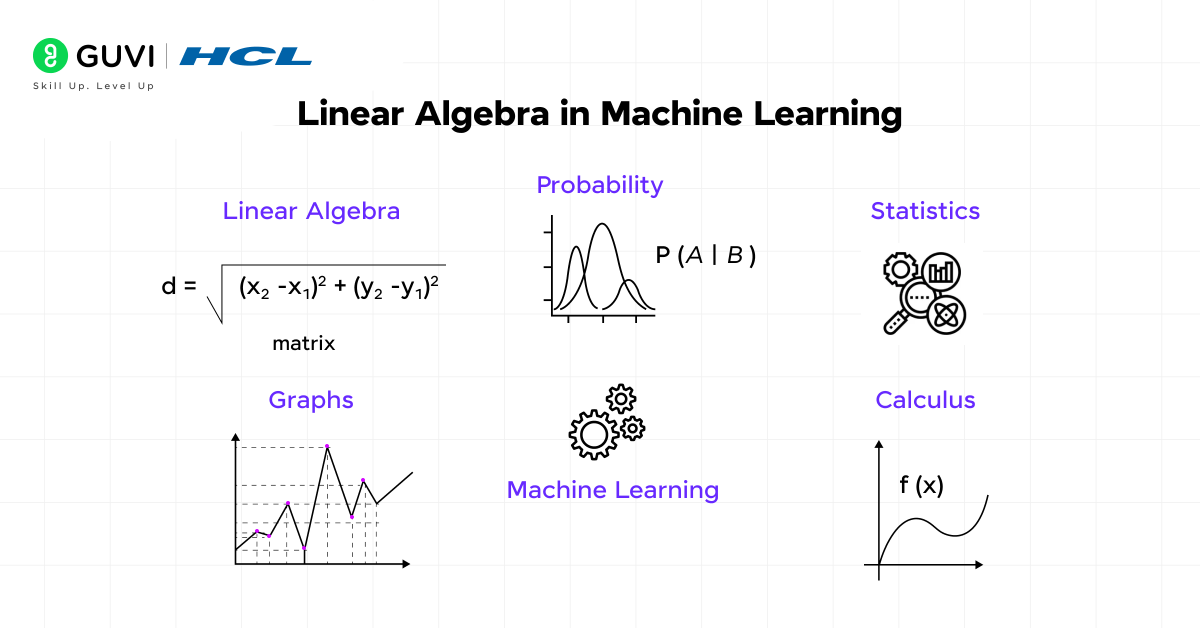
1) Linear Algebra as the Language of Data
Linear algebra provides the mathematical language that allows machines to represent and process data efficiently. In machine learning, a single data point is often represented as a vector, where each value corresponds to a feature. When multiple data points are combined, they form matrices that allow algorithms to process an entire dataset efficiently.
For example:
- Images in computer vision are represented as multi-dimensional arrays of numerical pixel values.
- Word embeddings in natural language processing represent words, sentences or documents as vectors in high-dimensional space.
- Structured datasets are represented as matrices, where rows typically represent observations and columns represent features.
This numerical representation makes it easier for machine learning algorithms to perform transformations, compare data points, reduce dimensions and identify patterns. Linear algebra therefore provides the foundation for converting raw data into a form that machine learning models can understand and process.
2) How Is Linear Algebra Used in Machine Learning?
Linear algebra appears at almost every stage of the machine learning pipeline, from preparing raw data to training and evaluating a model.
- Data Preprocessing: Operations such as feature scaling, centering and transformation can be applied efficiently across datasets using vectors and matrices. This helps prepare features for machine learning algorithms.
- Model Training: Many machine learning algorithms use vector and matrix operations to calculate predictions and learn model parameters. Dot products and matrix multiplication, for example, are fundamental to linear regression, logistic regression and neural networks.
- Model Evaluation: Vector operations make it possible to compare predicted and actual values efficiently. Metrics such as Mean Squared Error use these differences to measure prediction error across an entire dataset.
- Optimization: Training algorithms such as gradient descent update model parameters using vectors, gradients and matrix operations. In more advanced models, matrix calculus helps compute and optimise large numbers of parameters efficiently.
Together, these applications show why linear algebra is not limited to one machine learning algorithm. It provides the mathematical framework used to represent data, perform calculations and optimise models throughout the complete machine learning workflow.
Linear Algebra Concepts for Machine Learning at a Glance
| Concept | What It Means | Why It Matters in ML | Example |
|---|---|---|---|
| Scalar | Single number | Represents one measurement or parameter | Learning rate |
| Vector | Ordered list of numbers | Represents one observation or embedding | Customer features |
| Matrix | 2D arrangement of numbers | Represents datasets and transformations | Feature matrix |
| Tensor | Multi-dimensional numerical array | Represents complex ML data | Batch of images |
| Dot product | Multiplies and combines vectors | Measures relationships and computes predictions | Vector similarity |
| Matrix multiplication | Combines matrices | Powers model transformations | Neural-network layer |
| Norm | Measures vector magnitude | Used in distance and regularisation | L1/L2 norm |
| Rank | Measures independent information in a matrix | Helps identify redundant dimensions | Low-rank data |
| Eigenvector | Direction preserved by a transformation | Used in PCA | Principal direction |
| Eigenvalue | Scaling associated with an eigenvector | Indicates importance of PCA directions | Variance captured |
| SVD | Decomposes a matrix | Compression and dimensionality reduction | Recommendation systems |
| Least squares | Finds the best approximate solution | Used in regression | Best-fit model |
Core Concepts Every Beginner Should Learn
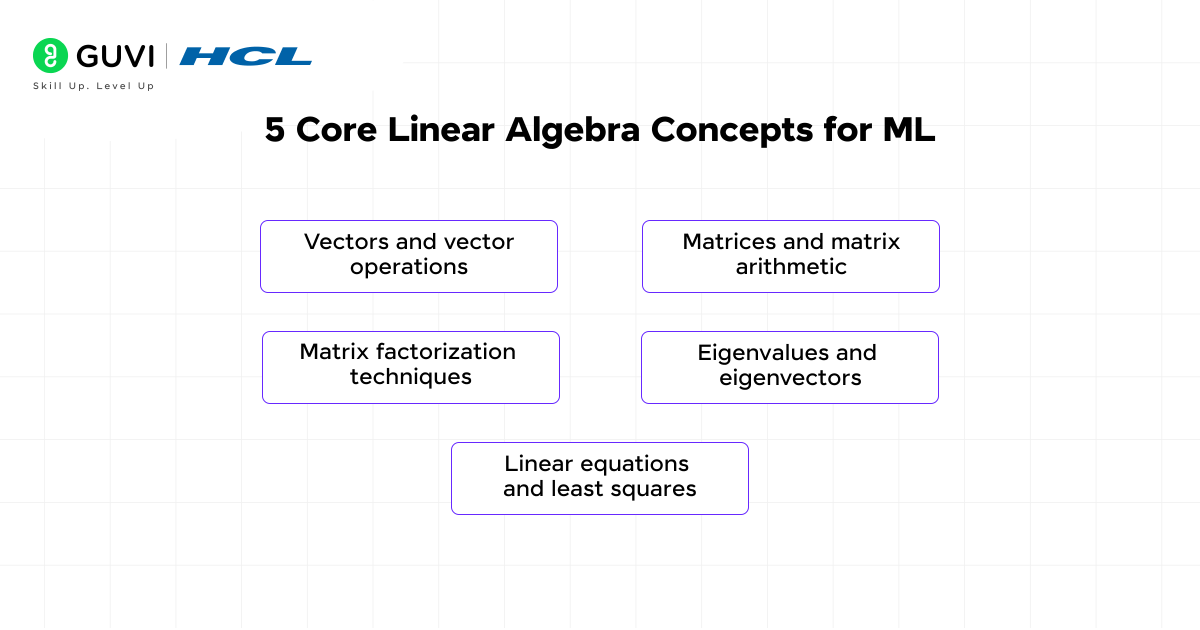
1. Scalars, Vectors, Matrices and Tensors
These structures form the basic vocabulary of machine learning.
Scalar
A scalar is one number.
Examples:
5
0.01
92.4
In ML, scalars can represent:
- Learning rates
- Loss values
- Individual features
- Model parameters
Vector
A vector contains multiple numbers.
For example:
x = [25, 72000, 3]This could represent:
- Age = 25
- Income = 72,000
- Number of purchases = 3
Vectors can also represent:
- Word embeddings
- Model weights
- Gradients
- Coordinates
- User profiles
Matrix
A matrix contains numbers arranged into rows and columns.
X =
[
 [25, 72000, 3],
 [31, 85000, 5],
 [22, 48000, 2]
]
Each row might represent one person.
Each column represents one feature.
Tensor
A tensor extends the idea to more dimensions.
For example, an RGB image can be represented approximately as:
height × width × channelsA batch of images adds another dimension.
batch × height × width × channelsUnderstanding vectors, matrices and tensors makes the data structures used by modern ML frameworks much easier to follow.
2. Vector Operations
Machine learning constantly performs calculations between vectors.
Important operations include:
Vector Addition
[1, 2] + [3, 4] = [4, 6]Scalar Multiplication
2 × [1, 3] = [2, 6]Dot Product
For:
a = [1, 2, 3]
b = [4, 5, 6]
the dot product is:
a · b = 1×4 + 2×5 + 3×6
      = 32
Dot products appear in:
- Linear regression
- Logistic regression
- Neural networks
- Support Vector Machines
- Embeddings
- Attention mechanisms
They are one of the most important operations to understand.
3. Norms and Distance
A norm measures the size or magnitude of a vector.
Two commonly encountered norms are:
L1 Norm
Adds absolute values.
||x||₁ = |x₁| + |x₂| + ...L2 Norm
Represents Euclidean length.
||x||₂ = √(x₁² + x₂² + ...)Norms appear in:
- Distance calculations
- Regularisation
- Optimisation
- Similarity measurement
K-Means clustering, for example, commonly uses Euclidean distance to determine which centroid is closest to a data point.
4. Matrix Operations
Matrices allow machine learning systems to process many observations simultaneously.
Important operations include:
- Matrix addition
- Scalar multiplication
- Matrix multiplication
- Transpose
- Element-wise operations
Matrix Multiplication
Suppose:
X = input data
W = weights
A model can transform the entire dataset using:
XWThis is far more efficient than calculating every observation separately.
Matrix multiplication is particularly important in neural networks.
5. Linear Transformations
A matrix can be viewed as something that transforms vectors.
Depending on the matrix, a transformation may:
- Scale
- Rotate
- Reflect
- Project
- Compress
data.
This perspective makes many advanced topics much easier to understand.
Instead of seeing a matrix as a grid of numbers, think:
What does this matrix do to the data?
That intuition becomes useful when studying neural networks and dimensionality reduction.
6. Rank and Linear Independence
Not every column in a dataset necessarily contains unique information.
Suppose one feature can be perfectly reconstructed from another.
The matrix contains redundancy.
Rank indicates the number of linearly independent dimensions represented by a matrix.
This matters because low-rank structures appear in:
- Dimensionality reduction
- Recommendation systems
- Data compression
- Matrix approximation
Understanding rank also helps explain why certain systems of equations cannot be solved uniquely.
7. Systems of Linear Equations and Least Squares
Many machine learning problems can be connected to systems of equations.
Suppose:
Ax = bIf an exact solution exists, you can solve for x.
Real-world datasets usually contain noise, so an exact solution often does not exist.
Least squares instead finds the solution that minimises prediction error.
This idea forms the mathematical foundation of linear regression.
A common textbook equation is:
β = (XᵀX)⁻¹XᵀyThis is useful for understanding the mathematics.
However, directly calculating the matrix inverse is generally not the preferred numerical approach in real applications.
Libraries typically use more stable solving techniques based on methods such as QR decomposition, SVD or least-squares solvers.
8. Eigenvalues and Eigenvectors
Eigenvalues and eigenvectors often seem difficult because they are introduced too abstractly.
Their practical interpretation is easier.
Imagine transforming a collection of vectors.
Most vectors change both:
- Direction
- Magnitude
An eigenvector points in a special direction that remains unchanged in direction after the transformation.
It may only become longer or shorter.
The amount by which it scales is the eigenvalue.
Mathematically:
Av = λvwhere:
A= transformation matrixv= eigenvectorλ= eigenvalue
These concepts are important in PCA because they help identify directions containing high variance.
Current machine-learning learning curricula also commonly progress from vectors and transformations to matrices, determinants, eigenvalues, eigenvectors and PCA.
9. Matrix Decomposition
Matrix decomposition breaks one matrix into simpler components.
Instead of working with one complicated matrix:
Ayou represent it using multiple matrices that are easier to analyse.
Important decomposition techniques include:
- Singular Value Decomposition
- Eigendecomposition
- QR decomposition
- LU decomposition
For ML beginners, SVD deserves the most attention.
10. Singular Value Decomposition
Singular Value Decomposition factorises a matrix as:
A = UΣVᵀSVD helps identify the most important structure inside a matrix.
Applications include:
- Data compression
- Noise reduction
- Dimensionality reduction
- Recommendation systems
- Pseudoinverse calculation
- Latent-factor analysis
Unlike eigendecomposition, SVD can be applied to rectangular matrices, which makes it extremely useful for real datasets.
How Much Linear Algebra Do You Need for Machine Learning?
This is where many beginners overcomplicate their preparation.
You do not need the same mathematical depth for every ML role.
Beginner Level
Learn:
- Scalars
- Vectors
- Matrices
- Matrix dimensions
- Vector addition
- Dot product
- Matrix multiplication
- Transpose
This is enough to start understanding basic machine learning models.
Intermediate Level
Add:
- Norms
- Distance
- Linear transformations
- Linear independence
- Rank
- Systems of equations
- Least squares
- Eigenvalues
- Eigenvectors
This level helps you understand algorithms rather than simply call them from libraries.
Advanced Level
Learn:
- Vector spaces
- Orthogonality
- Basis
- Projections
- SVD
- Pseudoinverse
- Matrix calculus
- Advanced decompositions
This becomes useful for:
- Deep learning
- ML research
- Optimisation
- Computer vision
- Recommendation systems
- Reading research papers
For most beginners, the best strategy is:
Learn enough mathematics to understand the ML concept you are currently studying, then deepen the theory as needed.
How Linear Algebra Is Used in Machine Learning
1. Linear Regression
Linear regression can represent predictions as:
ŷ = XβRather than calculating every prediction individually, matrix multiplication handles the entire dataset.
Least squares then finds coefficients that minimise prediction error.
2. Principal Component Analysis
PCA reduces dimensionality.
Suppose your dataset contains 100 features.
Some may carry overlapping information.
PCA finds new directions that capture as much variation as possible.
A simplified process is:
- Centre or standardise the data.
- Calculate a covariance matrix or work directly with SVD.
- Identify principal directions.
- Rank components by explained variance.
- Keep the most useful components.
- Project the data into the lower-dimensional space.
Eigenvectors or singular vectors provide the directions used for this transformation.
3. Recommendation Systems
Imagine a matrix:
        Movie1 Movie2 Movie3
User1      5      ?      3
User2      ?      4      5
User3      2      3      ?
The system wants to estimate the missing preferences.
Matrix-factorisation approaches can represent users and items using smaller latent vectors.
Those hidden factors may capture patterns related to preferences even though the factors themselves were not manually created.
4. Neural Networks
Neural networks depend heavily on matrix operations.
A dense layer performs an operation similar to:
Z = XW + bThen an activation function transforms the result.
Repeating this across layers creates a network.
Without matrix operations, processing large batches of examples would be extremely inefficient.
5. Embeddings and Similarity
Words, products, documents and users can be represented as vectors.
For example:
king  → [0.21, 0.58, ...]
queen → [0.24, 0.55, ...]
Vector similarity can then estimate how closely related two representations are.
Cosine similarity is commonly expressed as:
cos(θ) = (a · b) / (||a|| ||b||)This depends entirely on vector operations.
6. Transformers and Attention
Modern transformer models also depend extensively on linear algebra.
The attention operation is commonly expressed as:
Attention(Q, K, V)
=
softmax(QKᵀ / √dₖ)V
Here:
Qrepresents queries.Krepresents keys.Vrepresents values.
The core operations are matrix multiplication, transpose, scaling and transformation.
That is one reason linear algebra remains fundamental even as machine learning architectures become more advanced.
Linear Algebra Behind Popular Machine Learning Algorithms
| ML Algorithm | Main Linear Algebra Concepts | How They Are Used |
|---|---|---|
| Linear Regression | Matrices, least squares | Estimate coefficients |
| Logistic Regression | Vectors, dot products | Calculate weighted scores |
| K-Means | Vectors, norms | Measure distance from centroids |
| SVM | Dot products, vectors | Construct decision boundaries |
| PCA | Eigenvectors, SVD | Reduce dimensions |
| Neural Networks | Matrix multiplication | Process layers and weights |
| Recommendation Systems | Matrix factorisation | Learn latent user/item factors |
| Embeddings | Vectors, dot products | Represent and compare meaning |
| Transformers | Matrix multiplication | Compute attention |
| Image Models | Matrices and tensors | Represent and transform pixels |
Linear Algebra With Python and NumPy
Learning linear algebra only through formulas can make it feel unnecessarily abstract.

Python lets you connect each concept directly to computation.
Create a Vector
import numpy as np

x = np.array([2, 4, 6])

print(x)
Output:
[2 4 6]Calculate a Dot Product
import numpy as np

a = np.array([1, 2, 3])
b = np.array([4, 5, 6])

result = np.dot(a, b)

print(result)
Output:
32Matrix Multiplication
import numpy as np

X = np.array([
    [1, 2],
    [3, 4]
])

W = np.array([
    [5],
    [6]
])

result = X @ W

print(result)
Output:
[[17]
 [39]]
The @ operator performs matrix multiplication.
Solve a Least-Squares Problem
Instead of explicitly calculating an inverse, NumPy provides a least-squares solver.
import numpy as np

X = np.array([
    [1, 1],
    [1, 2],
    [1, 3]
])

y = np.array([2, 3, 5])

beta, residuals, rank, singular_values = np.linalg.lstsq(
    X,
    y,
    rcond=None
)

print(beta)
This approach is closer to how practical numerical computing handles regression problems.
Calculate Eigenvalues and Eigenvectors
import numpy as np

A = np.array([
    [2, 1],
    [1, 2]
])

values, vectors = np.linalg.eigh(A)

print(values)
print(vectors)
Perform SVD
import numpy as np

A = np.array([
    [1, 2],
    [3, 4],
    [5, 6]
])

U, S, VT = np.linalg.svd(A)

print(S)
You do not need to memorise every NumPy function.
The goal is to connect:
mathematical concept → Python operation → machine learning application
How to Learn Linear Algebra for Machine Learning Step by Step
A practical learning order is more effective than randomly studying mathematical chapters.
Step 1: Learn Basic Algebra
Be comfortable with:
- Variables
- Equations
- Functions
- Exponents
- Summation notation
Step 2: Learn Vectors
Understand:
- Vector notation
- Addition
- Scaling
- Magnitude
- Dot products
Then connect vectors to ML feature representations.
Step 3: Learn Matrices
Focus on:
- Shapes
- Rows and columns
- Transpose
- Addition
- Multiplication
Use NumPy alongside the theory.
Step 4: Understand Linear Transformations
Visualise matrices as operations that transform vectors rather than as tables of numbers.
This builds intuition for later topics.
Step 5: Study Systems of Equations and Least Squares
Connect these directly to regression.
Seeing the ML application makes the mathematics easier to remember.
Step 6: Learn Eigenvalues and Eigenvectors
Study them alongside PCA rather than as an isolated mathematical topic.
Step 7: Learn SVD
Connect SVD to:
- Compression
- PCA
- Matrix approximation
- Recommendation systems
Step 8: Apply Every Concept in Python
For every topic:
- Understand the idea.
- Calculate a tiny example manually.
- Implement it with NumPy.
- Identify where it appears in ML.
- Build a small experiment.
This approach keeps the mathematics tied to an actual purpose.
Build strong AI and machine learning foundations to understand linear algebra concepts used in ML models with HCL GUVI’s Artificial Intelligence and Machine Learning Program. Learn Python, SQL, ML, MLOps, Generative AI, Agentic AI, and real-world AI workflows through live online classes, Intel-designed curriculum, industry-grade projects, 1:1 doubt sessions, and placement assistance with 1000+ hiring partners
Linear Algebra Cheat Sheet for Machine Learning Beginners
| You See This in ML | Linear Algebra You Should Know |
|---|---|
| Dataset | Vectors and matrices |
| Similarity | Dot product and cosine similarity |
| K-Means | Vectors and Euclidean distance |
| Linear regression | Matrices and least squares |
| PCA | Eigenvalues, eigenvectors and SVD |
| Neural networks | Matrix multiplication and tensors |
| Embeddings | Vectors and norms |
| Recommendation systems | Matrix factorisation |
| Transformers | Matrix multiplication and dot products |
| Dimensionality reduction | Projections and decompositions |
Avoiding Common Mistakes When Learning Linear Algebra for Machine Learning

1. Starting With Too Much Theory
Trying to master every theorem before touching machine learning can quickly become overwhelming.
Learn the fundamentals first.
Deepen the theory when your ML work requires it.
2. Memorising Formulas Without Understanding Shapes
Matrix dimensions matter.
Before multiplying matrices, always ask:
What is the shape of X?
What is the shape of W?
What should the output shape be?
Understanding dimensions prevents many errors in machine learning code.
3. Ignoring Geometric Intuition
Vectors are not just lists of numbers.
They can represent:
- Directions
- Points
- Magnitudes
- Transformations
Visual intuition makes dot products, projections and eigenvectors much easier to understand.
4. Using Matrix Inverses Everywhere
Textbook formulas often contain:
A⁻¹That does not mean explicitly computing an inverse is always the best numerical method.
Libraries provide specialised solvers because they can be more stable and efficient.
5. Learning Math Without Python
Use NumPy while learning.
Seeing:
X @ Wnext to:
XWhelps bridge mathematics and code.
6. Ignoring the ML Connection
Do not learn eigenvectors and then wait months to discover why they matter.
Learn:
Eigenvectors → PCA
Least squares → Linear regression
Matrix multiplication → Neural networks
Factorisation → Recommendation systems
That connection makes the subject much easier to retain.
Linear algebra isn’t just abstract math—it powers the algorithms that shape modern AI:
The Term “Matrix” Comes from Latin: The word matrix means “womb” or “something from which others spring.” In math, it symbolizes a structure from which multiple results can be generated.
Eigenfaces in Facial Recognition: Early facial recognition systems used eigenvectors of images—called eigenfaces—to capture key patterns in human faces, a direct application of linear algebra.
These facts remind us that the formulas you practice aren’t just theory—they’ve been at the core of breakthroughs in AI and real-world applications.
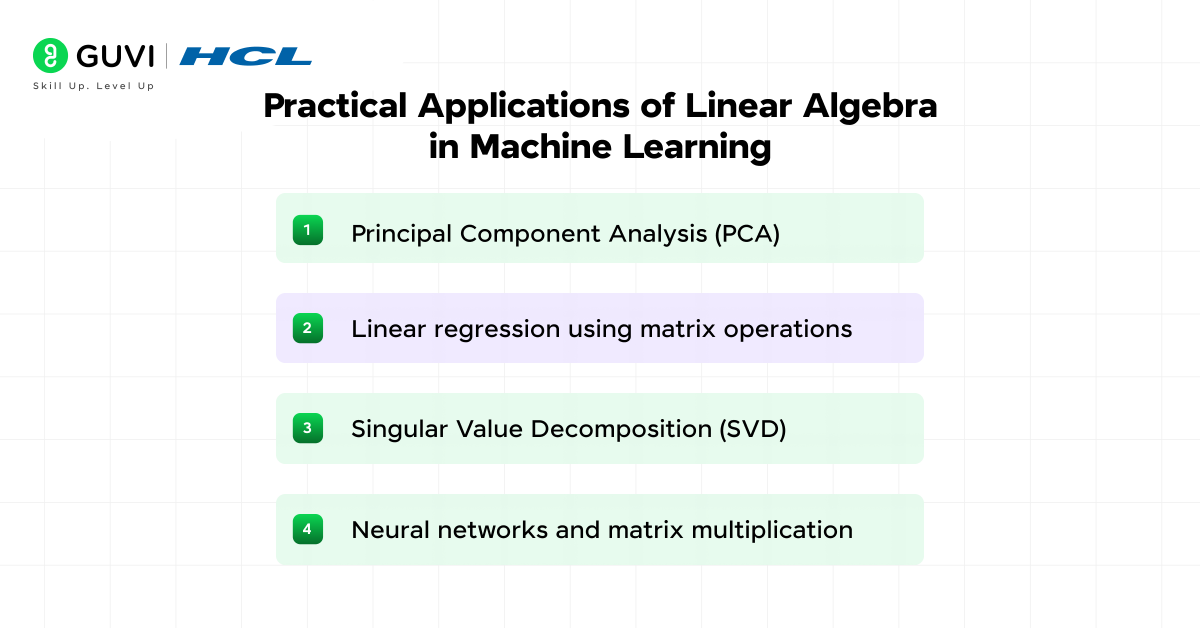
Practical Applications of Linear Algebra in Machine Learning
Linear algebra empowers practical machine learning implementations through efficient mathematical operations. Let’s examine how these concepts translate into real-world applications.
1) Principal Component Analysis (PCA)
Principal Component Analysis (PCA) is a dimensionality reduction technique used to reduce the number of features in a dataset while preserving as much important information as possible. It transforms the original features into a smaller set of new variables called principal components, which are uncorrelated and arranged according to the amount of variance they capture.
The process typically involves:
- Standardizing the data so features contribute on a comparable scale
- Computing the covariance matrix to understand relationships between features
- Finding eigenvalues and eigenvectors to identify the principal directions of variance
- Selecting the most important principal components
- Transforming the original data into the reduced feature space
PCA is widely used for data visualization, noise reduction, feature compression and preprocessing before machine learning. By removing redundant dimensions, it can simplify datasets without discarding most of their useful information.
2) Linear Regression Using Matrix Operations
Matrix algebra provides an efficient way to represent and solve linear regression problems, especially when a dataset contains multiple features.
Linear regression can be written as:
Y = Xβ + ε
Here, X represents the input features, β represents the model coefficients, Y represents the target values and ε represents the error term.
Using the least squares approach, a common mathematical expression for estimating the coefficients is:
β = (XᵀX)⁻¹XᵀY
Least squares finds the coefficients that minimise the squared difference between actual and predicted values. In practical machine learning applications, numerical libraries generally use more stable methods such as least-squares solvers, QR decomposition or SVD instead of explicitly calculating the matrix inverse.
This matrix-based representation makes linear regression efficient and easily extendable to datasets containing many explanatory variables.
3) Singular Value Decomposition (SVD)
Singular Value Decomposition (SVD) is a matrix factorisation technique that breaks a matrix into three simpler matrices:
X = UΣVᵀ
Each component captures a different part of the structure within the original matrix. This decomposition helps identify the most important patterns while reducing unnecessary information.
SVD is commonly used to:
- Calculate pseudoinverses for solving linear systems
- Reduce dimensionality
- Compress data by retaining only the most important singular values
- Remove noise from datasets
- Discover latent patterns in recommendation systems
- Support techniques such as PCA
For example, recommendation systems can use SVD-based matrix factorisation to uncover hidden relationships between users and items from a large user-item interaction matrix.
4) Neural Networks and Matrix Multiplication
Neural networks rely heavily on matrix multiplication because large numbers of inputs and model weights must be processed efficiently at every layer.
A simplified neural-network layer can be represented as:
Y = XW + b
Here, X represents the input data, W represents the weight matrix, b represents the bias and Y represents the transformed output before or after an activation function, depending on the notation used.
Instead of calculating each neuron separately, matrix multiplication allows an entire batch of inputs to pass through a layer simultaneously. This makes neural-network training and inference much more computationally efficient.
The same foundation extends to deep learning architectures such as transformers, where matrix operations are used extensively to calculate embeddings, attention scores and layer transformations.
Concluding Thoughts…
Linear algebra for machine learning becomes much easier once you stop treating it as a collection of unrelated formulas and start seeing how each concept supports an actual machine learning task. Vectors represent individual observations, while matrices organise complete datasets and perform transformations. Dot products help combine and compare information, while norms measure magnitude and distance between vectors. Least squares forms the mathematical foundation of regression, and eigenvectors help explain how techniques such as PCA identify important directions in data. Matrix factorisation uncovers hidden patterns in datasets, while matrix multiplication powers computations across neural networks and attention mechanisms.
For beginners, the goal is not to become a mathematician before building the first machine learning model. Start with vectors and matrices, practise each concept using Python, and connect every mathematical idea to the algorithm where it is actually used. This approach gives you something far more valuable than memorised formulas: a clear understanding of why machine learning models work the way they do.
FAQs
Is linear algebra necessary for machine learning?
Yes. Linear algebra is one of the main mathematical foundations of machine learning because datasets, model parameters and transformations are commonly represented using vectors, matrices and tensors. You can use high-level ML libraries without understanding every mathematical detail, but linear algebra becomes increasingly important when you want to understand how algorithms work, debug models or study advanced machine learning.
How much linear algebra do I need for machine learning?
Beginners should understand vectors, matrices, matrix multiplication, dot products, transpose, norms and basic systems of equations. Once you begin studying algorithms such as PCA, recommendation systems and neural networks, add eigenvalues, eigenvectors, rank, projections, least squares and SVD. Advanced theory can be learned later when a particular ML topic requires it.
Can I learn machine learning without linear algebra?
You can start using machine learning libraries without mastering linear algebra because libraries such as Scikit-learn and deep-learning frameworks perform the calculations for you. However, avoiding linear algebra completely makes it harder to understand model behaviour, dimensionality, embeddings, PCA, neural networks and many optimisation techniques. Learning ML and linear algebra together is usually more practical than postponing ML until all the mathematics is complete.
What linear algebra topics are most important for machine learning?
The most important topics are vectors, matrices, dot products, matrix multiplication, norms, linear transformations, systems of equations, least squares, rank, eigenvalues, eigenvectors and matrix decomposition techniques such as SVD. Beginners should prioritise vectors and matrices before moving to decomposition and more advanced vector-space concepts.
Should I learn linear algebra before machine learning?
You should learn the basic concepts before or alongside your first machine learning algorithms, but you do not need to complete an advanced linear algebra course first. Start with vectors, matrices and matrix operations. Then study each advanced concept when you encounter its ML application. For example, learn least squares with linear regression and eigenvectors with PCA. This keeps the mathematics connected to practical problems.
Success Stories

About the Author
Vaishali
I'm a seasoned writer with four years of experience across technical, non-technical, and just about every genre or niche you can imagine. Adaptable and curious, I enjoy exploring new topics and making information engaging and easy to understand. Fueled by a steady stream of tea, I approach each project with creativity, reliability, and genuine enthusiasm for storytelling.
View all posts by Vaishali
Connect with me @











Did you enjoy this article?