


Artificial Intelligence and Machine Learning Articles
Finance Manager to Data Analytics: Career Growth, Salary and Seniority
How to Evaluate LLM Outputs in Production Deployments
AI/ML Skills Gap 2026: Why Companies Can't Find Job-Ready Talent
20 AI/ML Interview Questions Recruiters Can Use Without a Tech Background - Best Guide


Get In Touch For Details! Request More Information

Naive Bayes Algorithm: A Simple Guide For Beginners [2026]
Jul 21, 2026 10 Min Read 7135 Views
(Last Updated)
The Naive Bayes classifier is one of the fastest and simplest algorithms you can use for machine learning classification tasks. Despite its simplicity, this probabilistic classifier performs remarkably well, particularly with small sample sizes. You’ve likely encountered its applications already—from spam filters sorting your emails to sentiment analysis determining if a product review is positive or negative.
In this guide, you’ll learn exactly how the Naive Bayes classifier works, why it’s so effective despite its simplicity, and how you can apply it to your own classification problems. I will explain everything simply so that you can focus on learning and mastering this algorithm. Let’s begin!
TL:DR
Naive Bayes is a supervised machine learning algorithm that predicts a class using probability. It applies Bayes’ theorem while assuming that each input feature contributes independently to the prediction.
Bayes’ theorem calculates the probability of a class after observing new evidence:
P(Class | Features) = [P(Features | Class) × P(Class)] / P(Features)
Here:
- P(Class | Features) is the posterior probability.
- P(Features | Class) is the likelihood.
- P(Class) is the prior probability.
- P(Features) is the probability of observing the evidence.
The classifier calculates the posterior probability for every possible class. It then selects the class with the highest probability.
Table of contents
- What is a Naive Bayes Classifier?
- Why Is It Called Naive? The Independence Assumption Explained
- Where it's used in machine learning
- Understanding Bayes’ Theorem
- 1) The formula and its components
- 2) Prior, likelihood, and posterior explained
- 3) How Bayes' Theorem applies to classification
- How Does Naive Bayes Work?
- 1) The independence assumption
- 2) Step-by-step working with a dataset
- 3) Calculating probabilities
- 4) Making predictions using MAP
- 5) Handling continuous vs categorical data
- Types of Naive Bayes Algorithms
- 1) Gaussian Naive Bayes
- 2) Multinomial Naive Bayes
- 3) Bernoulli Naive Bayes
- Types of Naive Bayes Algorithms
- Naive Bayes From Scratch in Python
- Comparing the Scratch Model With Scikit-Learn
- Output
- Naive Bayes for Spam Detection: Python Code Example
- Output
- Naive Bayes vs Logistic Regression vs SVM: When to Choose Which?
- Choose Naive Bayes When
- Choose Logistic Regression When
- Choose SVM When
- Simple Decision Rule
- Strengths and Limitations of the Naive Bayes Classifier
- 1) Advantages of Naive Bayes
- 2) Common pitfalls and zero-frequency problem
- Concluding Thoughts...
- FAQs
- Q1. What is the Naive Bayes classifier and how does it work?
- Q2. Why is it called "Naive" Bayes?
- Q3. What are the main types of Naive Bayes algorithms?
- Q4. What are the advantages of using Naive Bayes?
What is a Naive Bayes Classifier?
The Naive Bayes classifier is a simple probabilistic algorithm that uses probability to predict which category a data point belongs to. It operates as a supervised machine learning algorithm primarily used for classification tasks such as text classification.
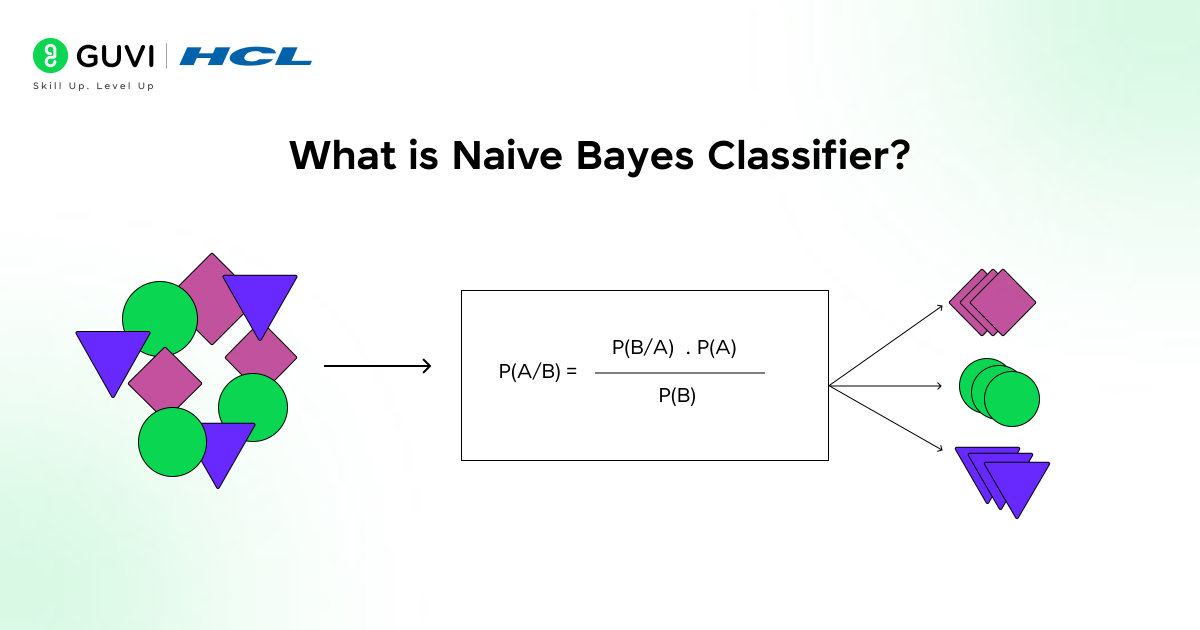
What makes this classifier unique is that it’s part of a family of generative learning algorithms. This means it attempts to model the distribution of inputs within a specific class or category rather than simply learning which features best distinguish between classes.
The classifier works by correlating different features or tokens with various classes and then using Bayes’ theorem to calculate the probability that an item belongs to a particular class. For instance, when classifying emails, it analyzes words (tokens) to determine whether a message is spam or legitimate.
Furthermore, Naive Bayes requires minimal training data to estimate the necessary parameters for classification. This characteristic makes it particularly valuable when working with limited datasets.
Why Is It Called Naive? The Independence Assumption Explained
The word “naive” refers to the algorithm’s assumption that all input features are conditionally independent once the class is known.
Consider an email containing the words “free,” “cash,” and “offer.” These words may commonly appear together in spam messages. However, Naive Bayes treats each word as a separate piece of evidence.
The model calculates:
P(Spam | free, cash, offer)
Using the independence assumption, it simplifies the likelihood as:
P(free | Spam) × P(cash | Spam) × P(offer | Spam)
The algorithm does not model the relationship between “free” and “cash.” It only measures how strongly each word is associated with spam.
This assumption is rarely completely true in real datasets. Words, measurements, and customer behaviours often influence one another. However, removing feature relationships makes the model fast, simple, and effective for many classification tasks.
The assumption works especially well in text classification because individual words can still provide useful evidence, even when their relationships are ignored. Scikit-learn describes Naive Bayes models as supervised methods based on Bayes’ theorem with strong feature-independence assumptions.
Where it’s used in machine learning
Despite its simplifying assumptions, the Naive Bayes classifier excels in various real-world applications:
- Text classification and document categorization – Organizing documents into different categories based on their content
- Spam filtering – One of the most popular applications, which distinguishes between legitimate and spam emails
- Sentiment analysis – Determining whether text expresses positive or negative sentiment
Naive Bayes is especially effective for high-dimensional text classification problems. Its efficiency comes from several factors:
- It requires only a small amount of training data
- It can predict results faster than many other classification algorithms
- The algorithm is highly scalable, needing just one parameter for each feature in a learning problem
Additionally, the classifier’s computational efficiency stems from how it treats each feature independently, allowing each distribution to be estimated separately as a one-dimensional distribution.
Understanding Bayes’ Theorem
Bayes’ theorem serves as the mathematical foundation for the Naive Bayes classifier. To truly master this algorithm, you need to understand how this elegant probability formula works and how it transforms into a powerful classification tool.
1) The formula and its components
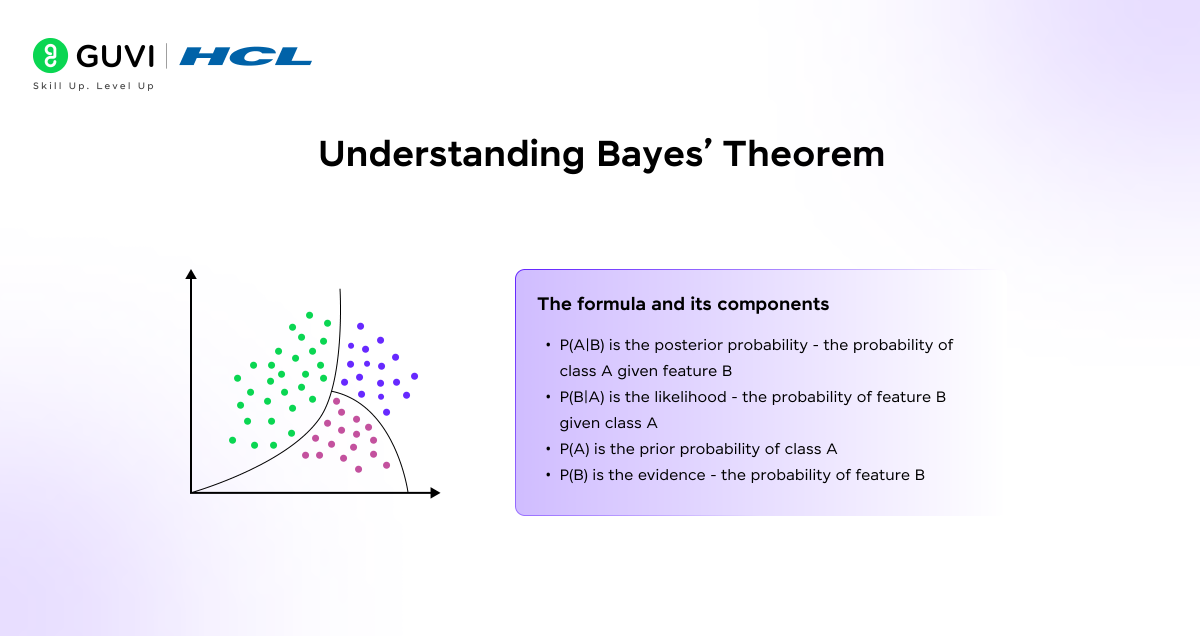
At its heart, Bayes’ theorem provides a way to calculate conditional probability—the likelihood of an event occurring based on prior knowledge of conditions related to the event. The formula looks like this:
P(A|B) = [P(B|A) × P(A)] / P(B)
Breaking this down:
- P(A|B) is the posterior probability – the probability of class A given feature B
- P(B|A) is the likelihood – the probability of feature B given class A
- P(A) is the prior probability of class A
- P(B) is the evidence – the probability of feature B
This formula allows you to calculate the probability of an event happening based on related evidence that has already been observed.
2) Prior, likelihood, and posterior explained
These components work together in a logical sequence:
- Prior probability represents your initial belief about how likely an outcome is before seeing any evidence. For instance, if 30% of emails in your dataset are spam, the prior probability of any new email being spam is 0.3.
- Likelihood measures how probable the observed evidence is, given a particular outcome. In spam detection, this might be the probability of seeing the word “discount” in spam emails versus non-spam emails.
- Posterior probability is your updated belief after considering the evidence. It represents the final probability that helps you make a decision. This is what the Naive Bayes classifier calculates to determine which class a data point belongs to.
Evidence normalizes the result, ensuring probabilities sum to 1. It represents the overall probability of observing the evidence regardless of the class.
To illustrate with a simple example, imagine classifying fruits:
- Prior: 60% of the fruits in your basket are apples
- Likelihood: 80% of apples are red, while only 30% of other fruits are red
- If you pick a red fruit, Bayes’ theorem helps calculate the posterior probability that it’s an apple
3) How Bayes’ Theorem applies to classification
In machine learning classification, Bayes’ theorem helps determine which category a data point belongs to based on its features. Here’s how it works:
- Start with prior probabilities for each class based on training data
- Calculate the likelihood of observing specific features in each class
- For a new data point, compute the posterior probability for each possible class
- Assign the data point to the class with the highest posterior probability
This approach is known as Maximum A Posteriori (MAP) estimation. For efficiency, Naive Bayes often works with the proportional formula:
P(Class|Features) ∝ P(Features|Class) × P(Class)
The classifier drops the denominator P(Features) since it remains constant across all class comparisons. When comparing which class is more likely, you only need to compute which class maximizes the numerator.
What makes Naive Bayes truly powerful is how it scales to problems with many features. Instead of trying to model complex feature interactions, it makes the “naive” assumption that features are independent, allowing it to calculate individual feature likelihoods separately and multiply them together.
How Does Naive Bayes Work?
Putting Naive Bayes to work requires understanding its unique approach to classification. Let’s examine how this algorithm functions in practice and why it performs remarkably well despite its simplicity.
1) The independence assumption
The core of Naive Bayes lies in its “naive” independence assumption—that all features contribute independently to the probability of a class, regardless of any correlations between them.
For instance, when classifying a fruit as an apple, the classifier assumes the color being red has no relationship with its roundness or diameter. This assumption rarely holds in real-world data, yet Naive Bayes often outperforms more complex classification methods.
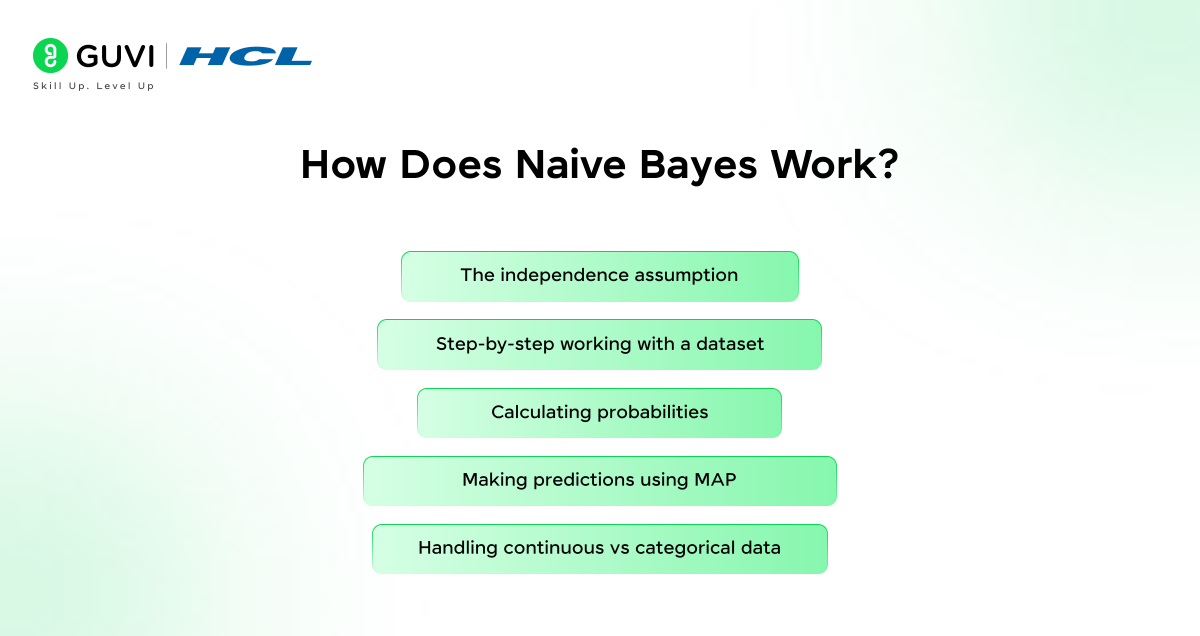
2) Step-by-step working with a dataset
Implementing Naive Bayes follows a straightforward process:
- Create frequency tables for each attribute against the target class
- Transform these frequency tables into likelihood tables
- Calculate prior probabilities for each class
- Apply the Naive Bayes equation to calculate posterior probabilities
- Classify new data points based on the highest posterior probability
Consider a weather example: to predict whether players will play sports based on weather conditions, you’d first count occurrences of each weather type (sunny, overcast, rainy) for both outcomes (play/don’t play).
3) Calculating probabilities
Naive Bayes calculates three key probabilities:
Prior probability: The initial probability of each class (e.g., P(Play=Yes) = 9/14 = 0.64)
Likelihood: The probability of features given a class (e.g., P(Overcast|Play=Yes) = 4/9 = 0.44)
Posterior probability: The probability of a class given observed features, calculated using Bayes’ theorem
4) Making predictions using MAP
For prediction, Naive Bayes employs Maximum A Posteriori (MAP) estimation—choosing the class with the highest posterior probability. The algorithm calculates the probability for each class and selects the one with the maximum value.
In practice, we often drop the denominator P(Features) as it remains constant across all class comparisons. Hence, we calculate:
P(Class|Features) ∝ P(Features|Class) × P(Class)
5) Handling continuous vs categorical data
Naive Bayes handles different data types accordingly:
- Categorical data: Uses frequency counts to estimate probabilities directly
- Continuous data: Typically assumes values follow a Gaussian (normal) distribution for each class
For continuous variables like age or temperature, the algorithm estimates the mean and variance for each class and uses the probability density function to calculate likelihoods.
Alternatively, you can “bin” continuous values into discrete categories (e.g., transform age into “young,” “middle-aged,” “senior”).
When working with mixed data types, you can either transform all data into a categorical representation or calculate probabilities separately for different data types and then multiply the results.
Types of Naive Bayes Algorithms
The Naive Bayes classifier comes in different flavors, each adapted to work with specific types of data. Understanding these variants helps you choose the right one for your classification tasks.
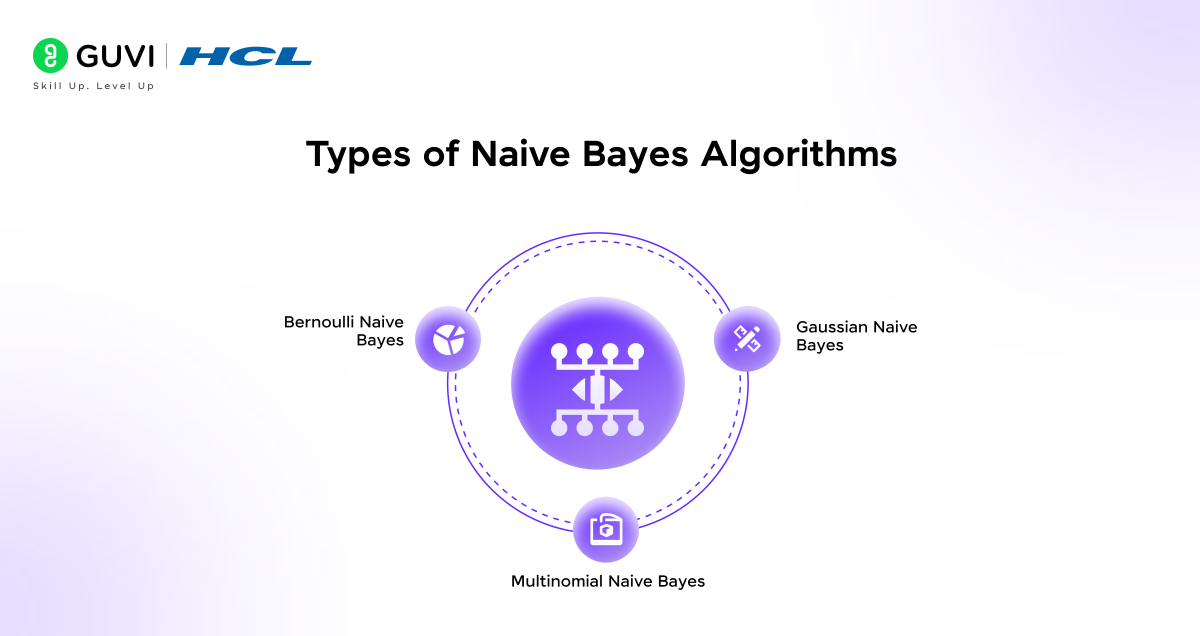
1) Gaussian Naive Bayes
Gaussian Naive Bayes (GNB) is designed specifically for continuous data where feature values follow a normal distribution. This variant works well when dealing with:
- Numerical measurements like height, weight, or sensor readings
- Continuous features that form bell-curved distributions
The algorithm assumes that data within each class follows a Gaussian distribution, modeling features using mean and variance parameters. GNB calculates the likelihood of different feature values for each class using the normal distribution.
2) Multinomial Naive Bayes
Multinomial Naive Bayes (MNB) excels with discrete data, specifically frequency counts. It’s typically used for:
- Text classification and document categorization
- Features representing word counts or term frequencies
This variant assumes that features follow a multinomial distribution, making it ideal for text analysis where you’re counting how often words appear. MNB is particularly effective for natural language processing tasks, where it models the distribution of word counts.
3) Bernoulli Naive Bayes
Bernoulli Naive Bayes works with binary data—features that are either present (1) or absent (0). Unlike Multinomial NB, which counts occurrences, Bernoulli NB only cares about whether a feature exists.
It’s best suited for:
- Binary/boolean features (yes/no, true/false)
- Document classification based on word presence rather than frequency
- Spam detection and sentiment analysis
The key distinction is that Bernoulli NB explicitly penalizes the non-occurrence of features in its decision rule.
To make things more interesting, here are a few surprising tidbits about the Naive Bayes algorithm and its history:
One of the Oldest ML Algorithms: Despite being widely used today, Naive Bayes has its roots in the 1800s, when Reverend Thomas Bayes introduced the probability theorem that powers this algorithm. That means the math behind your spam filter is over two centuries old!
Used in Gmail Spam Filtering: Every time Gmail filters your inbox to separate spam from genuine emails, there’s a high chance a Naive Bayes classifier is working in the background. Its speed and efficiency make it perfect for handling millions of messages daily.
Types of Naive Bayes Algorithms
Different Naive Bayes variants make different assumptions about the input data. Choosing the correct variant depends on whether the features contain measurements, counts, categories, or binary values.
| NB Variant | Best For | Main Assumption | Python Class |
|---|---|---|---|
| Gaussian Naive Bayes | Continuous numerical data such as height, temperature, or medical readings | Feature values follow a Gaussian or normal distribution within each class | GaussianNB |
| Multinomial Naive Bayes | Word counts, term frequencies, and document classification | Features represent non-negative counts or frequencies | MultinomialNB |
| Bernoulli Naive Bayes | Binary features and word presence or absence | Every feature has two possible states, usually 0 or 1 | BernoulliNB |
| Categorical Naive Bayes | Discrete categories such as colour, city, or product type | Each feature follows a categorical distribution | CategoricalNB |
| Complement Naive Bayes | Imbalanced text-classification datasets | Class weights are estimated using data from the other classes | ComplementNB |
Scikit-learn provides dedicated classes for Gaussian, Multinomial, Bernoulli, Categorical, and Complement Naive Bayes. Its documentation recommends Multinomial Naive Bayes for discrete features such as word counts and Bernoulli Naive Bayes for binary-valued features.

Naive Bayes From Scratch in Python
The following implementation builds Gaussian Naive Bayes without using a machine learning library.
The model performs four main tasks:
- Calculates the prior probability of each class.
- Calculates the mean of every feature within each class.
- Calculates the variance of every feature within each class.
- Uses Gaussian probability to predict the most likely class.
import numpy as np


class GaussianNaiveBayesScratch:
    def fit(self, X, y):
        """
        Train the Gaussian Naive Bayes classifier.
        """

        X = np.asarray(X, dtype=float)
        y = np.asarray(y)

        self.classes_ = np.unique(y)

        number_of_classes = len(self.classes_)
        number_of_features = X.shape[1]

        self.means_ = np.zeros(
            (number_of_classes, number_of_features)
        )
        self.variances_ = np.zeros(
            (number_of_classes, number_of_features)
        )
        self.priors_ = np.zeros(number_of_classes)

        for index, class_label in enumerate(self.classes_):
            class_rows = X[y == class_label]

            self.means_[index] = class_rows.mean(axis=0)

            # A small value prevents division by zero.
            self.variances_[index] = (
                class_rows.var(axis=0) + 1e-9
            )

            self.priors_[index] = (
                len(class_rows) / len(X)
            )

        return self

    def _calculate_log_likelihood(self, class_index, row):
        """
        Calculate the Gaussian log-likelihood for one class.
        """

        mean = self.means_[class_index]
        variance = self.variances_[class_index]

        return -0.5 * np.sum(
            np.log(2 * np.pi * variance)
            + ((row - mean) ** 2) / variance
        )

    def _predict_one(self, row):
        class_scores = []

        for class_index in range(len(self.classes_)):
            log_prior = np.log(self.priors_[class_index])

            log_likelihood = self._calculate_log_likelihood(
                class_index,
                row
            )

            class_scores.append(
                log_prior + log_likelihood
            )

        best_class_index = np.argmax(class_scores)

        return self.classes_[best_class_index]

    def predict(self, X):
        X = np.asarray(X, dtype=float)

        return np.array([
            self._predict_one(row)
            for row in X
        ])
Comparing the Scratch Model With Scikit-Learn
The next example trains the custom model and scikit-learn’s GaussianNB class on the same Iris dataset.
from sklearn.datasets import load_iris
from sklearn.metrics import accuracy_score
from sklearn.model_selection import train_test_split
from sklearn.naive_bayes import GaussianNB


# Load the dataset.
iris = load_iris()

X = iris.data
y = iris.target

# Create identical training and testing sets.
X_train, X_test, y_train, y_test = train_test_split(
    X,
    y,
    test_size=0.25,
    random_state=42,
    stratify=y
)

# Train the model created from scratch.
scratch_model = GaussianNaiveBayesScratch()
scratch_model.fit(X_train, y_train)

scratch_predictions = scratch_model.predict(X_test)

# Train the scikit-learn implementation.
sklearn_model = GaussianNB()
sklearn_model.fit(X_train, y_train)

sklearn_predictions = sklearn_model.predict(X_test)

# Compare both models.
scratch_accuracy = accuracy_score(
    y_test,
    scratch_predictions
)

sklearn_accuracy = accuracy_score(
    y_test,
    sklearn_predictions
)

print(
    "Scratch model accuracy:",
    round(scratch_accuracy * 100, 2),
    "%"
)

print(
    "Scikit-learn accuracy:",
    round(sklearn_accuracy * 100, 2),
    "%"
)

print(
    "Predictions are identical:",
    np.array_equal(
        scratch_predictions,
        sklearn_predictions
    )
)
Output
Scratch model accuracy: 92.11 %
Scikit-learn accuracy: 92.11 %
Predictions are identical: True
Both implementations follow the same Gaussian Naive Bayes logic. The scratch version shows how probabilities are calculated, whereas scikit-learn provides a tested and production-friendly implementation.
| Factor | From-Scratch Model | Scikit-Learn Model |
| Main purpose | Learning the internal calculations | Building practical machine learning solutions |
| Code length | Longer | Shorter |
| Input validation | Limited | Built into the library |
| Model features | Basic training and prediction | Supports probability prediction and additional parameters |
| Maintenance | Managed manually | Maintained by the scikit-learn project |
| Best use | Education and interviews | Projects and production workflows |
Naive Bayes for Spam Detection: Python Code Example
Spam detection is a classic Naive Bayes application. The model learns which words appear frequently in spam and legitimate messages.
This example uses:
CountVectorizerto convert emails into word-count features.MultinomialNBto classify each message.Pipelineto combine preprocessing and prediction.
Multinomial Naive Bayes is commonly used with discrete word-count features. Scikit-learn also notes that fractional values such as TF-IDF scores may work in practice.
from sklearn.feature_extraction.text import CountVectorizer
from sklearn.naive_bayes import MultinomialNB
from sklearn.pipeline import Pipeline


emails = [
    "Claim your free cash prize now",
    "Congratulations you won a free vacation",
    "Limited offer click here to win money",
    "Urgent claim your reward today",
    "Get cheap loans with instant approval",
    "Exclusive deal buy now and save",
    "Can we move our meeting to Monday",
    "Please review the attached project report",
    "Your interview is scheduled for tomorrow",
    "Let us have lunch after the presentation",
    "The client approved the latest design",
    "Please send the invoice by Friday"
]

labels = [
    "spam",
    "spam",
    "spam",
    "spam",
    "spam",
    "spam",
    "not spam",
    "not spam",
    "not spam",
    "not spam",
    "not spam",
    "not spam"
]


spam_model = Pipeline([
    (
        "vectorizer",
        CountVectorizer(lowercase=True)
    ),
    (
        "classifier",
        MultinomialNB(alpha=1.0)
    )
])

spam_model.fit(emails, labels)


new_emails = [
    "Win a free cash reward now",
    "Please review the meeting notes",
    "Exclusive money offer click today",
    "The project presentation is ready"
]

predictions = spam_model.predict(new_emails)

for email, prediction in zip(
    new_emails,
    predictions
):
    print(f"{prediction}: {email}")
Output
spam: Win a free cash reward now
not spam: Please review the meeting notes
spam: Exclusive money offer click today
not spam: The project presentation is ready
The vectorizer creates one feature for every recognised word. The classifier then calculates how likely those word counts are to appear in spam and non-spam emails.
Laplace smoothing is applied through alpha=1.0. It prevents an unseen word from reducing the probability of an entire class to zero.
This small dataset is suitable for understanding the workflow. A practical spam filter requires a much larger labelled dataset, separate training and testing sets, and metrics such as precision, recall, and F1-score.
Naive Bayes vs Logistic Regression vs SVM: When to Choose Which?
Naive Bayes, Logistic Regression, and Support Vector Machines can all solve classification problems. However, each model learns patterns differently.
Naive Bayes models how likely the features are within each class. Logistic Regression directly estimates class probabilities using a linear decision boundary. An SVM searches for a boundary that creates the widest possible margin between classes.
| Factor | Naive Bayes | Logistic Regression | SVM |
| Model type | Probabilistic generative classifier | Linear discriminative classifier | Margin-based classifier |
| Main assumption | Features are conditionally independent | The log-odds follow a linear relationship with features | Classes can be separated using a suitable boundary or kernel |
| Training speed | Very fast | Fast for many datasets | Can become slower on large datasets |
| Small datasets | Often performs well | May need more examples | Can perform well with careful tuning |
| High-dimensional text | Strong baseline | Often performs strongly | Effective, especially with linear kernels |
| Probability output | Available directly | Available directly | Requires extra probability estimation for some implementations |
| Feature relationships | Does not model them well | Can learn feature weights together | Can model complex boundaries using kernels |
| Interpretability | Easy to understand | Coefficients can be interpreted | Usually less interpretable |
| Feature scaling | Often not essential | Usually recommended | Important |
| Main Python class | GaussianNB or MultinomialNB | LogisticRegression | SVC or LinearSVC |
Logistic Regression produces probability-based outputs that can be converted into class predictions using a decision threshold. SVMs create separating hyperplanes and can use kernels to represent non-linear boundaries.
Choose Naive Bayes When
Naive Bayes is a strong choice when:
- The dataset is small.
- Training and prediction speed are important.
- The features contain word counts or binary indicators.
- A fast baseline model is needed.
- The problem involves spam detection, sentiment analysis, or document categorisation.
Naive Bayes may perform poorly when strongly related features carry important information.
Choose Logistic Regression When
Logistic Regression is suitable when:
- A clear linear relationship may separate the classes.
- Probability estimates are important.
- Feature coefficients need to be interpreted.
- The dataset contains enough labelled examples.
- A stable baseline is needed for binary or multiclass classification.
It is often preferred when understanding the direction and strength of each feature matters.
Choose SVM When
An SVM may be useful when:
- The dataset contains many features.
- The classes have a clear margin between them.
- The dataset is small or medium-sized.
- A non-linear boundary is required.
- Predictive performance matters more than model interpretation.
The kernel type, regularisation value, and feature scaling can strongly affect SVM performance.
Simple Decision Rule
Choose Naive Bayes for speed, limited training data, and text-based features.
Choose Logistic Regression for understandable coefficients and direct probability estimates.
Choose SVM for complex decision boundaries and high-dimensional datasets where careful tuning is possible.
Strengths and Limitations of the Naive Bayes Classifier
Despite its simplicity, the naive Bayes classifier shines in various scenarios while facing certain limitations. Let’s examine both sides of this popular algorithm.

1) Advantages of Naive Bayes
The naive Bayes algorithm offers several notable benefits:
- Computational Efficiency: It trains and predicts faster than many other classification methods
- Small Training Data: Requires relatively little training data to make accurate predictions
- Scalability: Handles high-dimensional data well, making it ideal for text classification
- Simplicity: Parameters are easier to estimate compared to other classifiers
- Less Sensitive to Irrelevant Features: The algorithm naturally ignores features that don’t contribute to classifications
2) Common pitfalls and zero-frequency problem
Despite its strengths, Naive Bayes faces several challenges:
- Independence Assumption: The core assumption that features are independent rarely holds true in real-world applications
- Zero Frequency Problem: When a categorical variable in test data doesn’t appear in training data, the model assigns zero probability, potentially distorting predictions
- Continuous Data Handling: The algorithm struggles with continuous data that changes gradually
- Class Imbalance Sensitivity: When training data is skewed, the model might consistently predict the majority class
Looking to master AI and Machine Learning from scratch? Enroll in HCL GUVI’s Intel Certified Artificial Intelligence and Machine Learning Course, designed by industry experts and IIT-Madras, to gain hands-on experience with real-world projects and tools like Naive Bayes, Python, and more. Perfect for beginners aiming for a tech career in 2026!
Concluding Thoughts…
Naive Bayes stands as a remarkably effective machine learning classifier despite its simplicity. Throughout this guide, you’ve learned how this algorithm leverages probability through Bayes’ Theorem to make surprisingly accurate predictions. The classifier’s “naive” independence assumption, though unrealistic in many scenarios, actually becomes its strength – allowing for faster computations and excellent performance with limited training data.
After all, Naive Bayes provides an excellent entry point into machine learning classification. You can implement it with minimal computational resources while still achieving competitive results. I hope this article has helped you understand Naives Bayes and do reach out to me in the comments section if you have any doubts. Good Luck!
FAQs
Q1. What is the Naive Bayes classifier and how does it work?
The Naive Bayes classifier is a simple probabilistic algorithm used for classification tasks in machine learning. It works by applying Bayes’ theorem with an assumption that all features are independent of each other. The classifier calculates the probability of a data point belonging to a particular class based on its features and assigns it to the class with the highest probability.
Q2. Why is it called “Naive” Bayes?
The term “naive” in Naive Bayes refers to the algorithm’s assumption that all features in a dataset are completely independent of each other. This assumption is often unrealistic in real-world scenarios, but it simplifies calculations and allows the classifier to perform well in many applications despite its simplicity.
Q3. What are the main types of Naive Bayes algorithms?
There are three main types of Naive Bayes algorithms: Gaussian Naive Bayes for continuous data, Multinomial Naive Bayes for discrete data like text classification, and Bernoulli Naive Bayes for binary data. Each type is suited for different kinds of data and classification tasks.
Q4. What are the advantages of using Naive Bayes?
Naive Bayes offers several advantages, including computational efficiency, the ability to work well with small training datasets, scalability for high-dimensional data, simplicity in implementation, and less sensitivity to irrelevant features. These qualities make it particularly useful for text classification and other tasks with limited computational resources.
Success Stories

About the Author
Vaishali
I'm a seasoned writer with four years of experience across technical, non-technical, and just about every genre or niche you can imagine. Adaptable and curious, I enjoy exploring new topics and making information engaging and easy to understand. Fueled by a steady stream of tea, I approach each project with creativity, reliability, and genuine enthusiasm for storytelling.
View all posts by Vaishali
Connect with me @


















Did you enjoy this article?