


Software Development Articles
How to Read and Understand System Design Diagrams?
System Engineer Roles and Responsibilities: 12 Proven Duties for Growth
SAP Consultant Roles and Responsibilities: 12 Proven Duties for Growth and Success
Network Engineer Roles and Responsibilities: 12 Essential Duties for Success


Get In Touch For Details! Request More Information
Software Developer Roles and Responsibilities in 2026
Jun 18, 2026 6 Min Read 4089 Views
(Last Updated)
Every software application, from the mobile apps we use for shopping to enterprise systems that power global organizations, is the result of careful planning, coding, and collaboration. At the center of this process are software developers, the professionals who turn ideas into digital solutions.
It’s easy to think that the software developer’s role and responsibilities are solely related to writing code. However, there are many other skills and responsibilities software developers have before they write a single line of code. Software developers analyze requirements and figure out a solution, design that solution, test the application, and ultimately ensure that even after they have deployed the software, it continues to run reliably. One of the additional roles software developers have is to work with designers, testers, and project managers, making software developers an important part of the team that gets things done!
In this blog, we will review the software developer roles and responsibilities, job description, daily tasks, along with skills required to be a software developer, but also the specific responsibilities of frontend developers, backend developers, and full-stack developers.
Table of contents
- Who is a Software Developer?
- Why Are Software Developer Roles Important?
- Software Developer Roles and Responsibilities
- Popular Roles of a Software Developer
- Key Responsibilities of a Software Developer
- Software Developer Duties
- Software Developer Daily Tasks
- Software Developer Skills
- To excel in their role, Developers need both Technical skills and Soft skills.
- Technical Skills:
- Soft Skills:
- Roles and Responsibilities of a Software Engineer vs Developer
- Future of Software Developer Roles
- Conclusion
- Q1. What are the key responsibilities of a software developer?
- Q2. What skills should a software developer have?
- Q3. How do software developer duties differ from software engineers?
- Q4. What is the career growth path for a software developer?
- Q5. What programming languages should beginners learn first?
Who is a Software Developer?
A software developer is a professional responsible for designing, coding, testing, and maintaining software applications. They translate user needs into working systems, ensuring that the software solves real-world problems.
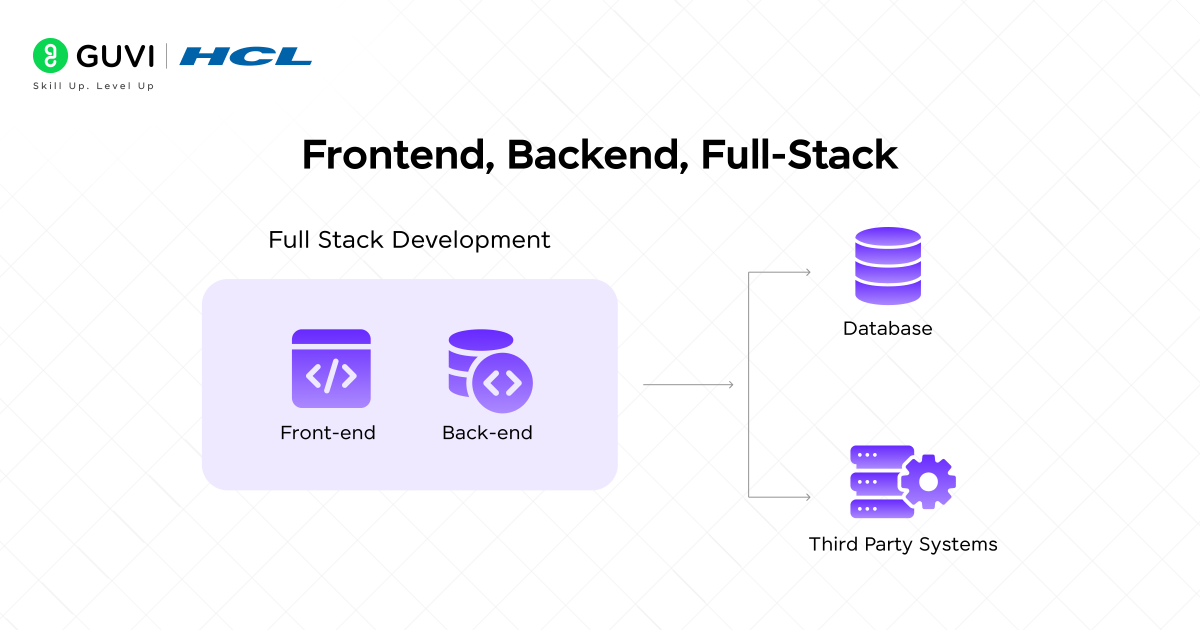
Developers can specialize in:
- Frontend development (developing user interfaces)
- Backend development (working with databases, servers, and logic)
- Full-stack development (working on both frontend and backend)
Their role varies depending on the project, but the ultimate goal remains the same: to build software that meets user requirements and performs efficiently.
Why Are Software Developer Roles Important?
Every software project’s success revolves around software developers. Even the best idea will forever remain an idea without these skilled individuals who build software applications. Developers do so much more than code; they ensure a business is able to adapt to, implement, and thrive in an ever-changing and technology-centric world.
Here are the reasons why software developers’ roles are important:
1) Bridging Business and Technology
Developers act as “translators” by transforming the company’s requirements into installable and usable software.
2) Ensuring Quality and Reliability
They design huge systems that are fast, secure, scalable and bug-free, while ensuring consistent performance
3) Ensuring Quality and Reliability
They design scalable, secure, and bug-free systems that maintain performance and support long-term growth.
4) Collaboration
Developers are part of multiple teams of designers, testers, and deployment teams, and help ensure that all workflow stages of the Software Development Life Cycle (SDLC) are sequentially and logically accomplished.
5) Driving Innovation
Successful software development can enhance business processes, increase productivity and customer satisfaction.
In short, developers are innovators and collaborative partners in a company and are also problem solvers who help transform ideas into revolutionary digital solutions.
Software Developer Roles and Responsibilities
The roles of a software developer involve wearing multiple hats throughout a project’s lifecycle. While coding is at the core, their work extends to problem-solving, collaborating, and ensuring software reliability.
Popular Roles of a Software Developer
1) Front-end Developer
a) Roles
Front-end developers work on everything the user sees or interacts with in a web application. They guarantee that all designs are visually appropriate, functional, and responsive for the appropriate device.
b) Responsibility:
- Turn UI/UX designs into working web pages using HTML, CSS, and JavaScript.
- Ensure websites and apps are responsive across devices.
- Optimize performance for speed and accessibility.
- Implement interactivity with frameworks like React, Angular, or Vue.
- Work with designers to maintain consistency in layout and branding.
c) Key Skills:
HTML, CSS, JavaScript, React/Angular/Vue, responsive design.
d) Average Salary:
Salary as a fresher front-end developer can range between ₹4 – ₹9LPA
2) Back-end Developer
a) Role:
Back-end developers handle the “brain” of the application. While users never directly see their work, it ensures that the software functions smoothly behind the scenes.
b) Responsibilities:
- Develop and maintain APIs for front-end communication.
- Design and manage databases (SQL/NoSQL).
- Handle authentication, authorization, and security.
- Optimize applications for scalability and performance.
- Integrate third-party services and APIs.
c) Key Skills:
Java, Python, Node.js, SQL/NoSQL, Docker, Kubernetes.
d) Average Salary:
Entry-level ₹5 – 12 LPA; experienced developers earn ₹8–15 LPA; senior roles can go up to ₹20–30 LPA+.
3) Full-stack Developer
a) Roles:
Full-stack developers are all-rounders who can work on both the front end and the back end. They are highly valued because they can build complete applications on their own.
b) Responsibilities:
- Design and develop user interfaces and server logic.
- Manage application databases and APIs.
- Ensure smooth integration between front-end and back-end.
- Troubleshoot issues across the stack.
- Collaborate with multiple teams for end-to-end delivery.
c) Key Skills:
JavaScript, HTML/CSS, React/Angular, Node.js, databases, Git.
d) Average Salary:
On average, ₹4 – 12 LPA, with senior professionals making ₹25+ LPA.
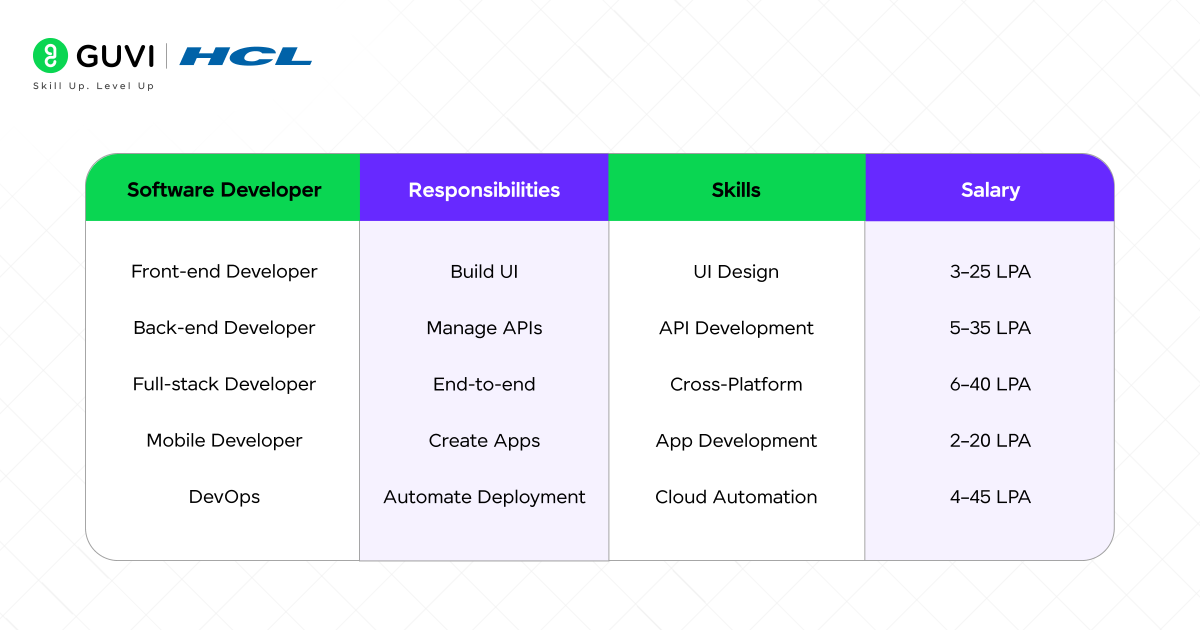
4) Mobile Developer
a) Roles
A Mobile Developer designs, builds, and maintains applications for mobile devices (smartphones and tablets). The Mobile Developer will also focus on how to make the app user-friendly, work reliably on different platforms (Android, iOS, or cross-platform development), and connect correctly to your backend. They will also optimize for performance, security, and compatibility with devices and operating systems.
b) Responsibilities:
- Design, develop, and maintain mobile applications.
- Write clean and efficient code for Android (Java/Kotlin) or iOS (Swift/Objective-C).
- Test apps for usability, performance, and security.
- Optimize applications for different devices and operating systems.
- Collaborate with designers and backend developers to integrate APIs.
- Stay updated with the latest mobile technologies and trends.
c) Key Skills:
Java, Kotlin, Swift, Objective-C, Flutter, React Native, mobile UI/UX design.
d) Average Salary:
Averages between ₹4 – 9 LPA, with cross-platform experts earning ₹18+ LPA.
5) DevOps / Development Operations Engineer
a) Role:
DevOps engineers act as the bridge between development and operations. Their goal is to make software delivery faster, automated, and more reliable.
b) Responsibilities:
- Set up CI/CD pipelines for continuous integration and deployment.
- Automate infrastructure and deployment processes.
- Manage containers and orchestration (Docker, Kubernetes).
- Monitor applications and servers for performance and reliability.
- Collaborate with developers to improve system efficiency.
c) Key Skills:
Jenkins, GitLab, Docker, Kubernetes, scripting, cloud platforms.
d) Average Salary:
Usually falls between ₹6 – 14 LPA, while experienced developers can earn ₹20–30+ LPA.

Key Responsibilities of a Software Developer
Here are the major software developer responsibilities that most job descriptions include:
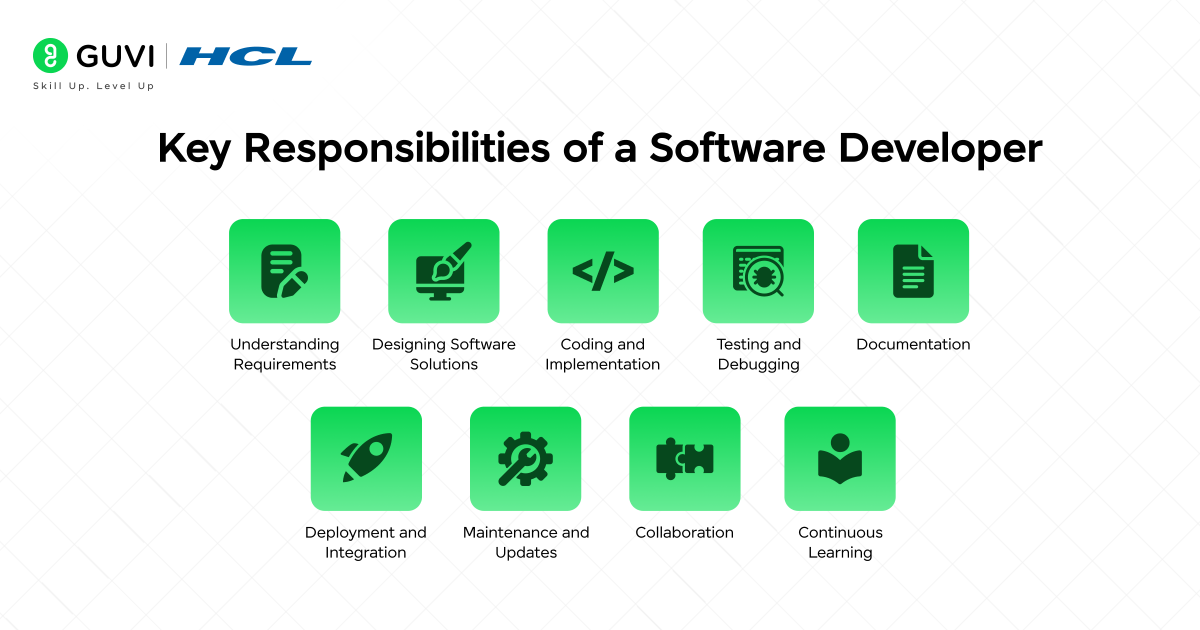
- Understanding Requirements
- Collaborate with business analysts, clients, or stakeholders to understand requirements.
- Make sure requirements are clear and there is no ambiguity around project objectives or user requirements.
- Designing Software Solutions
- Transform requirements into technical specifications
- Create flowcharts, architecture diagrams, or design documents.
- Coding and Implementation
- Programming and Implementing the Software.
- Use appropriate programming languages, frameworks, and libraries.
- Testing and Debugging
- Perform unit tests, integration tests, and debugging.
- Collaborate with QA teams to fix issues.
- Documentation
- Maintain technical documentation for future reference.
- Update manuals or guides for end users.
- Deployment and Integration
- Assist in software deployment to production environments.
- Ensure integration with third-party services or APIs.
- Maintenance and Updates
- Monitor software performance post-deployment.
- Fix bugs and release updates to improve functionality.
- Collaboration
- Work closely with designers, project managers, and testers.
- Participate in meetings, sprints, and reviews.
- Continuous Learning
- Stay updated with the latest programming languages, tools, and best practices.
Software Developer Duties
When it comes to software developer duties, they typically include:
- Writing, testing, and maintaining code.
- Debugging software issues.
- Reviewing code written by peers.
- Participating in code reviews and sprint planning.
- Communicating progress with stakeholders.
These duties may vary depending on whether the role is frontend, backend, or full-stack.
Software Developer Daily Tasks
The software developer’s daily tasks depend on project type and methodology (Agile, Waterfall, etc.). On a typical day, a developer might:
- Attend a daily stand-up meeting with the team.
- Work on assigned coding tasks or user stories.
- Debug errors reported by QA or users.
- Push code to version control (GitHub, GitLab).
- Collaborate with designers or product owners.
- Review pull requests from teammates.
- Document updates or write technical notes.
This shows that a developer’s day is dynamic, involving both coding and collaboration.
Software Developer Skills
To excel in their role, Developers need both Technical skills and Soft skills.
Technical Skills:
- Programming languages: Java, Python, C#, JavaScript, etc.
- Web frameworks: React, Angular, Django, Spring.
- Database management: SQL, NoSQL.
- Version control: Git.
- Testing tools: JUnit, Selenium, Jest.
- Cloud platforms: AWS, Azure, Google Cloud.
Soft Skills:
- Problem-solving mindset
- Communication skills
- Time management
- Teamwork and collaboration
- Adaptability to new technologies
Roles and Responsibilities of a Software Engineer vs Developer
The terms software engineer and software developer are often used interchangeably. However, there are slight differences:
- Software Engineers
Software engineers have a broader perspective on software development. They focus on leveraging engineering principles to build a solution that is scalable, reliable, and maintainable. They typically think about system architecture, work on infrastructure, and ensure that software solutions integrate seamlessly with larger systems. A software engineer cares about sustainability, performance, engineering best practices, etc.
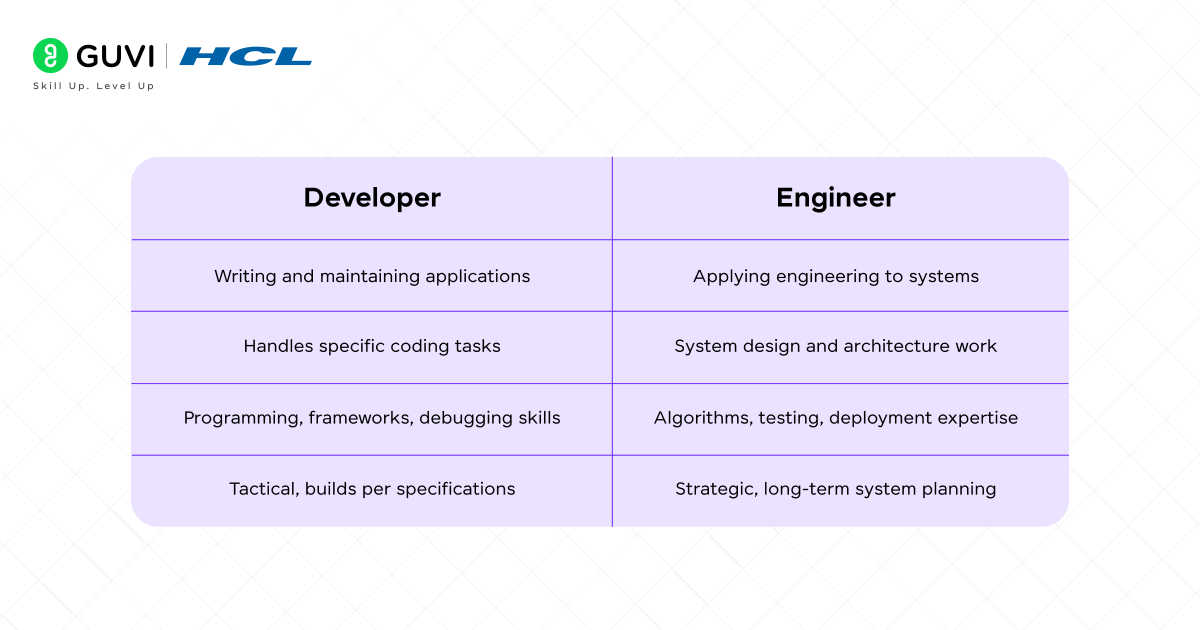
- Software Developers
On the contrary, software developers are more preoccupied with making requirements real through the application. This often involves some aspect of coding work, developing features or resolving bugs and verifying the software satisfies user needs. Developers essentially realize the project vision as the built end product according to design and business requirements.
In practice, the responsibilities overlap heavily, and many companies use the titles interchangeably.
Future of Software Developer Roles
The demand for developers continues to grow with blockchain, cloud computing, artificial intelligence and machine learning. Future developers will need to adapt to:
- More automation in coding (AI-assisted development).
AI-powered coding tools are on the rise; they are increasingly assisting developers in writing, debugging, and optimizing code. Although this increases productivity, it means developers will spend more time focused on solving problems, architecture, and clever thinking, rather than on lines of code.
- Cloud-native applications.
As businesses migrate to the cloud, developers will need to create applications that are designed to work in the cloud. Knowledge of containerization (Docker, Kubernetes) and serverless architectures will be even more useful.
- Cross-platform development.
Developers need to be focused on frameworks such as Flutter, React Native and Xamarin when creating applications to work across user segments (web, mobile, desktop, even wearable) where users access a variety of devices.
- Increased focus on cybersecurity.
With the growth of cybersecurity threats, every developer (whether front-end, back-end, or mobile) will always need to follow security best practices, but in time, every developer will need to integrate security into their development process (DevSecOps) and not as an afterthought.
Quick tips to become a Software Developer:
- Pick a Language: Either Python or Javascript is a good starting language to develop a solid foundation.
- Build Projects: Learn new skills through hands-on project work.
- Practice Daily: Solve code exercises for better problem-solving skills.
- Stay Curious: Keep learning new frameworks, tools, and best practices.
Ready to take your software development skills to the next level! Enroll in HCL GUVI’s IITM Pravartak and MongoDB Certified Online AI Software Development Course! With this course, you will receive hands-on real-world projects and real mentorship that will actually prepare you for the industry. The NSDC certification you will earn is a globally recognized certification, which enhances your resume and gives you a real edge in the ultra-competitive world of jobs today. Don’t just learn, build your future, Enroll today!
Conclusion
Being a software developer includes more than just coding. Software developers act as problem solvers, collaborators, and innovators who create solutions for the digital world. They may work on the frontend, backend, or full stack, as well as working in Agile teams across the SDLC phases. Regardless of what they do, developers fundamentally impact a business or organization’s success.
We discussed all the various things a software developer does, a few key tasks they are responsible for, and even how these responsibilities look on actual projects in the world. I hope this blog has given you some clarity and has been able to answered some of your questions.
Q1. What are the key responsibilities of a software developer?
A software developer is responsible for managing the complete process of an application. They will analyze requirements, develop clean code, test and debug, deploy the application, maintain the application, and they will ideally make further improvements and provide updates. Furthermore, they can also work with other teams to ensure that the software meets user requirements and performs appropriately.
Q2. What skills should a software developer have?
Performance skills for today’s tech environment continue to evolve thus requiring software developers to have skills in programming, databases, cloud, version control, testing, and soft skills such as problem-solving, communication, collaboration, adaptability, and time management.
Q3. How do software developer duties differ from software engineers?
Software developers are primarily focused on developing applications such as writing code, testing, and maintaining software. Software engineers work on broader topics such as system architecture, scalability, and design of the overall system infrastructure. The roles of developers and engineers often overlap when it comes to coding and problem-solving, but generally, developers are focused on specific applications, whereas engineers are often focused on large-scale complex systems.
Q4. What is the career growth path for a software developer?
Software developers can become senior developers, team leads, software architects, or product managers. After gaining experience, they could move into focused areas of specialization like artificial intelligence, or cybersecurity, or data science, or cloud engineering.
Q5. What programming languages should beginners learn first?
Those just starting out should focus on an easier and more common language. For example, Python or JavaScript make good beginner’s languages because they are commonly used, straightforward, and allow for a strong foundation before using more advanced languages like Java, C#, or frameworks.
Success Stories

About the Author
Vishalini Devarajan
An Aerospace Engineer turned content writer, I focus on making complex concepts easy to understand through well-structured, reader-friendly blogs. Whether it’s a technical topic or a non-technical one, I love creating content that is clear, engaging, and impactful.
View all posts by Vishalini Devarajan
Connect with me @
















Did you enjoy this article?