


Software Development Articles
How to Read and Understand System Design Diagrams?
System Engineer Roles and Responsibilities: 12 Proven Duties for Growth
SAP Consultant Roles and Responsibilities: 12 Proven Duties for Growth and Success
Network Engineer Roles and Responsibilities: 12 Essential Duties for Success


Get In Touch For Details! Request More Information
Your Roadmap to Mastering the Most In-Demand Software Developer Skills in India
Oct 08, 2025 5 Min Read 3181 Views
(Last Updated)
India’s technology sector is among the world’s fastest-growing, with product-based firms, IT giants, and startups vying for talented software developers. But in a job market where hundreds of résumés pile up on a recruiter’s desk each week, it’s your actual skills that matter more than your official qualifications. Employers are looking for developers who can fix issues, learn new technologies quickly, and write high-quality code under real-world constraints.
Strong software developer skills also give you flexibility in career choices. You could be building enterprise software for an MNC in Bengaluru, coding for a Silicon Valley startup from home, or freelancing on international platforms. Your skill set determines the type of project you receive, the pay you are offered, and your job stability in the long run. In other words, the better your skills, the more doors open for you, both within India and elsewhere.
Table of contents
- Core Technical Skills For Software Developers To Master
- Foundational Skills
- Execution Skills
- Advanced Skills
- Soft Skills That Make a Developer Stand Out
- Communication Skills
- Problem-Solving Mindset
- Adaptability and Learning Agility
- Time Management and Prioritization
- Teamwork and Collaboration
- How to Continuously Upgrade Your Software Developer Skills
- Learn Through Real Projects
- Take Online Courses and Certifications
- Participate in Hackathons and Coding Challenges
- Follow Industry Trends and Communities
- Seek Feedback and Mentorship
- Final Thoughts: Building a Career-Ready Skill Set
- Frequently Asked Questions
- Are software developer skills transferable to other tech roles?
- Which emerging trends should I follow to upgrade my skills in software development
- Can non-IT graduates develop software developer skills?
- How can open-source contributions improve your skills as a software developer?
Core Technical Skills For Software Developers To Master
Behind every successful software project is a mix of core skills that help developers turn ideas into reliable, functional applications. These aren’t just “good to have” — they’re the foundation of your work, whether you’re building for a startup, a global enterprise, or as a freelancer.
Here’s a quick visual map of the most important technical skills for today’s developers.
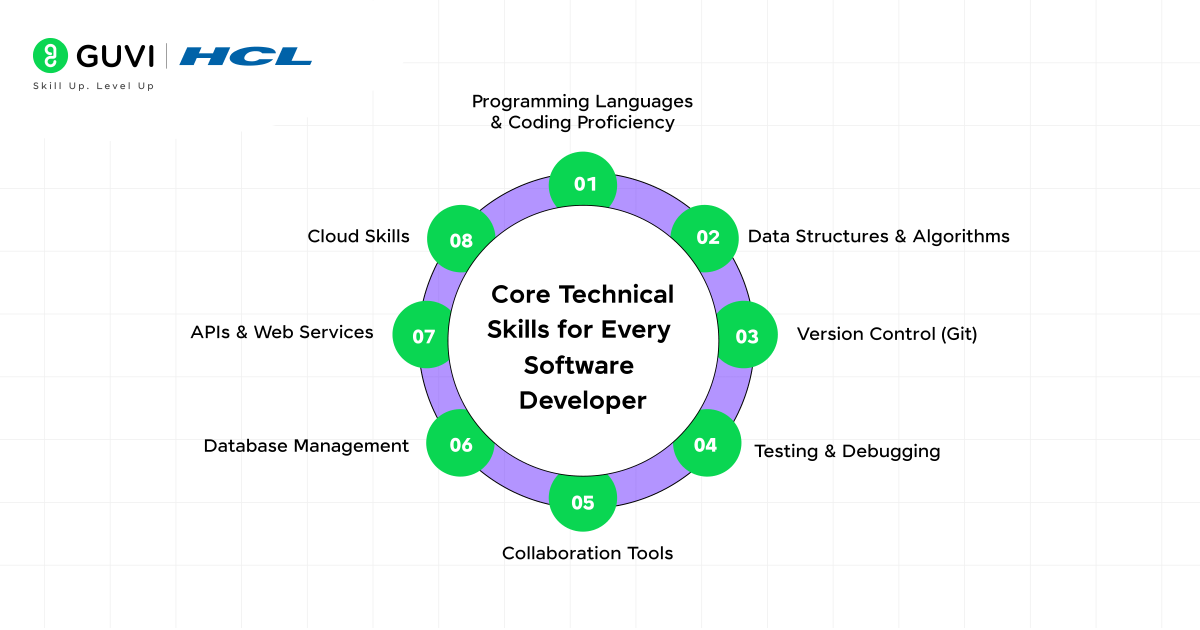
We’ll explore each of these in detail so you know exactly how they fit into your career growth.
Foundational Skills
These are the key skills for a software developer that form the backbone of your career. Without them, it’s hard to move forward in any project or domain.
Programming Languages and Coding Proficiency
Every developer needs strong coding proficiency to translate ideas into working applications. Mastering at least one primary programming language, such as Java, Python, or JavaScript, is essential for building problem-solving capability and adaptability.
In India’s hiring market, companies often shortlist candidates based on how well they can write clean, maintainable, and efficient code. Beyond syntax, you should focus on logic building, understanding data types, and following coding standards. Over time, picking up secondary languages or frameworks helps you stay relevant in a field that changes rapidly.
Data Structures and Algorithms
A strong grasp of data structures and algorithms is one of the must-have technical skills for software developers. These concepts, from arrays and linked lists to trees, graphs, and sorting algorithms, help you organize and process data efficiently.
They are not just academic topics; they influence application performance and scalability in real-world projects. In India, technical interviews for both service-based and product-based companies heavily test these skills, so consistent practice is essential for career growth.
Version Control with Git
Version control is the foundation of teamwork in modern development. Git is the most widely used system, allowing developers to create branches, merge updates, and track project history without overwriting work.
For instance, programming skills for software developers include navigating Git commands and working with platforms like GitHub, GitLab, or Bitbucket shows you can collaborate effectively and manage complex codebases — a skill that’s expected even in entry-level roles.
Execution Skills
Once the foundations are in place, these skills help you execute and deliver software that works reliably, meets quality standards, and is easy to maintain.
Testing and Debugging Expertise
Good developers don’t just write code; they also ensure it runs without issues. Testing and debugging expertise involves writing unit tests, performing integration tests, and using automated testing frameworks to catch errors early.
Debugging skills allow you to identify and fix issues quickly using tools like IDE debuggers, log analyzers, and breakpoints. This ability not only improves product quality but also saves time during deployment and reduces post-release bugs.
Collaboration Tools
Modern development is rarely a solo activity. Tools like Jira, Trello, Slack, and Microsoft Teams streamline communication, task management, and progress tracking.
For developers working in India’s fast-paced tech sector, often in hybrid or remote teams, proficiency in these tools signals that you can integrate smoothly into existing workflows and contribute effectively from day one.
Database Management
Among the many technical skills for software developers that are often underestimated is database management. This includes designing schemas, writing optimized SQL queries, and maintaining data integrity.
You should be comfortable with relational databases like MySQL and PostgreSQL, as well as NoSQL options like MongoDB for applications that require flexibility. Knowing indexing, query optimization, and basic security practices can make a huge difference in performance and reliability.
Advanced Skills
These skills help you work on more complex, large-scale projects and increase your value in the job market.
APIs and Web Services
APIs (Application Programming Interfaces) are how software systems talk to each other. As part of your software developer skills, you should know how to consume APIs, integrate third-party services, and build RESTful APIs from scratch.
Familiarity with formats like JSON and XML ensures smooth data exchange between systems. In India’s startup ecosystem, API integration is a frequent requirement for payment gateways, logistics platforms, and social media features.
Basic Cloud Skills
With more companies moving to the cloud, basic cloud skills are becoming essential. Knowing how to deploy applications, manage cloud storage, and configure servers on platforms like AWS, Microsoft Azure, or Google Cloud Platform gives you a clear edge.
Even beginner-level containerization skills with Docker or Kubernetes can boost your profile, especially for roles that involve DevOps or scalable application development.
Soft Skills That Make a Developer Stand Out
Technical expertise will get your foot in the door, but it’s your soft skills that often decide how far you go. They shape the way you work with others, solve problems under pressure, and adapt to changes in your environment. The right mix can make you a dependable and sought-after teammate.
Communication Skills
As a developer, you will interact with people from different backgrounds. Some will understand technical jargon, while others will not. Being able to explain complex ideas in simple terms is invaluable. Good communication also means active listening, giving constructive feedback, and documenting your work clearly so the whole team stays on the same page.

Problem-Solving Mindset
From bugs in code to unexpected client requests, challenges are part of the job. A problem-solving approach allows you to break issues into smaller, manageable parts and work through them methodically. This habit not only makes problem resolution faster but also helps prevent similar issues in the future.
Adaptability and Learning Agility
Technology changes quickly. One year a framework is in high demand, the next it may be replaced by something entirely new. Being adaptable means staying open to learning and trying out new tools, methods, and workflows. It keeps your skills relevant and your confidence intact when facing change.
Time Management and Prioritization
Developers often juggle multiple tasks and deadlines. Strong time management is about focusing on what needs to be done first and ensuring quality without constant last-minute stress. Setting realistic goals and tracking progress helps you deliver on time without compromising your work.
Teamwork and Collaboration
Software development is rarely a solo effort. Projects succeed when team members trust each other and work toward a shared goal. Being a good collaborator means respecting others’ input, offering help when needed, and being willing to learn from those around you.
How to Continuously Upgrade Your Software Developer Skills
In the tech world, standing still is the same as falling behind. New languages, frameworks, and tools appear regularly, and employers look for developers who can keep pace. Building your skills is not a one-time task but an ongoing process that shapes your career growth.
Learn Through Real Projects
Working on real-world projects is one of the fastest ways to sharpen your abilities. Whether it is a freelance assignment, an open-source contribution, or a personal side project, each challenge improves your coding proficiency, problem-solving, and ability to adapt.
Take Online Courses and Certifications
A well-chosen course can fill skill gaps and give you structured learning. Look for programs that cover both technical skills such as data structures and algorithms, version control with Git, and APIs, as well as practical tools like collaboration platforms or cloud deployment basics. Completing certifications adds credibility to your profile and can make you stand out in India’s competitive job market.
One such option is HCL GUVI’s Professional Certificate in AI Software Development Course, which offers IITM Pravartak and MongoDB certifications. It combines real-world projects with expert mentorship, thus helping you strengthen both core and emerging software developer skills.
Participate in Hackathons and Coding Challenges
Hackathons and coding contests push you to solve problems quickly under time pressure. They are also a great way to explore new technologies, meet other developers, and even connect with potential employers. Platforms like HackerRank, CodeChef, and LeetCode are popular starting points.
Follow Industry Trends and Communities
Staying updated with industry news, blogs, and developer forums helps you spot emerging technologies before they become mainstream. Joining communities on GitHub, Stack Overflow, or LinkedIn allows you to learn from experienced developers and share your own expertise.
Seek Feedback and Mentorship
One of the fastest ways to improve is to get input from others. Feedback from peers or seniors can highlight areas you might overlook. A mentor can guide you on what skills to focus on, how to approach challenges, and how to make better career decisions.
Final Thoughts: Building a Career-Ready Skill Set
The strongest careers in software development are built on a mix of solid technical knowledge, adaptable thinking, and consistent practice. While it’s important to learn the right tools and frameworks, it’s just as important to understand what the industry actually needs from developers today.
Resources like this guide on hiring software developers in India can give you valuable perspective on current expectations and trends. By aligning your learning path with these insights, you can focus on skills that not only interest you but also improve your chances of working on challenging, rewarding projects.
In the end, your skills are an investment. The more time and effort you put into refining them, the more opportunities you’ll be able to create for yourself in India’s thriving tech sector.
Frequently Asked Questions
Are software developer skills transferable to other tech roles?
Many skills overlap with roles like DevOps engineer, product manager, and data analyst. Knowledge of coding, version control, and testing is valuable across multiple tech positions.
Which emerging trends should I follow to upgrade my skills in software development
Stay informed about AI integration, low-code/no-code platforms, blockchain applications, and advanced cloud services, as these are shaping the future of software development.
Can non-IT graduates develop software developer skills?
Yes. Many successful developers come from non-IT backgrounds by learning programming, data structures, and software tools through online courses and practical projects.
How can open-source contributions improve your skills as a software developer?
Working on open-source projects exposes you to real-world codebases, collaborative workflows, and feedback from experienced developers, which accelerates skill growth.
Success Stories










Did you enjoy this article?