


Entrepreneurship Articles
Employment Law Basics for Startup Founders: Hiring Compliance Guide for India
Data Privacy Compliance for Startups: A Practical & Best Guide for Founders
GST for Startups: A Beginner's Best Guide to Registration, Tax & Compliance
Founder Agreement and Equity Vesting: What You Need to Know in 2026


Get In Touch For Details! Request More Information

Factors Influencing Entrepreneurship
Jul 22, 2026 7 Min Read 8093 Views
(Last Updated)
Entrepreneurship is the process of spotting an opportunity and taking the risk to build something new — a product, a service, or a business — where nothing existed before. Not everyone who spots that opportunity acts on it, and not every venture that launches survives, which is where the factors influencing entrepreneurship come in — the personal traits and external conditions that decide who starts, who succeeds, and who fails.
From risk appetite and skills to funding, policy, and culture, these factors shape entrepreneurship everywhere, but especially in India’s fast-growing yet uneven startup ecosystem. This blog breaks down what drives — and derails — entrepreneurial success.
Table of contents
- TL;DR Summary
- Who is an Entrepreneur?
- Essential Entrepreneurship Skills Every Founder Needs
- Top 7 Factors Influencing Entrepreneurship
- Economic factors:
- Social and Cultural Factors:
- Technological Factors:
- Political and Legal Factors:
- Psychological Factors:
- Environmental Factors:
- Demographic Factors:
- Factors Influencing Entrepreneurship: Types, Examples, and Impact
- Personal Factors vs Environmental Factors of Entrepreneurship
- Personal Factors (Internal)
- Environmental Factors (External)
- Key Factors Influencing Entrepreneurship in India: Policy, Funding, and Culture
- Government Policies Influencing Entrepreneurship in India in 2026
- Factors Leading to Startup Failure in India
- Conclusion
- FAQs
- What are the main factors influencing entrepreneurship?
- What are personal factors in entrepreneurship?
- What are environmental factors in entrepreneurship?
- What government policies support entrepreneurship in India?
- Why do most startups fail in India?
- Which factor has the biggest impact on entrepreneurship?
TL;DR Summary
- Entrepreneurship is shaped by 7 key factors — economic, social and cultural, technological, political and legal, psychological, environmental, and demographic — each pulling founders toward or away from taking the leap.
- Entrepreneurship isn’t just “starting a business” — it’s spotting a problem others accept as normal and putting your own money, time, and reputation on the line to fix it.
- The factors influencing entrepreneurship fall into two camps: personal traits such as risk appetite and motivation, and external forces such as funding, policy, and culture.
- In India, entrepreneurship runs on a mix of DPIIT recognition, seed funding schemes, and state-level incentives, alongside a digital backbone like UPI that’s opened doors for smaller founders.
- Government schemes in 2026 — SISFS, Atal Innovation Mission, SAMRIDH, and credit guarantee programs — are actively de-risking the earliest, most fragile stage of building a startup.
- Nearly 90% of Indian startups fail within five years, mostly from misreading market demand, weak founding teams, and running out of cash before the business proves itself.
- India ranks as the third-largest startup ecosystem in the world with over 698,000 registered startups, a direct result of the combined economic, policy, and cultural factors covered in this blog.
- Women-led startups receive less than 3% of total venture capital in India, despite making up 14–18% of all founders—a clear example of how social and cultural factors continue to shape who gets funded.
Who is an Entrepreneur?
An Entrepreneur isn’t just someone who “starts a business” — that’s the textbook definition that misses the point entirely. An entrepreneur is someone who looks at a broken system, an unmet need, or a problem everyone else has learned to live with, and refuses to accept it as permanent.
They put their own money, time, reputation, and sleep on the line to fix it — with zero guarantee it’ll work. It’s less about the business plan and more about the mindset: seeing possibility where others see “that’s just how things are.”
Explore: Advantages and Disadvantages of Entrepreneurship You Should Know
The responsibilities of an entrepreneur include:
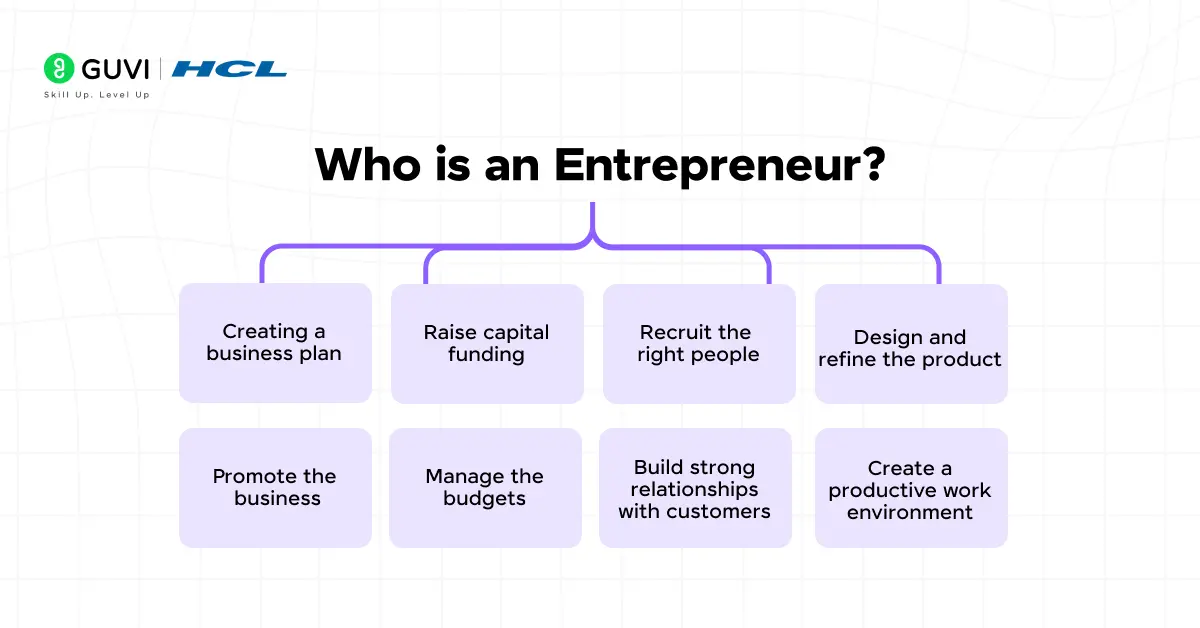
- They are responsible for creating a business plan that outlines the vision, goals, and financial strategy.
- They raise capital funding from investors, banks, or from personal savings.
- They design and refine the product based on the market needs.
- They recruit the right people and create a productive work environment.
- They promote the business and drive revenue through different marketing tactics.
- In the early-stage startup, they manage the budgets, accounting to ensure profitability.
- They build strong relationships with customers, partners, and stakeholders.
Also Read: What is an Entrepreneurship Program?
Ready to turn these factors into an actual venture? IIT Delhi’s Executive Management Programme in Entrepreneurship Development, offered through IIT Delhi’s Continuing Education Programme in partnership with HCL GUVI, takes you from idea to investor-ready business in 9 months. Get access to IIT Delhi faculty, campus immersion, and mentorship — with a capstone project to test everything you’ve learned.
Essential Entrepreneurship Skills Every Founder Needs
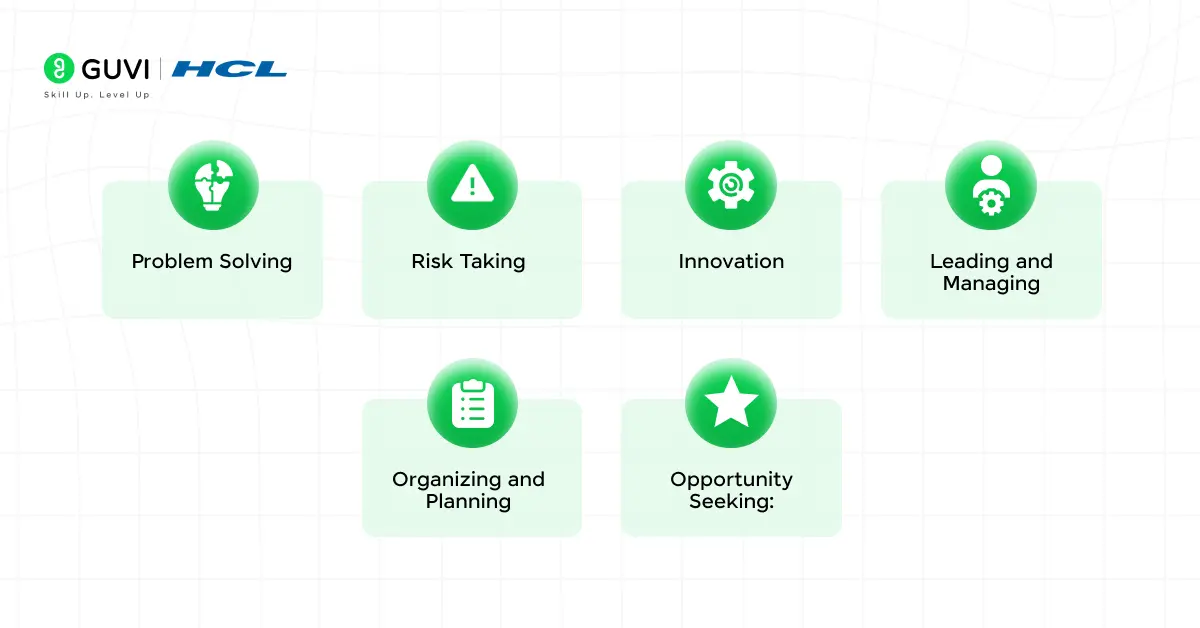
Great business ideas fail all the time — what separates the entrepreneurs who make it is a specific set of skills that turn an idea into something that actually works. Here’s what that toolkit looks like:
- Problem Solving: Spotting the pain points people deal with every day and building solutions worth paying for.
- Risk Taking: Making bold financial, personal, or professional bets — not blindly, but with eyes wide open to what’s at stake.
- Innovation: Coming up with ideas, products, or methods that don’t just compete — they open up markets that didn’t exist before.
- Leading and Managing: Rallying a team around a vision and keeping them moving toward it, even when things get messy.
- Organizing and Planning: Turning ambition into action — allocating resources, setting real goals, and mapping out how to hit them.
- Opportunity Seeking: Staying alert to the gaps and unmet needs everyone else walks past without noticing.
Discover: Entrepreneurship Projects: Ideas, Types, and Getting Started
Top 7 Factors Influencing Entrepreneurship
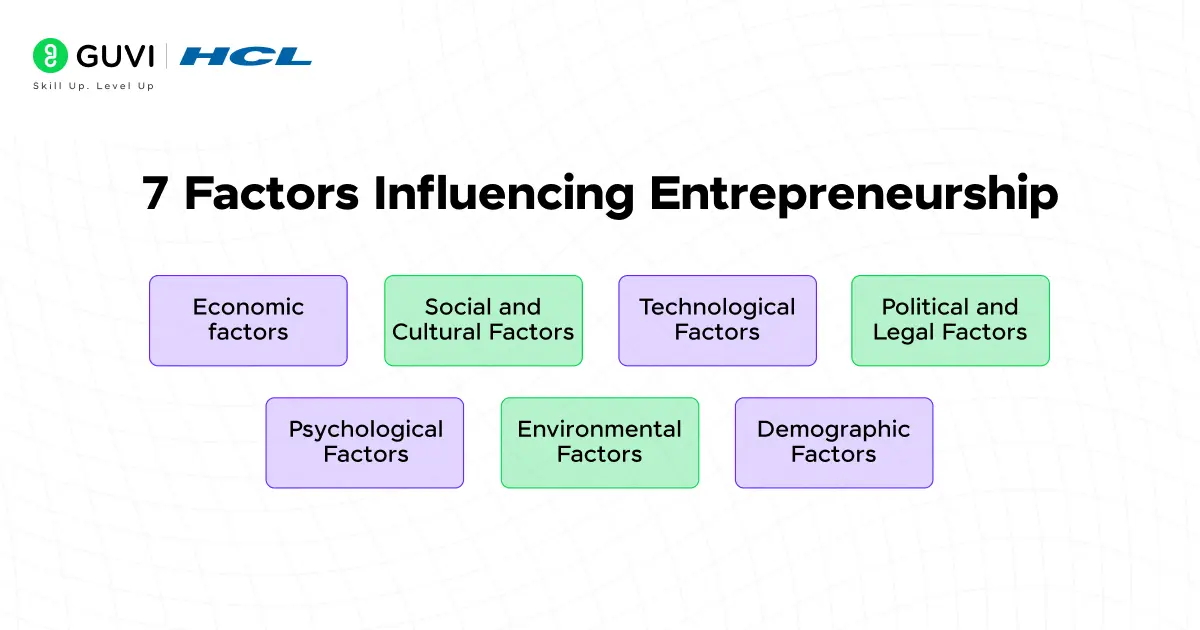
In this section, let’s look into the top 7 factors that influence entrepreneurship.
Economic factors:
- The health of the economy greatly impacts entrepreneurship. The key elements include access to capital, availability of resources, inflation rates, employment levels, and consumer purchasing power.
- These elements are essential for startup funding, building, and expanding throughout the market.
- A stable economy helps determine the demand for new products or services.
Social and Cultural Factors:
- Cultural values, family background, social norms, and societal attitudes towards entrepreneurship play important roles.
- Societies that value independence, innovation, and success tend to produce more entrepreneurs.
- These factors are important for building strong connections and relationships that drive business success.
Technological Factors:
- Technological factors include accessing advanced technologies that enable innovation and efficiency in business operations.
- Rapid technological advances can create new industries or transform existing ones to a greater extent, giving entrepreneurs fresh opportunities.
- This factor is crucial to advancing the company and increasing productivity.
Political and Legal Factors:
- Government laws, stability, regulations, tax policies, and support programs directly affect the business initiation and operation.
- Some business environments encourage entrepreneurial growth. Some countries’ government policies provide grants and subsidies to start a business.
- Legal factors affect the business registration process, intellectual property rights, and legal protections.
Psychological Factors:
- An individual’s mindset, motivation, risk tolerance, self-confidence, and desire to succeed influence their decision to become an entrepreneur.
- This helps drive the idea of starting and growing a business. The entrepreneur should have a strong willingness to embrace the uncertainty and potential failure.
- This is the first factor every entrepreneur needs to surpass to achieve great success.
Environmental Factors:
- Environmental factors include the physical and ecological environment, such as natural resources, climate, and sustainability concerns.
- These factors can shape the kind of businesses that are viable in a region. These factors can have a great impact on global economic trends in entrepreneurship.
Demographic Factors:
- Demographic factors are the characteristics of a population, such as age distribution, education levels, income brackets, and population growth, that affect the market demand and labour availability.
- These factors shape entrepreneurial opportunities and contribute significantly to the diversity of perspectives within the entrepreneurial ecosystem.
Explore: What is Digital Entrepreneurship? A Simple Guide
Factors Influencing Entrepreneurship: Types, Examples, and Impact
Entrepreneurship rarely depends on just one thing — it’s shaped by a mix of what’s happening inside a person and what’s happening around them. Here’s a quick snapshot of how these factors break down:
| Factor | Type (Internal/External) | Example | Impact Level |
|---|---|---|---|
| Economic Factors | External | Access to capital, inflation rates, consumer purchasing power | High |
| Social and Cultural Factors | External | Family background, societal attitude toward risk-taking | High |
| Technological Factors | External | Access to digital tools, automation, AI-driven platforms | High |
| Political and Legal Factors | External | Government subsidies, tax policies, business regulations | High |
| Psychological Factors | Internal | Risk tolerance, self-confidence, motivation to succeed | High |
| Environmental Factors | External | Natural resources, climate conditions, sustainability norms | Medium |
| Demographic Factors | External | Population age, education levels, income distribution | Medium |
While the table gives you the full picture at a glance, two of these factors deserve a closer look — the ones within an entrepreneur’s control, and the ones outside it. Let’s break down personal factors versus environmental factors, and how each shapes the entrepreneurial journey.
Fair point — that closing-summary pattern is a dead giveaway. Let me redo it without that crutch.
Personal Factors vs Environmental Factors of Entrepreneurship
Every entrepreneurial journey is shaped by two forces — one that comes from within you, and one that surrounds you. Understanding both helps you see why some ideas take off while others never get off the ground.
Personal Factors (Internal)
These are the traits you carry with you, no matter where you start out:
- Risk Appetite: Your willingness to bet on yourself, even when the outcome isn’t guaranteed.
- Motivation: What drives you to keep going when things get hard — money, independence, or the need to solve a problem you care about.
- Self-Confidence: Believing your idea is worth pursuing, especially before anyone else agrees with you.
- Skills and Experience: The knowledge and expertise you bring in, whether from past jobs, education, or just years of figuring things out.
- Vision: Your ability to see where an idea could go, long before it actually gets there.

Environmental Factors (External)
These are the conditions around you — the ones you don’t control, but still have to navigate:
- Economic Climate: Access to funding, market demand, and the overall health of the economy you’re operating in.
- Government Policy: Regulations, taxes, and support schemes that either open doors for you or make things harder.
- Social and Cultural Attitudes: Whether the people around you see entrepreneurship as admirable or risky.
- Technology and Infrastructure: The tools and systems available to help you build, scale, and reach customers.
- Market Competition: Who else is solving the same problem, and how crowded your space already is.
Take 2 founders with the exact same idea — one launches in a city with easy access to funding and a culture that celebrates risk-takers, the other launches in a place where banks won’t lend, and family members question the decision. Same internal drive, wildly different outcomes. That gap is exactly what these two categories explain.
Key Factors Influencing Entrepreneurship in India: Policy, Funding, and Culture
India’s startup story isn’t just about ambition — it’s shaped by a specific mix of policy support, capital flow, and a culture that’s slowly warming up to risk-taking. Here’s what’s actually driving it:
- Startup India Initiative: Since its launch, this government program has made it easier to register a business, access tax exemptions, and get fast-tracked patent support — removing a lot of the early friction founders used to face.
- Digital Public Infrastructure: Systems like UPI and India Stack have made it dramatically cheaper and faster to build fintech, e-commerce, and consumer-tech businesses, giving even small founders access to payment rails that once required enterprise-level infrastructure.
- Shifting Investor Behavior: Funding in India has matured — investors today are backing startups with real revenue, strong unit economics, and a clear path to profit, rather than just chasing growth stories. This makes fundraising tougher for first-time founders but healthier for the ecosystem in the long term.
- Rise of Tier 2 and Tier 3 Cities: Entrepreneurship in India is no longer just a Bengaluru or Mumbai story. Improved internet access and remote-work culture have opened the door for founders in smaller cities to build and scale.
- Cultural Shift Toward Risk-Taking: Failure used to carry heavy social stigma in India. That’s changing — more families and communities now see entrepreneurship as a legitimate, even respected, career path rather than a risky detour from a “stable job.”
Government Policies Influencing Entrepreneurship in India in 2026
Getting registered and claiming tax breaks is just the starting point — the real support in 2026 shows up in how founders actually get funded, backed, and pushed toward scale:
- Startup India Seed Fund Scheme (SISFS): This is often the first real money a founder sees — capital to build a prototype and test it in the market, through approved incubators, without having to give away equity this early.
- Fund of Funds for Startups (FFS): SIDBI doesn’t fund startups directly here — instead, this money flows into venture funds that then invest in Indian startups, and 2026 brought a bigger pool of capital into this pipeline.
- Atal Innovation Mission (AIM): Think of this as where the next generation gets its hands dirty — Atal Tinkering Labs let young innovators actually experiment with AI and robotics instead of just reading about it.
- Credit Guarantee Schemes (CGTMSE, PMMY): For founders without collateral, these schemes make borrowing possible at all — Mudra Yojana alone has backed over 48 million loans, and in 2026, the TarunPlus loan ceiling was raised to ₹20 lakh.
- SAMRIDH Scheme: Built for startups that already have a working product and just need the push to scale — up to ₹40 lakh in grants, plus mentorship and help getting into the market.
- State-Level Startup Policies: Karnataka and Maharashtra aren’t just following the central playbook — Maharashtra reimburses patent costs and backs incubation, while Karnataka’s Idea2PoC grants specifically target early tech ideas.
Factors Leading to Startup Failure in India
Almost 90% of startups in India don’t make it past their first five years. And it’s rarely one bad call that kills them — usually it’s a slow mix of what the founder got wrong and what the market didn’t forgive.
What Goes Wrong Internally
- The team wasn’t right from day one. Weak founding teams are behind close to a quarter of failures — having smart people in the room isn’t the same as having people who can actually build together under pressure.
- Money ran out faster than expected. Raising too early, too late, or spending without a real plan — cash problems catch up with almost every startup that doesn’t take financial discipline seriously.
- There was no real business model, just a good idea. A product without a clear plan for revenue, operations, and marketing tends to fall apart the moment it meets reality.
- Founders held on too tight. Refusing to pivot, or dismissing feedback that didn’t match the original vision — stubbornness kills more startups than bad luck does.
What Goes Wrong Externally
- Nobody actually wanted what they built. Misreading market demand is the single biggest reason startups fail in India — it shows up in 42% of cases.
- Competitors moved faster. Roughly 1 in 5 startups fail simply because someone else got there first or built better while they were still figuring things out.
- Investors got pickier. Funding hasn’t dried up, but it’s become selective — capital now flows to startups with real numbers, leaving many early founders stuck trying to raise their next round.
- B2B sales dragged on forever. Long enterprise sales cycles and tight budgets have quietly turned a lot of startups into “zombies” — still alive on paper, but not actually growing.
Most of these startups didn’t crash overnight. They leaked slowly, and by the time it was obvious, it was already too late to fix.
Prefer to learn at your own pace? HCL GUVI’s Entrepreneurship Course covers Lean Startup methodology, MVP building, and the Business Model Canvas in just 7 hours of content — with quizzes and real case studies to make it stick. Enroll and start turning your idea into a validated business plan!
Conclusion
No single factor determines whether a business succeeds — it’s the combination of personal drive, access to funding, policy support, and market conditions that shapes the outcome. Understanding the factors influencing entrepreneurship helps founders prepare for what’s within their control and adapt to what isn’t, which is often the real difference between a startup that survives and one that doesn’t.
FAQs
1. What are the main factors influencing entrepreneurship?
The main factors influencing entrepreneurship include personal traits such as risk-taking and motivation, as well as external factors such as funding, policy, culture, and market conditions.
2. What are personal factors in entrepreneurship?
Personal factors are internal traits like risk appetite, self-confidence, motivation, and skills that drive someone to start a business.
3. What are environmental factors in entrepreneurship?
Environmental factors are external conditions, such as the economy, government policy, technology, and culture, that shape entrepreneurial opportunities.
4. What government policies support entrepreneurship in India?
Schemes such as SISFS, the Atal Innovation Mission, and DPIIT recognition under Startup India are among the key factors influencing entrepreneurship in India today.
5. Why do most startups fail in India?
Startups in India mostly fail due to misreading market demand, weak founding teams, and running out of funding.
6. Which factor has the biggest impact on entrepreneurship?
Economic factors like access to funding and market demand are generally considered the most influential in entrepreneurship.
Success Stories







Did you enjoy this article?