


MERN Articles
A Guide to Explore MERN Stack Developer Salary in 2026
The Next Generation of Frontend Tools: Why Vite is Leading the Way
The Evolution of React Hooks: From Concept to Modern Practices

Get In Touch For Details! Request More Information
30 MERN Stack Interview Questions and Answers 2026 for Freshers & Experienced Developers
Sep 15, 2026 11 Min Read 98080 Views
(Last Updated)
Hey, so you’ve got a MERN stack interview coming up, or you’re preparing for one, and you’re wondering: “Do I actually know enough to walk in there with confidence?”
Here’s the honest truth: most candidates know the basics. They can explain what MongoDB is. They know React renders components. But the developers who actually get hired? They understand why things work the way they do, they’ve broken things while building projects, and they can back up every answer with a real example.
That’s exactly what this guide is built for. We’ve put together 35 of the most asked MERN stack interview questions, from the “tell me what MERN stands for” basics all the way to the sneaky, tricky questions that trip up even experienced developers. Every answer comes with a clear explanation, a code example where it helps, and the kind of context that makes your answer sound like it came from someone who’s actually built with this stack.
So, let’s get started!
Quick Answer: To prepare for a MERN stack interview in 2026, focus on:
- JavaScript fundamentals: Promises, async/await, closures, event loop, ES6+, and error handling
- React: Hooks, state management, rendering, routing, performance, and component architecture
- Node.js and Express: REST APIs, middleware, authentication, error handling, and asynchronous programming
- MongoDB: Schema design, indexing, aggregation pipelines, queries, and Mongoose
- Security: JWT, cookies, CORS, CSRF, XSS, rate limiting, and authorization
- Practical development: Git, testing, debugging, deployment, Docker, and CI/CD
- Advanced interviews: Scalability, caching, WebSockets, system design, and production architecture
- Coding rounds: JavaScript problems, API building, custom Hooks, DSA, and debugging tasks

Table of contents
- MERN Stack Interview Focus Areas: Quick Comparison
- Beginner MERN Stack Interview Questions and Answers
- What is the MERN Stack, and why is it popular?
- What is MongoDB, and why is it used in the MERN stack?
- What is Express.js, and what role does it play in MERN?
- What is React, and why is it used for the frontend?
- What is Node.js, and how is it used in MERN?
- Can you explain the difference between SQL and NoSQL databases?
- What is the Virtual DOM in React, and why does it matter?
- What is the difference between SQL and MongoDB?
- What is npm, and why is it important in MERN development?
- What is JSX in React?
- What is a REST API, and how does it connect React with Node.js in MERN?
- Intermediate MERN Stack Interview Questions and Answers
- What is Mongoose, and why is it used instead of the native MongoDB driver?
- What is the difference between useState and useReducer in React?
- How does routing work in a MERN application?
- What is JWT, and how is authentication implemented in MERN?
- What is CORS, and how do you handle it in a MERN app?
- What is the difference between useEffect and useLayoutEffect?
- How do you manage global state in a React application?
- What is middleware in Express.js?
- What is the difference between state and props in React?
- What is Axios, and how is it different from the Fetch API?
- Advanced MERN Stack Interview Questions and Answers
- How do you optimize the performance of a React application?
- How do you handle authentication and authorization in a MERN app at scale?
- Explain the MongoDB Aggregation Pipeline.
- What is Server-Side Rendering (SSR) and when would you use it with a MERN app?
- How do you prevent common security vulnerabilities in a MERN application?
- What is WebSocket, and when would you use it in a MERN app instead of REST?
- What are React Hooks rules, and what happens if you break them?
- How do you implement code splitting in a React app, and why does it matter?
- What is the Event Loop in Node.js, and how does it enable non-blocking I/O?
- How would you design the architecture of a production-ready MERN application?
- Complete MERN Stack Interview Preparation Guide in India 2026
- What to Prepare for a MERN Interview in 2026
- MERN Stack Versions to Know in 2026
- MERN Stack Developer Salary in India in 2026
- Conclusion
- FAQs
- What questions are asked in a MERN Stack interview?
- How do I prepare for a MERN Stack interview?
- Are coding questions asked in MERN Stack interviews?
- Is MERN Stack enough to get a job in 2026?
- What is the salary of a MERN Stack Developer in India?
MERN Stack Interview Focus Areas: Quick Comparison
| Interview Area | What Interviewers Test | Common Topics | Difficulty |
|---|---|---|---|
| MongoDB | Database design and data handling | CRUD, indexing, schema design, aggregation, Mongoose | Beginner to Advanced |
| Express.js | Backend API development | Routing, middleware, REST APIs, validation, error handling | Beginner to Advanced |
| React | Frontend architecture and performance | Hooks, state, props, routing, rendering, optimization | Beginner to Advanced |
| Node.js | Server-side JavaScript knowledge | Event loop, async programming, streams, APIs | Beginner to Advanced |
| JavaScript | Core programming ability | Promises, closures, ES6+, arrays, objects, async/await | All Levels |
| Authentication & Security | Ability to build secure applications | JWT, cookies, RBAC, CORS, CSRF, XSS | Intermediate to Advanced |
| Full-Stack Integration | How well you understand the complete flow | React → API → Express → MongoDB → response | Intermediate |
| System Design | Production and scalability knowledge | Redis, queues, caching, Docker, CI/CD, scaling | Advanced |
| Coding Round | Practical problem-solving ability | DSA, APIs, custom Hooks, debugging, JavaScript | All Levels |
Beginner MERN Stack Interview Questions and Answers
If you’re stepping into your first MERN developer interview, this section is your foundation. These questions test whether you understand what each layer of the stack does, how they connect, and why MERN became such a popular choice for building modern web applications.
1. What is the MERN Stack, and why is it popular?

The MERN Stack is a combination of four key technologies:
- MongoDB: A NoSQL database for storing data.
- Express.js: A lightweight web application framework for Node.js.
- React: A JavaScript library for building user interfaces.
- Node.js: A JavaScript runtime for server-side development.
Its popularity stems from its end-to-end use of JavaScript, which simplifies development and enables efficient, real-time data flow between client and server. This makes the MERN Stack an excellent choice for single-page applications (SPAs) and dynamic websites
New to MERN? The foundation of the entire stack is JavaScript. Brush up on JS fundamentals before diving deeper: JavaScript Tutorial. Need the web layer too? HTML5 Tutorial | CSS Tutorial
2. What is MongoDB, and why is it used in the MERN stack?
MongoDB is a NoSQL database that stores data in flexible, JSON-like documents called BSON (Binary JSON). Unlike relational databases that use fixed tables and rows, MongoDB allows you to store data in varying structures, which makes it ideal for applications where data models evolve.
In the MERN stack, MongoDB pairs naturally with Node.js and JavaScript because data is stored and retrieved in a format that closely resembles JavaScript objects, reducing the need for data transformation.
3. What is Express.js, and what role does it play in MERN?
Express.js is a minimal, unopinionated web application framework for Node.js. It simplifies the process of building server-side applications by providing tools for routing, middleware management, request handling, and response formatting.
4. What is React, and why is it used for the frontend?
React is an open-source JavaScript library developed by Facebook (Meta) for building user interfaces. It uses a component-based architecture, where UIs are broken into reusable, self-contained components, each managing its own state and logic.
5. What is Node.js, and how is it used in MERN?
Node.js is a server-side JavaScript runtime built on Chrome’s V8 engine. It allows JavaScript, traditionally a browser-only language, to run on the server. In the MERN stack, Node.js powers the backend, runs Express.js, handles incoming HTTP requests, executes server logic, and connects to MongoDB.
6. Can you explain the difference between SQL and NoSQL databases?

- SQL Databases:
- Use structured tables with predefined schemas.
- Suitable for applications with fixed schemas (e.g., financial systems).
- Examples: MySQL, PostgreSQL.
- NoSQL Databases:
- Use dynamic schemas which are more flexible.
- Ideal for handling unstructured or semi-structured data like user profiles, logs, or sensor data.
- Examples: MongoDB, CouchDB.
Want a deeper understanding of SQL databases alongside MongoDB? HCL GUVI’s free SQL & DBMS handbook covers relational databases, JOINs, normalization, and transactions — exactly what you need to answer SQL vs NoSQL questions confidently: SQL & DBMS Tutorial
6. What is the Virtual DOM in React, and why does it matter?
The Virtual DOM is a lightweight, in-memory representation of the actual DOM. When a React component’s state changes, React first updates the Virtual DOM, then compares it with the previous Virtual DOM snapshot using a process called diffing, and finally updates only the changed parts of the real DOM.
7. What is the difference between SQL and MongoDB?
| Feature | MongoDB | SQL (e.g., MySQL, PostgreSQL) |
| Data Format | JSON-like documents | Tables with rows and columns |
| Schema | Flexible / Schema-less | Fixed schema |
| Relationships | Embedded documents or references | Foreign keys and JOINs |
| Scalability | Horizontal (sharding) | Vertical (scale-up) |
| Query Language | MongoDB Query Language (MQL) | SQL |
| Best For | Unstructured, evolving data | Structured, relational data |
Interview tip:
Mention that MongoDB’s flexible schema makes it ideal for rapid development and apps with evolving data requirements, while SQL is better for applications with complex relational data and strict ACID compliance.
8. What is npm, and why is it important in MERN development?
npm (Node Package Manager) is the default package manager for Node.js. It allows developers to install, manage, and share reusable JavaScript packages (libraries and frameworks). In MERN development, npm is used to install everything from Express and Mongoose on the backend to React and Axios on the frontend.
Commands you should know:
- npm init initializes a new project
- npm install <package> installs a dependency
- npm run <script> runs a custom script (e.g., npm run start, npm run build)
- npm install –save-dev installs a development-only dependency
9. What is JSX in React?
JSX (JavaScript XML) is a syntax extension for JavaScript that allows you to write HTML-like code inside JavaScript files. It makes React component structure more readable and intuitive. JSX is not valid JavaScript; it gets compiled by Babel into React.createElement() calls before reaching the browser.
// JSX

const greeting = <h1>Hello, MERN Developer!</h1>;

// What Babel compiles it to:

const greeting = React.createElement('h1', null, 'Hello, MERN Developer!');
10. What is a REST API, and how does it connect React with Node.js in MERN?
A REST API (Representational State Transfer API) is a set of rules for building web services that communicate over HTTP. In a MERN app, the React frontend communicates with the Node/Express backend by making HTTP requests to REST API endpoints.
The typical flow:
- User interacts with React UI (e.g., clicks “Submit”)
- React sends an HTTP request (GET, POST, PUT, DELETE) to an Express route
- Express processes the request and interacts with MongoDB
- MongoDB returns data → Express sends it back as JSON → React updates the UI
React was originally built by Jordan Walke at Facebook to solve the problem of updating news feed content without refreshing the entire page. It was open-sourced in 2013 and has since become the most widely-used frontend library in the world. As of 2025, over 40% of professional developers use React as their primary frontend tool, according to the Stack Overflow Developer Survey.
Looking to move beyond basic ChatGPT skills? Here’s your chance to be a part of Be part of the Bharat AI Initiative, a nationwide movement by HCL GUVI, in association with OpenAI, built to help India’s youth develop advanced ChatGPT skills absolutely free! Learn structured prompting, refine responses with clarity, and apply ChatGPT more effectively in projects, assignments, and everyday work. Learn in English, Hindi, Marathi, Tamil, or Telugu and start your free AI journey!
Intermediate MERN Stack Interview Questions and Answers
You’ve cleared the foundation. Now comes the part where most candidates separate themselves. Intermediate questions test whether you actually build with MERN or just understand it conceptually.
11. What is Mongoose, and why is it used instead of the native MongoDB driver?
Mongoose is an Object Document Mapper (ODM) for MongoDB and Node.js. It provides a schema-based solution for modeling application data, meaning you define the structure, data types, and validation rules for your MongoDB documents in code.
While the native MongoDB Node.js driver works fine, Mongoose adds:
- Schema definitions (enforce structure on schema-less MongoDB)
- Data validation (before saving to DB)
- Middleware/hooks (pre and post hooks for save, update, delete)
- Populated references (like JOINs , using .populate())
- Instance and static methods on models
12. What is the difference between useState and useReducer in React?
Both hooks manage state in functional React components, but they serve different use cases:
| Feature | useState | useReducer |
| Best For | Simple, independent state values | Complex state with multiple sub-values or logic |
| Syntax | const [state, setState] = useState(initial) | const [state, dispatch] = useReducer(reducer, initial) |
| State Updates | Direct via setter function | Via dispatched actions and a reducer function |
| Predictability | Good for simple cases | Better for complex, testable state logic |
Mongoose, schema design, and ODM patterns are core MERN interview topics that go deeper than theory. HCL GUVI’s MERN Full Stack course gives you hands-on Mongoose practice through real project builds: MERN Full Stack Course
13. How does routing work in a MERN application?
MERN applications use two separate routing systems, one on the frontend and one on the backend:
Frontend Routing (React Router): Handles navigation between pages/views in the React app without triggering a full page reload. Common components: <BrowserRouter>, <Routes>, <Route>, <Link>, <Navigate>.
Backend Routing (Express.js): Defines API endpoints that the frontend communicates with. Example: app.get(‘/api/users’, controller).
In a full MERN app, react-router-dom manages client-side navigation, while Express routes handle data fetching, authentication, and CRUD operations. It’s important to configure Express to serve the React build for all non-API routes (app.get(‘*’, …)) in production.
14. What is JWT, and how is authentication implemented in MERN?
JWT (JSON Web Token) is an open standard for securely transmitting information between parties as a compact, digitally-signed JSON object. In MERN apps, JWT is the most common method for implementing stateless user authentication.
Authentication Flow:
- User submits login credentials (email + password)
- Express verifies credentials against MongoDB
- If valid, Express signs a JWT using a secret key and sends it to the client
- React stores the JWT (in memory or httpOnly cookie)
- For protected routes, React includes the JWT in the Authorization header (Bearer <token>)
- Express middleware verifies the JWT on each protected request
Looking to move beyond basic ChatGPT skills? Here’s your chance to be a part of Be part of the Bharat AI Initiative, a nationwide movement by HCL GUVI, in association with OpenAI, built to help India’s youth develop advanced ChatGPT skills absolutely free! Learn structured prompting, refine responses with clarity, and apply ChatGPT more effectively in projects, assignments, and everyday work. Learn in English, Hindi, Marathi, Tamil, or Telugu and start your free AI journey!
15. What is CORS, and how do you handle it in a MERN app?
CORS (Cross-Origin Resource Sharing) is a browser security mechanism that blocks web pages from making requests to a domain different from the one that served the page. In MERN development, this commonly occurs when the React frontend (e.g., localhost:3000) tries to call the Express backend (e.g., localhost:5000).
Fix: Use the cors npm package in your Express server:
16. What is the difference between useEffect and useLayoutEffect?
| Feature | useEffect | useLayoutEffect |
| Timing | Runs after the browser paints the screen | Runs before the browser paints |
| Use Case | Data fetching, subscriptions, timers | DOM measurements, animations that need instant layout info |
| Performance | Non-blocking (async feel) | Blocking (synchronous) |
| Default Choice | Yes, use this in most cases | Only when you need to read/modify the DOM before painting |
Interview tip:
Using useLayoutEffect when useEffect is sufficient can cause performance issues. Always default to useEffect and only switch to useLayoutEffect when you experience visual flickering or layout jumps.
17. How do you manage global state in a React application?
There are several approaches, each with different tradeoffs:
1. React Context API + useReducer, Built-in solution for medium-complexity apps. Good for auth state, theme, and language preferences.
2. Redux Toolkit, an industry standard for large applications with complex, shared state. Provides createSlice, createAsyncThunk, and configureStore for structured state management.
3. Zustand, a lightweight alternative to Redux, increasingly popular in 2025 for its minimal boilerplate.
4. React Query / TanStack Query, for managing server state (data fetched from APIs). Handles caching, loading states, and background refetching automatically.
Interview tip: Don’t just say “Redux.” Mention that the right tool depends on the app’s complexity and whether the state is local UI state (useState), shared UI state (Context/Zustand), or server state (React Query).
18. What is middleware in Express.js?
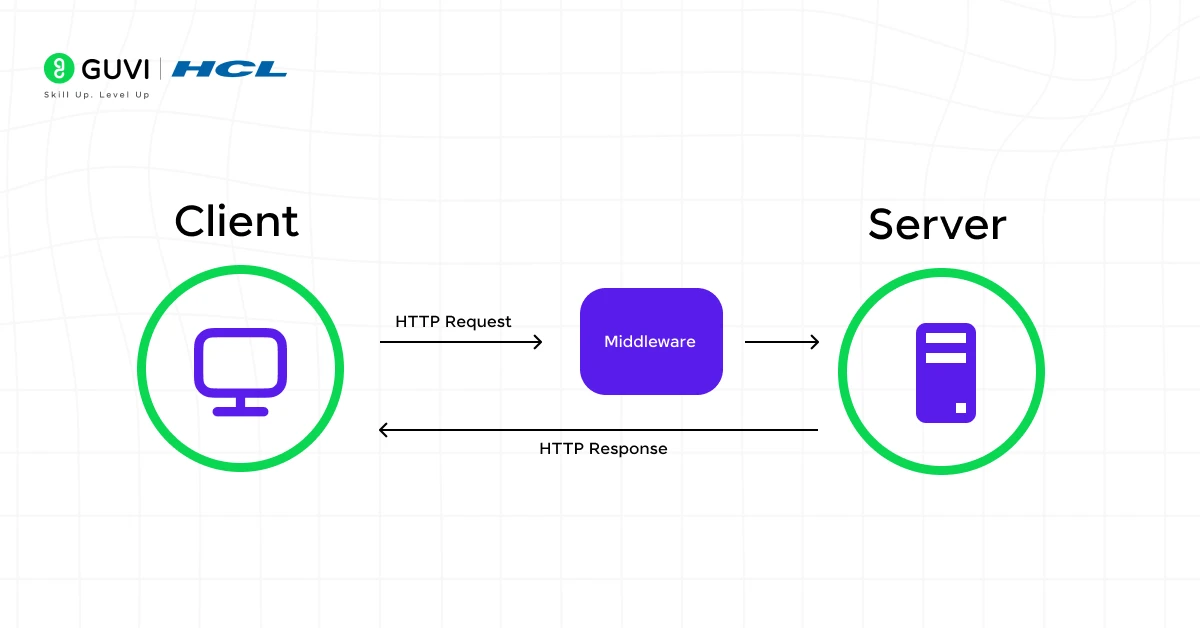
Middleware in Express.js is any function that has access to the req (request), res (response), and next objects in the request-response cycle. Middleware functions execute in sequence, and each one can modify the request/response, end the cycle, or call next() to pass control to the following middleware.
19. What is the difference between state and props in React?

- State: Represents data managed within a component. It is mutable and controlled by the component itself.
- Props: Short for properties, these are immutable data passed from a parent component to a child component.
20. What is Axios, and how is it different from the Fetch API?
Both Axios and Fetch are used to make HTTP requests from React to Express APIs, but Axios is preferred in most MERN projects for several reasons:
| Feature | Axios | Fetch API |
| JSON Handling | Automatic , parses JSON by default | Manual , need to call response.json() |
| Error Handling | Throws errors for non-2xx status codes | Only rejects on network failures |
| Request Interceptors | Built-in | Not available |
| Request Cancellation | Supports cancel tokens | Requires AbortController |
| Browser Support | Wide | Wide (modern browsers) |
| Bundle Size | ~11kb | Built-in (0kb) |
For production MERN apps, Axios is typically preferred because its interceptors allow you to attach JWT tokens to every request globally, handle 401 errors uniformly, and simplify error handling.

Advanced MERN Stack Interview Questions and Answers
This is where senior-level interviews live. Advanced questions test your understanding of architecture, performance, security, and scalability.
21. How do you optimize the performance of a React application?
Performance optimization in React operates on multiple levels:
Component-level:
- React.memo() , prevents re-rendering of functional components when props haven’t changed
- useMemo() , memoizes expensive computed values
Bundle-level:
- Code splitting via dynamic import() , load only what’s needed
- Tree shaking , eliminate unused code in production builds
Data fetching:
- Pagination or infinite scroll instead of loading all data
- React Query for caching and background sync
- Debouncing search inputs before triggering API calls
Rendering:
- Virtualize long lists using react-window or react-virtual , only render what’s visible
- Avoid anonymous functions and object literals in JSX props (they create new references on each render)
22. How do you handle authentication and authorization in a MERN app at scale?
At scale, authentication and authorization go beyond basic JWT implementation:
Authentication:
- Use short-lived access tokens (15 min) + long-lived refresh tokens (7–30 days)
- Store access tokens in memory (React state), refresh tokens in httpOnly cookies
- Implement a /refresh endpoint that issues new access tokens using the refresh token
- Use token rotation , invalidate refresh tokens after each use
Authorization:
- Implement Role-Based Access Control (RBAC) , assign roles (admin, user, editor) to users in MongoDB
- Create Express middleware that checks the user’s role before granting access to routes
- For fine-grained permissions, consider Attribute-Based Access Control (ABAC)
React performance optimisation questions — code splitting, memoization, lazy loading — appear in almost every senior frontend developer interview. HCL GUVI’s MERN course covers these patterns with real production-scale project implementations: MERN Full Stack Development Course
23. Explain the MongoDB Aggregation Pipeline.
The Aggregation Pipeline is MongoDB’s powerful framework for data processing and transformation. It passes documents through a series of stages, where each stage transforms the data before passing it to the next.
db.orders.aggregate([

  { $match: { status: "completed" } },

  { $group: { _id: "$category", totalRevenue: { $sum: "$amount" } } },

  { $sort: { totalRevenue: -1 } }

]);
24. What is Server-Side Rendering (SSR) and when would you use it with a MERN app?
Server-Side Rendering (SSR) means rendering React components on the server and sending fully-formed HTML to the browser, rather than sending a blank HTML shell + JavaScript bundle (which is Client-Side Rendering / CSR).
For most production MERN apps with public-facing pages, adopting Next.js as the frontend layer is now the industry-standard move.
25. How do you prevent common security vulnerabilities in a MERN application?
| Vulnerability | Description | Prevention |
| XSS (Cross-Site Scripting) | Injecting malicious scripts | Sanitize user input (DOMPurify), use httpOnly cookies |
| SQL/NoSQL Injection | Manipulating database queries | Use Mongoose validation, sanitize inputs (express-mongo-sanitize) |
| CSRF | Forging authenticated requests | Use CSRF tokens or SameSite cookie attribute |
| Broken Authentication | Weak token/session handling | Short-lived JWTs, refresh token rotation, bcrypt for passwords |
| Sensitive Data Exposure | Exposing API keys, DB credentials | Use .env files, never commit secrets, use secret managers in production |
| DoS / Brute Force | Overwhelming server with requests | express-rate-limit, CAPTCHA on auth endpoints |
| Dependency Vulnerabilities | Outdated packages with CVEs | Run npm audit regularly, use Snyk or Dependabot |
Looking to move beyond basic ChatGPT skills? Here’s your chance to be a part of Be part of the Bharat AI Initiative, a nationwide movement by HCL GUVI, in association with OpenAI, built to help India’s youth develop advanced ChatGPT skills absolutely free! Learn structured prompting, refine responses with clarity, and apply ChatGPT more effectively in projects, assignments, and everyday work. Learn in English, Hindi, Marathi, Tamil, or Telugu and start your free AI journey!
26. What is WebSocket, and when would you use it in a MERN app instead of REST?
WebSocket is a protocol that provides a persistent, full-duplex communication channel between the client and server over a single TCP connection , unlike HTTP, which is request-response and stateless.
Use WebSocket when:
- You need real-time, bidirectional communication: chat apps, live notifications, collaborative editing
- Server needs to push data to clients without being asked (stock tickers, live scoreboards)
- Latency must be minimal (multiplayer games, live dashboards)
Use REST when:
- Standard CRUD operations with no real-time requirement
- Public APIs consumed by third parties
- Caching and idempotency matter
27. What are React Hooks rules, and what happens if you break them?
React enforces two core rules for Hooks:
Rule 1: Only call Hooks at the top level. Never call Hooks inside loops, conditions, or nested functions. React relies on the order of Hook calls being consistent between renders to correctly maintain state. Calling a Hook conditionally changes the call order, causing React to assign state to the wrong Hook.
Rule 2: Only call Hooks from React functions Call Hooks from React functional components or custom Hooks, never from regular JavaScript functions, classes, or event handlers directly.
What happens if you break them: React will throw an error in development mode: “React Hook cannot be called inside a callback.” In some cases, silent bugs occur where state gets assigned incorrectly between renders, leading to UI inconsistency that’s very hard to debug.
Enforcement: Use the eslint-plugin-react-hooks ESLint plugin , it catches violations at development time.
28. How do you implement code splitting in a React app, and why does it matter?
Code splitting is the practice of breaking a large JavaScript bundle into smaller chunks that are loaded on demand rather than all at once. Without it, users must download the entire app upfront , even code for pages they may never visit.
Implementation:
// React.lazy + Suspense , built-in code splitting

import { lazy, Suspense } from 'react';

const Dashboard = lazy(() => import('./pages/Dashboard'));

const Profile = lazy(() => import('./pages/Profile'));

function App() {

  return (

    <Suspense fallback={<div>Loading...</div>}>

      <Routes>

        <Route path="/dashboard" element={<Dashboard />} />

        <Route path="/profile" element={<Profile />} />

      </Routes>

    </Suspense>

  );

}
29. What is the Event Loop in Node.js, and how does it enable non-blocking I/O?
The Event Loop is the core mechanism that allows Node.js to perform non-blocking I/O despite JavaScript being single-threaded.
How it works:
- Node.js receives an I/O request (e.g., read a file, query MongoDB)
- It delegates the task to the libuv thread pool (C++ layer) and continues executing other code
- When the I/O operation completes, the callback is placed in the callback queue
- The Event Loop continuously checks if the call stack is empty , if it is, it picks the next callback from the queue and executes it
30. How would you design the architecture of a production-ready MERN application?
A production-ready MERN architecture goes far beyond a basic Express + React + MongoDB setup:
Frontend (React):
- Next.js for SSR/SSG where SEO matters
- Component library (Tailwind CSS + shadcn/ui or MUI)
- React Query for server state, Zustand for UI state
- Code splitting, lazy loading, and bundle optimization
- Environment-based config via .env
Backend (Node.js + Express):
- Layered architecture: Routes → Controllers → Services → Models
- Centralized error handling middleware
- Request validation (using Joi or express-validator)
- Logging (Winston + Morgan)
- Rate limiting, CORS, and helmet for security
Database (MongoDB):
- Mongoose ODM with proper schema validation
- Indexing on frequently-queried fields
- Aggregation pipelines for analytics
- MongoDB Atlas for managed hosting + automatic backups
Infrastructure:
- REST API or optional GraphQL layer
- Redis for caching and session storage
- Message queue (BullMQ or RabbitMQ) for background jobs
- Docker for containerization + Docker Compose for local dev
- CI/CD pipeline (GitHub Actions → staging → production)
Interview tip: Even if you haven’t implemented all of these, being able to articulate why each layer exists demonstrates senior-level architectural thinking.
Designing production-ready MERN applications is what separates job-ready developers from hobbyists. If you want to actually build one with CI/CD, security patterns, state management, and deployment — HCL GUVI’s MERN Full Stack course gives you exactly that, with placement support: MERN Full Stack Development Course
Complete MERN Stack Interview Preparation Guide in India 2026
MERN stack interviews in India in 2026 increasingly combine theoretical questions with practical implementation. Candidates should be ready to explain a project from frontend to database rather than preparing only definitions.
Recent candidate reports show questions around React Hooks, custom Hooks, Promise.all, the Node.js event loop, REST APIs, JWT authentication, MongoDB, CI/CD, DSA, session management, security, and error-handling architecture.
What to Prepare for a MERN Interview in 2026
- Master JavaScript first: Closures, promises, async/await, event loop, destructuring, arrays, objects, and ES modules.
- Understand the complete request flow: Be able to explain how data moves from React to Express and Node.js before reaching MongoDB.
- Know React beyond basic Hooks: Prepare rendering behavior, state management, routing, performance, code splitting, and server/client architecture.
- Practice backend development: Build REST APIs with authentication, validation, middleware, and centralized error handling.
- Strengthen MongoDB concepts: Prepare indexing, aggregation pipelines, schema design, transactions, and Mongoose.
- Review security: Understand JWT, httpOnly cookies, RBAC, CORS, CSRF, XSS, rate limiting, and secret management.
- Prepare your projects: Interviewers may ask why you chose a technology, what failed, how you debugged it, and how you would scale it.
- Practice DSA and JavaScript coding: Current interview reports show coding problems appearing alongside MERN-specific questions.
MERN Stack Versions to Know in 2026
You do not need to memorize every patch number for an interview. However, answers should reflect the modern ecosystem rather than outdated React 17/18 or Express 4 assumptions.
| Technology | Current 2026 Reference | Interview Relevance |
| MongoDB | 8.3 stable | Aggregation, indexing, transactions, schema design |
| Express.js | 5.2.1 | Routing, middleware, async error handling |
| React | 19.2 | Hooks, rendering, Server Components, React Compiler |
| Node.js | 24.19 LTS / 26.7 Current | Event loop, streams, APIs, async I/O |
| Mongoose | 9.9.x | Schemas, validation, middleware, models |
| React Router | 8.0.1 | Client-side routing |
| Next.js | 16.3 | SSR, Server Components, full-stack React |
| Redux Toolkit | 2.12.0 | Complex client state |
| Zustand | 5.0.15 | Lightweight shared state |
| TanStack Query | 5.102.x | Server-state fetching and caching |
| Axios | 1.19.0 | HTTP requests and interceptors |
React’s official documentation currently identifies 19.2 as the latest React line. Node.js lists 26.x as Current and 24.x as LTS, while Express is currently on 5.2.1. MongoDB currently lists 8.3 as its stable release, while Mongoose documentation is on the 9.9.x series. React Router has moved to v8, and Next.js is currently on the 16.3 release line. Redux Toolkit is currently 2.12.0, Zustand 5.0.15, Axios 1.19.0, and TanStack Query remains on its rapidly updated 5.x release line.
MERN Stack Developer Salary in India in 2026
Salary varies significantly with experience, location, company, and project skills. Glassdoor currently reports a median total pay of around ₹4.36 lakh per year for MERN Stack Developers in India, with a typical total-pay range of approximately ₹3.14 lakh to ₹7 lakh per year.
Candidates with stronger skills in React, Node.js, system design, TypeScript, cloud deployment, databases, security, and production architecture can target broader full-stack engineering roles where compensation may differ considerably from MERN-specific averages.
Conclusion
If you’ve read this far, you’re more prepared for a MERN stack interview than the majority of candidates who’ll be in that room with you. But reading is only half the battle; the developers who actually get hired are the ones who’ve built things, broken things, and can explain exactly what happened and why.
Use this guide as a reference, not a script. The goal isn’t to memorize 30 answers; it’s to deeply understand the reasoning behind each one so you can handle follow-up questions, edge cases, and curveballs with confidence.
FAQs
What questions are asked in a MERN Stack interview?
MERN interviews commonly cover JavaScript, React Hooks, state management, Node.js, Express middleware, REST APIs, MongoDB, Mongoose, JWT authentication, security, and full-stack integration.
Candidates may also face coding problems, project-based questions, debugging exercises, DSA, deployment, and system-design questions depending on their experience level. Current 2026 interview reports confirm this broader practical focus.
How do I prepare for a MERN Stack interview?
Start with strong JavaScript fundamentals before revising MongoDB, Express.js, React, and Node.js individually. Then practice building APIs, authentication systems, CRUD applications, React components, MongoDB queries, and complete full-stack projects.
You should also be prepared to explain architectural decisions from your own projects rather than memorizing definitions.
Are coding questions asked in MERN Stack interviews?
Yes. MERN interviews can include JavaScript coding problems, array and string questions, promises, async programming, custom React Hooks, REST API implementation, debugging, and basic DSA.
A recent full-stack interview report from India included string problems, duplicate detection, BFS/DFS, time complexity, REST APIs, React Hooks, JWT, and the Node.js event loop.
Is MERN Stack enough to get a job in 2026?
MERN provides a strong full-stack foundation, but knowing only the four core technologies may not be enough for competitive roles.
Candidates should also develop skills in JavaScript, Git, REST APIs, authentication, testing, DSA, deployment, security, and debugging. Knowledge of TypeScript, Next.js, Docker, cloud platforms, CI/CD, and system design can further strengthen a profile.
What is the salary of a MERN Stack Developer in India?
Glassdoor currently reports median total compensation of approximately ₹4.36 lakh per year for MERN Stack Developers in India, with a typical range of roughly ₹3.14 lakh to ₹7 lakh per year. Actual salaries vary significantly based on experience, city, company, portfolio, and additional full-stack skills.
Success Stories

About the Author
Lukesh S
A professional content writer who has experience in freelancing and now working as a Technical Content Writer at HCL GUVI having sound knowledge in Blog Writing and Creative Writing!
View all posts by Lukesh S
Connect with me @

Did you enjoy this article?
Comments



























This article was very informative and well-structured. It helped me understand core full-stack development topics clearly. Thank you for providing a detailed mock interview with answers—very useful for freshers like me preparing for IT interviews. I look forward to more content like this!