


Motion Graphics Articles
Top Graphic Design Courses with Certification in 2025
6 Inspiring Motion Graphics Portfolios to Spark Your Creativity
Motion Graphic Designer vs Graphic Designer: Which Career Is Right for You?


Get In Touch For Details! Request More Information
15 Motion Graphics Trends in 2026 Every Designer and Brand Should Know
Sep 07, 2026 8 Min Read 36544 Views
(Last Updated)
A few years ago, adding smooth text animation or a polished 3D object was enough to make a design feel current. That is no longer the case.
Motion graphics in 2026 are becoming more experimental. AI can generate video from a prompt. Real-time engines can render complex 3D environments instantly. At the same time, audiences are responding to work that feels less perfect, more tactile and more human.
Adobe’s 2026 Creative Trends research reflects this shift. It highlights sensory design, authentic human connection, surreal experimentation and local cultural influence as major creative directions for the year.
For motion designers, this creates an interesting challenge. Knowing the software is no longer enough. You also need to understand how visual styles, technology and audience expectations are changing. Here are 15 motion graphic trends shaping 2026 and how you can use them in your own creative work.
Quick Answer: The top motion graphics trends in 2026 include AI-assisted animation, real-time 3D, kinetic typography, mixed media, tactile visuals, procedural animation and vertical-first design. Designers are increasingly combining tools like After Effects, Blender, Unreal Engine, Adobe Firefly and Runway to create faster and more immersive visual experiences. The strongest trend is the shift towards workflows that blend AI, 3D, storytelling and human-led creative direction.
Table of contents
- Motion Graphics Trends in 2026: Quick Comparison
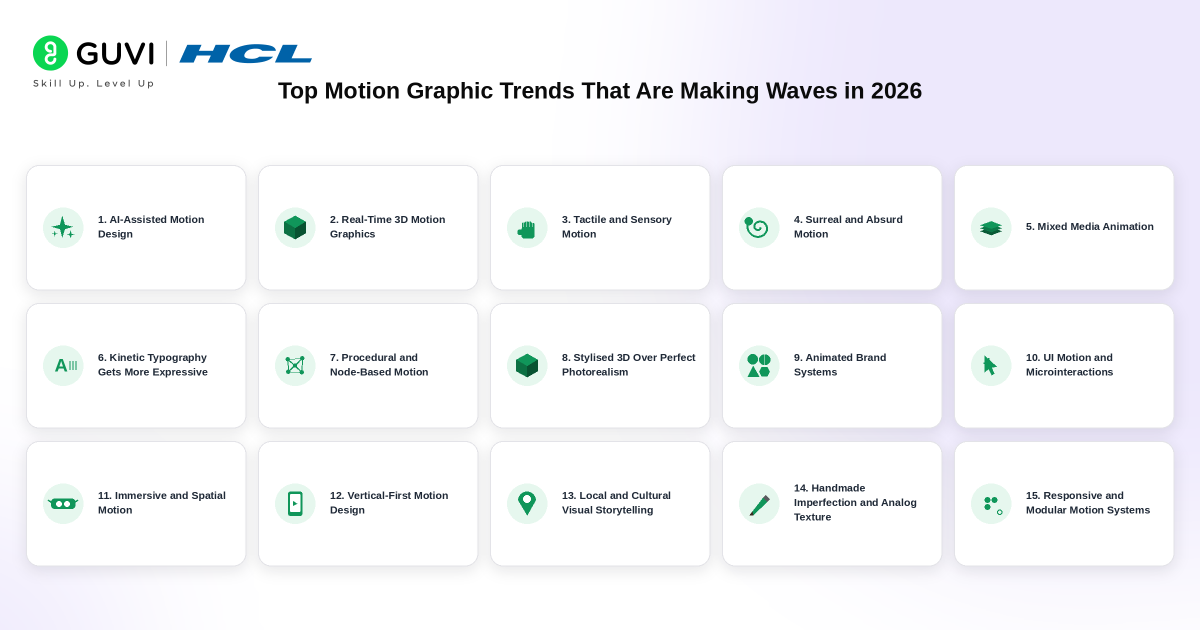
- Top Motion Graphic Trends That Are Making Waves in 2026
- AI-Assisted Motion Design
- Real-Time 3D Motion Graphics
- Tactile and Sensory Motion
- Surreal and Absurd Motion
- Mixed Media Animation
- Kinetic Typography Gets More Expressive
- Procedural and Node-Based Motion
- Stylised 3D Over Perfect Photorealism
- Animated Brand Systems
- UI Motion and Microinteractions
- Immersive and Spatial Motion
- Vertical-First Motion Design
- Local and Cultural Visual Storytelling
- Handmade Imperfection and Analog Texture
- Responsive and Modular Motion Systems
- Motion Graphics Tools Designers Should Know in 2026
- Top Motion Graphics Trends in India in 2026
- Motion Graphics Designer Salary in India in 2026
- Is AI Replacing Motion Graphic Designers?
- How to Use Motion Graphic Trends Without Copying Them
- Conclusion
- FAQs
- What are the biggest motion graphics trends in 2026?
- Is motion graphics in demand in 2026?
- Which software is best for motion graphics in 2026?
- Will AI replace motion graphic designers?
- What is the future of motion graphics?
Motion Graphics Trends in 2026: Quick Comparison
| Motion Graphic Trend | What Defines It | Best Used For |
| AI-Assisted Motion Design | Generative video and automated creative workflows | Concepts, storyboards, social content |
| Real-Time 3D | Interactive, high-quality rendering | Product films, virtual production, events |
| Tactile and Sensory Motion | Textures, depth and physical-looking surfaces | Advertising, fashion, lifestyle |
| Surreal Motion Design | Impossible scenes and playful transformations | Social campaigns, music, entertainment |
| Mixed Media Animation | 2D, video, illustration and 3D combined | Editorial and branded storytelling |
| Kinetic Typography | Text becomes the main moving visual | Reels, ads, explainers |
| Procedural Animation | Motion generated through systems and nodes | Complex animation and simulations |
| Stylised 3D | Expressive 3D rather than pure realism | Branding, products, social content |
| Animated Brand Systems | Motion built into brand identity | Logos, campaigns, digital products |
| UI Motion and Microinteractions | Small animations that communicate interface behaviour | Apps and websites |
| Immersive and Spatial Motion | Motion designed for 3D environments | XR, events, spatial interfaces |
| Vertical-First Motion | Animation composed specifically for mobile formats | Reels, Shorts, social ads |
| Local and Cultural Motion | Regional aesthetics and cultural references | Localised campaigns |
| Handmade and Imperfect Animation | Rough, organic and analog visual treatment | Fashion, music, editorial |
| Responsive Motion Systems | Adaptable animation built for multiple outputs | Large brand and content systems |
Top Motion Graphic Trends That Are Making Waves in 2026
1. AI-Assisted Motion Design
Artificial Intelligence is no longer limited to generating a strange image that designers use for inspiration. It is becoming part of the actual motion-design workflow.
Modern generative video systems can create clips from text or still images. Designers can specify camera movements, scene changes and visual direction before taking the generated material into a traditional editing or compositing workflow.
Adobe Firefly now supports text-to-video and image-to-video generation. It can also use a reference clip to reproduce camera movements such as pans, zooms and tilts. Runway’s Gen-4.5 similarly supports text-to-video and image-to-video generation with detailed control over camera choreography and sequences of events.
The real trend is therefore not AI replacing motion designers. It is designers using AI to speed up:
- Concept development
- Storyboarding
- Style exploration
- B-roll creation
- Background generation
- Visual experimentation
- Alternate versions of a scene
A strong motion designer still needs to control pacing, composition, storytelling and brand consistency.
2. Real-Time 3D Motion Graphics
Traditional 3D workflows often require designers to wait for scenes to render before reviewing the final result.
Real-time engines are changing that process.
Motion designers can now work with lighting, materials, environments and animation while seeing much closer to the final result immediately.
Unreal Engine 5.8 expanded real-time worldbuilding, lighting, character animation and virtual-production capabilities in 2026. Epic also describes it as the final planned major Unreal Engine 5 release before its development focus moves towards Unreal Engine 6.
Real-time 3D is especially useful for:
- Virtual production
- Broadcast graphics
- Product visualisation
- Event visuals
- Digital environments
- Interactive experiences
For designers who want to move beyond traditional 2D motion, real-time 3D is becoming an increasingly valuable skill.
Build practical multimedia and animation skills to understand and apply the latest motion graphics trends in 2026 with HCL GUVI’s Multimedia and Animation Course. Learn animation fundamentals, visual storytelling, design workflows, creative tools, and real-world motion design concepts through structured training designed for aspiring designers and creative professionals.
3. Tactile and Sensory Motion
Not everything in 2026 is becoming cleaner and more digital.
One of the year’s strongest creative directions is almost the opposite.
Designers are adding surfaces that appear soft, rough, wet, grainy, glossy or handmade. Movement reinforces these qualities through stretching, bouncing, melting and other physical behaviours.
Adobe describes this broader 2026 direction as “All the Feels”, where texture and motion help digital visuals create a stronger sensory impression.
For motion graphics, that can translate into:
- Fuzzy 3D lettering
- Liquid surfaces
- Inflatable typography
- Metallic distortion
- Paper textures
- Fabric simulation
- Grainy animation
It works particularly well for fashion, beauty, food and lifestyle campaigns where visual texture can make an otherwise flat screen feel more physical.
4. Surreal and Absurd Motion
A product floating through space is no longer unusual.
In 2026, surreal motion is becoming much stranger.
Designers are creating scenes where objects transform unexpectedly, proportions change and physical rules stop applying. AI video generation has made this type of experimentation easier because creators can explore ideas that would have required expensive VFX or 3D production in the past.
Adobe calls the wider creative trend Surreal Silliness, describing a move towards playful and deliberately unexpected visuals.
The best surreal motion does not feel random. The strange visual idea still needs to support the story or brand.
5. Mixed Media Animation
Mixed media remains strong, but it looks more sophisticated in 2026.
Instead of simply placing an illustration over a photograph, designers are blending:
- Live-action video
- Hand-drawn animation
- Photography
- 3D objects
- Scanned textures
- Typography
- AI-generated material
The contrast between these visual languages gives the animation personality.
Mixed media is particularly useful when a polished 3D render feels too commercial or a completely handmade animation feels too informal. Combining the two can create something distinctive.
This trend also overlaps with the renewed interest in collage and layered design identified in Adobe’s 2026 design forecast.
6. Kinetic Typography Gets More Expressive
Kinetic typography is not new. What is changing is how aggressively designers are treating the text itself as an animation system.
Words can stretch, compress, rotate, disappear or react to sound. Letters can become transitions between scenes rather than simply appearing on top of them.
This works particularly well for short-form content because the message remains visible even when viewers watch without sound.
Adobe Premiere’s June 2026 release even introduced single-word animated captions designed for fast-paced social video.
For motion designers, typography now needs to be considered during animation planning rather than added at the end.
Know More About: Typography in User Interfaces: Basic Guide for Beginners
7. Procedural and Node-Based Motion
Not every animation needs to be keyframed individually.
Procedural animation uses rules, parameters and node systems to generate or control movement. This becomes useful when a designer needs hundreds of objects, repeated patterns or physically influenced motion.
Blender 5.2 LTS pushes further in this direction through Geometry Nodes and experimental node-powered physics for areas such as hair and cloth simulation.
Procedural workflows are especially useful for:
- Particle systems
- Generative patterns
- Data-driven visuals
- Large object groups
- Physics-based animation
- Reusable motion systems
They also make it easier to create variations without manually rebuilding every animation.
8. Stylised 3D Over Perfect Photorealism
Photorealistic 3D is still important, especially for product visualisation. However, 2026 is not simply about making everything indistinguishable from a photograph.
Designers are also deliberately exaggerating materials and proportions.
Objects may appear inflated, toy-like, translucent or unusually soft. Lighting can be theatrical instead of realistic.
This gives 3D work a stronger creative identity.
Current tools support both directions. Blender’s latest 5.2 LTS includes updates across rendering, Geometry Nodes and procedural physics, while Cinema 4D 2026.3 continues expanding its 3D and Redshift workflows.
The strongest 3D work therefore does not necessarily ask, “Does this look real?”
A better question is, “Does this visual style support the idea?”
9. Animated Brand Systems
A logo animation is useful, but modern brand motion goes much further.
Brands increasingly need animation that remains recognisable across websites, apps, social content, presentations and video advertising.
That requires a motion system rather than one isolated animation.
A motion identity may define:
- How the logo enters
- How typography moves
- How transitions behave
- How shapes react
- Animation timing
- Repeating movement patterns
When these rules stay consistent, viewers can start recognising the brand through movement even before seeing its logo.
Also Read: Top 10 YouTube Channels to Learn Motion Graphics at Your Own Time
10. UI Motion and Microinteractions
Some of the most useful motion graphics are almost invisible.
A button changing state, a card expanding or a progress indicator moving can help users understand what an interface is doing.
These microinteractions make digital products feel responsive.
Motion is particularly useful for communicating:
- State changes
- Loading
- Navigation
- User feedback
- Hierarchy
- Progress
However, interface motion needs restraint. Animation should explain the interaction rather than slow it down.
Accessibility also matters. Designers should consider users who prefer reduced motion and ensure essential information does not depend entirely on animation.
Must Know About: Motion Graphics in UI/UX: Enhancing User Experience with Dynamic Visuals
11. Immersive and Spatial Motion
Motion design is gradually moving beyond the rectangular video frame.
Virtual production, immersive installations and spatial interfaces require animation that works inside an environment rather than only on a flat screen.
This changes how designers think about:
- Scale
- Depth
- Camera position
- Viewer movement
- Spatial typography
- Environmental transitions
Real-time tools such as Unreal Engine make these workflows more practical by allowing designers to build and preview complex environments interactively.
For motion designers interested in entertainment, experiential design or virtual production, understanding spatial animation can open new types of work.
Must Know About: Virtual Reality vs Augmented Reality: Important Things To Know

12. Vertical-First Motion Design
Vertical animation is no longer simply a horizontal video cropped to fit a phone.
Short-form platforms have made 9:16 composition its own design format.
A vertical frame changes where designers place:
- Faces
- Typography
- Products
- Captions
- Calls to action
It also affects the speed of movement because viewers encounter short-form content differently from traditional video.
Current creative tools increasingly accommodate this workflow. Runway Gen-4.5 supports 9:16 generated video, while Adobe Firefly supports social and vertical video workflows.
Designing specifically for the final screen produces much better results than creating one master animation and blindly resizing it.
13. Local and Cultural Visual Storytelling
Global design does not have to look culturally neutral.
One of Adobe’s major 2026 creative themes is Local Flavor, which focuses on real places, cultural references and regional creative identities.
For motion designers, this can mean incorporating:
- Regional typography
- Local illustration styles
- Architecture
- Craft traditions
- Cultural colour references
- Language-specific motion
- Familiar everyday environments
The goal is not to decorate a generic animation with cultural symbols. Strong localisation starts with understanding the audience and developing the visual idea around that context.
This trend is especially relevant in multilingual markets such as India.
14. Handmade Imperfection and Analog Texture
Perfect gradients and mathematically smooth animation can sometimes feel too sterile.
Motion designers are deliberately bringing imperfections back into digital work.
That may include:
- Hand-drawn lines
- Stop-motion movement
- Film grain
- Photocopied textures
- Rough masking
- Uneven typography
- Frame-by-frame animation
Adobe’s 2026 design forecast similarly points towards organic and imperfect creative work as audiences respond to visuals that feel less machine-perfect.
This does not mean abandoning digital tools. Many designers create the imperfections digitally or combine physical assets with digital compositing.
The result simply feels more human.
15. Responsive and Modular Motion Systems
Brands now need one creative idea to work across many formats.
The same campaign may appear as a website hero animation, vertical Reel, digital advertisement, presentation and in-store display.
Creating each version from scratch wastes time.
Responsive motion systems solve this by creating reusable components and animation rules that can adapt to multiple sizes and durations.
This changes how motion designers structure their projects. Instead of building one fixed composition, they need to think in terms of:
- Reusable components
- Flexible layouts
- Replaceable content
- Multiple aspect ratios
- Variable durations
- Consistent animation rules
This approach becomes increasingly useful as AI and automation make large-scale content variation easier.
Motion Graphics Tools Designers Should Know in 2026
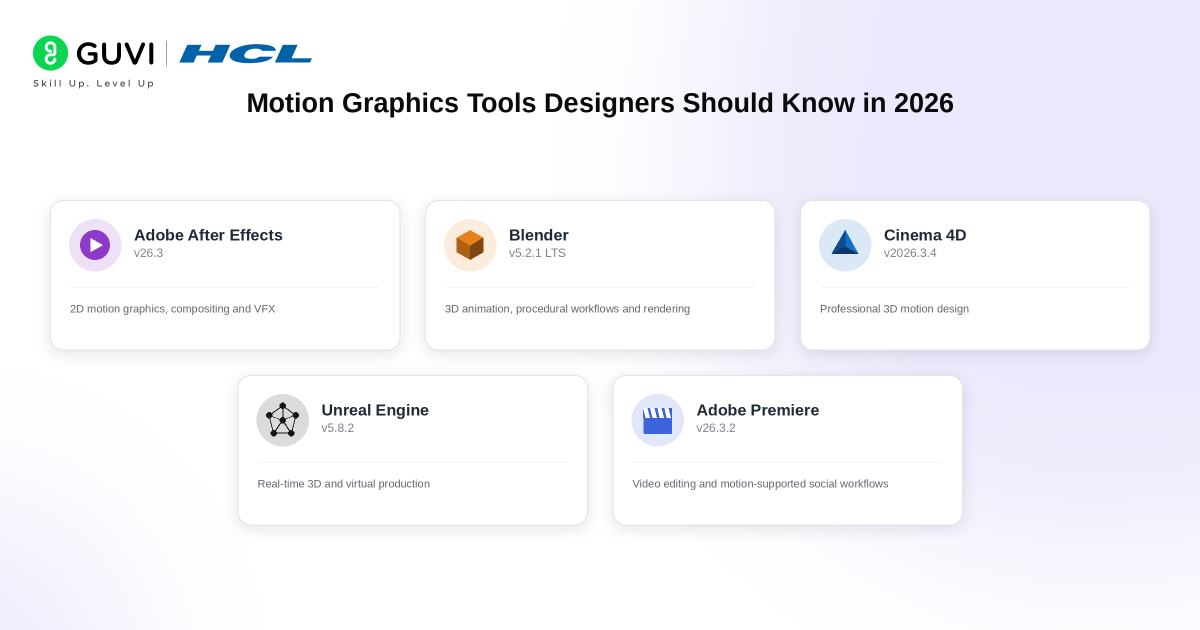
Motion graphics software is also changing quickly. As of August 2026, some of the major production tools include:
| Tool | Current 2026 Version | Best For |
| Adobe After Effects | 26.3 | 2D motion graphics, compositing and VFX |
| Blender | 5.2.1 LTS | 3D animation, procedural workflows and rendering |
| Cinema 4D | 2026.3.4 | Professional 3D motion design |
| Unreal Engine | 5.8.2 | Real-time 3D and virtual production |
| Adobe Premiere | 26.3.2 | Video editing and motion-supported social workflows |
Adobe After Effects 26.3 introduced features including Depth of Field in its Advanced 3D renderer and direct SVG-to-editable-shape workflows. Blender 5.2 LTS launched in July 2026 and is supported until July 2028. Unreal Engine 5.8 arrived in June, followed by the 5.8.2 hotfix in August.
Learning every tool is unnecessary. A beginner can start with one strong 2D motion tool and gradually add 3D or real-time software as projects become more complex.
Top Motion Graphics Trends in India in 2026
India’s motion-design market is being influenced by many of the same global technologies, but the way these trends appear locally is different.
Vertical-first motion is highly relevant because brands create large volumes of social and mobile advertising. Regional and culturally specific design is also becoming more valuable as campaigns adapt to different Indian languages and audiences.
Another growing area is 3D product visualisation. E-commerce, beauty, technology and consumer brands can create polished product films without relying entirely on physical shoots. Generative video is also making previsualisation and concept development faster.
For designers building careers in India, the most useful skill combination in 2026 is not simply knowing one piece of software. A stronger portfolio can demonstrate:
- After Effects animation
- Typography
- Visual storytelling
- 3D fundamentals
- Short-form content
- AI-assisted workflows
- Basic editing and compositing
Motion Graphics Designer Salary in India in 2026
Glassdoor reports an average base salary of around ₹5 lakh per year for Motion Graphics Designers in India, with a typical base-pay range of approximately ₹4 lakh to ₹7 lakh per year. Individual salaries vary considerably with experience, city, portfolio quality and specialisation.
Designers who combine motion graphics with 3D, VFX, product visualisation or advanced editing may qualify for a broader range of roles than someone working only with basic 2D animation.
Is AI Replacing Motion Graphic Designers?
AI is changing motion-design work, but current evidence points towards workflow redistribution rather than simple replacement.
Adobe’s 2026 research examined creative job postings and surveyed 1,433 working creatives along with 3,300 people training for creative careers. It found that AI skills were becoming more explicit in job requirements while creative professionals were incorporating AI into selected parts of their workflows. For motion designers, AI can handle or accelerate parts of ideation and asset generation.
It still does not remove the need to decide:
- What should move
- Why it should move
- How long the movement should last
- What emotion the scene should create
- Whether the animation matches the brand
The value of a designer therefore moves further towards creative direction, taste and storytelling as production tools become faster.
How to Use Motion Graphic Trends Without Copying Them
Motion graphic trends should guide your creative direction, not determine the final design. Before choosing a trend, define the message, target audience, platform and emotion you want the animation to create.
Then adapt the trend instead of reproducing it. Change the typography, colour palette, pacing, transitions, composition and visual treatment to match your own concept. For example, a surreal style may work well for entertainment or fashion, while procedural motion and clean 3D may suit technology or product-focused campaigns.
You can also combine two or more trends carefully. Mixed media can be paired with kinetic typography, while tactile textures can make 3D animation feel less polished and more distinctive. The goal is to use current visual language while keeping the execution connected to the brand or story.
Most importantly, avoid adding a trend only because it is popular. If the motion does not improve clarity, storytelling or audience engagement, it is better to leave it out. Strong motion design should still feel relevant after the trend itself becomes less popular.
Conclusion
Motion graphics in 2026 are moving in two directions at the same time. Technology is making animation faster and more sophisticated. AI can generate video. Real-time engines can create complex environments. Procedural tools can build animations that once required hours of manual work. Yet the visual trends gaining attention are often the ones that feel human, strange, tactile or culturally specific.
That is an important lesson for designers. The future of motion graphics is not about using every new tool or copying every visual trend. Learn what the technology makes possible. Then use it to create movement that supports the idea, fits the audience and gives the work its own identity.
FAQs
What are the biggest motion graphics trends in 2026?
Major motion graphics trends in 2026 include AI-assisted animation, real-time 3D, tactile visual styles, surreal motion, mixed media, expressive kinetic typography, procedural animation, immersive experiences and culturally localised design.
Is motion graphics in demand in 2026?
Motion graphics continues to be used across advertising, social media, entertainment, UI/UX, product marketing and digital content. Demand varies by industry and location, but designers who can combine animation with 3D, video editing and modern AI-assisted workflows have a broader range of applications for their skills.
Which software is best for motion graphics in 2026?
Adobe After Effects remains a major tool for 2D motion design and compositing. Blender and Cinema 4D are widely used for 3D, while Unreal Engine is useful for real-time 3D and virtual production. The best tool depends on the type of motion work you want to create.
Will AI replace motion graphic designers?
AI can automate parts of asset creation, concept generation and video production, but motion design also depends on storytelling, composition, timing and creative judgement. Current creative-industry research indicates that AI is changing how creative work is distributed rather than simply removing the role of human creators.
What is the future of motion graphics?
The future of motion graphics is moving towards a combination of AI-generated assets, real-time rendering, procedural animation and spatial experiences. At the same time, tactile textures, cultural specificity and handmade imperfections are growing as creators look for ways to make increasingly digital content feel distinctive and human.
Success Stories

About the Author
Vaishali
I'm a seasoned writer with four years of experience across technical, non-technical, and just about every genre or niche you can imagine. Adaptable and curious, I enjoy exploring new topics and making information engaging and easy to understand. Fueled by a steady stream of tea, I approach each project with creativity, reliability, and genuine enthusiasm for storytelling.
View all posts by Vaishali
Connect with me @





Did you enjoy this article?