


Career Articles
How to Learn SQL Python Power BI While Working an Eight or Nine-Hour Job
Is Data Analytics a Good Career for BFSI Professionals?
Reporting Analyst to Data Scientist: Is It the Natural Next Step?


Get In Touch For Details! Request More Information

Can Credit Analysts Transition into Data Science?
Oct 29, 2026 4 Min Read 22 Views
(Last Updated)
A credit analyst already does a slow, manual version of data science. You pull financials, build a view of risk, justify a recommendation, and defend it to a committee. The difference is that a data scientist does the same job with models that score thousands of borrowers at once.
So yes, credit analysts transition into data science more easily than most finance professionals, because credit risk is one of the oldest and best paid uses of machine learning. The shift needs Python, SQL, statistics, and a working grasp of modelling, but your domain judgement is the harder part and you already have it.
This guide skips the basics. It covers what credit analysts transition into, the roles that fit, the skill gap, a step by step roadmap, projects, and salaries in India.
Table of contents
- TL;DR Summary
- What is the Credit Analysts Transition into Data Science?
- Why Credit Analysts Transition Faster Than Most
- Roles Credit Analysts Transition Into
- Data Analyst or Data Scientist: Which First?
- Skills Credit Analysts Transition Needs
- Roadmap for Credit Analysts Transition
- Months 1 to 2: SQL and Python Basics
- Months 3 to 4: Statistics and Logistic Regression
- Months 5 to 7: Machine Learning and Validation
- Months 8 to 10: Portfolio and Applications
- Projects That Help Credit Analysts Transition
- Where Credit Analysts Transition Into Jobs
- Credit Analysts Transition Salary in India
- Salary by Role
- What This Means for Your Move
- 💡 Did You Know?
- Common Mistakes in Credit Analysts Transition
- Conclusion
- FAQs
- Can credit analysts transition into data science?
- How long does the credit analysts transition take?
- Do credit analysts transition into data science without a maths degree?
- Which roles suit the credit analysts transition best?
- Which programming language should credit analysts learn first?
TL;DR Summary
- What it is: Credit analysts transition into data science by moving from judging borrowers manually to building models that predict default, fraud, and customer behaviour.
- What transfers: Risk thinking, financial statement analysis, regulatory awareness, and committee level communication.
- What to learn: SQL, Python, statistics, then machine learning with a focus on classification.
- Best first roles: Credit risk analytics, credit risk modelling, and fraud analytics.
- Project idea: A loan default prediction model with a clear scorecard.
- Salary reality: Credit analysts average about ₹9 LPA, data analysts about ₹6.5 LPA, and senior data analysts about ₹11 LPA.
- Next step: Take one loan dataset and build a default model as your first project for credit analysts transition.
What is the Credit Analysts Transition into Data Science?
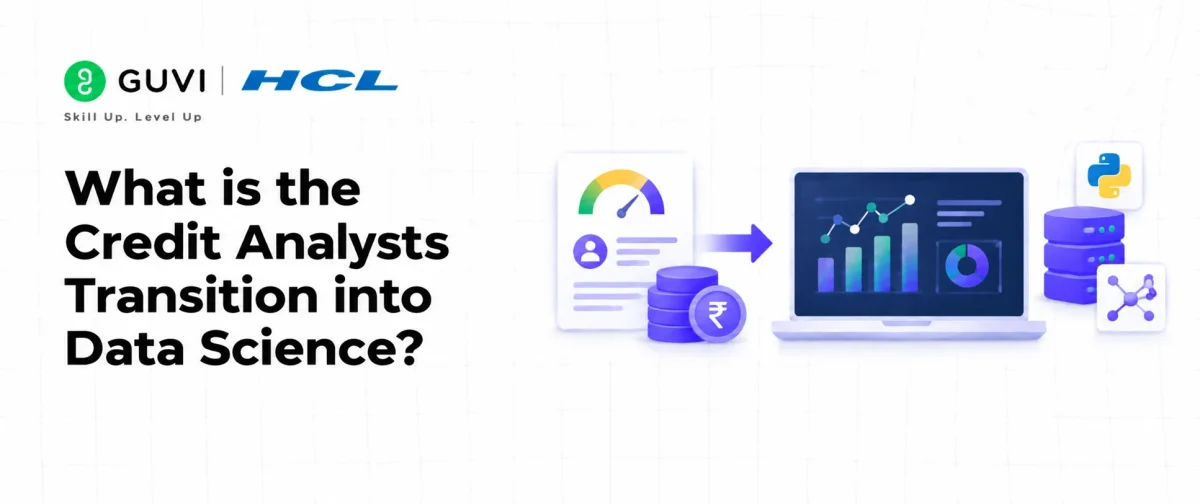
The credit analysts transition is a career move in which a credit or risk professional shifts from assessing borrowers by hand to building statistical and machine learning models that do it at scale. Credit analysts transition into roles such as credit risk modeller, risk analytics specialist, or data scientist in lending.
It is a natural path because banks and NBFCs already run on scorecards, probability of default models, and portfolio analytics. The credit analysts transition keeps your domain and adds the technical layer behind it.
If you want a structured path with mentors and projects, HCL GUVI’s Data Science Program, offered with IITM Pravartak, covers Python, SQL, statistics, and machine learning in weekday and weekend batches built for working professionals.
Why Credit Analysts Transition Faster Than Most
Domain knowledge is the slow part of data science, and credit analysts already have it. This table shows how your daily work maps to the field.
| Credit Analyst Skill | Data Science Equivalent |
|---|---|
| Reading financial statements | Feature engineering from raw data |
| Judging default risk | Classification modelling |
| Setting credit limits and policy | Scorecards and decision rules |
| Portfolio monitoring | Model monitoring and drift tracking |
| Covenant and early warning checks | Anomaly detection |
| Credit committee notes | Model documentation and storytelling |
| RBI and Basel awareness | Model governance and explainability |
That last row matters. Regulated lenders need models they can explain, which makes your compliance instinct a real advantage for credit analysts transition into data science.
Roles Credit Analysts Transition Into
Not every data science role fits equally. The table compares the most common destinations.
| Role | Focus | Fit for Credit Analysts |
|---|---|---|
| Credit Risk Analytics Analyst | Portfolio reporting, risk metrics | Very high, closest step |
| Credit Risk Modeller | Scorecards, PD, LGD, EAD models | Very high |
| Fraud Analytics Analyst | Anomaly and fraud pattern detection | High |
| Data Scientist in lending | End to end ML for credit decisions | High after upskilling |
| Business Intelligence Analyst | Dashboards and reporting | High, easy first step |
| General Data Scientist | Varied domains | Medium |
Most credit analysts transition first into risk analytics or modelling, then widen. The move from financial analyst to data analyst follows a similar pattern, where domain depth shortens the learning curve.
Data Analyst or Data Scientist: Which First?
Many credit analysts transition through an analyst role before a data scientist role. The difference between data analyst and data scientist demand helps you choose the entry point.
| Factor | Data Analyst First | Data Scientist Directly |
|---|---|---|
| Time to ready | 4 to 6 months | 9 to 12 months |
| Maths depth | Moderate | High |
| Competition | Higher | Lower for risk domain profiles |
| Risk of rejection | Lower | Higher without projects |
| Long term ceiling | Strong, with upskilling | Strong |
For most people, the analyst route is safer. If you want to compare paths for finance backgrounds more closely, see data analytics versus data science for finance.
Skills Credit Analysts Transition Needs
The skill list is long, but the order matters. This table shows the priority for credit analysts transition into data science.
| Priority | Skill | Why It Matters | Target Depth |
|---|---|---|---|
| 1 | SQL | Pull loan and repayment data | Joins, CTEs, window functions |
| 2 | Python | Modelling and automation | pandas, scikit-learn |
| 3 | Statistics | Core of every credit model | Distributions, hypothesis tests |
| 4 | Logistic regression | Standard credit model | Coefficients, WOE, IV |
| 5 | Tree based models | Higher accuracy | Random forest, gradient boosting |
| 6 | Model evaluation | Risk models need strong validation | AUC, KS, Gini, calibration |
| 7 | Explainability | Regulators expect it | SHAP, feature importance |
Many worry about coding. The question is covered in whether coding is required for data science, and the short answer is that modelling needs Python but not software engineering depth.
Start by writing your usual data pulls as SQL queries with examples, then work through the Python interview questions that data roles ask most often.
Roadmap for Credit Analysts Transition
This roadmap assumes 8 to 10 hours of study a week alongside your current job.
1. Months 1 to 2: SQL and Python Basics
Rebuild a monthly portfolio report with SQL and pandas. Learn joins, groupby, and plotting.
2. Months 3 to 4: Statistics and Logistic Regression
Learn distributions, confidence intervals, and logistic regression. Build a simple default model on public loan data.
3. Months 5 to 7: Machine Learning and Validation
Add tree based models, cross validation, and the metrics credit teams use, such as AUC, KS, and Gini. Compare your models against a scorecard baseline.
4. Months 8 to 10: Portfolio and Applications
Finish two projects, document them like a model validation report, and apply for risk analytics and modelling roles. Use the data scientist resume and portfolio guide to present your work.

Want to follow this roadmap with mentors and live projects? HCL GUVI’s Data Science Program covers the same sequence, from SQL and Python to machine learning, with placement support.
Projects That Help Credit Analysts Transition
Projects are the proof recruiters want. These three fit the credit domain and use public data.
| Project | What You Build | What It Shows |
|---|---|---|
| Loan default prediction | Logistic regression and gradient boosting model | Core credit modelling |
| Credit scorecard | WOE binning, IV, scorecard points | Industry standard method |
| Fraud detection | Anomaly model on transaction data | Handling imbalanced data |
Document each project like a model validation note: objective, data, method, results, limits, and monitoring plan. That format is familiar to you and impresses hiring managers. For more ideas, see these SQL project ideas.
Use public or synthetic data only and never take real borrower records out of your employer’s systems.
Where Credit Analysts Transition Into Jobs
Demand for credit risk and data skills is spread across several employer types.
| Employer Type | Typical Work |
|---|---|
| Banks and NBFCs | Scorecards, collections, portfolio analytics |
| Fintech lenders | Underwriting models, fraud, alternative data |
| Credit bureaus | Bureau scores and risk analytics |
| Rating agencies | Quantitative credit research |
| Global capability centres | Risk modelling and validation |
| Consulting and Big 4 firms | Risk advisory and model validation |
Large technology employers also hire data scientists, as listed among the top product based companies for data scientists, though credit domain roles are most common in lenders and fintechs.
Credit Analysts Transition Salary in India
Pay is a major reason for the move, though the picture is more nuanced than for other finance roles. These are averages for India, and offers vary by city, employer, and skill depth.
1. Salary by Role
| Role | Average Annual Salary |
|---|---|
| Financial Analyst | ₹5.8 LPA |
| Data Analyst | ₹6.5 LPA |
| Business Intelligence Analyst | ₹8.9 LPA |
| Credit Analyst | ₹9 LPA |
| Senior Data Analyst | ₹11 LPA |
| Business Intelligence Manager | ₹17.4 LPA |
| Analytics Manager | ₹23.8 LPA |
2. What This Means for Your Move
An average data analyst earns less than an average credit analyst, so a jump straight to an analyst role can mean a pay dip. The gains come at senior levels: a senior data analyst earns about 22% more than the average credit analyst, and an analytics manager earns about 164% more.
This is why credit analysts transition best when they enter at a risk analytics or modelling level, not at a generic entry role. Your domain depth lets you negotiate a higher starting point.
💡 Did You Know?
- Logistic regression remains a core technique in many credit scorecards because its predictions are relatively easy for regulators and credit committees to interpret.
- Gini and Kolmogorov-Smirnov (KS) statistics are commonly used by credit risk teams to evaluate how well a model distinguishes between good and bad borrowers.
- Microsoft’s PL-300 exam is the official certification exam for the Power BI Data Analyst Associate credential.
Common Mistakes in Credit Analysts Transition
- Jumping to deep learning: Credit teams prize explainable models. Master logistic regression and gradient boosting first.
- Ignoring your domain: Generic projects blend in. Credit specific projects set you apart.
- Skipping SQL: Loan and repayment data sit in databases, so SQL gives the fastest return.
- Using real borrower data: This is regulated. Use public or synthetic data only.
- Accepting a pay dip needlessly: Target risk analytics or modelling roles, not generic entry positions.
Conclusion
Credit analysts transition into data science with a real head start: risk judgement, financial analysis, and regulatory awareness. Add SQL, Python, statistics, and one or two credit specific projects, and you become the person who builds the models behind lending decisions.
If you are ready to build those skills with mentors and projects, explore HCL GUVI’s Data Science Program and start turning your credit experience into a data science career.
If you are also weighing wider options, the career options for finance professionals are worth a look.
FAQs
1. Can credit analysts transition into data science?
Yes. Credit analysts transition well because credit risk already relies on statistical models, and your domain knowledge is hard to teach. You need to add SQL, Python, statistics, and machine learning.
2. How long does the credit analysts transition take?
Most working professionals need 4 to 6 months for an analyst role and 9 to 12 months for a data scientist role, with 8 to 10 hours of study a week.
3. Do credit analysts transition into data science without a maths degree?
No. You need working statistics, such as distributions, hypothesis tests, and regression, not a degree. Credit teams care more about modelling judgement and explainability.
4. Which roles suit the credit analysts transition best?
Credit risk analytics, credit risk modelling, and fraud analytics are the closest fits. Lending focused data scientist roles come next after upskilling.
5. Which programming language should credit analysts learn first?
Learn SQL first, then Python. SQL pulls loan data and Python builds the models. R is used in some banks, but Python covers more roles.
Success Stories

About the Author
Jebasta
I translate the language of data into stories that anyone can understand. As a writer with a data science background, I simplify analytics, AI, and decision-making so beginners and enthusiasts can confidently explore the world of data.
View all posts by Jebasta
Connect with me @













Did you enjoy this article?