


Career Articles
Deloitte India Hiring Process 2026: Best Guide
Deloitte NLA Interview Experience 2026: Rounds, Questions and Preparation - Best Guide
HCL Placement Paper: Sample Quantitative Aptitude Questions With Solutions
HCL Eligibility Criteria 2026: A Complete Fresher Hiring Guide


Get In Touch For Details! Request More Information
HCL TechBee Pros and Cons: Is It Worth Joining After Class 12?
Sep 28, 2026 4 Min Read 41 Views
(Last Updated)
Table of contents
- TL;DR
- Introduction
- What Is the HCL TechBee Program?
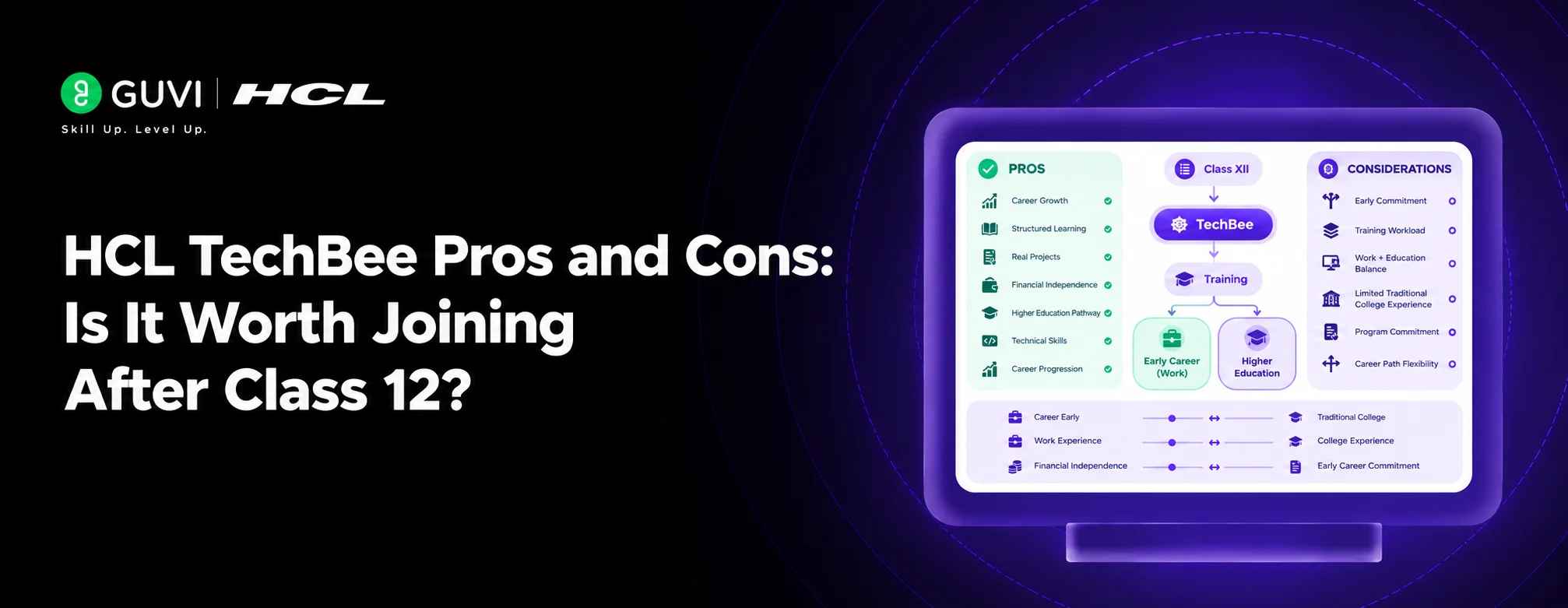
- HCL TechBee Pros and Cons at a Glance
- What Are the Major HCL TechBee Advantages?
- You Gain Work Experience Early
- You Can Earn While Continuing Your Education
- Training Goes Beyond Coding
- What Are the Major HCL TechBee Disadvantages?
- The Program Has a Significant Upfront Cost
- Work and Higher Education Can Be Demanding
- You Specialize Earlier
- What Does the HCL TechBee Career Path Look Like?
- From Class 12 to an Entry-Level Role
- A Career Scenario to Consider
- Who Should Consider HCL TechBee?
- Common Mistakes Students Make Before Joining TechBee
- Looking Only at the “Job Assurance” Message
- Comparing Only the First Salary
- Ignoring the Work-Study Load
- Not Reading the Latest Terms
- Conclusion
- FAQs
- Is the HCL TechBee program good after Class 12?
- What is the duration of HCL TechBee?
- What stipend does HCL TechBee offer?
- What are the main HCL TechBee disadvantages?
- Can I pursue a degree after HCL TechBee?
- What jobs are available through HCL TechBee?
- Is TechBee better than a regular engineering degree?
TL;DR
- Early IT entry: Start building industry experience soon after Class 12.
- 12-month training: Combines classroom learning with on-the-job exposure.
- Earn while training: Get a ₹10,000 monthly stipend during the internship phase.
- Work + study: Pursue higher education while building professional experience.
- Key benefits: Early exposure, practical skills, structured training, and career opportunities.
- Key drawbacks: Program fees, work-study pressure, early specialization, and less traditional campus life.
- Best suited for: Students who are confident about pursuing an IT career early.
Introduction
If you have just completed Class 12, the HCL TechBee pros and cons matter because the program asks you to make a career decision much earlier than the conventional engineering or undergraduate route.
TechBee offers a 12-month pathway into entry-level technology and digital-support roles at HCLTech, followed by opportunities to work while pursuing higher education. That early experience can be valuable, but the program is not automatically the right alternative to college for every student.
What Is the HCL TechBee Program?
The HCL TechBee program is HCLTech’s early-career pathway for eligible Class 12 graduates. Candidates complete 12 months of training covering IT foundations, job-specific skills, professional development, and on-the-job experience before moving into eligible full-time roles after successful completion.
HCLTech currently operates with more than 223,000 employees across 60 countries, giving TechBee participants exposure to the environment of a large global technology company, according to the HCLTech company overview.
HCL TechBee Pros and Cons at a Glance
The easiest way to evaluate TechBee is to compare what you gain with what you give up.
| Factor | Advantage | Potential Disadvantage |
| Career start | Enter the technology workforce after Class 12 | Career direction is chosen relatively early |
| Training | 12 months of structured technical and professional training | Requires sustained performance before full-time employment |
| Experience | On-the-job training includes exposure to live HCLTech projects | Less conventional college-campus exposure |
| Earnings | ₹10,000/month stipend during internship | Stipend is not equivalent to a full-time salary |
| Higher education | Degree opportunities through partner institutions while working | Balancing employment and academics can be demanding |
| Cost | Creates a defined training-to-career pathway | Current listed program fees are substantial |
| Career exposure | Entry-level opportunities across software, infrastructure, testing and related functions | Initial role flexibility may be narrower than exploring careers through a traditional degree |
According to the official HCL TechBee program page, the program currently lists fees of ₹1.80 lakh for IT Services and ₹0.81 lakh for Business Process Operations, along with a ₹10,000 monthly stipend during the internship. Because compensation figures can change, and the current page contains differing figures across sections, candidates should verify the salary stated in their latest admission and employment documents.
What Are the Major HCL TechBee Advantages?
The strongest HCL TechBee benefits come from combining skills, experience, income, and education earlier than the traditional college-first route.
1. You Gain Work Experience Early
TechBee includes 6–9 months of classroom training followed by 3–6 months of on-the-job training. During the latter phase, candidates can work on live HCLTech projects.
That matters because software and application developers are among the technology roles the World Economic Forum identifies as fast-growing through 2030.
2. You Can Earn While Continuing Your Education
One of the biggest HCL TechBee advantages is the work-integrated education route. The current program lists higher-education opportunities involving institutions including BITS Pilani, IIT Guwahati, IIIT Kottayam, SASTRA University, Amity University Online and IIM Sirmaur.
This can help you build professional experience while progressing academically instead of treating education and employment as completely separate stages.
3. Training Goes Beyond Coding
The curriculum includes IT fundamentals, job-specific training, simulations, case-based learning, communication, professional grooming and coaching.
That combination is relevant because the World Economic Forum reports that nearly 40% of job skills are expected to change by 2030, while technical skills and human capabilities such as analytical thinking and resilience are increasing in importance.
TechBee started with a pilot batch of just 80 Class 12 students. By 2022, HCLTech was taking thousands of school-leavers into the program, showing how an experiment with a small cohort evolved into a much larger early-career pathway.
What Are the Major HCL TechBee Disadvantages?
A useful HCL TechBee review should examine the constraints just as carefully as the benefits. TechBee is a structured alternative career path, not a shortcut that removes the need for hard work or further education.
1. The Program Has a Significant Upfront Cost
The current official page lists fees of ₹1.80 lakh for IT Services and ₹0.81 lakh for Business Process Operations.
Before enrolling, compare the total cost with your family budget, financing terms, expected salary, higher-education expenses, and alternative college or training routes.
2. Work and Higher Education Can Be Demanding
After entering employment, pursuing a degree alongside a full-time role requires disciplined time management.
A TechBee participant profiled by HCLTech also acknowledged missing aspects of traditional campus life while following the work-and-study route. That trade-off may matter if campus activities, clubs, networking, research, or a conventional residential college experience are priorities for you.
3. You Specialize Earlier
TechBee can accelerate your entry into IT, but early specialization is not always an advantage.
If you are still deciding between computer science, electronics, design, business, research, or another field, a broader undergraduate experience may give you more time to explore before committing to one professional track.
What Does the HCL TechBee Career Path Look Like?
The HCL TechBee career path is structured rather than open-ended. Knowing the stages beforehand helps you judge whether the pace suits you.
From Class 12 to an Entry-Level Role
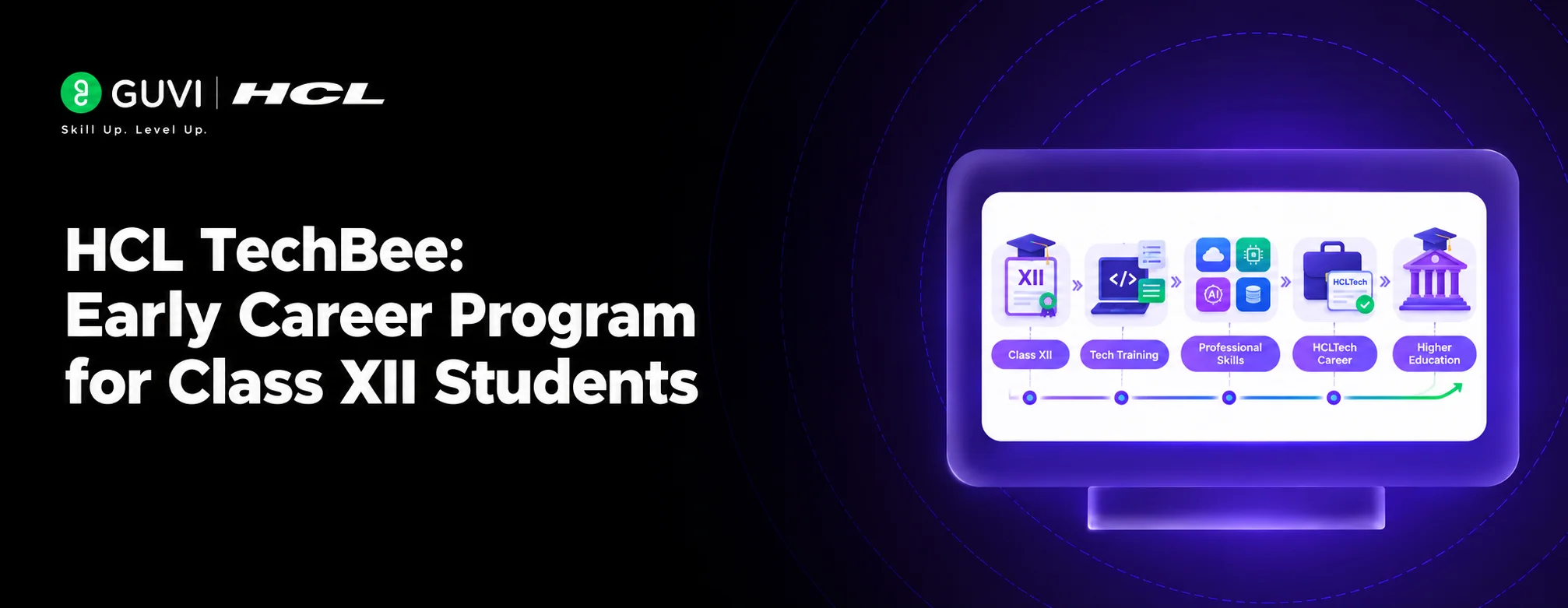
The typical route is:

- Meet eligibility requirements and complete the selection process.
- Complete 6–9 months of classroom training.
- Complete 3–6 months of on-the-job training.
- Successfully finish the 12-month program.
- Move into an eligible full-time HCLTech role.
- Pursue an approved higher-education program while working.
Current HCL TechBee career opportunities include entry-level work across Software Engineering, Infrastructure Management, Test Engineering, Design Engineering, and Digital Process Operations.
A Career Scenario to Consider
Imagine two students completing Class 12 together. One enters a conventional four-year degree, while the other follows TechBee and begins accumulating industry experience earlier.
The TechBee learner may have more workplace exposure after several years, while the conventional student may have broader campus, academic, internship, and placement experiences. Neither route guarantees stronger long-term outcomes; your skills, degree choice, performance, projects, and career decisions still matter.
Who Should Consider HCL TechBee?
TechBee can make practical sense if you already have a strong interest in technology, prefer hands-on learning, want early professional exposure, and are comfortable studying alongside work.
It may be less suitable if you want a traditional residential college experience, need several years to explore different career fields, or prefer completing your undergraduate degree before entering full-time employment.
Common Mistakes Students Make Before Joining TechBee
These mistakes can turn a potentially suitable program into a poor personal fit.
1. Looking Only at the “Job Assurance” Message
Do not interpret job assurance as permission to ignore performance requirements. The official pathway ties progression to successful completion of training. Review the current offer, training conditions, assessment requirements, and employment terms before paying any fee.
2. Comparing Only the First Salary
A starting salary tells you very little about a 10-year technology career. Compare the skills you will learn, degree options, projects, role exposure, future mobility, and your ability to keep upskilling.
3. Ignoring the Work-Study Load
Working and studying together sounds efficient, but it also requires consistent discipline. Ask yourself whether you can handle deadlines, assessments, professional responsibilities, and academic coursework at the same time.
4. Not Reading the Latest Terms
Program fees, eligibility criteria, salary figures, university partnerships, and roles can change. In fact, HCL TechBee’s current page itself displays different salary figures in different sections. Treat the latest official admission and employment documents as decisive rather than relying on an old review or social-media post.
Whichever career path you choose after Class 12, practical skills can help you prepare for real-world technology roles. Explore the HCL GUVI premium career programs such as the Software and AI Engineer Programme where you’ll get structured, career-focused learning, or build full-stack skills. You can also choose from a wide range of self-paced tech courses for a head-start, before you move into your preferred career domain..
Conclusion
The HCL TechBee pros and cons show why the program can be attractive without being the universal answer after Class 12. Its major strengths are early industry exposure, structured technical training, internship earnings, HCLTech career opportunities, and the ability to combine employment with higher education. Its trade-offs include program fees, an intensive work-study schedule, earlier career specialization, and less exposure to conventional campus life.
Before choosing, compare the latest TechBee offer with your preferred undergraduate options, finances, learning style, and long-term career goals. The right route is the one that develops both your qualifications and relevant skills sustainably.
FAQs
1. Is the HCL TechBee program good after Class 12?
It can suit students who want early IT experience and are comfortable combining employment with higher education. The HCL TechBee pros and cons should be compared with your college alternatives before deciding.
2. What is the duration of HCL TechBee?
The current HCL TechBee program lasts 12 months, combining 6–9 months of classroom learning with 3–6 months of on-the-job training.
3. What stipend does HCL TechBee offer?
The current official program page states that candidates receive ₹10,000 per month during the internship.
4. What are the main HCL TechBee disadvantages?
The main considerations are program fees, the workload of combining employment with higher education, early career specialization, and reduced exposure to conventional campus life.
5. Can I pursue a degree after HCL TechBee?
Yes. The program lists higher-education opportunities with institutions including BITS Pilani, IIT Guwahati, IIIT Kottayam, SASTRA University, Amity University Online, and IIM Sirmaur. Specific eligibility depends on the program and institution.
6. What jobs are available through HCL TechBee?
The official site lists entry-level opportunities across Software Engineering, Infrastructure Management, Test Engineering, Design Engineering, and Digital Process Operations.
7. Is TechBee better than a regular engineering degree?
They are different pathways. TechBee emphasizes early employment and work-integrated education, while a conventional engineering degree generally provides a more traditional academic and campus experience. Compare curriculum, cost, degree, career flexibility, and learning style.
Success Stories













Did you enjoy this article?