


Artificial Intelligence and Machine Learning Articles
What is Contrastive Learning Explained: A Complete Guide
Autoencoders Explained: Compression and Reconstruction


Get In Touch For Details! Request More Information
AI in Legal Tech: Contract Review and Case Research
Aug 27, 2026 5 Min Read 35 Views
(Last Updated)
AI in Legal Tech is transforming how law firms and legal departments handle contract review and case research, reducing manual work by 50–90% while improving accuracy.
Legal AI tools can now analyze 40-page contracts in 8–12 minutes versus 3–4 hours manually, and cut associate research hours by 60–70%.
This guide explains how AI in Legal Tech works for contract review and case research, the measurable benefits, leading tools, and practical implementation steps.
Table of contents
- Direct Answer
- TL;DR Summary
- What Is AI in Legal Tech?
- Why AI Matters for Legal Now
- AI in Legal Tech: Contract Review
- How AI Contract Review Works
- AI Contract Review Capabilities
- Measurable Benefits of AI Contract Review
- How AI Legal Research Works
- AI Legal Research Capabilities
- Leading AI Legal Research Tools
- Implementation Roadmap for AI in Legal Tech
- Best Practices for AI Contract Review
- Best Practices for AI Legal Research
- Implementation Steps
- Common Mistakes to Avoid
- Conclusion
- FAQs
- What is AI in Legal Tech?
- How does AI contract review work?
- Can AI replace lawyers for legal research?
- What are the benefits of AI in legal contract review?
- Which AI tools are best for legal work?
- Is AI legal research reliable?
Direct Answer
AI in Legal Tech for contract review and case research uses natural language processing, machine learning, and legal-specific large language models to automate document analysis, clause extraction, risk identification, and legal research. AI contract review systems identify clause deviations from playbooks, flag risk issues, suggest redlines with justifications, and generate summaries of key terms. AI legal research platforms analyze millions of cases, statutes, and regulations to find relevant precedent in minutes, generating research memos with citations that attorneys must verify.
TL;DR Summary
- AI in Legal Tech reduces contract review time by 50–90% and associate research hours by 60–70%.
- AI contract review identifies clause deviations, flags risks, suggests redlines, and generates summaries.
- AI legal research finds relevant precedent in minutes from millions of cases and statutes.
- Leading tools include Kira Systems, Luminance, CoCounsel, Harvey AI, and Casetext.
- Implementation requires verified databases, citation verification, and attorney oversight.
What Is AI in Legal Tech?
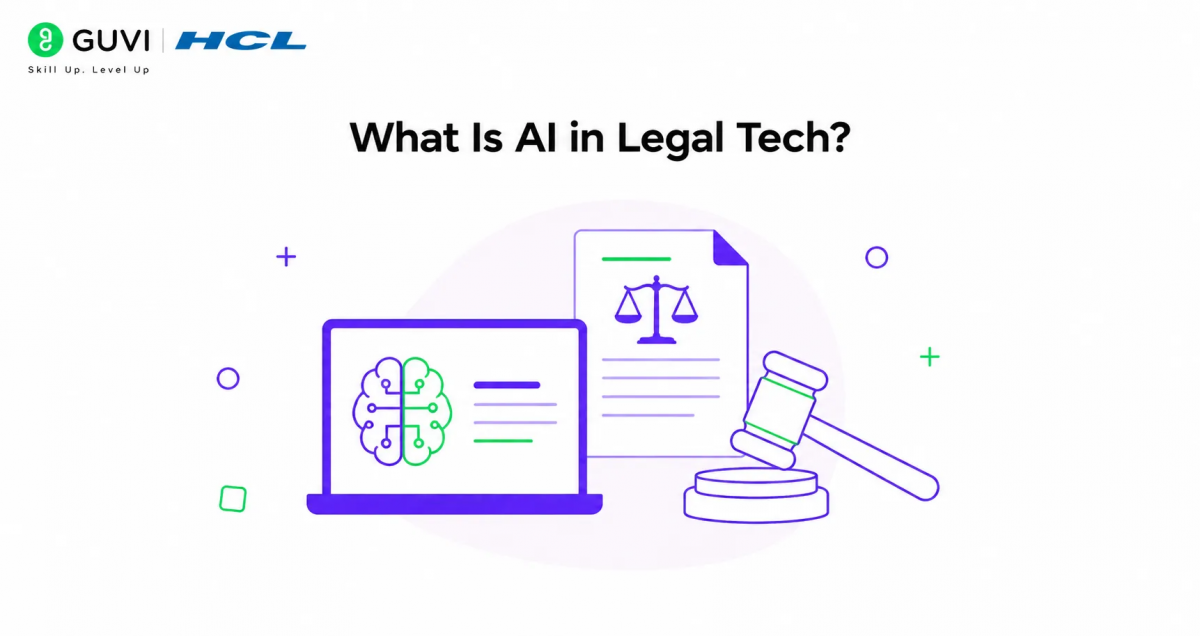
AI in Legal Tech refers to artificial intelligence applications designed specifically for legal work, including document search, analytics, automation, contract review, legal research, and compliance monitoring.
Legal AI is a broad umbrella for software that assists legal work, including document search, analytics, and automation.
AI legal agents are autonomous software systems that use large language models and multi-agent architectures to perform legal tasks contract analysis, case research, compliance monitoring, and document drafting with minimal human intervention, operating within defined legal workflows.
Why AI Matters for Legal Now
The legal industry faces increasing pressure to reduce costs, improve turnaround times, and handle growing document volumes. AI addresses these challenges by automating routine tasks while allowing attorneys to focus on high-value strategic work.
Recent data shows legal teams using AI reduce contract review time by 45–90%, with per-contract costs dropping from $400–$800 (junior associate manual review) to $80–$150 (AI agent plus senior attorney review gate).
AI in legal tech uses NLP and LLMs to auto-extract clauses, flag risks, and suggest edits in contracts, while AI research assistants surface relevant cases, statutes, and precedents from massive corpora in seconds. Master AI & ML at HCL GUVI: Artificial Intelligence and Machine Learning.
AI in Legal Tech: Contract Review
How AI Contract Review Works
AI contract review is the use of artificial intelligence to assist legal professionals in reading, analyzing, and marking up contracts.
A typical contract review pipeline runs four agents in sequence: a document ingestion agent that reads and chunks the file, an extraction agent that identifies clause categories against a defined playbook, a cross-reference agent that checks jurisdiction-specific statutes, and a drafting agent that produces the summary memo.
The exact workflow an AI agent follows on a commercial services agreement:
- Ingest and parse the document
- Extract key clause categories liability cap, indemnification, IP ownership, termination, governing law
- Compare each clause against the firm’s pre-loaded playbook or market-standard benchmarks
- Flag deviations with risk classification (high/medium/low)
- Generate a redline draft with suggested alternative language
- Produce an executive summary memo
AI Contract Review Capabilities
AI contract review software can identify clause deviations from a playbook, flag risk issues, suggest redlines with justifications, and generate summaries of key terms.
Seven ways AI accelerates contract review:
- Clause identification: Automatically identifies and categorizes all clauses in a contract
- Risk flagging: Highlights unusual clauses and deviations from standard terms
- Redline suggestions: Provides alternative language with justifications
- Compliance checking: Verifies contracts against regulatory requirements
- Obligation tracking: Identifies and tracks contractual obligations and renewal dates
- Summary generation: Creates executive summaries of key terms
- Playbook enforcement: Ensures contracts align with firm or company standards
Measurable Benefits of AI Contract Review
| Metric | Improvement |
| Contract Review Time | 50–90% reduction |
| Processing Time | Up to 90% decrease |
| Quarterly Throughput | Doubled |
| Error Detection | 23% more risky clauses caught |
| Per-Contract Cost | $400–$800 → $80–$150 |
| Review Duration | 8 hours → 1.5 hours (average) |
AI typically reduces contract review time by 50–70%, with many organizations achieving up to 90% decreases in processing time and doubling quarterly contract throughput.
AI catches 23% more risky clauses than manual review and reduces contract review time from 8 hours to 1.5 hours per contract on average.
How AI Legal Research Works
Generative AI in Law refers to AI systems that automate legal research, draft contracts, analyze documents, predict case outcomes, and generate legal memoranda, transforming legal practice from manual document review to AI-assisted workflows.
AI-powered legal research platforms analyze millions of cases, statutes, regulations, and secondary sources to find relevant precedent in minutes. These systems understand legal concepts, identify analogous cases across jurisdictions, and surface overlooked authority that traditional keyword searches miss.
AI legal research workflow:
Step 1: Ask for an issue outline and jurisdictional hooks. Have AI break the question into elements, defenses, and procedural standards.
Step 2: Require citations and quotations Force the system to include citations and identify what it believes is the controlling authority.
Step 3: Verify every authority in your primary research system. Confirm the case exists, the holding matches, and any quote is accurate.
Step 4: Shepardize/KeyCite. Make sure the authority is still good law and hasn’t been limited or overruled.
Step 5: Attorney writes final analysis and applies the facts
AI Legal Research Capabilities
AI legal research tools perform multiple functions:
- Natural language queries: Search using plain English questions instead of keywords
- Case law analysis: Find relevant cases that keyword search would miss
- Statute and regulation search: Comprehensive coverage of statutory law
- Brief outline generation: Create structured outlines from case descriptions
- Research memo drafting: Generate preliminary research memos with citations
- Analogous case identification: Find similar cases across jurisdictions
- Citation verification: Link to actual cases and verify authority
AI-powered legal search understands legal concepts, not just keywords, and generates brief outlines from case descriptions.
Leading AI Legal Research Tools
| Tool | Provider | Key Features | Best For |
| CoCounsel | Thomson Reuters | GPT-4-powered searches case law/statutes/regulations, generates research memos with citations | Legal research assistant |
| Harvey AI | Harvey AI | Purpose-built legal AI, natural language queries, used by elite firms | Comprehensive legal work |
| Casetext (Parallel) | Thomson Reuters | AI-powered legal search, understands concepts, generates brief outlines | Case research |
| Westlaw Precision | Thomson Reuters | AI-enhanced legal research with verified databases | Traditional research enhancement |
| Lexis+ AI | LexisNexis | AI legal research with citation verification | Research and drafting |
CoCounsel by Thomson Reuters is an AI legal research assistant powered by GPT-4 with legal-specific training that searches case law, statutes, and regulations and generates research memos with citations.

Harvey AI is a purpose-built legal AI used by Allen & Overy and other elite firms with natural language queries for legal research.
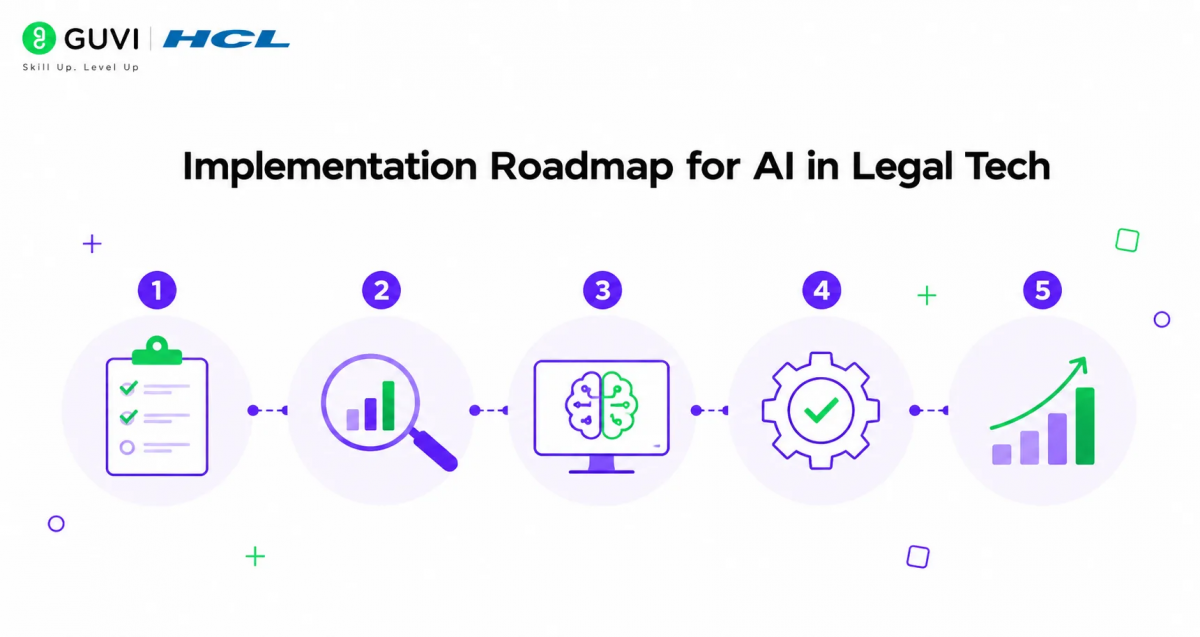
Implementation Roadmap for AI in Legal Tech
Best Practices for AI Contract Review
Seven-step workflow for AI contract review:
- Set the scope: Define what types of contracts and clauses to review
- Build a clause and risk taxonomy: Create your firm’s playbook and risk classifications
- Run AI extraction and summaries for first pass: Let AI do initial analysis
- Validate on a sample set: Check AI accuracy on representative contracts
- Apply escalation rules: Define when human review is required
- Produce defensible deliverables: Ensure outputs meet legal standards
- Keep an audit trail: Document all AI-assisted decisions
Best Practices for AI Legal Research
Critical safeguards for AI legal research:
Problem: AI hallucination and fake citations.
Solution:
- Use legal-specific AI tools with verified databases (Casetext, Lexis, Westlaw, Harvey AI) that link to actual cases
- ALWAYS verify every citation independently
- Never submit AI-generated briefs without attorney verification
- Use Shepard’s/KeyCite to verify cases are real and still good law
Implementation Steps
If you’re evaluating adoption, the next steps are practical:
- Create an internal AI usage policy that defines what’s allowed, what requires approval, and what must be verified
- Run a controlled pilot in a high-volume workflow like NDA review or diligence extraction
- Build quality control into the workflow with sampling, confidence thresholds, escalation rules, and citation verification gates
AI in legal tech uses NLP and LLMs to auto-extract clauses, flag risks, and suggest edits in contracts, while AI research assistants surface relevant cases, statutes, and precedents from massive corpora in seconds. Master AI & ML at HCL GUVI: Artificial Intelligence and Machine Learning.
Common Mistakes to Avoid
- Using general-purpose AI tools without legal-specific training or verified databases
- Submitting AI-generated work without attorney verification
- Failing to verify every citation independently
- Not using Shepard’s/KeyCite to confirm cases are still good law
- Skipping the creation of an internal AI usage policy
- Running AI tools without quality control gates and escalation rules
- Expecting AI to replace attorney judgment rather than augment it
- Not maintaining an audit trail of AI-assisted decisions
- Overlooking jurisdiction-specific requirements and variations
- Failing to train legal teams on proper AI tool usage and limitations
AI legal agents process documents in 8–12 minutes versus 3–4 hours manually for contract review, and reduce associate research hours by 60–70% for legal research memos. Review contracts with Claude, research case law with Perplexity, draft documents with GPT-5, and process filings with Gemini different AI models excel at different legal tasks.
Conclusion
AI in Legal Tech for contract review and case research represents a fundamental transformation in how legal work is performed. By using natural language processing and legal-specific AI tools, law firms and legal departments can reduce contract review time by 50–90%, cut associate research hours by 60–70%, and catch 23% more risky clauses than manual review.
Implementation requires careful attention to verification, citation checking, and maintaining attorney oversight. The key is using AI to augment—not replace—legal expertise, with proper safeguards including verified databases, independent citation verification, and clear usage policies. Legal teams that adopt AI strategically while maintaining quality control will gain significant competitive advantages in speed, accuracy, and cost efficiency.
FAQs
What is AI in Legal Tech?
AI in Legal Tech refers to artificial intelligence applications designed for legal work, including contract review, legal research, document drafting, compliance monitoring, and case analysis using legal-specific tools and verified databases.
How does AI contract review work?
AI contract review uses NLP and machine learning to ingest documents, extract clauses, compare against playbooks, flag deviations with risk classifications, generate redlines with suggested language, and produce executive summaries—typically in 8–12 minutes for a 40-page agreement.
Can AI replace lawyers for legal research?
No. AI augments legal research by finding relevant precedent in minutes from millions of cases, but attorneys must verify every citation, confirm cases are still good law using Shepard’s/KeyCite, and write the final analysis applying facts to law.
What are the benefits of AI in legal contract review?
AI reduces contract review time by 50–90%, cuts per-contract costs from $400–$800 to $80–$150, catches 23% more risky clauses than manual review, and doubles quarterly contract throughput.
Which AI tools are best for legal work?
Leading tools include Kira Systems/Litera for contract analysis, Luminance for international contracts, CoCounsel and Harvey AI for legal research, Casetext for case search, and Ironclad AI for contract lifecycle management.
Is AI legal research reliable?
AI legal research is reliable when using legal-specific tools with verified databases (Casetext, Lexis, Westlaw, Harvey AI) and when attorneys independently verify every citation and confirm cases are still good law.
Success Stories

About the Author
HCL GUVI
This article was selected and published as part of the HCL GUVI AI Blogathon 2026, an initiative designed to encourage students, AI enthusiasts, and aspiring tech writers to simplify complex AI concepts through impactful technical content. The contest recognized high-quality, original, and insightful AI-focused blogs, with selected authors receiving publication opportunities on the HCL GUVI blog platform along with official author credits and recognition.
View all posts by HCL GUVI
Connect with me @






Did you enjoy this article?