


Artificial Intelligence and Machine Learning Articles
What is Contrastive Learning Explained: A Complete Guide
Autoencoders Explained: Compression and Reconstruction


Get In Touch For Details! Request More Information
Apache Airflow for ML Pipeline Orchestration
Aug 27, 2026 5 Min Read 29 Views
(Last Updated)
Apache Airflow has become the de facto standard for orchestrating complex ML pipelines in production environments.
Its DAG-based workflow management enables reliable scheduling, monitoring, and execution of multi-step ML processes.
This guide explains how to use Airflow for ML pipeline orchestration with practical examples and best practices.
Table of contents
- Direct Answer
- TL;DR Summary Box
- What Is Apache Airflow?
- Core Concepts
- Why Airflow for ML?
- Building ML Pipelines with Airflow
- Basic DAG Structure
- Common ML Pipeline Patterns
- Batch Training Pipeline
- Inference Pipeline
- Model Evaluation Pipeline
- Advanced Airflow Features for ML
- Dynamic Task Generation
- Branching for Conditional Execution
- SubDAGs for Modularity
- Sensors for External Dependencies
- Best Practices for ML Pipelines
- DAG Design
- Error Handling
- Performance and Monitoring
- Common Mistakes to Avoid
- What Should You Do Next?
- Conclusion
- FAQs
- What is Apache Airflow used for in ML?
- Is Airflow good for real-time ML pipelines?
- How do I handle model versioning in Airflow?
- Can Airflow handle large-scale ML training?
- What's the difference between Airflow and MLflow?
- How do I pass data between Airflow tasks?
- Should I use Airflow for feature engineering?
- How do I secure Airflow for production?
Direct Answer
Apache Airflow is an open-source platform for programmatically authoring, scheduling, and monitoring workflows as Directed Acyclic Graphs (DAGs). For ML pipelines, Airflow orchestrates tasks like data ingestion, preprocessing, model training, evaluation, and deployment with built-in retry logic, dependency management, and monitoring. Key components include DAGs for workflow definition, Operators for task execution, Sensors for waiting on external events, and Executors for parallel task processing, making it ideal for production ML workflows requiring reliability and observability.
TL;DR Summary Box
- Airflow orchestrates ML pipelines as DAGs with task dependencies
- Built-in scheduling, retry logic, and monitoring capabilities
- Rich ecosystem of operators for ML tasks (Python, Spark, Kubernetes)
- Scales from single machine to distributed clusters
- Best for batch ML pipelines; consider alternatives for real-time streaming
What Is Apache Airflow?
Apache Airflow is a platform to programmatically author, schedule, and monitor workflows. Originally created by Airbnb in 2014, it’s now maintained by the Apache Software Foundation and widely adopted for data and ML pipeline orchestration.
Core Concepts
DAGs (Directed Acyclic Graphs):
- Workflows defined as code (Python)
- Tasks represented as nodes
- Dependencies as edges between tasks
- No cycles allowed (acyclic)
Tasks:
- Individual units of work
- Execute specific operations (data extraction, model training, etc.)
- Can succeed, fail, or be skipped
- Support retries and timeouts
Operators:
- Templates for task types
- PythonOperator for Python code
- BashOperator for shell commands
- Specialized operators (Spark, Kubernetes, etc.)
Sensors:
- Special operators that wait for conditions
- Wait for external data, APIs, or time
- Poke interval-based checking
- Timeout and retry logic
Executors:
- Determine how tasks are executed
- SequentialExecutor for development
- LocalExecutor for single machine parallelism
- CeleryExecutor for distributed clusters
- KubernetesExecutor for container orchestration
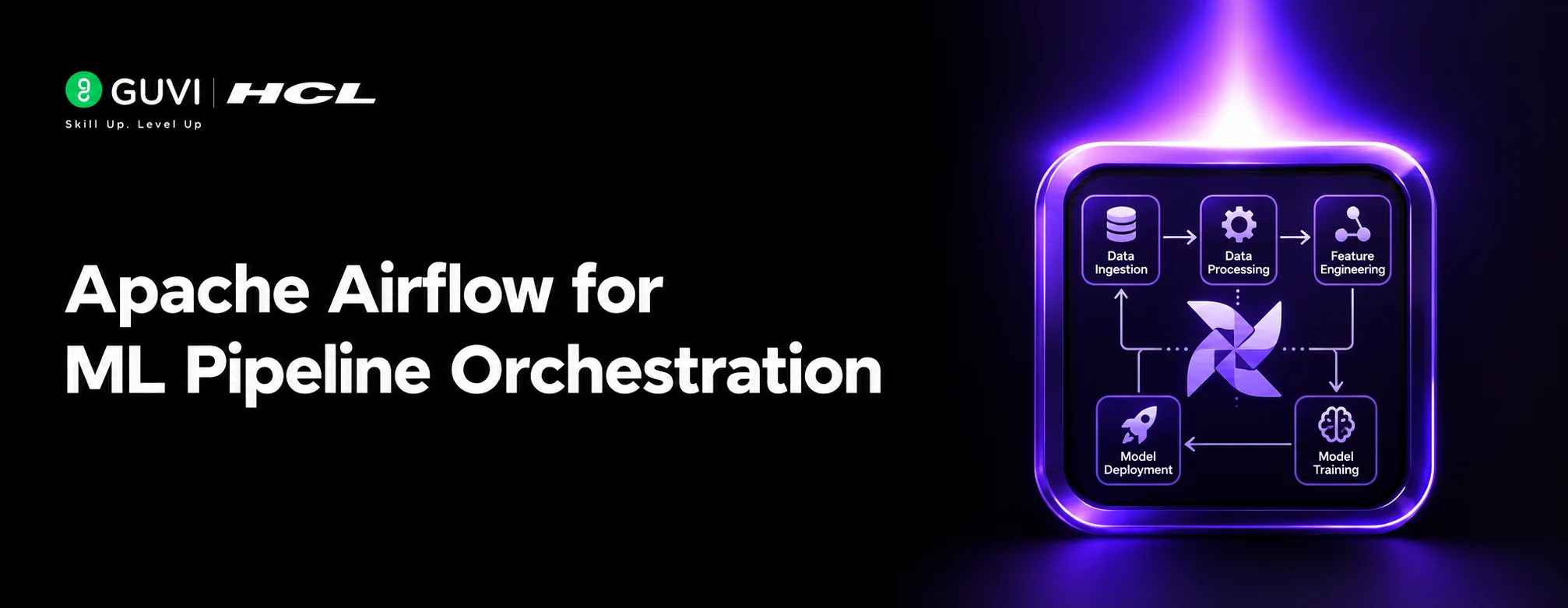
Apache Airflow orchestrates ML pipelines by defining DAGs that schedule data ingestion, feature engineering, model training, evaluation, and deployment with retries, alerts, and dependency management. Master AI & ML at HCL GUVI: Artificial Intelligence and Machine Learning.
Why Airflow for ML?
ML pipelines have unique requirements that Airflow addresses:
Complex Dependencies:
- Data preprocessing must complete before training
- Model evaluation depends on training completion
- Deployment requires successful evaluation
- Airflow manages these dependencies automatically
Scheduling and Automation:
- Retrain models on schedule (daily, weekly)
- Trigger pipelines on data arrival
- Handle time zone considerations
- Backfill historical data when needed
Reliability and Recovery:
- Automatic retries on failure
- Alert on pipeline failures
- Resume from failed tasks (not restart entire pipeline)
- Audit trail of all executions
Monitoring and Observability:
- Web UI for pipeline visualization
- Task-level logging and metrics
- Historical execution tracking
- Integration with monitoring tools
Building ML Pipelines with Airflow
Basic DAG Structure
A typical ML pipeline DAG includes:
python

from airflow import DAG

from airflow.operators.python import PythonOperator

from datetime import datetime, timedelta

default_args = {

    'owner': 'ml-team',

    'depends_on_past': False,

    'start_date': datetime(2026, 1, 1),

    'retries': 2,

    'retry_delay': timedelta(minutes=5),

}

dag = DAG(

    'ml_training_pipeline',

    default_args=default_args,

    schedule_interval='@daily',

    catchup=False

)

def extract_data():

    # Extract data from source

    pass

def preprocess_data():

    # Clean and transform data

    pass

def train_model():

    # Train ML model

    pass

def evaluate_model():

    # Evaluate model performance

    pass

def deploy_model():

    # Deploy to production

    pass

extract_task = PythonOperator(

    task_id='extract_data',

    python_callable=extract_data,

    dag=dag

)

preprocess_task = PythonOperator(

    task_id='preprocess_data',

    python_callable=preprocess_data,

    dag=dag

)

train_task = PythonOperator(

    task_id='train_model',

    python_callable=train_model,

    dag=dag

)

evaluate_task = PythonOperator(

    task_id='evaluate_model',

    python_callable=evaluate_model,

    dag=dag

)

deploy_task = PythonOperator(

    task_id='deploy_model',

    python_callable=deploy_model,

    dag=dag

)
# Define dependencies
extract_task >> preprocess_task >> train_task >> evaluate_task >> deploy_taskCommon ML Pipeline Patterns
1. Batch Training Pipeline
Use Case: Retrain models on schedule with new data
Typical Tasks:
- Extract new data from data warehouse
- Validate data quality
- Preprocess and feature engineer
- Train model with hyperparameter tuning
- Evaluate against validation set
- Compare with current production model
- Deploy if performance improves
- Send notifications on completion/failure
Scheduling:
- Daily, weekly, or monthly retraining
- Trigger on data availability
- Backfill for historical analysis
2. Inference Pipeline
Use Case: Generate predictions on new data
Typical Tasks:
- Load new input data
- Load trained model from model registry
- Preprocess input data (same as training)
- Generate predictions
- Store predictions in database
- Monitor prediction quality
- Alert on anomalies
Scheduling:
- Batch inference: hourly, daily
- Near real-time: every few minutes
- Event-driven: on data arrival
3. Model Evaluation Pipeline
Use Case: Monitor model performance in production
Typical Tasks:
- Collect production predictions and actuals
- Calculate performance metrics (accuracy, precision, recall)
- Detect data drift and concept drift
- Compare with training performance
- Generate performance reports
- Alert on performance degradation
- Trigger retraining if needed
Scheduling:
- Daily or weekly monitoring
- Real-time monitoring with streaming
- On-demand evaluation
Advanced Airflow Features for ML
Dynamic Task Generation
Generate tasks dynamically based on data:
python

def get_model_list():

    # Query database for models to retrain

    return ['model_a', 'model_b', 'model_c']

def create_training_tasks(dag, model_list):

    for model_name in model_list:

        PythonOperator(

            task_id=f'train_{model_name}',

            python_callable=train_model,

            op_kwargs={'model_name': model_name},

            dag=dag

        )
Branching for Conditional Execution
Execute different paths based on conditions:
python

from airflow.operators.branch import BranchPythonOperator

def should_deploy(**context):

    # Check if model performance meets threshold

    if performance > threshold:

        return 'deploy_task'

    else:

        return 'skip_deployment'

branch_task = BranchPythonOperator(

    task_id='check_performance',

    python_callable=should_deploy,

    dag=dag

)
SubDAGs for Modularity
Group related tasks into SubDAGs:
python

from airflow.operators.subdag import SubDagOperator

def create_preprocessing_subdag(parent_dag_id, child_dag_id, default_args):

    subdag = DAG(

        dag_id=f'{parent_dag_id}.{child_dag_id}',

        default_args=default_args,

        schedule_interval=None

    )

    # Define preprocessing tasks

    task1 = PythonOperator(task_id='clean_data', dag=subdag, ...)

    task2 = PythonOperator(task_id='feature_engineering', dag=subdag, ...)

    task1 >> task2

    return subdag
Sensors for External Dependencies
Wait for external events before proceeding:
python

from airflow.sensors.external_task import ExternalTaskSensor

wait_for_data = ExternalTaskSensor(

    task_id='wait_for_etl_completion',

    external_dag_id='etl_pipeline',

    external_task_id='load_to_warehouse',

    mode='reschedule',

    dag=dag

)
Best Practices for ML Pipelines
DAG Design
Keep DAGs focused, use meaningful task IDs, and define dependencies explicitly. Group related tasks for easier maintenance and debugging.
Error Handling
Retry only temporary failures and validate data before processing. Design tasks to be idempotent and use checkpoints for recovery.
Performance and Monitoring
Parallelize independent tasks, manage resources with pools, and monitor task duration, failures, logs, and SLA misses.
Apache Airflow orchestrates ML pipelines by defining DAGs that schedule data ingestion, feature engineering, model training, evaluation, and deployment with retries, alerts, and dependency management. Master AI & ML at HCL GUVI: Artificial Intelligence and Machine Learning.
Common Mistakes to Avoid
- Monolithic DAGs: One huge DAG for everything (hard to maintain)
- No error handling: Assuming tasks always succeed
- Hardcoded values: Not using variables or parameters
- Ignoring idempotency: Tasks that can’t be safely retried
- Poor task naming: Unclear what tasks do from task_id
- No monitoring: Not tracking pipeline health
- Over-scheduling: Running too frequently without need
- Under-scheduling: Not running often enough for freshness
- No backfill strategy: Can’t reprocess historical data
- Ignoring security: Exposing credentials in DAG code
Airflow was originally developed at Airbnb in 2014 to manage their complex data pipelines and was open-sourced in 2016. It became an Apache Software Foundation project in 2019 and is now used by thousands of organizations worldwide. The term “DAG” (Directed Acyclic Graph) is central to Airflow’s design—workflows must be acyclic to prevent infinite loops and ensure pipelines eventually complete.
What Should You Do Next?
Use this practical checklist:
- Start with Airflow in local/docker environment for learning
- Design your first simple ML pipeline DAG
- Implement proper error handling and retries
- Set up monitoring and alerting from day one
- Use version control for all DAG code
- Document your DAGs and tasks clearly
- Implement data quality checks before processing
- Choose appropriate executor for your scale
- Plan for backfill and historical reprocessing
- Regularly review and optimize pipeline performance
Conclusion
Apache Airflow provides a robust, scalable platform for orchestrating ML pipelines in production. Its DAG-based approach, rich operator ecosystem, and built-in monitoring make it ideal for managing complex ML workflows requiring reliability and observability.
Success requires thoughtful DAG design, proper error handling, and comprehensive monitoring. Start simple, iterate based on learnings, and scale your Airflow infrastructure as your ML operations mature.
FAQs
What is Apache Airflow used for in ML?
Airflow orchestrates ML pipelines by scheduling and monitoring tasks like data ingestion, preprocessing, model training, evaluation, and deployment with automatic retry logic and dependency management.
Is Airflow good for real-time ML pipelines?
Airflow is best for batch and near-real-time pipelines (minutes granularity). For true real-time streaming, consider Apache Kafka, Flink, or specialized streaming platforms alongside Airflow.
How do I handle model versioning in Airflow?
Store model artifacts in a model registry (MLflow, S3 with versioning) and pass model version as a parameter to tasks. Track versions in task logs and metadata for auditability.
Can Airflow handle large-scale ML training?
Yes, with appropriate executors (KubernetesExecutor, CeleryExecutor) and infrastructure. For very large training jobs, trigger external systems (Spark, Kubernetes jobs) from Airflow rather than running training directly in Airflow tasks.
What’s the difference between Airflow and MLflow?
Airflow orchestrates workflows and schedules tasks. MLflow manages the ML lifecycle (experiments, models, registry). They’re complementary—use Airflow to orchestrate pipelines that use MLflow for model management.
How do I pass data between Airflow tasks?
Use XComs for small data (metadata, paths), external storage (S3, databases) for large data, and task outputs for intermediate results. Avoid passing large datasets through XComs.
Should I use Airflow for feature engineering?
Yes, Airflow can orchestrate feature engineering pipelines. For feature stores, integrate with systems like Feast or Tecton, using Airflow to trigger feature computation and updates.
How do I secure Airflow for production?
Use RBAC for access control, encrypt connections and variables, store credentials in secrets backend (not in DAG code), enable authentication, use HTTPS, and regularly update Airflow to patch security vulnerabilities.
Success Stories

About the Author
HCL GUVI
This article was selected and published as part of the HCL GUVI AI Blogathon 2026, an initiative designed to encourage students, AI enthusiasts, and aspiring tech writers to simplify complex AI concepts through impactful technical content. The contest recognized high-quality, original, and insightful AI-focused blogs, with selected authors receiving publication opportunities on the HCL GUVI blog platform along with official author credits and recognition.
View all posts by HCL GUVI
Connect with me @







Did you enjoy this article?