


Uncategorised Articles
The Weekly Client Check-In: A Template for Forward Deployed Engineers
Claude for Code Documentation with JSDoc


Get In Touch For Details! Request More Information
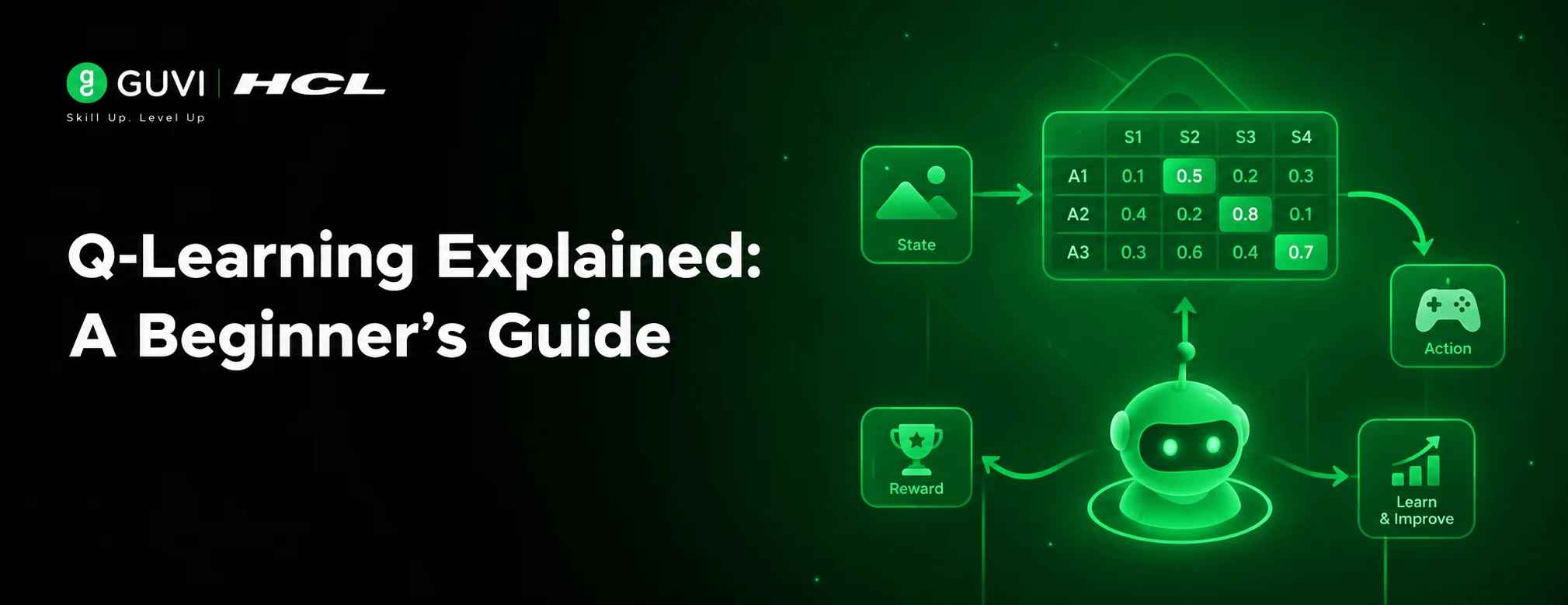
Q-Learning Explained: A Beginner’s Guide
Aug 25, 2026 3 Min Read 412 Views
(Last Updated)
Reinforcement learning involves an agent learning how to make decisions by interacting with an environment and receiving rewards. Q-Learning is one of the most widely known reinforcement learning algorithms. It helps an agent learn which actions are valuable in different states without requiring a model of how the environment works. This guide explains Q-Learning, the Q-table, the learning process, and how agents improve their decisions over time.
Table of contents
- TL;DR
- Quick Answer
- What Is Q-Learning?
- How Q-Learning Works
- Step 1: Observe the State
- Step 2: Choose an Action
- Step 3: Receive a Reward
- Step 4: Observe the New State
- Step 5: Update the Q-Value
- The Q-Learning Formula
- Exploration vs Exploitation
- Exploration
- Exploitation
- Q-Table
- Q-Learning vs Traditional Supervised Learning
- Common Applications
- Game AI
- Robotics
- Resource Management
- Recommendation Systems
- Key Concepts to Remember
- A Practical Q-Learning Workflow
- Define the Environment
- Initialize Q-Values
- Choose an Action
- Execute the Action
- Receive the Reward
- Update the Q-Value
- Repeat
- Evaluate the Policy
- Real-World Applications
- Game Development
- Robotics
- Traffic Management
- Resource Allocation
- Best Practices
- Conclusion
- FAQs
- What is Q-Learning?
- What is a Q-value?
- What is a Q-table?
- What is the learning rate in Q-Learning?
- What is the discount factor?
- What is epsilon-greedy exploration?
- What is the difference between Q-Learning and DQN?
TL;DR
- Q-Learning is a reinforcement learning algorithm.
- It learns the value of taking an action in a particular state.
- These values are stored in a Q-table in basic implementations.
- The agent updates Q-values using rewards and future estimates.
- Exploration and exploitation help the agent learn effective behavior.
Quick Answer
| Q-Learning is a model-free reinforcement learning algorithm that learns the expected value of taking different actions in different states. The agent uses these learned Q-values to choose actions that maximize future rewards. It does not need to know the environment’s transition rules beforehand, making it useful for learning decision-making policies through interaction and feedback. |
What Is Q-Learning?
Q-Learning learns a function commonly called the Q-function.
The Q-function estimates:
How valuable is it to take a particular action in a particular state?
For example, in a grid-based game, an agent may learn that moving right from a particular position is more valuable than moving left because it is more likely to eventually reach a goal.
The learned values can be represented using a Q-table:
| State | Action | Q-Value |
| S1 | Left | 2.1 |
| S1 | Right | 5.7 |
| S2 | Left | 3.4 |
| S2 | Right | 1.2 |
The agent can use these values to select promising actions.
How Q-Learning Works
A typical learning cycle is:
State → Action → Reward → New State → Q-Value Update
Step 1: Observe the State
The agent observes its current state.
Step 2: Choose an Action
The agent selects an action, balancing exploration and exploitation.
Step 3: Receive a Reward
The environment provides feedback after the action.
Step 4: Observe the New State
The agent transitions to another state.
Step 5: Update the Q-Value
The agent updates its estimate based on the reward and the estimated value of the new state.
The Q-Learning Formula
The standard Q-Learning update rule is:
Q(s,a) ← Q(s,a) + α [r + γ max Q(s′,a′) − Q(s,a)]
Where:
- Q(s,a) = current value of taking action a in state s
- α = learning rate
- r = immediate reward
- γ = discount factor
- s′ = new state
- max Q(s′,a′) = highest estimated future action value
The update gradually adjusts the Q-value toward a better estimate.
Exploration vs Exploitation
An agent needs to balance two behaviors.
Exploration
The agent tries actions it has not tested enough to discover potentially better strategies.
Exploitation
The agent chooses an action that currently has the highest estimated value.
A common approach is epsilon-greedy exploration, where the agent usually chooses the best-known action but occasionally selects a random action.
Q-Table
A Q-table stores the estimated value of different state-action combinations.
For small environments, a table can be practical and easy to understand.
However, large or continuous state spaces can make a Q-table impractical because the number of possible states can become extremely large.
This is where approaches such as Deep Q-Networks (DQN) can use neural networks to approximate Q-values instead of storing every value in a table.
Q-Learning vs Traditional Supervised Learning
Q-Learning does not require a dataset containing the correct action for every situation.
Instead:
Agent → Takes Action → Receives Reward → Learns
The agent learns through interaction with its environment rather than being directly told the correct answer.
Common Applications
Game AI
Train agents to learn strategies in games and simulated environments.
Robotics
Learn action policies for navigation and interaction.
Resource Management
Optimize decisions involving changing resource conditions.
Recommendation Systems
Model sequential decisions where actions can affect future interactions.
Q-Learning is called off-policy because it can learn the value of an optimal policy while the agent follows a different behavior policy during exploration.

Key Concepts to Remember
- Q-value: Estimated value of taking an action in a state.
- Q-table: Stores state-action values in basic Q-Learning.
- Learning rate: Controls how quickly new information changes Q-values.
- Discount factor: Controls the importance of future rewards.
- Exploration: Trying actions to discover better strategies.
- Exploitation: Choosing the best-known action.
- Model-free: Does not require a predefined environment model.
- Off-policy: Can learn an optimal policy independently of the behavior policy.
The HCL GUVI’s Artificial Intelligence eBook introduces artificial intelligence, machine learning, generative AI, and intelligent automation concepts, helping learners understand modern AI technologies and their practical applications.
A Practical Q-Learning Workflow
1. Define the Environment
Specify the states, actions, and reward structure.
2. Initialize Q-Values
Create a Q-table or another Q-value representation.
3. Choose an Action
Use an exploration strategy such as epsilon-greedy selection.
4. Execute the Action
Allow the agent to interact with the environment.
5. Receive the Reward
Observe the feedback from the environment.
6. Update the Q-Value
Apply the Q-Learning update rule using the reward and future value estimate.
7. Repeat
Continue the process across many episodes until the agent learns a useful policy.
8. Evaluate the Policy
Test whether the learned behavior produces desirable long-term rewards.
Real-World Applications
Game Development
Train agents to make decisions based on game states and rewards.
Robotics
Learn navigation and control strategies through environmental interaction.
Traffic Management
Use reinforcement learning approaches to optimize decisions in simulated traffic environments.
Resource Allocation
Learn strategies for allocating resources as conditions change over time.
Professionals interested in artificial intelligence, reinforcement learning, and machine learning can strengthen their expertise through HCL GUVI’s Artificial Intelligence and Machine Learning Course.
Best Practices
- Define meaningful rewards that reflect the actual objective.
- Choose an appropriate learning rate and discount factor.
- Maintain a useful balance between exploration and exploitation.
- Train across enough episodes to allow learning.
- Monitor whether rewards improve over time.
- Use DQN or other function-approximation approaches for large state spaces.
- Evaluate the learned policy on situations not used during training.
Conclusion
Q-Learning is a model-free reinforcement learning algorithm that learns the value of actions through interaction with an environment. By updating Q-values based on rewards and future estimates, an agent can gradually learn which actions lead to better outcomes. Q-tables work well for small, discrete environments, while neural-network-based approaches such as DQN can extend the underlying idea to larger state spaces.
FAQs
1. What is Q-Learning?
Q-Learning is a model-free reinforcement learning algorithm that learns the expected value of taking different actions in different states.
2. What is a Q-value?
A Q-value estimates the expected future reward associated with taking a particular action from a particular state.
3. What is a Q-table?
A Q-table stores Q-values for different state-action combinations and is commonly used in basic Q-Learning implementations.
4. What is the learning rate in Q-Learning?
The learning rate (α) controls how strongly newly obtained information changes an existing Q-value.
5. What is the discount factor?
The discount factor (γ) determines how much importance the agent gives to future rewards compared with immediate rewards.
6. What is epsilon-greedy exploration?
Epsilon-greedy exploration allows the agent to choose the best-known action most of the time while occasionally selecting another action to explore alternatives.
7. What is the difference between Q-Learning and DQN?
Q-Learning traditionally uses a table to store Q-values, while a Deep Q-Network (DQN) uses a neural network to approximate Q-values, making it more suitable for larger state spaces.
Success Stories

About the Author
HCL GUVI
This article was selected and published as part of the HCL GUVI AI Blogathon 2026, an initiative designed to encourage students, AI enthusiasts, and aspiring tech writers to simplify complex AI concepts through impactful technical content. The contest recognized high-quality, original, and insightful AI-focused blogs, with selected authors receiving publication opportunities on the HCL GUVI blog platform along with official author credits and recognition.
View all posts by HCL GUVI
Connect with me @










Did you enjoy this article?