


Artificial Intelligence and Machine Learning Articles
Simulated Annealing Algorithm Explained
Isolation Forest for Anomaly Detection


Get In Touch For Details! Request More Information
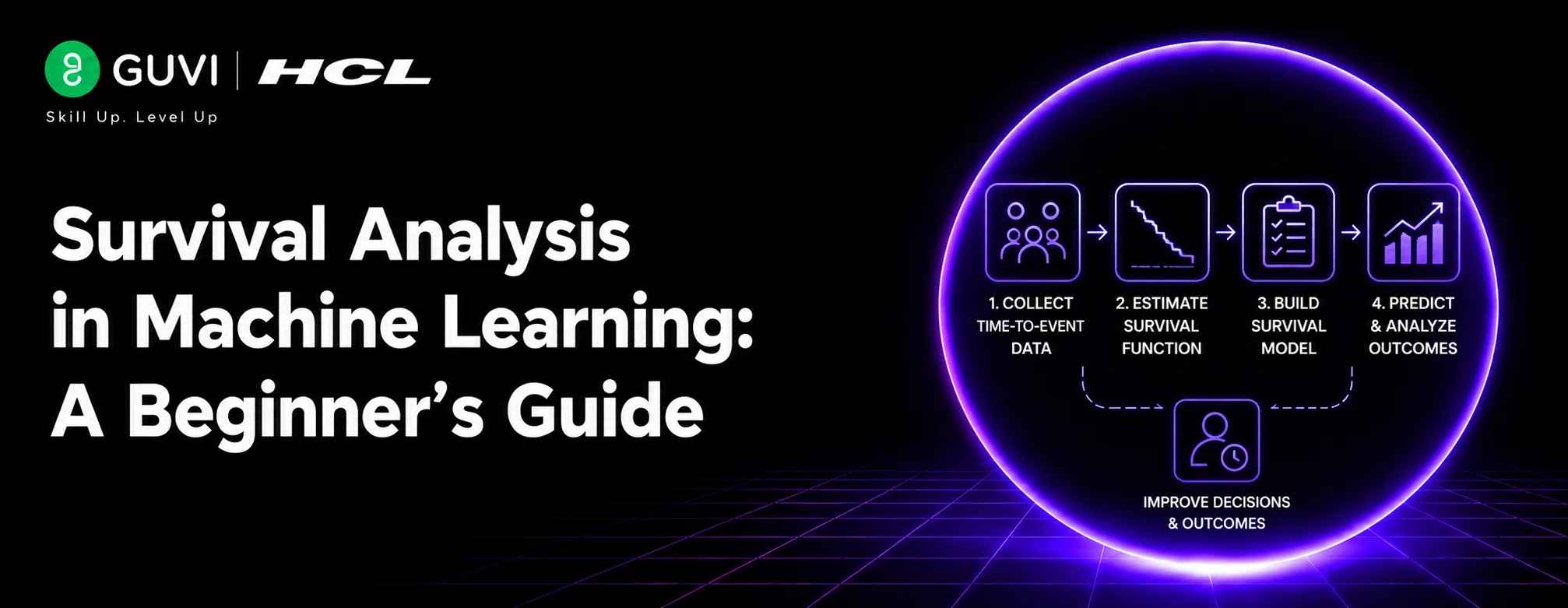
Survival Analysis in Machine Learning: A Beginner’s Guide
Aug 28, 2026 3 Min Read 66 Views
(Last Updated)
Many machine learning problems focus not only on whether an event will occur but also on when it will happen. This is where Survival Analysis in Machine Learning becomes valuable. Originally developed for medical research, Survival Analysis is now widely used in healthcare, finance, manufacturing, and customer analytics to predict time-to-event outcomes. This guide explains Survival Analysis in simple terms, its key concepts, popular models, and practical applications.
Table of contents
- TL;DR Summary
- Why Survival Analysis Matters
- What is Survival Analysis?
- Key Concepts in Survival Analysis
- Survival Time
- Event
- Censoring
- Survival Function
- Common Survival Analysis Models
- Kaplan-Meier Estimator
- Cox Proportional Hazards Model
- Random Survival Forests
- Deep Learning Survival Models
- Applications of Survival Analysis
- Healthcare
- Finance
- Manufacturing
- Retail
- Human Resources
- Benefits of Survival Analysis
- Time-Based Predictions
- Handles Censored Data
- Better Business Planning
- Broad Industry Adoption
- When Should You Use Survival Analysis?
- Healthcare
- Customer Analytics
- Manufacturing
- Finance
- Human Resources
- Applications You Can Build with Survival Analysis
- Healthcare
- Business Intelligence
- Finance
- Manufacturing
- Limitations of Survival Analysis
- Best Practices
- Conclusion
- FAQs
- What is Survival Analysis?
- What is censoring in Survival Analysis?
- What is the Kaplan-Meier estimator?
- What is the Cox Proportional Hazards model?
- Where is Survival Analysis used?
- Is Survival Analysis a machine learning algorithm?
- Why is Survival Analysis important?
TL;DR Summary
- Survival Analysis predicts when an event is likely to occur.
- It handles incomplete observations using censoring.
- Time-to-event prediction supports better decision-making.
- Machine learning extends traditional survival models.
- Survival Analysis has applications across multiple industries.
Direct Answer
| Survival Analysis is a statistical and machine learning technique used to predict the time until a specific event occurs. Unlike traditional prediction models, it accounts for incomplete observations through censoring while estimating survival probabilities over time. It is commonly used for customer churn prediction, equipment failure analysis, medical research, predictive maintenance, and risk assessment across industries. |
Why Survival Analysis Matters
Many real-world decisions depend not only on predicting whether an event will happen but also on estimating when it is most likely to occur.
Benefits include:
- Time-to-event prediction
- Better risk assessment
- Improved decision-making
- Handles incomplete data
- Supports predictive maintenance
- Enables proactive planning
Learners can build survival analytics skills through HCL GUVI’s Artificial Intelligence and Machine Learning Course.
What is Survival Analysis?
Survival Analysis is a statistical method that estimates the time until an event of interest occurs.
The event could be:
- Customer churn
- Equipment failure
- Disease recurrence
- Loan default
- Product replacement
- Employee attrition
Unlike traditional classification models, Survival Analysis predicts both the probability and timing of future events.
Key Concepts in Survival Analysis
Understanding these concepts makes Survival Analysis easier to learn.
Survival Time
The duration between the start of observation and the occurrence of an event.
Event
The outcome being studied, such as customer churn, equipment failure, or patient recovery.
Censoring
Some observations end before the event occurs. Survival Analysis handles these incomplete records without discarding valuable information.
Survival Function
The survival function estimates the probability that an event has not occurred by a given point in time.
Common Survival Analysis Models
Several statistical and machine learning models support time-to-event prediction.
Kaplan-Meier Estimator
The Kaplan-Meier estimator calculates survival probabilities over time using observed event data and censoring.
Cox Proportional Hazards Model
A widely used regression model that estimates how different variables influence the likelihood of an event occurring.
Random Survival Forests
An ensemble machine learning algorithm that extends Random Forests for survival prediction.
Deep Learning Survival Models
Neural network-based approaches capture complex nonlinear relationships in large survival datasets.
Applications of Survival Analysis
Survival Analysis supports decision-making across many industries.
Healthcare
- Patient survival prediction
- Disease progression analysis
- Clinical trial evaluation
Finance
- Loan default prediction
- Credit risk assessment
- Customer retention analysis
Manufacturing
- Predictive maintenance
- Equipment failure prediction
- Warranty analysis
Retail
- Customer churn prediction
- Subscription retention
- Customer lifetime analysis
Human Resources
- Employee attrition prediction
- Workforce planning
- Retention analysis
Benefits of Survival Analysis
Survival Analysis provides unique capabilities that traditional prediction models cannot easily offer.
Time-Based Predictions
Predicts both whether an event will occur and when it is likely to happen.
Handles Censored Data
Uses incomplete observations without introducing unnecessary bias.
Better Business Planning
Supports proactive decision-making through accurate time-to-event forecasting.
Broad Industry Adoption
Applicable across healthcare, finance, manufacturing, marketing, and business analytics.
When Should You Use Survival Analysis?
Survival Analysis is most effective when predicting not only whether an event will occur but also when it is likely to happen.
Healthcare
Predict patient survival, disease recurrence, treatment effectiveness, and clinical outcomes over time.
Customer Analytics
Estimate customer churn timing, subscription retention, and customer lifetime value.
Manufacturing
Forecast equipment failures, maintenance schedules, and product reliability.
Finance
Predict loan defaults, insurance claims, and customer risk over specific time periods.
Human Resources
Estimate employee attrition, workforce retention, and resignation trends.
Professionals interested in predictive analytics, statistical modeling, machine learning, and business intelligence can strengthen their expertise through HCL GUVI’s Artificial Intelligence and Machine Learning Course.
One of the biggest strengths of Survival Analysis is its ability to use censored data. Even when an event has not yet occurred for some observations, the model can still learn from those records instead of excluding them, leading to more reliable time-to-event predictions.

Applications You Can Build with Survival Analysis
Survival Analysis supports many real-world machine learning applications.
Healthcare
- Patient survival prediction
- Disease progression analysis
- Clinical trial evaluation
- Treatment effectiveness
- Hospital outcome prediction
Business Intelligence
- Customer lifetime analysis
- Churn prediction
- Revenue forecasting
- Retention analysis
- Risk assessment
Finance
- Loan default prediction
- Credit risk modeling
- Insurance claim forecasting
- Customer retention
- Fraud risk analysis
Manufacturing
- Predictive maintenance
- Equipment failure prediction
- Warranty analysis
- Asset lifecycle management
- Maintenance scheduling
The HCL GUVI’s Artificial Intelligence eBook introduces the fundamentals of generative AI, machine learning, prompt engineering, and intelligent automation. It helps learners understand predictive analytics, statistical modeling, business intelligence, and practical AI applications across multiple industries.
Limitations of Survival Analysis
Although Survival Analysis is highly effective for time-to-event prediction, it has certain limitations.
Limitations include:
- Requires sufficient historical time-based data.
- Performance depends on accurate event records.
- Traditional models may assume proportional hazards.
- More difficult to interpret than basic regression models.
- May require advanced feature engineering for complex datasets.
Understanding these limitations helps practitioners select the most appropriate modeling technique.
Warning: Survival Analysis models should always be validated using appropriate evaluation metrics and real historical data. Verify assumptions, handle censored observations correctly, monitor model performance over time, and retrain models periodically as new data becomes available to maintain accurate forecasting and reliable business decisions.
Best Practices
- Clearly define the event being predicted.
- Handle censored observations appropriately.
- Clean and preprocess historical data.
- Validate model assumptions before training.
- Compare multiple survival models.
- Monitor prediction accuracy regularly.
- Retrain models as new data becomes available.
Conclusion
Survival Analysis helps organizations predict not only whether an event will occur but also when it is likely to happen. By modeling time-to-event outcomes, handling censored observations, and supporting accurate risk estimation, it enables better decision-making across healthcare, finance, manufacturing, and customer analytics, making it an essential technique for predictive modeling and business forecasting.
FAQs
1. What is Survival Analysis?
Survival Analysis is a statistical and machine learning technique that predicts the time until a specific event occurs while accounting for incomplete observations through censoring.
2. What is censoring in Survival Analysis?
Censoring occurs when the event being studied has not happened before the observation period ends. Survival Analysis incorporates these incomplete observations into the model instead of discarding them.
3. What is the Kaplan-Meier estimator?
The Kaplan-Meier estimator is a non-parametric method used to estimate survival probabilities over time based on observed events and censored data.
4. What is the Cox Proportional Hazards model?
The Cox Proportional Hazards model is a regression model that analyzes how different variables influence the risk and timing of an event.
5. Where is Survival Analysis used?
It is widely used in healthcare, finance, insurance, manufacturing, retail, telecommunications, and human resources for time-to-event prediction and risk analysis.
6. Is Survival Analysis a machine learning algorithm?
Traditional Survival Analysis is based on statistical methods, but modern machine learning techniques such as Random Survival Forests and deep survival models extend its capabilities for more complex prediction tasks.
7. Why is Survival Analysis important?
Survival Analysis enables organizations to estimate event timing, handle censored data effectively, improve forecasting accuracy, optimize resource planning, and make proactive, data-driven decisions across a wide range of real-world applications.
Success Stories

About the Author
HCL GUVI
This article was selected and published as part of the HCL GUVI AI Blogathon 2026, an initiative designed to encourage students, AI enthusiasts, and aspiring tech writers to simplify complex AI concepts through impactful technical content. The contest recognized high-quality, original, and insightful AI-focused blogs, with selected authors receiving publication opportunities on the HCL GUVI blog platform along with official author credits and recognition.
View all posts by HCL GUVI
Connect with me @













Did you enjoy this article?