


Product Management Articles
Product Market Fit: How to Know You’ve Found It - Best Guide
What is Product Analytics? Best & Ultimate Beginner's Guide to Understanding User Behavior
What is Product Adoption? Best Guide to Product Adoption: Meaning, Lifecycle & Metrics


Get In Touch For Details! Request More Information
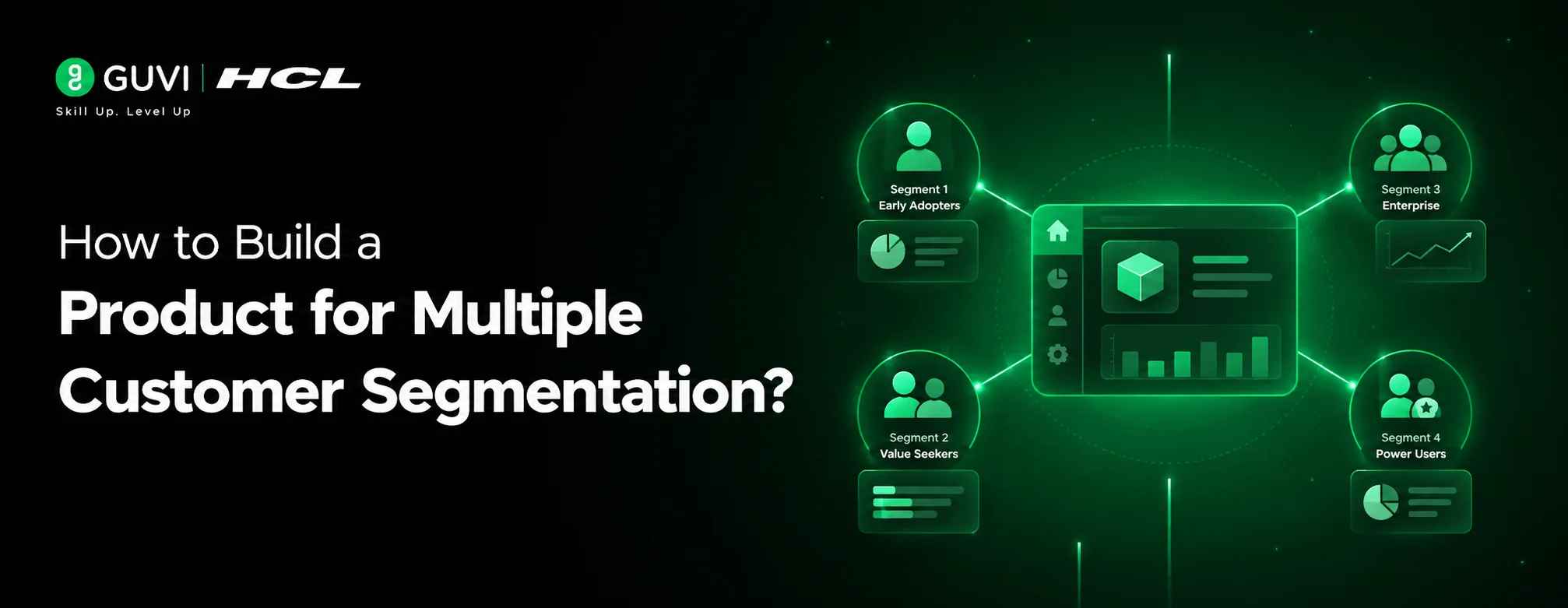
How to Build a Product for Multiple Customer Segmentation? (Best 2026 Guide)
Aug 07, 2026 7 Min Read 39 Views
(Last Updated)
Table of contents
- TL;DR
- Introduction
- What Does It Mean to Build a Product for Multiple Customer Segmentation?
- What is Customer Segmentation?
- Example of Customer Segmentation:
- Quick Comparison: Customer Segmentation at a Glance
- Why Customer Segmentation Matters
- Customer Segmentation vs. Market Segmentation
- Example
- Product Manager's Blueprint: Build One Product, Not Many
- Step 1: Identify Customer Segments
- Step 2: Validate Customer Problems
- Step 3: Build One Core Product
- Step 4: Personalize the Experience
- Step 5: Measure and Improve
- Step-By-Step Guide: How To Build a Product for Multiple Customer Segmentation
- Step 1: Identify Your Target Audience
- Step 2: Build One Core Product
- Step 3: Personalize Without Adding Complexity
- Step 4: Prioritize Features That Deliver Value
- Step 5: Measure, Learn, and Continuously Improve
- Real-World Examples of Building a Product for Multiple Customer Segments
- Netflix's Multi-Segment Approach
- HubSpot's Diverse Market Penetration
- Common Mistakes to Avoid
- Over-Segmentation
- Insufficient Validation
- Neglecting Core Experience
- Inconsistent Messaging
- Ignoring Integration Challenges
- Enhance Your Skills with HCL GUVI
- Conclusion
- Frequently Asked Questions
- What is customer segmentation in product development?
- How many customer segments should I target initially?
- What's the difference between market segmentation and customer segmentation?
- How do I measure the success of a multi-segment product strategy?
- Can small companies effectively target multiple segments?
- What role does product personalization play in segmentation?
- How do I avoid feature bloat when serving multiple segments?
TL;DR
- Building a product for multiple customer segmentation starts with effective customer segmentation to identify users with different needs and priorities.
- Instead of creating separate products, successful companies build one scalable core product, validate customer problems through research, personalize experiences with role-based features, onboarding, and pricing, and continuously improve using customer feedback and analytics.
- Companies like Spotify and Slack demonstrate how this approach serves diverse audiences
- Avoiding common pitfalls such as over-segmentation, poor validation, and feature bloat, ultimately driving stronger customer engagement, retention, and business growth.
Introduction
What if you could double your market reach without doubling your development costs? The secret lies in mastering customer segmentation, a powerful strategy that enables businesses to serve diverse audiences with a single, intelligently designed product.
Today’s consumers demand personalized experiences, yet building entirely separate products for each group is neither scalable nor cost-effective.
Companies that excel at personalization generate 40% more revenue from existing customers compared to those that don’t personalize. This financial impact of understanding and serving multiple customer segments effectively.
This comprehensive guide provides actionable frameworks for identifying meaningful customer segmentation, implementing product personalization strategies, and avoiding common pitfalls that derail multi-segment initiatives. You’ll learn how industry leaders successfully balance customization with scalability while maintaining a cohesive user experience across diverse market segments.
What Does It Mean to Build a Product for Multiple Customer Segmentation?
Building a product for multiple customer segments means designing one core product that serves different groups of users through personalization, configurable features, pricing tiers, workflows, and user experiences.
Instead of creating separate products, businesses tailor the experience based on each segment’s needs while maintaining a shared product foundation. This approach improves scalability, customer satisfaction, and long-term revenue growth.
What is Customer Segmentation?
Customer segmentation is the practice of dividing a company’s target audience into smaller groups based on shared characteristics, behaviors, goals, or needs so you can build products, experiences, and marketing strategies that better serve each group.
Rather than treating every customer the same, segmentation helps businesses understand that different users solve different problems, even when they’re using the same product.
Example of Customer Segmentation:
Consider a project management platform.
Although every customer uses the same software, their expectations vary significantly:
- A freelancer wants a lightweight task tracker.
- A startup needs team collaboration features.
- A marketing agency requires client dashboards.
- An enterprise organization prioritizes security, governance, and advanced reporting.
Each customer segment has unique priorities, but they all rely on the same underlying product.
This is why modern product teams focus on building flexible products instead of entirely separate solutions.
Quick Comparison: Customer Segmentation at a Glance
| Segmentation Type | Best Used For | Example | Product Strategy |
| Demographic | Consumer Products | Students, Professionals | Pricing, UI, Messaging |
| Behavioral | SaaS Products | Power Users, Casual Users | Feature Recommendations |
| Geographic | Global Products | India vs US Users | Localization, Language |
| Psychographic | Lifestyle Apps | Fitness Enthusiasts | Personalized Content |
| Firmographic | B2B Products | Startups vs Enterprises | Enterprise Features |
| Technographic | Software Products | Cloud Users vs On-Premise Users | Integrations |
| Lifecycle | Subscription Businesses | New vs Loyal Customers | Onboarding & Retention |
| Value-Based | Premium Services | High-value Customers | Exclusive Benefits |
Why Customer Segmentation Matters
As products grow, so do customer expectations. Different users often have different workflows, budgets, and goals, even when they’re using the same product.
Without customer segmentation, product teams risk adding unnecessary features, creating confusing user experiences, or investing in capabilities that few customers actually need.
By understanding your audience, you can:
- Prioritize high-impact features
- Improve product personalization
- Increase customer retention
- Reduce feature bloat
- Make better product roadmap decisions
According to HubSpot’s State of Marketing, companies that use audience segmentation and personalized experiences consistently achieve higher engagement, stronger customer retention, and better conversion rates than businesses relying on one-size-fits-all marketing and product strategies.

Customer Segmentation vs. Market Segmentation
Although the terms are often used interchangeably, customer segmentation and market segmentation serve different purposes.
| Customer Segmentation | Market Segmentation |
| Focuses on existing or potential customers | Focuses on the broader market |
| Helps personalize product experiences | Helps identify target markets |
| Used for product development and customer success | Used for marketing and business strategy |
| Improves engagement and retention | Improves customer acquisition |
| Guides feature prioritization | Guides market positioning |
Example
Suppose you’re launching an online learning platform.
Market segmentation helps you identify broad audiences such as students, working professionals, businesses, and educational institutions.
Once you’ve decided to target working professionals, customer segmentation helps you identify smaller groups within that audience, such as software developers, product managers, career switchers, and data analysts.
Market segmentation answers “Who should we target?”
Customer segmentation answers “How should we build the product for them?”
Product Manager’s Blueprint: Build One Product, Not Many
Instead of creating separate products for every audience, successful companies follow this five-step framework:
Step 1: Identify Customer Segments
Group users based on shared needs, behaviors, or business goals.
Step 2: Validate Customer Problems
Confirm that each segment has genuine pain points through interviews, surveys, and product analytics.
Step 3: Build One Core Product
Develop a strong foundation that solves the primary problem shared by all users.
Step 4: Personalize the Experience
Use role-based dashboards, feature flags, configurable workflows, and pricing tiers to tailor the experience for different customer groups.
Step 5: Measure and Improve
Track customer adoption, retention, feature usage, and satisfaction to continuously refine your product.
Key Insight: Customers don’t expect different products—they expect a product that understands their needs.
Step-By-Step Guide: How To Build a Product for Multiple Customer Segmentation
Step 1: Identify Your Target Audience
Before building features, you need to understand who you’re building for.
Many products fail because teams assume all users have the same goals. In reality, different customer groups often use the same product in different ways. Identifying these differences early helps you create a product that scales without becoming overly complex.
Conduct Customer Research
Start by gathering insights from multiple sources instead of relying on assumptions. Useful research methods include:
- Customer interviews
- Online surveys
- Product analytics
- Sales and CRM data
- Customer support tickets
- User feedback and reviews
Combining qualitative and quantitative research gives you a complete picture of your customers.
Build Customer Personas
Customer personas transform research into actionable insights. A simple persona should include:
| Attribute | Example |
| Persona | Startup Sarah |
| Role | Founder |
| Goal | Manage projects efficiently |
| Pain Point | Limited time and budget |
| Success Metric | Faster team collaboration |
Personas help product managers prioritize features based on real user needs rather than assumptions.
Understand Customer Jobs-to-Be-Done (JTBD)
Instead of asking “Who is my customer?”, ask:
“What job is the customer trying to accomplish?”
For example:
- A freelancer uses a project management tool to stay organized.
- A startup uses the same tool to improve team collaboration.
- An enterprise uses it to manage departments, permissions, and compliance.
The product remains the same, but the desired outcomes differ. Understanding these “jobs” helps you build solutions that deliver value across multiple customer segments.
Great products start with understanding users. Before building features, learn how Product Managers conduct user research, validate customer problems, and make data-driven product decisions.
Step 2: Build One Core Product
Once you’ve identified your customer segments, focus on building a single, scalable product.
The foundation of every successful product is a strong core that solves the primary problem shared by all users.
Think about some of the world’s leading SaaS platforms:
- Netflix streams content for every subscriber.
- Spotify provides music streaming for all users.
- Slack enables workplace communication for teams of every size.
Each company has one core product. Personalization comes later.
Core Features vs. Segment-Specific Features
To avoid feature bloat, divide your roadmap into two categories.
| Core Features | Segment-Specific Features |
| User login | Enterprise SSO |
| Dashboard | Advanced analytics |
| Search | Compliance reporting |
| Notifications | API access |
| Basic collaboration | Team permissions |
Build the essentials first. Then add specialized features only where they create meaningful value.
Should You Build One Product or Multiple Products?
This is one of the biggest strategic decisions in product management.
For most businesses, a single product with personalized experiences is more scalable than maintaining multiple products.
| Build One Product When… | Build Multiple Products When… |
| Customers share the same core problem | Customers solve completely different problems |
| Features can be personalized | Workflows are entirely different |
| A shared codebase is practical | Separate technologies are required |
| You want faster updates | Independent release cycles are necessary |
Rule of thumb: If personalization can solve the differences, build one product, not multiple products.
Not every feature belongs in Version 1. Learn how successful startups build an MVP, validate ideas quickly, and reduce development costs before scaling.
Step 3: Personalize Without Adding Complexity
Personalization is what makes a single product feel relevant to multiple customer segments.
Instead of creating separate applications, tailor the experience using configuration and role-based access.
Effective Product Personalization Strategies
Role-Based Dashboards
Show different information depending on the user’s role.
For example:
- Marketing Managers see campaign performance.
- Sales Teams see pipeline metrics.
- Administrators see security and user management.
Personalized Onboarding
Guide users based on their goals.
A freelancer may need a simple setup checklist, while an enterprise administrator requires tutorials for permissions and integrations.
Tiered Pricing
Different customer segments have different budgets.
A typical SaaS pricing model might include:
- Free
- Starter
- Professional
- Enterprise
Customers pay for the features they need without forcing businesses to maintain separate products.
Feature Flags
Feature flags allow teams to enable or disable functionality for specific customer segments.
Benefits include:
- Controlled rollouts
- Beta testing
- Enterprise-only features
- Faster experimentation
- Lower development risk
This approach helps product teams innovate while maintaining a single codebase.
According to recent studies, Companies leveraging behavioral segmentation see 73% higher customer engagement rates.
Personalization works best when combined with structured product planning. Discover how Product Managers prioritize features and balance customer needs with business goals.
Step 4: Prioritize Features That Deliver Value
Once you’ve identified your customer segments and built a scalable core product, the next challenge is deciding what to build next.
Every feature request competes for time, budget, and engineering resources. Instead of implementing every suggestion, product managers use prioritization frameworks to focus on changes that create the greatest customer and business impact.
Use the RICE Framework
The RICE Framework helps evaluate feature ideas using four factors:
| Factor | What It Measures |
| Reach | How many users will benefit? |
| Impact | How much value will it create? |
| Confidence | How certain are you about the expected outcome? |
| Effort | How much time and development work is required? |
Features with high reach and impact but low effort should generally receive higher priority.
Balance Customer Needs with Business Goals
When prioritizing features, ask:
- Does this solve a significant customer problem?
- Which customer segment benefits the most?
- Will it improve adoption or retention?
- Does it support the product vision?
- Is it worth the engineering effort?
A clear prioritization process helps prevent feature bloat while ensuring every release delivers measurable value.
Step 5: Measure, Learn, and Continuously Improve
Launching a product isn’t the finish line; it’s the beginning of an ongoing improvement cycle. Customer needs evolve, markets change, and new competitors emerge.
To keep your product relevant for multiple customer segments, you need to continuously measure performance, gather feedback, and refine the experience.
Successful product teams rely on data rather than assumptions. They regularly analyze how different customer segments interact with the product and identify opportunities to improve adoption, engagement, and retention.
Track Segment-Specific Metrics
Instead of looking only at overall product performance, measure how each customer segment is performing. This helps you understand which features deliver value and where users are facing challenges.
Some key metrics include:
| Metric | Why It Matters |
| Feature Adoption Rate | Shows which features are most valuable to different customer segments. |
| Customer Retention Rate | Measures how many users continue using your product over time. |
| Customer Churn Rate | Identifies which segments are leaving and why. |
| Monthly Active Users (MAU) | Indicates overall product engagement. |
| Customer Satisfaction (CSAT) | Measures how satisfied users are with their experience. |
| Net Promoter Score (NPS) | Evaluates customer loyalty and willingness to recommend your product. |
| Customer Lifetime Value (CLV) | Helps determine the long-term value of each customer segment. |
For example, if enterprise customers rarely use a recently launched reporting feature while startups adopt it quickly, you may need to redesign the experience or prioritize improvements for enterprise users.
Collect Continuous Customer Feedback
Analytics explain what users are doing, but customer feedback explains why they’re doing it.
Build regular feedback loops through:
- In-app surveys
- Customer interviews
- Product reviews
- Support tickets
- Community forums
- Sales and customer success teams
Listening to customers helps uncover pain points, validate feature ideas, and identify opportunities for future improvements.
Experiment and Iterate
Not every new feature will succeed on the first attempt. Instead of making large-scale changes, test ideas with smaller user groups before rolling them out to everyone.
Some common experimentation techniques include:
- A/B Testing: Compare two versions of a feature to determine which performs better.
- Feature Flags: Release new functionality to specific customer segments before a full launch.
- Beta Programs: Gather early feedback from selected users to refine features before general availability.
These approaches reduce risk and ensure product decisions are backed by real user behavior.
Keep Customer Segments Updated
Customer segments aren’t fixed forever. As your product grows, new user groups emerge, customer expectations change, and existing segments evolve.
Review your customer segmentation strategy regularly by asking:
- Have our customers’ needs changed?
- Are new customer segments emerging?
- Which segments generate the highest engagement and revenue?
- Are we solving the same core problem, or has it evolved?
Updating your segmentation strategy ensures your product continues to deliver relevant experiences as your business scales.
Building a successful product is an ongoing process. Learn how Agile methodologies help product teams release faster, gather feedback, and continuously improve products.
Key Takeaway: Building a product for multiple customer segments is a continuous process. The most successful companies measure performance, listen to customers, experiment with new ideas, and refine their product over time to deliver value to every user segment.
Real-World Examples of Building a Product for Multiple Customer Segments
Netflix’s Multi-Segment Approach
Netflix serves multiple customer segments through:
- Individual subscriptions for personal viewers
- Family plans for households with diverse tastes
- Regional content libraries for geographic markets
- Kids profiles with parental controls
- Premium tiers for simultaneous streaming
Each offering addresses specific needs while leveraging the same recommendation engine and streaming infrastructure.
HubSpot’s Diverse Market Penetration
HubSpot targets different organizational segments with:
- Free CRM for small businesses and startups
- Starter packages for growing companies
- Professional suites for established businesses
- Enterprise solutions for large organizations
Their segmentation strategy accounts for company size, marketing maturity, and budget considerations.
Common Mistakes to Avoid
1. Over-Segmentation
Creating too many small segments can dilute resources and complicate product development. Focus on meaningful differences that drive distinct product requirements.
2. Insufficient Validation
Assuming you understand segment needs without direct research leads to products that miss the mark. Always validate assumptions with real customer feedback.
3. Neglecting Core Experience
While customizing for segments, don’t lose sight of the fundamental user experience everyone shares. Core functionality should remain intuitive and consistent.
4. Inconsistent Messaging
Different segments require different communication approaches, but mixed messages can confuse potential customers about your value proposition.
5. Ignoring Integration Challenges
Personalization features that don’t integrate smoothly with core functionality create friction and reduce overall product quality.
Enhance Your Skills with HCL GUVI
Ready to master customer segmentation and product development strategies?
Our Product Management Course provides hands-on training in market analysis, user research, and multi-segment product development. Learn from industry experts and build real-world projects that demonstrate your skills to potential employers.
Conclusion
Building products for multiple customer segments is both an art and a science. It requires deep customer understanding, strategic thinking, and careful execution.
When done right, segmentation enables businesses to serve diverse needs while maximizing reach and revenue.
Success comes from balancing personalization with simplicity, validating assumptions with real data, and continuously iterating based on customer feedback. Thoughtful segmentation is key to sustainable growth in today’s competitive market.
Remember that effective multi-segment product development is an ongoing process. Markets evolve, customer needs change, and new segments emerge. Stay agile, keep learning, and always put your customers first.
Frequently Asked Questions
1. What is customer segmentation in product development?
Customer segmentation in product development is the process of dividing your target market into distinct groups based on shared characteristics, behaviors, or needs. This allows you to design and deliver more relevant products and experiences to each group.
2. How many customer segments should I target initially?
Focus on 2-3 primary segments when starting. This allows you to develop deep expertise in serving those groups without spreading resources too thin. You can expand to additional segments as you grow.
3. What’s the difference between market segmentation and customer segmentation?
Market segmentation refers to dividing the overall market into subsets, while customer segmentation specifically focuses on categorizing your existing or potential customers. In practice, these terms are often used interchangeably in product development contexts.
4. How do I measure the success of a multi-segment product strategy?
Track segment-specific metrics such as adoption rates, feature usage, retention, and revenue, alongside overall product health indicators. Regular surveys and user interviews also provide qualitative insights into segment satisfaction.
5. Can small companies effectively target multiple segments?
Yes, but they should be selective about which segments to pursue. Small companies often succeed by serving niche segments that larger competitors overlook, rather than competing broadly.
6. What role does product personalization play in segmentation?
Product personalization brings segmentation to life by actually tailoring the user experience to each segment’s needs. Without personalization, segmentation remains a theoretical exercise with limited business impact.
7. How do I avoid feature bloat when serving multiple segments?
Focus on core functionality that serves all users first. Then add segment-specific features that can be enabled selectively. Use configurability rather than separate codebases when possible.
Success Stories

About the Author
Hashmithaa
Hi, I’m Hashmithaa — a content writer with a love for words. Writing isn’t just what I do; it’s how I connect, communicate, and create meaning in a noisy digital world. And if my words help someone make a better decision, learn something new, or feel more confident, then I’ve done my job well.
View all posts by Hashmithaa
Connect with me @









Did you enjoy this article?