


Business Analytics Articles
Using Claude for Personalized Content at Scale
How to Use Claude for YouTube Script writing


Get In Touch For Details! Request More Information

What is Digital Product Management? A Beginner-Friendly Career Guide
Aug 04, 2026 6 Min Read 300 Views
(Last Updated)
Table of contents
- TL;DR Summary
- Introduction
- What is Digital Product Management?
- Digital Product Management Definition
- Why Digital Product Management Matters
- What Does a Digital Product Manager Do?
- Key Responsibilities of a Digital Product Manager
- Digital Product Manager vs Product Owner
- Digital Product Management vs Traditional Product Management
- The Digital Product Management Process
- Step 1: Discover the Problem
- Step 2: Define Product Strategy
- Step 3: Build a Product Roadmap
- Step 4: Execute with Agile Product Management
- Step 5: Measure and Improve
- Skills Needed to Become a Digital Product Manager
- Core Skills for Digital Product Management
- Your First Steps into Digital Product Management
- How Digital Product Management Works Across Industries
- Banking and Fintech
- EdTech
- E - Commerce and Retail
- Common Mistakes Beginners Make
- 1: Confusing Features with Outcomes
- 2: Building Without User Research
- 3: Treating the Product Roadmap as a Fixed Timeline
- 4: Ignoring Metrics After Launch
- Salary and Career Benefits
- Conclusion
- Frequently Asked Questions
- What is digital product management?
- What does a digital product manager do?
- Is digital product management a good career?
- Do I need coding to become a digital product manager?
- What is the product management process?
- What is the difference between a digital product manager and product owner?
- What skills are needed for digital product management?
- What are examples of digital products?
- How can beginners start learning digital product management?
TL;DR Summary
Digital product management is the process of planning, building, launching, improving, and scaling digital products such as apps, SaaS platforms, fintech tools, eCommerce websites, and AI-powered solutions. A digital product manager connects customer needs, business goals, technology teams, design teams, and market insights to create products that users actually want. The role involves product strategy, product roadmap planning, agile product management, lifecycle decisions, user research, prioritization, and performance tracking. It is a high-growth career path because businesses increasingly depend on digital products for revenue, customer experience, and competitive advantage.
Introduction
Digital product management is becoming one of the most valuable career skills as companies shift from “selling products” to building app-first, platform-first, and AI-enabled customer experiences.
Think about how you use Swiggy, Zerodha, Netflix, Amazon, or Google Pay. Behind every feature, checkout flow, recommendation engine, or onboarding screen, there is a product team deciding what to build, why to build it, and how to measure success.
That is why demand for product-minded professionals is rising. The World Economic Forum says employers expect 39% of key job skills to change by 2030, with technological literacy, analytical thinking, and agility becoming more important.
What is Digital Product Management?
Digital product management focuses on managing digital products from idea to launch and improvement. It combines business thinking, customer understanding, design, technology, analytics, and delivery planning.
Digital Product Management Definition
Digital product management is the practice of identifying customer problems, defining product strategy, prioritizing features, working with design and engineering teams, launching digital products, and improving them using data and user feedback. It helps businesses create apps, platforms, websites, SaaS products, and digital services that solve real user needs.
Why Digital Product Management Matters
Digital products are never truly “finished.” A banking app, food delivery platform, or learning app must keep improving based on user behavior, competition, regulations, technology, and business goals.
McKinsey found that companies with mature product and platform operating models had 38% higher customer engagement and 37% higher brand awareness than lower-performing companies. It also found that product management practices had the strongest impact among key operating model elements.
That is why product managers are not just “feature planners.” Some of their key responsibilities include helping companies decide where to invest time, money, engineering effort, and customer experience improvements.
The apps you use every day are never really complete. Food delivery apps, payment apps, streaming platforms, and learning apps keep changing because product teams constantly study user behavior, test improvements, and update the product roadmap based on what users actually do.
What Does a Digital Product Manager Do?
A digital product manager works between customers, business teams, designers, developers, marketers, and leadership. Their job is to make sure the product solves the right problem and creates measurable value.
Key Responsibilities of a Digital Product Manager
A digital product manager usually handles:
- Understanding customer pain points through research and data
- Defining product strategy and success metrics
- Creating and maintaining a product roadmap
- Prioritizing features with business and engineering teams
- Working with UI/UX, engineering, QA, sales, and marketing
- Tracking adoption, retention, revenue, engagement, and feedback
- Improving the product throughout the product lifecycle
For example, if a fintech app sees many users dropping off during KYC, the product manager may study user behavior, identify friction points, redesign the flow, test the new version, and measure completion rates.
Digital Product Manager vs Product Owner
A digital product manager usually owns the broader product direction, market understanding, business goals, and long-term roadmap.
A product owner is an agile role that focuses on maximizing product value from the Scrum Team’s work and managing the product backlog. Scrum.org explains that the Product Owner is accountable for maximizing the value of the product created by the Scrum Team.
In some companies, one person handles both roles. In larger teams, the product manager focuses on strategy while the product owner focuses on delivery execution.
Digital Product Management vs Traditional Product Management
Digital product management is more data-driven, iterative, and software-led than traditional product management. This difference matters because digital products can be launched, tested, updated, and personalized faster.
| Factor | Digital Product Management | Traditional Product Management |
| Product Type | Apps, SaaS, platforms, websites, digital services | Physical goods or offline services |
| Update Cycle | Continuous releases and iterations | Slower release cycles |
| Data Usage | Heavy use of analytics, A/B testing, funnels, feedback | Market research and sales feedback |
| Team Setup | Engineering, design, data, marketing, support | Manufacturing, supply chain, sales |
| Roadmap Style | Flexible and outcome-driven | Often milestone or launch-driven |
| Customer Feedback | Real-time through usage data and reviews | Slower through surveys and sales teams |
The Digital Product Management Process
The product management process gives structure to product decisions. It helps teams avoid random feature building and focus on user value.
Step 1: Discover the Problem
Start by asking: “What user problem are we solving?” This may involve customer interviews, support tickets, competitor research, analytics, surveys, and market trends.
For example, an eCommerce company may discover that users abandon carts because delivery charges appear too late in the checkout process.
Step 2: Define Product Strategy
Product strategy explains the product’s target users, value proposition, business goal, differentiation, and success metrics.
A good product strategy answers:
- Who is this product for?
- What problem does it solve?
- Why will users choose it?
- How will the business measure success?
Step 3: Build a Product Roadmap
A product roadmap communicates what the team will focus on and why. Atlassian describes a roadmap as important because it connects short-term efforts with long-term business goals.
A roadmap should not be a fixed wishlist. It should evolve based on learning, user feedback, technical feasibility, and business priorities.
Step 4: Execute with Agile Product Management
Agile product management helps teams build in small increments, test quickly, and adapt based on feedback.
According to Digital.ai’s 18th State of Agile findings, 29% of respondents said they are accountable for connecting Agile work to business outcomes, and 26% influence product and portfolio planning.
This shows how agile work is moving beyond delivery speed and becoming more connected to product strategy.
Step 5: Measure and Improve
After launch, the product manager tracks metrics such as activation, retention, conversion, revenue, churn, customer satisfaction, and feature usage.
This is where digital product management becomes powerful. You do not guess forever. You learn from data and improve the product lifecycle continuously.
Skills Needed to Become a Digital Product Manager
You do not need to be a coder to become a digital product manager. But you must understand how technology, business, users, and teams work together.
Core Skills for Digital Product Management
| Skill | Why It Matters |
| User Research | Helps you understand real customer needs, pain points, motivations, and behavior before deciding what to build. |
| Product Strategy | Helps you connect product decisions with business goals, market opportunities, customer value, and long-term growth. |
| Roadmapping | Helps you prioritize what to build next, communicate direction clearly, and align teams around shared outcomes. |
| Agile Product Management | Helps teams deliver value in smaller iterations, gather feedback faster, and adapt when priorities change. |
| Data Analysis | Helps you measure product performance, understand user behavior, validate decisions, and improve adoption or retention. |
| Communication | Helps you align stakeholders, explain trade-offs, manage expectations, and keep design, engineering, and business teams moving together. |
| Basic Tech Understanding | Helps you collaborate better with engineers, understand feasibility, ask the right questions, and make practical product decisions. |
| UX Thinking | Helps you create product experiences that are simple, useful, accessible, and easier for users to complete. |
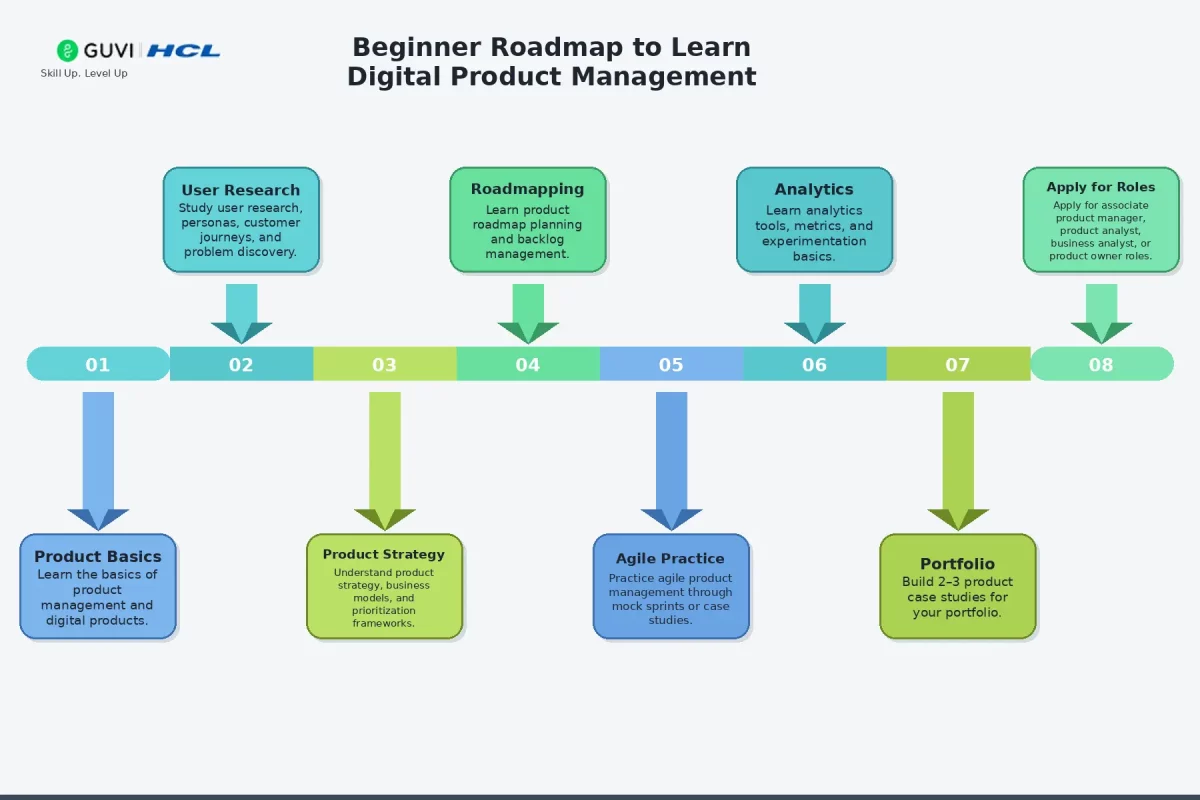
Your First Steps into Digital Product Management
Here’s a beginner-friendly roadmap to help you start strong.

How Digital Product Management Works Across Industries
Digital product management looks different across industries, but the core responsibility remains the same: solve user problems while creating business value.
Banking and Fintech
A digital product manager in fintech may work on UPI payments, lending flows, fraud checks, savings dashboards, or onboarding journeys.
For instance, improving KYC completion may require user research, document upload redesign, backend validation, compliance coordination, and funnel tracking.
EdTech
In an EdTech platform, product managers may improve course discovery, learning progress dashboards, practice modules, mentor booking, or certificate completion.
For example, if learners drop off after week two, the product team may introduce reminders, shorter lessons, practice quizzes, or mentor nudges.
E – Commerce and Retail
In E-Commerce, product managers often improve search, recommendations, cart conversion, payments, delivery tracking, returns, and loyalty programs.
A small checkout improvement can directly affect revenue because users interact with the product at scale.
Common Mistakes Beginners Make
Even smart beginners struggle in product roles because digital product management is not just about ideas. It is about making disciplined decisions with limited time, budget, and engineering capacity.
1: Confusing Features with Outcomes
Many beginners think product management means listing features. That is a weak approach because features do not automatically create value.
A better approach is to define the outcome first. For example, instead of saying “add a chatbot,” say “reduce support tickets by 20% for order-status queries.”
This shifts the conversation from output to impact. It also helps engineering and design teams understand why the work matters.
2: Building Without User Research
A product idea may sound exciting in a meeting, but users may not need it. This is why discovery is important before development.
Beginners often skip interviews, analytics, and usability checks because they want to move fast. But speed without clarity leads to wasted development effort.
Even five user conversations can reveal hidden friction. Good product managers stay close to customer behavior, not just stakeholder opinions.
3: Treating the Product Roadmap as a Fixed Timeline
A product roadmap is not a rigid promise list. It is a direction-setting tool that should adapt as the team learns.
Beginners often commit exact dates too early without checking technical dependencies, market changes, or user feedback. This creates pressure and disappointment later.
A stronger roadmap focuses on themes, outcomes, confidence levels, and priorities. It gives direction without blocking learning.
4: Ignoring Metrics After Launch
Launch is not the finish line. It is the start of measurement.
A feature may be beautifully designed and still fail if users do not adopt it. That is why product managers must define success metrics before release.
Track whether users discover, use, repeat, and benefit from the feature. If the numbers are weak, learn why and improve.
Salary and Career Benefits
Digital product management is attractive because it sits at the intersection of business, technology, design, and leadership.
In India, Glassdoor reports an average Product Manager base pay of around ₹18 lakh per year, with a commonly listed base pay range of ₹11 lakh to ₹26 lakh per year based on salary submissions.
For global context, the U.S. Bureau of Labor Statistics reports that computer and information systems managers had a median annual wage of $171,200 in May 2024, with employment projected to grow 15% from 2024 to 2034. While this is not the same role as product management, it reflects strong demand for technology leadership roles.
The biggest benefit is career flexibility. You can move into product strategy, growth product management, platform product management, product leadership, product operations, or entrepreneurship.
Also Read : Product Management Salaries in India in 2026 Across Levels
If you want to move from understanding concepts to handling real product decisions, a guided program can help you build the right foundation. The Certificate Programme in Product Management by IIM Indore is designed for learners who want to build, launch, and scale products through live online learning, campus immersion and an expert faculty.
This can be a practical next step if you want mentorship, structured product thinking, and career-ready exposure to product strategy, roadmaps, analytics, and execution.
Conclusion
Digital product management is the discipline of building digital products that users need and businesses can grow sustainably. It brings together product strategy, customer research, agile product management, product roadmap planning, analytics, and lifecycle improvement. If you are someone who enjoys solving problems, working with teams, understanding users, and making business decisions, this career path can be a strong fit. Start by learning the fundamentals, analyzing real apps, building product case studies, and practicing how to turn customer problems into measurable product outcomes.
Frequently Asked Questions
1. What is digital product management?
Digital product management is the process of planning, building, launching, and improving digital products such as apps, websites, SaaS tools, and platforms. It connects customer needs, business goals, technology, design, and data.
2. What does a digital product manager do?
A digital product manager defines product strategy, prioritizes features, builds a product roadmap, works with cross-functional teams, tracks metrics, and improves the product based on user feedback.
3. Is digital product management a good career?
Yes. Digital product management is a strong career because companies increasingly rely on digital products for growth, customer experience, and revenue. It also offers paths into leadership, strategy, and entrepreneurship.
4. Do I need coding to become a digital product manager?
You do not need to code daily. However, you should understand technology basics, APIs, data, software development, and engineering constraints so you can work effectively with technical teams.
5. What is the product management process?
The product management process includes problem discovery, user research, product strategy, roadmap planning, prioritization, agile execution, launch, measurement, and continuous improvement.
6. What is the difference between a digital product manager and product owner?
A digital product manager usually owns strategy, market understanding, roadmap direction, and business outcomes. A product owner focuses more on backlog priorities and maximizing value from the Scrum Team’s work.
7. What skills are needed for digital product management?
Important skills include user research, product strategy, analytics, communication, prioritization, roadmap planning, agile product management, UX thinking, and basic technical understanding.
8. What are examples of digital products?
Digital products include mobile apps, SaaS platforms, eCommerce websites, learning platforms, payment apps, AI tools, cloud dashboards, streaming platforms, and online marketplaces.
9. How can beginners start learning digital product management?
Beginners can start by studying product basics, analyzing popular apps, learning user research, building product case studies, practicing roadmap creation, and understanding agile delivery.
Success Stories










Did you enjoy this article?