


Electric Vehicle Articles
What is Vehicle-to-Grid Technology : How EVs Can Power the Grid
EV Infrastructure in India: Best Components, Charging Network, Challenges & Future (2026 Guide)
EV Battery Manufacturing Process Explained
Basics of Electric Vehicle Simulations Using ANSYS (2026 Guide)


Get In Touch For Details! Request More Information
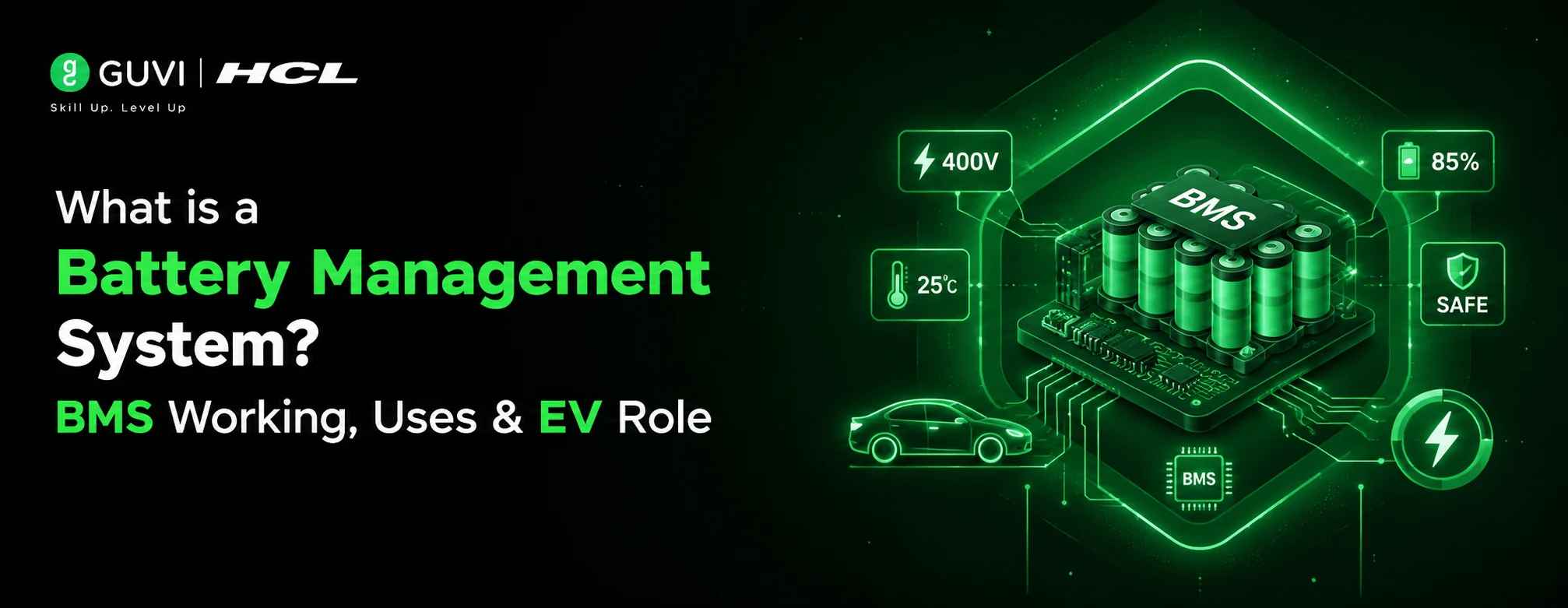
What is a Battery Management System? BMS Working, Uses & EV Role
Aug 04, 2026 5 Min Read 330 Views
(Last Updated)
Table of contents
- TL;DR Summary
- Introduction
- What is a Battery Management System?
- BMS Full Form and Meaning
- Why is a Battery Management System Important?
- Battery Management System Working
- How Does a Battery Management System Work?
- Step-by-Step BMS Working Process
- Key Components of a Battery Management System
- Battery Monitoring System
- Battery Protection System
- Cell Balancing Circuit
- BMS in Electric Vehicles
- Lithium Battery Management System vs Battery Protection System
- BMS Use Cases
- Electric Vehicles
- Renewable Energy Storage
- Consumer Electronics
- Industrial Backup Systems
- Common Mistakes to Avoid While Learning BMS
- Mistake 1: Thinking BMS Only Shows Battery Percentage
- Mistake 2: Ignoring Thermal Management
- Mistake 3: Treating All Lithium Batteries the Same
- Mistake 4: Skipping Communication Protocols
- Mistake 5: Not Testing Fault Conditions
- Career Value of Learning Battery Management System
- Skills to Learn for BMS Careers
- Conclusion
- Frequently Asked Questions
- What is a battery management system?
- What is the BMS full form?
- How does battery management system working happen?
- Why is BMS important in electric vehicles?
- What is an EV battery management system?
- Is a lithium battery management system necessary?
- Is BMS the same as a battery protection system?
- What skills are needed to work on BMS?
TL;DR Summary
A battery management system is the “brain” of a rechargeable battery pack. It monitors voltage, current, temperature, charge level, health, and safety conditions so the battery can work efficiently without overheating, overcharging, or deep discharging. In electric vehicles, a BMS helps improve battery life, driving range, charging safety, and overall vehicle reliability. As EV adoption grows worldwide, understanding BMS in electric vehicles is becoming an important skill for engineers, technicians, and EV professionals.
Introduction
EVs, drones, smartphones, solar storage systems, and industrial backup systems all depend on batteries. But here is the real problem: a battery pack is only as safe and efficient as the system managing it.
That system is called a battery management system.
A battery management system monitors and controls a rechargeable battery pack to keep it safe, efficient, and reliable. It tracks voltage, current, temperature, state of charge, and battery health while protecting the pack from overcharging, overheating, short circuits, and deep discharge.
This matters more today because electric mobility is scaling fast. Global electric car sales exceeded 20 million in 2025, making one in four new cars sold worldwide electric, according to an IEA report.
What is a Battery Management System?
A battery management system is an electronic control system that supervises rechargeable batteries during charging, discharging, storage, and operation.
In simple terms, it answers three critical questions:
- Is the battery safe right now?
- How much charge is left?
- How healthy is the battery over time?
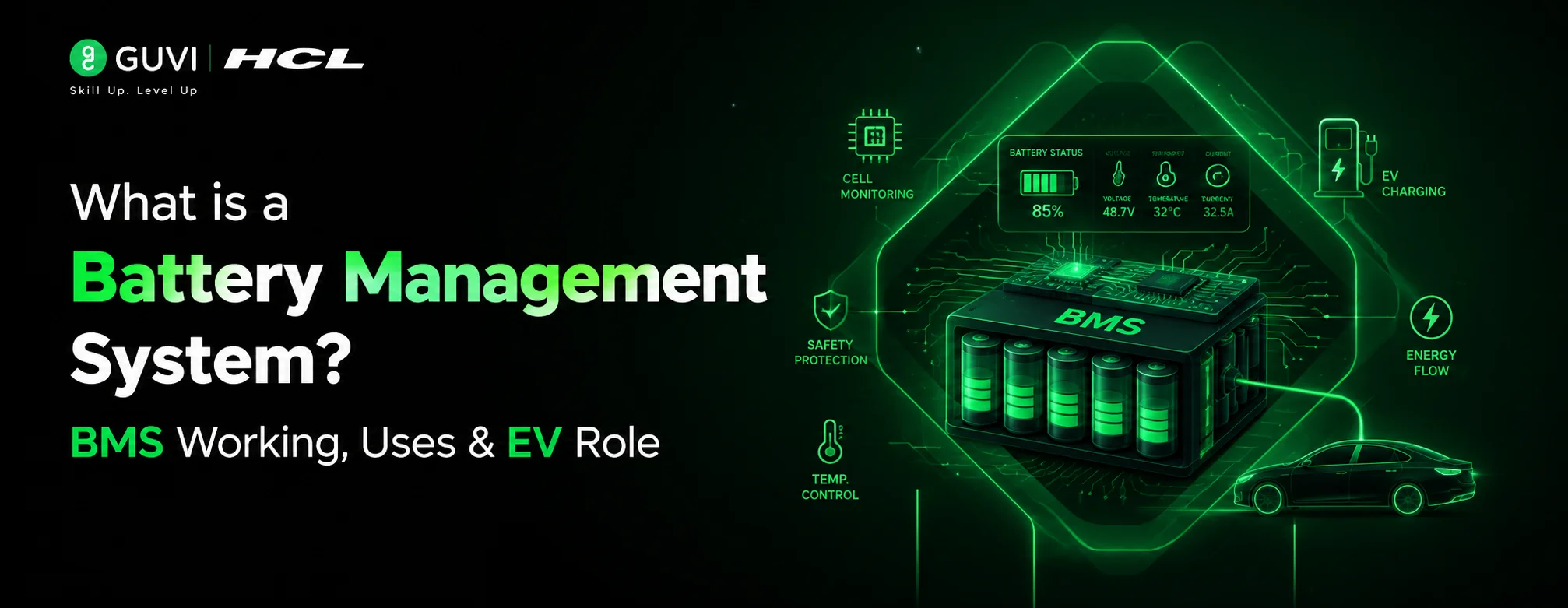
A modern BMS does more than display battery percentage. It acts as a battery monitoring system, battery protection system, diagnostic unit, and communication bridge between the battery and the device using it.
BMS Full Form and Meaning
The BMS full form is Battery Management System.
You will commonly hear this term in EV engineering, lithium-ion battery design, renewable energy storage, consumer electronics, power tools, and industrial battery packs.
For example, in an electric scooter, the BMS checks whether each lithium-ion cell is operating within safe voltage and temperature limits before allowing the motor controller to draw power.
Why is a Battery Management System Important?
A battery pack contains multiple cells. These cells may not age equally, charge equally, or heat equally. Without BMS control, one weak or overheated cell can affect the entire battery pack.
The battery management system helps with:
- Safety: prevents overvoltage, undervoltage, overcurrent, short circuit, and overheating.
- Performance: ensures the battery delivers power efficiently.
- Longer battery life: reduces stress on individual cells.
- Accurate range estimate: calculates remaining charge in EVs.
- Fault detection: alerts the system before failure becomes dangerous.
Global battery demand for the energy sector crossed the 1 TWh milestone in 2024, which shows how fast battery-powered mobility and storage systems are expanding.
Battery Management System Working
Before you understand the battery management system working, imagine a classroom where every student performs differently. A good mentor checks each student’s progress instead of judging only the class average.
A BMS does the same with battery cells.
How Does a Battery Management System Work?
A battery management system works by collecting sensor data from the battery pack, processing it through control algorithms, and taking action when values move outside safe limits. It monitors voltage, current, and temperature, estimates charge and health, balances cells, and communicates with chargers, controllers, or vehicle systems.
Step-by-Step BMS Working Process
| Step | What the BMS Does | Why It Matters |
| 1 | Measures cell voltage | Detects overcharge or deep discharge |
| 2 | Tracks current flow | Prevents overload and short circuits |
| 3 | Monitors temperature | Reduces thermal risk |
| 4 | Estimates SOC and SOH | Shows charge level and battery health |
| 5 | Balances cells | Keeps all cells at similar charge levels |
| 6 | Communicates faults | Helps charger, motor controller, or dashboard respond |
MathWorks lists monitoring, state estimation, cell balancing, power management, thermal management, protection, and communication as major BMS functions.
Key Components of a Battery Management System
A BMS is not a single sensor. It is a combination of hardware, software, and control logic.
Battery Monitoring System
The battery monitoring system measures:
- Cell voltage
- Pack voltage
- Current
- Temperature
- Insulation condition in high-voltage packs
- Charge and discharge patterns
Texas Instruments notes that EV BMS designs use pack monitoring for high-voltage, current, and temperature measurements to diagnose and manage battery safety.
Battery Protection System
A battery protection system takes action when the battery becomes unsafe.
It can disconnect charging, stop discharging, limit current, or trigger fault alerts. This is especially important in lithium battery management system design because lithium-ion cells are sensitive to overcharging, deep discharge, and high temperatures.
Cell Balancing Circuit
Cell balancing ensures weaker and stronger cells stay within a safe charge range.
There are two common types:
- Passive balancing: releases extra charge as heat.
- Active balancing: transfers energy from stronger cells to weaker cells.
Active balancing is more efficient, but it is also more complex and expensive.
BMS in Electric Vehicles
BMS in electric vehicles is one of the most critical control systems because the battery pack is expensive, high-voltage, and directly linked to safety and range.
An EV battery management system communicates with:
- Motor controller
- On-board charger
- Thermal management system
- Vehicle control unit
- Dashboard display
- Charging infrastructure
For example, when you fast-charge an EV, the BMS checks cell temperature, maximum allowable current, and state of charge before allowing high-power charging.
If the battery gets too hot, the BMS can reduce charging speed or request cooling support.
Also Read : How Does an Electric Vehicle Work?
Lithium Battery Management System vs Battery Protection System
Many beginners confuse a lithium battery management system with a basic protection board. They are related, but not the same.
| Feature | Lithium Battery Management System | Battery Protection System |
| Main role | Monitor, estimate, balance, communicate, protect | Protect against unsafe conditions |
| Used in | EVs, solar storage, robotics, e-bikes, drones | Small battery packs, tools, electronics |
| Intelligence | Higher | Lower |
| Communication | Often supports CAN, UART, SMBus, or Bluetooth | Usually limited or absent |
| Cell balancing | Common | Not always available |
| Best example | EV battery management system | Basic 3S or 4S lithium protection board |
BMS Use Cases
Electric Vehicles
In EVs, the BMS decides whether the battery can safely charge, discharge, or deliver peak power. Companies building electric scooters, electric cars, buses, and battery-swapping platforms rely on BMS logic for safety and uptime.

Renewable Energy Storage
Solar battery systems use BMS units to manage charge cycles, prevent deep discharge, and extend battery life during daily energy storage operations.
Consumer Electronics
Your laptop or smartphone battery percentage is not just a simple voltage reading. It comes from monitoring and estimation logic managed by battery control circuitry.
Industrial Backup Systems
Data centers and telecom towers use battery monitoring systems to ensure backup power is available during outages.
Common Mistakes to Avoid While Learning BMS
BMS is practical, but beginners often approach it too theoretically. Avoid these mistakes early.
Mistake 1: Thinking BMS Only Shows Battery Percentage
SOC estimation is only one function. A BMS also handles safety, protection, temperature, cell balancing, and communication.
In real systems, battery percentage is the result of continuous voltage, current, and temperature analysis. So, do not treat BMS as just a display feature; treat it as a decision-making system.
Mistake 2: Ignoring Thermal Management
Battery safety is closely connected to temperature. A design that ignores heat buildup can fail even if voltage readings look normal.
For example, during fast charging or high-speed EV operation, heat can rise quickly inside the battery pack. A good EV battery management system must detect this early and coordinate cooling or power reduction.
Mistake 3: Treating All Lithium Batteries the Same
Li-ion, LiFePO4, and Li-polymer batteries have different voltage ranges, charging behavior, and safety needs.
Using the same BMS settings for every lithium battery can reduce battery life or create safety risks. Always understand the battery chemistry before choosing or configuring a lithium battery management system.
Mistake 4: Skipping Communication Protocols
EV BMS systems often communicate through CAN, UART, SPI, or other protocols. Learning only sensors without communication limits your practical understanding.
In electric vehicles, the BMS must share data with the charger, motor controller, dashboard, and vehicle control unit. That is why communication protocols are important for anyone learning BMS in electric vehicles.
Mistake 5: Not Testing Fault Conditions
A good BMS design must be tested for overvoltage, undervoltage, overcurrent, temperature rise, and sensor failure scenarios.
Many failures happen not during normal use but during edge cases such as loose wiring, poor cooling, charger faults, or sudden load changes. Testing these conditions helps make the battery protection system more reliable.
Career Value of Learning Battery Management System
Battery skills are becoming more valuable as EVs, storage systems, and clean mobility scale. According to an IEA report electric car sales are expected to reach around 23 million in 2026, close to 30% of global car sales.
In India, EV infrastructure, engineering, and related roles are expected to see some of the strongest salary increments, with TeamLease-linked reporting pointing to 8.6% to 10.2% salary growth in FY2026–27 for high-demand sectors including EV infrastructure.
Skills to Learn for BMS Careers
| Skill Area | What to Learn |
| Battery fundamentals | Cell chemistry, voltage, capacity, C-rate |
| Electronics | Sensors, protection ICs, MOSFETs, relays |
| Embedded systems | Microcontrollers, firmware, ADCs |
| Algorithms | SOC, SOH, fault detection |
| Communication | CAN, UART, SPI, Bluetooth |
| EV systems | Motors, chargers, power electronics, thermal systems |
Conclusion
A battery management system is essential wherever rechargeable batteries are used, especially in electric vehicles and lithium battery packs. It monitors battery parameters, protects against unsafe conditions, balances cells, estimates charge and health, and communicates with connected systems. As EV adoption grows, BMS knowledge is becoming a valuable skill for engineers interested in batteries, embedded systems, power electronics, and clean mobility. Start by learning battery fundamentals, then move into sensors, protection circuits, SOC estimation, and EV system integration.
If you want to move from understanding BMS concepts to learning EV systems in a structured way, explore IIT Delhi CEP Certified Advanced Programme in Electric Vehicle Technology. The programme covers EV-focused areas such as battery systems, BMS, chargers, power electronics, and industry-aligned technologies. Plus, you get access to IIT Delhi’s amazing campus and an expert faculty to guide you through your learning journey.
Frequently Asked Questions
1. What is a battery management system?
A battery management system is an electronic system that monitors, controls, and protects a rechargeable battery pack. It helps improve safety, performance, battery life, and charge accuracy.
2. What is the BMS full form?
The BMS full form is Battery Management System. It is widely used in EVs, lithium batteries, solar storage systems, and industrial battery applications.
3. How does battery management system working happen?
Battery management system working involves measuring voltage, current, and temperature, estimating charge and health, balancing cells, and triggering protection actions when unsafe conditions occur.
4. Why is BMS important in electric vehicles?
BMS in electric vehicles protects the high-voltage battery pack, improves range estimation, supports safe charging, manages thermal risks, and communicates with the vehicle control system.
5. What is an EV battery management system?
An EV battery management system is a specialized BMS designed for electric vehicle battery packs. It manages cell safety, charging, discharging, balancing, diagnostics, and communication with EV subsystems.
6. Is a lithium battery management system necessary?
Yes. A lithium battery management system is necessary because lithium batteries can be damaged by overcharging, deep discharge, overheating, and cell imbalance.
7. Is BMS the same as a battery protection system?
No. A battery protection system mainly protects against unsafe limits, while a complete BMS also monitors, estimates battery health, balances cells, stores data, and communicates with other systems.
8. What skills are needed to work on BMS?
You should learn battery basics, electronics, embedded systems, sensors, microcontrollers, SOC/SOH algorithms, CAN communication, and EV powertrain fundamentals.
Success Stories












Did you enjoy this article?