


Uncategorised Articles
Q-Learning Explained: A Beginner's Guide
Claude for Code Documentation with JSDoc


Get In Touch For Details! Request More Information
Claude for Game Design: World-Building and Lore
Aug 17, 2026 4 Min Read 362 Views
(Last Updated)
Building a believable game world from scratch is one of the most time-consuming creative challenges in game development, requiring consistent history, cultures, factions, and lore that players can explore without running into contradictions. Claude for game design gives developers and narrative designers a conversational creative partner that can generate, expand, and stress-test world-building elements on demand.
Table of contents
- Quick TL;DR
- What Is Claude and How Does It Help Game Designers?
- Using Claude for World-Building: Core Approaches
- World-Building Elements Claude Can Generate
- Using Claude for Lore Writing
- Maintaining Lore Consistency with Claude
- Real-World Example: Building an Indie RPG World in a Weekend
- Conclusion
- What is Claude and how is it used in game design?
- Can Claude help with world-building for RPGs?
- How do I keep Claude's output consistent with my existing lore?
- Can Claude write in-game dialogue and NPC conversations?
- Does Claude replace a game narrative designer?
- How do I prompt Claude effectively for game world-building?
Quick TL;DR
Claude for game design helps developers, writers, and indie creators build rich game worlds faster by generating lore, character backstories, faction systems, dialogue, and world history through natural conversation. Claude acts as a collaborative creative partner that can brainstorm, expand, and maintain consistency across complex fictional universes. Whether you are building an RPG, a narrative adventure, or a strategy game, Claude can accelerate world-building without replacing your creative vision.
Want to build real technical and creative skills to bring your game ideas to life? Explore HCL GUVI’s Full Stack Development Course, designed to help you develop the programming and project-building foundations that game development demands.
What Is Claude and How Does It Help Game Designers?
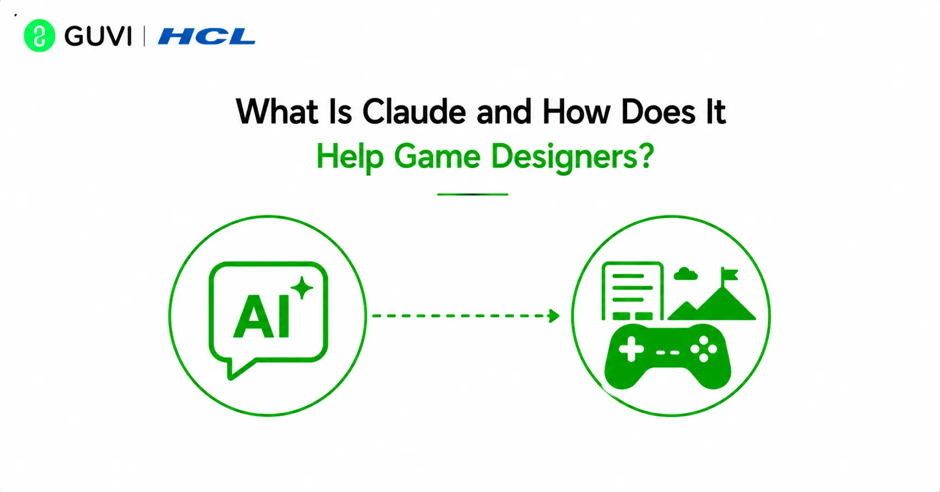
Claude is an AI assistant built by Anthropic that understands and generates detailed, contextually consistent text across long conversations. For game designers, this means Claude can hold an entire fictional world’s context in a single conversation and help you build on it coherently.
Claude is particularly useful for game design tasks that involve:
- Generating detailed world history and mythology
- Creating consistent faction systems with motivations and conflicts
- Writing character backstories and dialogue
- Designing magic systems, technological rules, or cultural traditions
- Stress-testing lore for internal contradictions
- Producing placeholder content for prototypes quickly
Claude works best as a creative collaborator rather than a content generator. The strongest results come when you bring a creative direction and use Claude to explore, expand, and stress-test your ideas.
Read More: How to Build AI Apps with Claude and Share Them Easily
Using Claude for World-Building: Core Approaches
- Establishing the Foundation
Start by giving Claude a clear creative brief for your world before asking it to generate specific elements. The more context you provide upfront, the more consistent the output throughout the conversation.
I am building a dark fantasy RPG set in a world where magic is dying.
The world has three main factions: a theocratic empire that controls
the remaining magic, a network of underground rebels who believe magic
should be free, and an ancient race of non-human beings who remember
the world before magic existed. Help me develop the history, tensions,
and key lore elements for this world.
This single prompt gives Claude enough to generate consistently across dozens of follow-up requests without losing the core creative direction.
- Expanding Existing Lore
Claude works well for expanding lore you have already started. Paste in what you have written and ask Claude to identify gaps, suggest expansions, or generate additional detail in specific areas.
Here is the history of the Valdris Empire I have written so far.
Can you suggest three major historical events I have not covered yet
that would create interesting player-facing consequences in the present day?
This keeps Claude working within your creative constraints rather than generating a parallel world that conflicts with your existing work.
Want to build real technical and creative skills to bring your game ideas to life? Explore HCL GUVI’s Full Stack Development Course, designed to help you develop the programming and project-building foundations that game development demands.
World-Building Elements Claude Can Generate
- Faction Systems and Political Structures
Claude can generate detailed faction profiles including leadership structures, core beliefs, internal tensions, relationships with other factions, and short and long-term goals. These profiles give writers and quest designers a consistent reference to draw from.
Useful prompts for faction building:
- “Generate a detailed profile for the underground rebel faction including their hierarchy, methods, core beliefs, and internal disagreements.”
- “What would a typical recruit’s journey into this faction look like from first contact to full membership?”
- “What does this faction want that they would never publicly admit?”
- Mythology and Creation Lore
Every believable game world needs a mythology that different cultures within the world interpret differently. Claude can generate a core myth and then produce three or four culturally distinct versions of it, exactly as different in-world groups might have retold and distorted it over centuries.
- Geography and Culture
Claude can generate culturally consistent details for specific regions, including naming conventions, architectural styles, food, trade goods, religious practices, and social hierarchies. Feeding Claude a one-sentence geography description often produces enough cultural detail to brief an entire environment art team.
A study of game post-mortems published by the Game Developers Conference found that narrative and lore rework ranks among the top five causes of scope creep in story-driven games, making early lore consistency tools like Claude particularly valuable for small teams without dedicated narrative directors.
Using Claude for Lore Writing
- In-World Documents and Artifacts
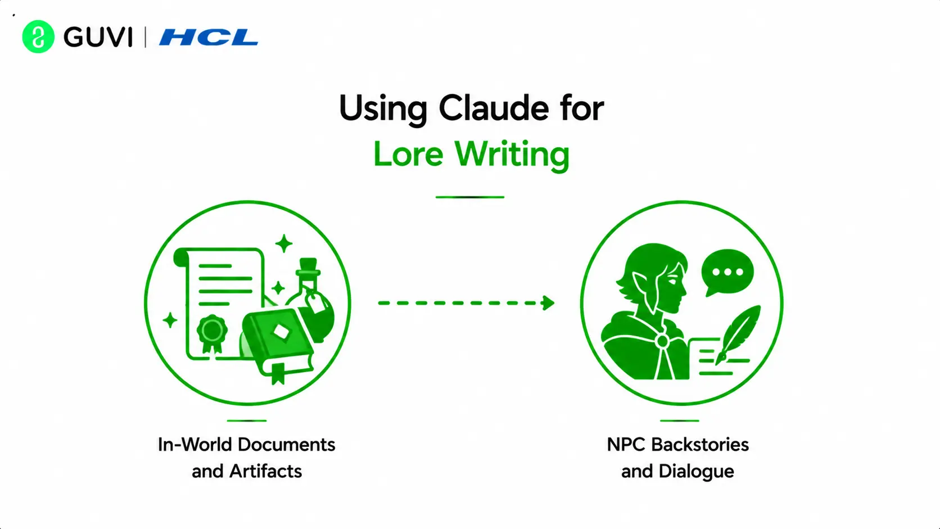
One of Claude’s most useful applications in game lore is generating in-world text, the kind of content players discover as collectibles, journal entries, propaganda posters, or ancient inscriptions.

Write a public decree from the Valdris Empire announcing a new law
restricting unauthorized magic use. Write it in the formal, slightly
threatening tone of a bureaucratic theocracy that genuinely believes
it is protecting the public.
In-world documents add narrative depth without requiring main story screen time and can be generated quickly for prototype builds.
- NPC Backstories and Dialogue
Claude can generate layered NPC backstories that include formative experiences, contradictions, secrets, and relationship histories. These give voice actors and writers richer material to work from than a flat character summary.
Generate a backstory for a mid-ranking soldier in the Empire whoprivately doubts the theocracy but is too afraid to defect. Include
a specific personal loss that explains both his loyalty and his doubt.
Maintaining Lore Consistency with Claude
One of the most common world-building problems is internal contradiction, where details established early in development conflict with elements added later. Claude can help catch these in several ways.
- Lore consistency checks: Paste in two sections of lore and ask Claude to identify any contradictions or timeline inconsistencies between them.
- Stress-testing from a player perspective: Ask Claude to play the role of a detail-obsessed player and find plot holes or questions the current lore does not answer satisfactorily.
- Maintaining a lore bible: Paste your accumulated world notes at the start of a new conversation and ask Claude to answer design questions strictly within what has already been established, flagging anything that requires new canonical decisions.
Some of the most detailed game worlds in history, including the lore systems of The Elder Scrolls and Planescape, were built by small writing teams working with structured lore bibles over many years.
Real-World Example: Building an Indie RPG World in a Weekend
Consider an indie developer working solo on a narrative RPG with a planned release on Steam. They have a core gameplay mechanic but no developed world or story.
Over a single weekend, they use Claude to establish a world foundation through a detailed briefing prompt, generate five faction profiles with internal conflicts, create a 500-year timeline of major historical events, write twelve in-world documents for player discovery, and identify three major lore contradictions in their initial notes before writing a single line of in-game text.
The developer enters the following week with a complete lore bible that would previously have taken months to draft alone, allowing their limited production time to focus on level design and mechanics rather than foundational world-building.
Conclusion
Claude for game design offers narrative designers, indie developers, and world-builders a genuinely useful creative partner for the aspects of game development that are most time-consuming to do alone, specifically generating consistent lore, faction depth, character backstory, and in-world text at scale.
The strongest results come from treating Claude as a collaborative tool within a clear creative framework.
FAQ
What is Claude and how is it used in game design?
Claude is an AI assistant by Anthropic that helps game designers generate lore, faction profiles, character backstories, in-world documents, and world history through natural conversation.
Can Claude help with world-building for RPGs?
Yes. Claude can generate detailed world history, mythology, cultural systems, political factions, and NPC backstories suited for RPG development, working consistently within a creative brief you provide.
How do I keep Claude’s output consistent with my existing lore?
Paste your established lore into the conversation at the start of each session and instruct Claude to work strictly within what has already been established, flagging anything that requires new decisions.
Can Claude write in-game dialogue and NPC conversations?
Yes. Claude can generate NPC dialogue, journal entries, in-world documents, and faction-specific speech patterns when given a character brief and tonal direction.
Does Claude replace a game narrative designer?
No. Claude works best as a creative collaborator that expands and stress-tests a designer’s vision, not as a replacement for creative direction, final editing, or narrative structure decisions.
How do I prompt Claude effectively for game world-building?
Start with a detailed creative brief covering your world’s core premise, tone, major factions, and key conflicts before asking for specific elements. The more context you provide upfront, the more consistent the output.
Success Stories

About the Author
Vishalini Devarajan
An Aerospace Engineer turned content writer, I focus on making complex concepts easy to understand through well-structured, reader-friendly blogs. Whether it’s a technical topic or a non-technical one, I love creating content that is clear, engaging, and impactful.
View all posts by Vishalini Devarajan
Connect with me @









Did you enjoy this article?