


Career Articles
How to Mentor Junior Developers: A Practical Guide
Mock Interview Platforms: Which One Is Best in 2026?


Get In Touch For Details! Request More Information
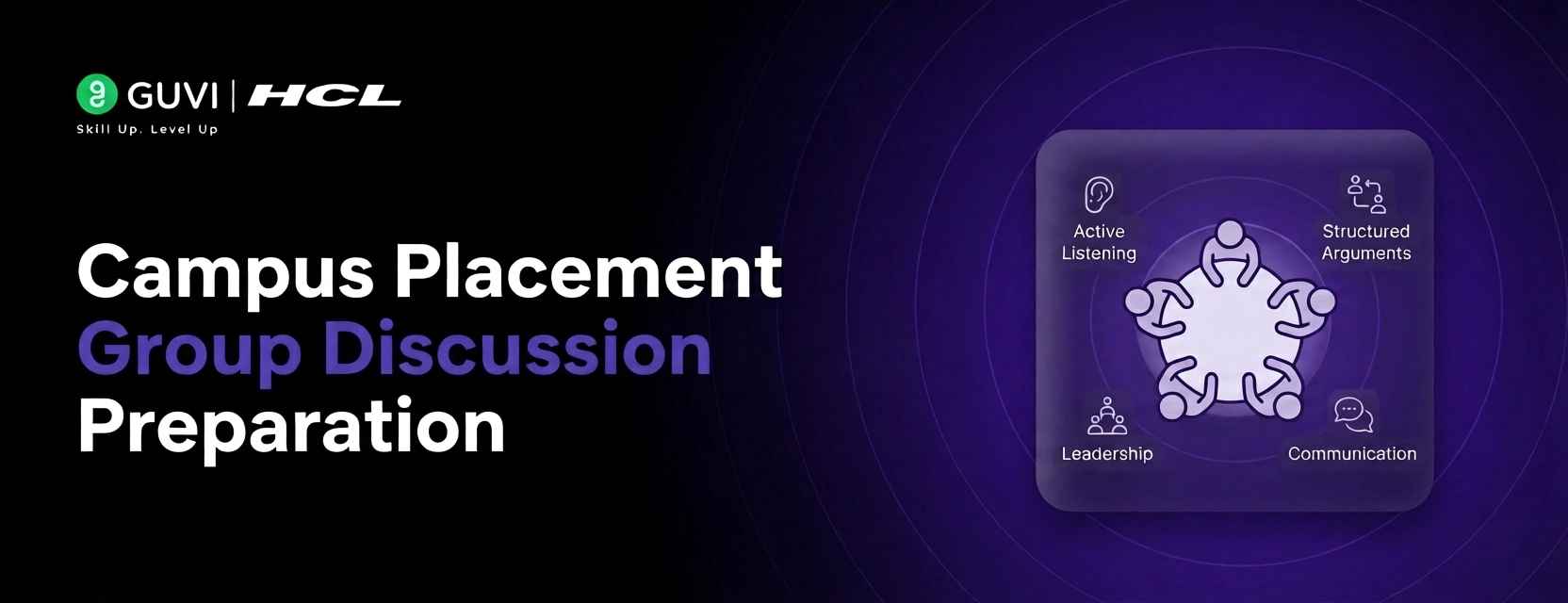
Campus Placement GD Preparation: Everything You Need to Know
Jun 19, 2026 4 Min Read 21 Views
(Last Updated)
Campus placements focus on more than just technical skills or a strong GPA. Many companies use Group Discussions (GDs) as an initial screening round to evaluate communication, teamwork, leadership, and analytical thinking. Understanding how GDs operate and preparing for them can significantly increase your chances of standing out and advancing in the placement process.
Table of contents
- TL;DR
- What is a Group Discussion in Campus Placements?
- Why Companies Conduct GD Rounds
- Skills Recruiters Evaluate During GDs
- Communication Skills
- Leadership Potential
- Teamwork and Collaboration
- Analytical Thinking
- Confidence and Presence
- Types of Group Discussions in Campus Placements
- Topic-Based GD
- Case Study GD
- Abstract GD
- Problem-Solving GD
- How to Prepare for a GD Round
- Improve Your Current Affairs Knowledge
- Practice Mock GDs
- Learn Structured Thinking
- Enhance Communication Skills
- Develop Active Listening Habits
- Winning Strategies During a Group Discussion
- Start the Discussion If You Have a Strong Opening
- Use Facts and Examples
- Build on Others' Ideas
- Stay Professional During Disagreements
- Summarize When Appropriate
- Common GD Mistakes to Avoid
- Speaking Too Much
- Interrupting Others
- Remaining Silent
- Speaking Without Structure
- Becoming Aggressive
- Popular GD Topics for Campus Placements
- Technology Topics
- Education Topics
- Business Topics
- Social Topics
- Sample GD Framework for Any Topic
- Step 1: Define the Topic
- Step 2: Present Key Benefits
- Step 3: Address Challenges
- Step 4: Offer a Balanced Perspective
- Step 5: Conclude Effectively
- Final Tips to Ace Campus Placement GDs
- Conclusion
- FAQs
- What is the ideal speaking time in a group discussion?
- Is it necessary to start the discussion to get selected?
- What skills do recruiters evaluate during a GD?
- How can I improve my GD performance quickly?
- What are the most common GD topics in campus placements?
- How can I overcome nervousness in a GD?
- What should I do if someone interrupts me during a GD?
TL;DR
- Group discussions help recruiters assess communication, teamwork, leadership, and problem-solving skills.
- Speaking first can create a positive impression, but making meaningful contributions is more important than being the most vocal.
- Active listening and building on others’ ideas are often seen favorably by evaluators.
- Staying updated with current affairs and practicing mock GDs can greatly enhance performance.
- Avoid taking over the discussion, interrupting others, or speaking without a clear structure.
Strong communication and interview skills play a crucial role in placement success. Students looking to improve their confidence, communication, and interview performance can explore HCL GUVI’s Interview Preparation Course. The course is designed to help learners prepare for recruiter interactions and navigate placement interviews more effectively.
What is a Group Discussion in Campus Placements?
A Group Discussion is a formal conversation where multiple candidates discuss a topic, problem, or case study within a set amount of time. Recruiters watch how participants communicate, collaborate, analyze information, and present their viewpoints in a group setting.
Unlike interviews, where candidates answer specific questions, GDs require participants to think quickly, respond to different perspectives, and contribute meaningfully to the discussion. For employers, GDs provide a quick way to evaluate several candidates at once while assessing skills that resumes alone cannot measure.
Why Companies Conduct GD Rounds
Companies want individuals who can work well in teams, communicate clearly, and solve problems together. A GD helps recruiters find candidates who can:
- Express ideas clearly
- Listen actively
- Collaborate effectively
- Handle disagreements professionally
- Show leadership potential
- Think logically under pressure
Since modern workplaces often rely on collaboration, employers use GDs to see if candidates can contribute positively in team settings.
Skills Recruiters Evaluate During GDs
[In-article image 2: The infographic should depict the heading title. Have an illustration depicting all skills as a flow chart or mind map representing them]
Communication Skills
Strong communication skills can help you express your ideas clearly during GDs and interviews. To improve these skills and prepare for recruiter interactions, check out MNC Interview Preparation for Freshers.
Leadership Potential
Leadership in a GD isn’t about dominating the discussion. It’s about guiding conversations, encouraging participation, and keeping the group focused on the topic.
Teamwork and Collaboration
Companies appreciate candidates who can work well with others. Listening, acknowledging different viewpoints, and expanding on others’ ideas show strong teamwork skills.
Analytical Thinking
Participants are often judged on how effectively they analyze situations, connect facts, and provide logical arguments rather than emotional reactions.
Confidence and Presence
Eye contact, posture, voice clarity, and overall confidence affect how recruiters view candidates during discussions. Building confidence is essential for performing well in placement rounds. This guide on How to Prepare for an Interview can help you strengthen your communication and interview skills.
Types of Group Discussions in Campus Placements
[In-article image 3: The infographic should depict the heading title. Have an illustration depicting all GD as a flow chart or mind map representing them]
Topic-Based GD
Candidates discuss a particular topic such as artificial intelligence, social media, climate change, or remote work.
Case Study GD
Participants analyze a business scenario and suggest solutions based on the information available.
Abstract GD
The discussion centers around abstract topics such as “Blue is the New Black” or “The Sky Has No Limits.”

Problem-Solving GD
Candidates work together to resolve a practical issue while demonstrating analytical and decision-making skills.
In group discussions (GDs), recruiters typically do not evaluate candidates based on how much they speak. Instead, they assess a combination of skills such as communication clarity, active listening, teamwork, leadership potential, and logical reasoning. Candidates who contribute meaningfully, build on others’ points, and help the discussion move forward often create a stronger impression than those who dominate the conversation without structure. Effective participation is about adding value to the group discussion, not overpowering it.
How to Prepare for a GD Round
Improve Your Current Affairs Knowledge
Reading newspapers, business magazines, and technology news helps you form informed opinions on common GD topics. Focus on:
- Technology trends
- Business news
- Economic developments
- Government policies
- Global events
Practice Mock GDs
Regular practice boosts confidence and fluency in speaking. Join:
- College placement clubs
- Mock placement sessions
- Peer discussion groups
Learn Structured Thinking
Before you speak, organize your thoughts into a simple format:
- Introduction
- Supporting points
- Examples
- Conclusion
Structured responses often make a stronger impression than long, disorganized arguments.
Enhance Communication Skills
Work on:
- Pronunciation
- Voice modulation
- Clarity
- Confidence
Recording yourself while speaking can help you identify areas to improve.
Develop Active Listening Habits
Listening is as crucial as talking. Candidates who acknowledge others’ points and build on them usually perform better than those who merely wait for their turn to speak.
Active listening is a valuable skill in both GDs and interviews. Reviewing these Top 25 HR Interview Questions and Answers can help you understand what recruiters expect from candidates.
Winning Strategies During a Group Discussion
Start the Discussion If You Have a Strong Opening
Taking the lead can showcase your confidence and leadership. But don’t initiate just for visibility. A weak opening can backfire.
Use Facts and Examples
Support your arguments with examples, statistics, or real-world observations to appear more credible. For instance, when discussing AI and employment, mentioning trends in automation can strengthen your argument.
Build on Others’ Ideas
Instead of repeating points, expand on them.
For example:
“To add to what Rahul mentioned, another important aspect is…”
This shows collaboration and listening skills.
Stay Professional During Disagreements
Disagreements are common in GDs.
Rather than saying:
“You’re wrong.”
You could say:
“I respect your viewpoint, but I’d like to share a different opinion.”
Summarize When Appropriate
If you have the chance, summarize the key points of the discussion. A solid summary shows leadership, attentiveness, and clarity of thought.
Professional communication becomes even more important in later hiring stages. Understanding the Technical Interview vs HR Interview: 7 Key Differences can help you prepare more effectively.
Common GD Mistakes to Avoid
Speaking Too Much
Some candidates think that constant talking improves their visibility. In reality, evaluators care more about relevance and quality than speaking time.
Interrupting Others
Frequent interruptions leave a negative impression and suggest poor teamwork.
Remaining Silent
Even if you have great knowledge, it won’t help if recruiters never hear your thoughts. Aim to contribute at least three to four meaningful times during the discussion.
Speaking Without Structure
Jumping between ideas can confuse listeners and weaken your arguments.
Becoming Aggressive
Confidence is valued, but aggression is not. Keep your professionalism even when opinions differ.
Clearing a GD is only one step in the placement journey. HCL GUVI’s Interview Preparation Course helps students improve communication, confidence, and interview performance. These skills can be valuable throughout the recruitment process.
Popular GD Topics for Campus Placements
Technology Topics
- Artificial Intelligence and Job Automation
- Cybersecurity Challenges
- Electric Vehicles in India
- Future of Generative AI
Education Topics
- Online vs Offline Learning
- Importance of Internships
- Skill-Based Education
Business Topics
- Startups vs MNCs
- Four-Day Work Week
- Remote Work Culture
Social Topics
- Impact of Social Media
- Climate Change
- Digital Privacy
Sample GD Framework for Any Topic
When faced with an unfamiliar topic, follow this simple framework.
Step 1: Define the Topic
Start by briefly explaining the concept.
Step 2: Present Key Benefits
Discuss advantages and positive impacts.
Step 3: Address Challenges
Highlight limitations, risks, or concerns.
Step 4: Offer a Balanced Perspective
Consider multiple viewpoints instead of presenting only one side.
Step 5: Conclude Effectively
Summarize the discussion and provide a logical final takeaway.
Final Tips to Ace Campus Placement GDs
- Stay calm and composed.
- Speak clearly, not too fast.
- Support your arguments with examples.
- Listen actively before you respond.
- Encourage quieter members to participate.
- Avoid memorized speeches.
- Maintain positive body language.
- Focus on adding value to the discussion.
Remember, recruiters are assessing how you function in a team, not just how well you can win an argument.
If you’re preparing for campus recruitment beyond GDs, explore How to Prepare for CS/IT Placements 2026 for practical placement strategies.
Conclusion
Group discussions are an important part of campus placements, helping recruiters evaluate communication, teamwork, leadership, and analytical thinking skills. With consistent practice, structured thinking, and active participation, you can significantly improve your GD performance. Start preparing early, stay informed, and approach every discussion with confidence to increase your chances of placement success.
FAQs
1. What is the ideal speaking time in a group discussion?
There is no set duration. Instead of talking constantly, focus on making three to four meaningful contributions throughout the discussion.
2. Is it necessary to start the discussion to get selected?
No. Starting the discussion can help create visibility, but candidates are judged on the quality of their contributions, not who speaks first.
3. What skills do recruiters evaluate during a GD?
Recruiters commonly assess communication skills, leadership, teamwork, analytical thinking, confidence, and listening ability.
4. How can I improve my GD performance quickly?
Practice mock discussions regularly, stay updated on current affairs, enhance your communication skills, and learn to structure your arguments logically.
5. What are the most common GD topics in campus placements?
Some frequently discussed topics include technology, business, education, social issues, artificial intelligence, startups, climate change, and workplace trends.
6. How can I overcome nervousness in a GD?
Practice regularly, stay informed about current affairs, and focus on sharing meaningful points rather than trying to speak the most.
7. What should I do if someone interrupts me during a GD?
Stay calm, let them finish, and politely continue making your point. Maintaining professionalism leaves a positive impression.
Success Stories

About the Author
Vishalini Devarajan
An Aerospace Engineer turned content writer, I focus on making complex concepts easy to understand through well-structured, reader-friendly blogs. Whether it’s a technical topic or a non-technical one, I love creating content that is clear, engaging, and impactful.
View all posts by Vishalini Devarajan
Connect with me @









Did you enjoy this article?