


Cyber Security Articles
How to Perform a Basic Penetration Test on Your Web App
Falco Runtime Security Tutorial: Catch Attacks as They Happen


Get In Touch For Details! Request More Information

A SOC Analyst (Security Operations Centre Analyst) is an important member of an organisation responsible for ensuring its digital security.
Companies that handle large volumes of critical information and digital assets are always vulnerable to cyberattacks and hacking. Therefore, to protect their sensitive data and entire software infrastructure, these professionals are deployed.
But handling these complex tasks demands a set of skills. So let’s move forward and discuss the essential SOC Analyst skills.
Table of contents
- TL;DR Summary
- SOC Analyst: Role & Responsibility
- Monitor
- Detect
- Analyze
- Respond
- How to Become a SOC Analyst
- SOC Analyst Skills Required for a Successful Career
- Programming Skills
- Network Security
- Threat Detection
- Incident Response
- SIEM Tools
- Log Analysis
- Malware Analysis
- Vulnerability Assessment
- Security Monitoring
- Linux Fundamentals
- Windows Security
- TCP/IP Networking
- Firewall Management
- Cyber Threat Intelligence
- SOC Analyst Tools and Technologies: Tabular Overview
- Conclusion
- FAQs
- How long does it take to become a SOC Analyst?
- Is programming mandatory for a SOC Analyst role?
- Which operating system should beginners focus on first?
- What are the most important SOC Analyst skills for beginners?
- Can someone from a non-technical background become a SOC Analyst?
- Which tools should I learn first as a beginner to develop SOC Analyst Skills?
TL;DR Summary
- A SOC Analyst protects an organisation’s systems, networks, and digital assets by identifying and responding to cyber threats.
- The core responsibilities of a SOC Analyst include monitoring, detecting, analysing, and responding to security incidents.
- Building strong SOC Analyst skills in areas like network security, threat detection, and incident response is essential for success.
- Key SOC Analyst skills also include working with SIEM tools, log analysis, Linux, Windows, and cybersecurity monitoring technologies.
- Understanding SOC Analyst skills, career pathways, and commonly used tools can help beginners start a career in cybersecurity with confidence.
Splunk, founded in 2003, became a key SOC tool by enabling real-time search and analysis of machine-generated security logs.
SOC Analyst: Role & Responsibility
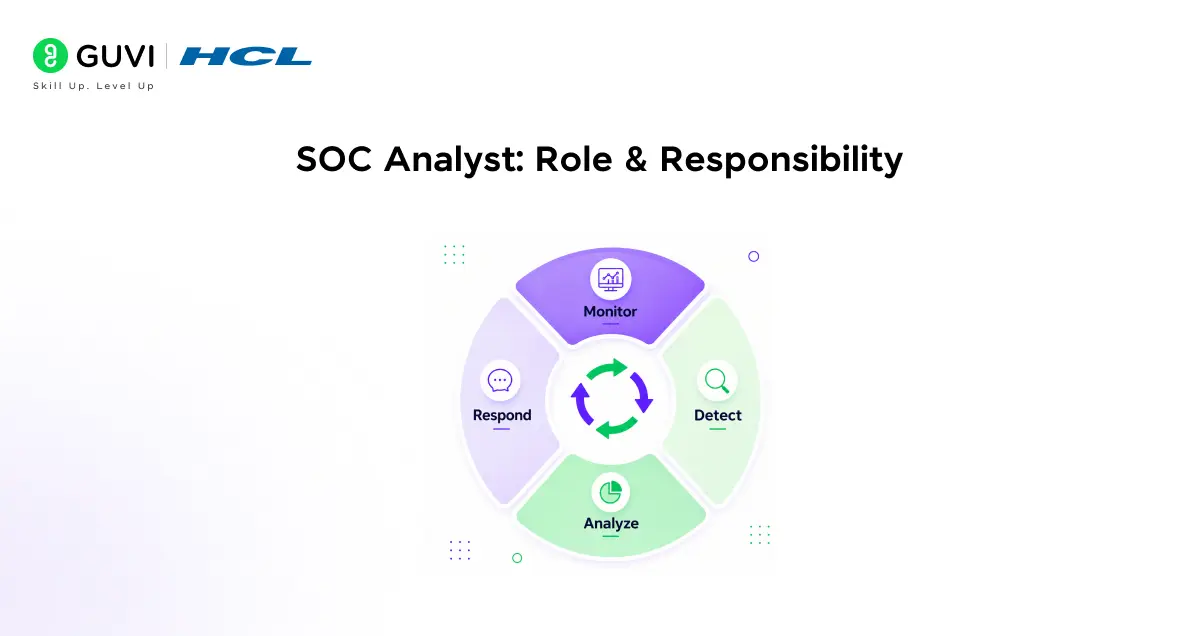
Suspicious activities can occur at any time, and their intensity level also varies. And it is the responsibility of the SOC Analyst to frequently monitor those activities and respond to security alerts.
The following are the 4 primary core responsibilities of a SOC Analyst:
1. Monitor
A SOC Analyst monitors the company’s systems, networks, servers, and security tools throughout the day to ensure everything is running normally.
2. Detect
When a security alert appears, the SOC Analyst checks whether it could be a hacking attempt, malware infection, or any other suspicious activity.
3. Analyze
After identifying a potential threat, the SOC Analyst investigates it to understand what happened, where it originated, and how much risk it poses to the company.
4. Respond
If the threat is real, the SOC Analyst takes action or alerts the security team to stop the attack and prevent further damage.
Key Roles of a SOC Analyst:
- Monitor security alerts to identify unusual activity across systems and networks.
- Detect cyber threats before they can impact the organisation.
- Investigate suspicious events to determine whether they pose a security risk.
- Respond to security incidents and help contain potential attacks.
- Report security findings to relevant teams and stakeholders.
- Protect digital assets such as data, networks, and critical systems.
- Maintain security records for future analysis and compliance purposes.
- Improve security posture by supporting ongoing security efforts.
Also Read: What is Cybersecurity
Begin your journey in cybersecurity with HCL GUVI’s Cyber Security and Ethical Hacking Course for beginners and build practical skills in ethical hacking and defence to prepare for real-world security jobs.
How to Become a SOC Analyst
- No fixed degree is required, but IT, Computer Science, or any graduation helps as a starting point.
- Learn basic computer networks and cybersecurity fundamentals first.
- Do SOC or cybersecurity training to understand real security monitoring work.
- Certifications can help, but skills and practical knowledge matter more than certificates.
- Practice working with security alerts and tools to build real job-ready experience.
SOC Analyst Skills Required for a Successful Career

The following SOC Analyst skills are required for building a strong foundation in cybersecurity and developing a career in the field:
1. Programming Skills
Programming skills help SOC Analysts automate repetitive tasks, analyze security data, and understand how malicious scripts or software work.
While deep programming expertise is not required for entry-level roles, having a basic understanding of coding can be very useful.
The following are some commonly used programming languages:
- Python
- PowerShell
- Bash
- JavaScript
- C++
2. Network Security
Network security is the ability to understand how data moves across networks and how to protect it from unauthorised access. Since many cyber attacks target networks, SOC Analysts must know how to identify and respond to suspicious network activity.
3. Threat Detection
Threat detection involves identifying signs of cyber attacks, malware infections, or unauthorised access attempts. SOC Analysts use security tools and alerts to recognise potential threats before they can cause damage.
4. Incident Response
Incident response is the process of handling security incidents after they have been detected. A SOC Analyst helps investigate the issue, contain the threat, and support efforts to restore normal operations as quickly as possible.
5. SIEM Tools
SIEM (Security Information and Event Management) tools help SOC Analysts collect, monitor, and analyse security events from different systems in one place. These tools make it easier to detect suspicious activities and investigate security incidents.

The following are some popular SIEM tools:
- Splunk
- IBM QRadar
- Microsoft Sentinel
- ArcSight
- LogRhythm
6. Log Analysis
Log analysis involves reviewing records generated by systems, applications, and network devices. SOC Analysts examine these logs to identify unusual activities, investigate incidents, and understand what happened during a security event.
7. Malware Analysis
Malware analysis is the process of studying malicious software such as viruses, worms, and ransomware. This helps SOC Analysts understand how the malware works and determine the best way to respond to the threat.
8. Vulnerability Assessment
Vulnerability assessment involves identifying weaknesses in systems, networks, or applications that attackers could exploit. SOC Analysts use this knowledge to help organisations reduce security risks and strengthen their defences.
9. Security Monitoring
Security monitoring involves continuously observing systems, networks, and security tools for unusual activity. This helps SOC Analysts detect potential threats early and take action before they become serious incidents.
10. Linux Fundamentals
Many servers, security tools, and enterprise systems run on Linux. A SOC Analyst should understand basic Linux commands, file management, permissions, and system operations to investigate and respond to security events effectively.
The following are some commonly used Linux distributions:
- Ubuntu
- Kali Linux
- Red Hat Enterprise Linux (RHEL)
- CentOS
- Debian
11. Windows Security
Since many organisations use Windows systems, SOC Analysts need to understand Windows security features, user accounts, permissions, logs, and common attack methods that target Windows environments.
12. TCP/IP Networking
TCP/IP networking helps SOC Analysts understand how devices communicate over a network. This knowledge is essential for investigating suspicious connections, analysing network traffic, and identifying potential security threats.
13. Firewall Management
Firewalls help control incoming and outgoing network traffic based on security rules. SOC Analysts should understand how firewalls work to investigate blocked connections, identify suspicious traffic, and support network security efforts.
14. Cyber Threat Intelligence
Cyber threat intelligence involves gathering and analysing information about current cyber threats, attack methods, and hacker activities. This helps SOC Analysts stay informed about emerging risks and better prepare for potential attacks.
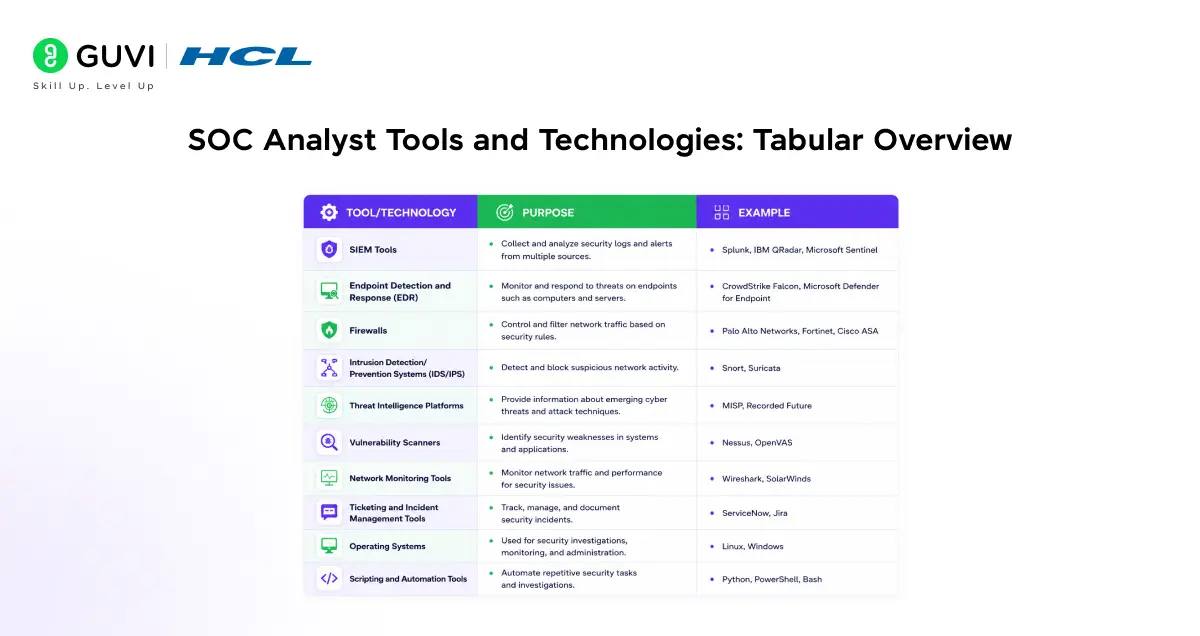
SOC Analyst Tools and Technologies: Tabular Overview
Jump into HCL GUVI’s Cybersecurity Bundle Course (6 courses) and learn how real cyber attacks happen and how to stop them, while building hands-on skills, earning global certifications, and upgrading yourself into a job-ready cybersecurity pro. This is your sign to stop scrolling and start levelling up your future!
Conclusion
Developing SOC Analyst skills is like a roller coaster ride full of ups and downs. And it has obvious reasons behind this statement.
Compared to other technical roles, this position requires a high level of technical command, which often takes considerable time to develop.
But as a beginner, your core focus must be to strengthen the technical foundations, combined with constant upskilling and self-reflection.
FAQs
1. How long does it take to become a SOC Analyst?
With regular learning and practice, many beginners can develop SOC Analyst skills within a few months.
2. Is programming mandatory for a SOC Analyst role?
Basic programming knowledge is useful, but advanced coding is not required for most entry-level roles.
3. Which operating system should beginners focus on first?
Linux is a great starting point because many security tools run on it.
4. What are the most important SOC Analyst skills for beginners?
Network security, threat detection, incident response, and SIEM tools are some of the key SOC Analyst skills.
5. Can someone from a non-technical background become a SOC Analyst?
Many people enter cybersecurity by learning SOC Analyst skills through training and hands-on practice.
6. Which tools should I learn first as a beginner to develop SOC Analyst Skills?
Start with SIEM tools, log analysis platforms, and basic Linux commands.
Success Stories














Did you enjoy this article?