


Business Analytics Articles
Using Claude for Personalized Content at Scale
How to Use Claude for YouTube Script writing


Get In Touch For Details! Request More Information

Who Is a Business Analyst? Roles, Skills, and Career Path
Jul 21, 2026 5 Min Read 712 Views
(Last Updated)
Imagine a company wants to build a new software system but is confused about what it should do. They need someone to talk to customers, understand problems, and write clear requirements so developers know what to build.
A business analyst is the bridge between business problems and technology solutions. They understand what companies need and translate that into actionable plans. Every successful project has a strong business analyst working behind the scenes.
This guide explains who is a business analyst, what they do, what skills they need, and how they fit into organizations.
Table of contents
- Quick TL;DR Summary
- Who is a Business Analyst?
- What Do Business Analysts Actually Do?
- Skills Required to Be a Business Analyst
- Types of Business Analysis
- Real-World Business Analyst Projects
- Career Path for Business Analysts
- Conclusion
- FAQs
- Do I need a degree to become a business analyst?
- What certifications help business analysts?
- What tools do business analysts use?
- Can I transition to business analysis from another career?
- How much do business analysts earn?
Quick TL;DR Summary
- This guide explains who is a business analyst, professionals who bridge the gap between business needs and technology solutions by gathering requirements and creating improvement plans.
- You will learn what business analysts actually do on a daily basis, from talking to stakeholders to documenting requirements to tracking project outcomes.
- The guide covers the skills required including communication, analysis, problem-solving, technical understanding, and business acumen.
- Step-by-step examples show how business analysts work, typical projects they handle, and why companies desperately need them.
- You will understand the difference between business analysts and related roles, career paths, and salary information.
Who Is a Business Analyst?
A business analyst is a professional who acts as a bridge between business stakeholders and technical teams by identifying business needs, analyzing processes, and recommending effective solutions. They gather and document requirements, evaluate existing workflows, identify opportunities for improvement, and translate business objectives into clear functional specifications. By combining analytical thinking, communication skills, and domain knowledge, business analysts help organizations improve efficiency, reduce costs, and make informed decisions that support business growth and transformation.
Who is a Business Analyst?

- The bridge between business and technology
A business analyst is a professional who analyzes business processes, identifies problems, and recommends solutions. They translate business needs into technical requirements that developers can understand and build.
- Understanding business problems
Business analysts ask questions and listen carefully to understand what is really going on. They look beyond surface complaints to find root causes. A customer might complain about slow reports, but the real problem might be data architecture.
- Creating clear requirements
Once they understand problems, business analysts write detailed requirements. These documents tell developers exactly what to build. Clear requirements prevent misunderstandings and costly rework.
- Bridging communication gaps
Executives speak business language. Developers speak technical language. Business analysts translate between them. They explain technical constraints to business people and business value to technical teams.
- Recommending improvements
Business analysts do not just document the current state. They analyze processes, find inefficiencies, and recommend improvements. They help companies work smarter.
- Tracking project success
Business analysts define what success looks like. After projects launch, they track whether improvements were achieved. They measure business impact, not just technical completion.
Read More: A Complete Business Analyst Career Roadmap
What Do Business Analysts Actually Do?
- Gathering requirements
Business analysts conduct interviews, surveys, and workshops to understand what stakeholders need. They ask probing questions and listen carefully. Good requirement gathering prevents expensive mistakes later.
- Analyzing current state
They document how things currently work. They create process flows, identify bottlenecks, and understand existing systems. This “as-is” analysis provides a baseline for improvement.
- Defining future state
They envision how things could work better. They design improved processes, recommend new systems, or suggest organizational changes. This “to-be” state becomes the project goal.
- Writing detailed requirements
Business analysts write specifications that developers can understand. They describe what the system should do, not how to build it. Good requirements are specific, measurable, and testable.
- Creating documentation
They produce user stories, process diagrams, data models, and requirement documents. This documentation guides development and serves as reference after launch.
- Facilitating meetings
Business analysts run workshops, requirements sessions, and stakeholder meetings. They ensure everyone understands requirements and agrees on scope.
- Testing and validation
They create test plans and validate that solutions meet requirements. They ensure projects deliver what was promised.
- Monitoring outcomes
After projects launch, they track whether business goals were achieved. They measure improvements and identify any gaps.
One of the most common causes of project failure is not poor coding or technology choices, but unclear, incomplete, or misunderstood requirements. Business Analysts play a critical role in bridging the gap between stakeholders and development teams by identifying business needs, documenting requirements, clarifying expectations, and ensuring that solutions align with organizational goals. Effective business analysis helps reduce costly rework, minimize project risks, and improve communication throughout the project lifecycle. Organizations that invest in strong requirements gathering, stakeholder collaboration, and business analysis practices are often better positioned to deliver successful projects that meet both user expectations and business objectives.
Skills Required to Be a Business Analyst
- Communication skills
- Listening carefully to understand what people really mean
- Asking probing questions to uncover hidden problems
- Explaining complex concepts in simple language
- Writing clear documentation
- Presenting findings to different audiences
- Analytical skills
- Thinking critically about problems
- Breaking complex processes into understandable pieces
- Identifying patterns and root causes
- Making data-driven recommendations
- Logical reasoning
- Technical skills
- Basic understanding of databases and systems
- Familiarity with software development concepts
- Ability to use business analysis tools
- Understanding of APIs and integrations
- Technical literacy (not necessarily coding)
- Business skills
- Understanding business processes and operations
- Knowledge of industry and company
- Financial awareness and cost-benefit analysis
- Strategic thinking
- Project management basics
- Soft skills
- Patience and empathy with stakeholders
- Attention to detail
- Problem-solving mindset
- Ability to influence without authority
- Curiosity and continuous learning
The impact of a Business Analyst is often most visible when something goes wrong. In successful projects, stakeholders may focus on the final product, the development team, or project leadership, while the behind-the-scenes work of gathering requirements, aligning expectations, and managing stakeholder communication can go unnoticed. Yet these activities are often essential to keeping projects on track and ensuring that teams build the right solution in the first place. Strong business analysts help reduce ambiguity, prevent misunderstandings, and connect business goals with technical execution. As organizations increasingly recognize the value of effective requirements management and cross-functional collaboration, business analysis is gaining recognition as a key contributor to project and product success.

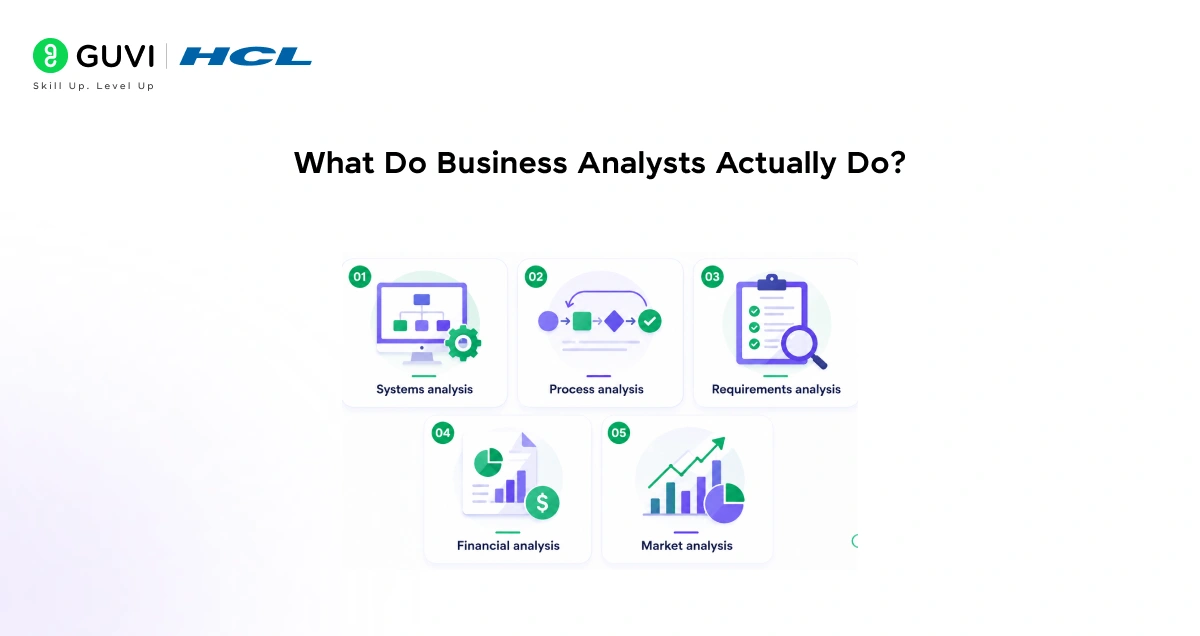
Types of Business Analysis
- Systems analysis
Analyzing how systems work and how to improve them. Creating requirements for new systems or system improvements. Most common type of business analysis.
- Process analysis
Examining business processes to find inefficiencies and recommend improvements. Often leads to process automation or restructuring.
- Requirements analysis
Gathering and documenting detailed requirements for projects. Ensuring requirements are complete, clear, and testable.
- Financial analysis
Analyzing business financial data to support decision making. Calculating costs and benefits of proposed solutions.
- Market analysis
Understanding markets, competitors, and customers. Supporting strategic decisions about products and markets.
Real-World Business Analyst Projects
- System implementation
A company wants to implement new accounting software. The business analyst gathers requirements from finance, operations, and reporting teams. They document exactly what the software must do. They validate that the software meets requirements and trains users.
- Process improvement
A manufacturing company has slow order processing. The business analyst maps the current process, finds bottlenecks, and recommends changes. They work with the team to implement improvements and measure results.
- Regulatory compliance
A bank needs to comply with new regulations. The business analyst understands the requirements, analyzes current processes, and recommends changes to ensure compliance. They document everything for audit purposes.
- Customer portal development
A utility company wants a self-service customer portal. The business analyst interviews customers to understand what features matter most. They write requirements and validates the final system meets customer needs.
- Organizational restructuring
A company is merging departments. The business analyst analyzes current roles and processes. They recommend new structures and document transition plans.
Career Path for Business Analysts

- Entry level
Junior Business Analyst or Business Systems Analyst positions. Often combined with data analyst or QA testing responsibilities. Focus on learning business processes and improving communication skills.
- Mid-career
Senior Business Analyst or Business Analyst roles managing larger projects. More independence and responsibility. Often mentor junior analysts.
- Advanced roles
Lead Business Analyst, Principal Analyst, or Business Analysis Manager. Managing teams and setting direction. Strategic projects and organizational analysis.
- Specialized paths
Becoming a Product Manager, Project Manager, or Management Consultant. Using business analysis skills in different roles.
To learn more on how to become a business analyst, enroll in HCL GUVI’s AI-Powered Business Analytics Course. Designed for aspiring analysts and data-driven professionals, this program helps you build hands-on skills in Excel, SQL, Power BI, Tableau, Python, and Generative AI. With expert mentorship, industry-relevant curriculum, and recognized certification, you’ll gain the skills needed to become job-ready for a successful career in business analytics.
Conclusion
A business analyst bridges the gap between business problems and technology solutions by understanding needs and creating clear requirements. They work with stakeholders to gather requirements, analyze processes, and recommend improvements.
Business analysts need diverse skills including communication, analysis, technical understanding, and business knowledge. They are the glue that holds projects together and ensures solutions actually solve problems.
The career path for business analysts is strong with good salaries and opportunities across industries. If you enjoy understanding problems, communicating clearly, and helping organizations improve, business analysis is a rewarding career.
FAQs
1. Do I need a degree to become a business analyst?
No specific degree is required, though many have business, computer science, or IT degrees. What matters is developing relevant skills and demonstrating business analysis ability through projects and certifications.
2. What certifications help business analysts?
Common certifications include CBAP (Certified Business Analysis Professional), PMC (Project Management Professional), and Agile certifications. These demonstrate expertise and often lead to better job opportunities.
3. What tools do business analysts use?
Popular tools include Jira for requirement tracking, Confluence for documentation, Lucidchart for process diagrams, and various data analysis tools. The specific tools depend on the company and project.
4. Can I transition to business analysis from another career?
Yes. People come from IT support, project management, data analysis, and various business roles. Your domain expertise combined with business analysis skills is valuable.
5. How much do business analysts earn?
Entry-level business analysts earn 55,000 to 75,000 dollars. Senior business analysts earn 95,000 to 140,000 dollars. Location, industry, and experience affect salary significantly.
Success Stories

About the Author
Vishalini Devarajan
An Aerospace Engineer turned content writer, I focus on making complex concepts easy to understand through well-structured, reader-friendly blogs. Whether it’s a technical topic or a non-technical one, I love creating content that is clear, engaging, and impactful.
View all posts by Vishalini Devarajan
Connect with me @











Did you enjoy this article?