


Artificial Intelligence and Machine Learning Articles
How to Evaluate LLM Outputs in Production Deployments
AI/ML Skills Gap 2026: Why Companies Can't Find Job-Ready Talent
20 AI/ML Interview Questions Recruiters Can Use Without a Tech Background - Best Guide
How Industry-Backed AI/ML Bootcamps Are Changing the AI/ML Hiring Pipeline - Best Guide 2026


Get In Touch For Details! Request More Information
Goal-Based Agent in AI: A Complete Guide
Aug 19, 2026 6 Min Read 1121 Views
(Last Updated)
What separates a truly intelligent machine from a simple rule-following program? The answer lies in purposeful, goal-directed behaviour. A thermostat reacts to temperature. A spam filter reacts to email content. But a goal-based agent does something fundamentally different: it asks: What do I need to achieve, and what sequence of actions will get me there?
Goal-Based Agents represent a critical step up the ladder of agent intelligence in AI. They reason about future states, plan across multiple steps, and evaluate actions not by what they do right now but by whether they bring the agent closer to its goal. This capacity for forward-looking, goal-directed reasoning is what enables AI agents to handle complex, real-world problem-solving tasks.
In this article, we explore what a Goal Based Agent is, how it differs from simpler agent types, how it plans and searches for solutions, and where goal-directed behaviour powers modern AI applications.
Table of contents
- TL;DR
- The Five Types of AI Agents: Where Goal Based Agents Fit
- Goal-Based Agent Architecture: The Key Components
- Sensors and Percepts
- World Model
- Goal Formulation
- Search and Planning
- Actuators and Actions
- Goal Formulation and Problem Solving in AI
- The Five Elements of Problem Formulation
- Search Algorithms: The Planning Engine of Goal-Based Agents
- Uninformed Search Algorithms
- Informed (Heuristic) Search Algorithms
- Real-World Applications of Goal-Based Agents in AI
- Limitations of Goal-Based Agents in AI
- Conclusion
- FAQs
- What is a Goal-Based Agent in AI?
- How does it differ from a simple reflex agent?
- Which search algorithms do goal-based agents use?
- What is goal formulation in AI agent design?
- When should you use a utility-based agent instead?
TL;DR
• A Goal-Based Agent selects actions based on what it needs to achieve, not just what it currently perceives.
• It uses an internal world model, goal formulation, and search algorithms to plan a solution path.
• It is more flexible than reflex agents; it can handle novel situations by reasoning about goals.
• Search algorithms like BFS, DFS, and A* are the planning engines inside goal-based agents.
• Goal-Based Agents power navigation systems, game AI, robotics, and autonomous planning.
What Is a Goal-Based Agent in AI?
A Goal-Based Agent is a type of intelligent agent in artificial intelligence that chooses actions based on a specific goal it aims to achieve. Unlike simple reflex agents that respond only to current inputs, a goal-based agent uses knowledge of the environment, search techniques, and planning methods to evaluate possible actions and determine the sequence of steps most likely to reach the desired goal state.
The Five Types of AI Agents: Where Goal Based Agents Fit
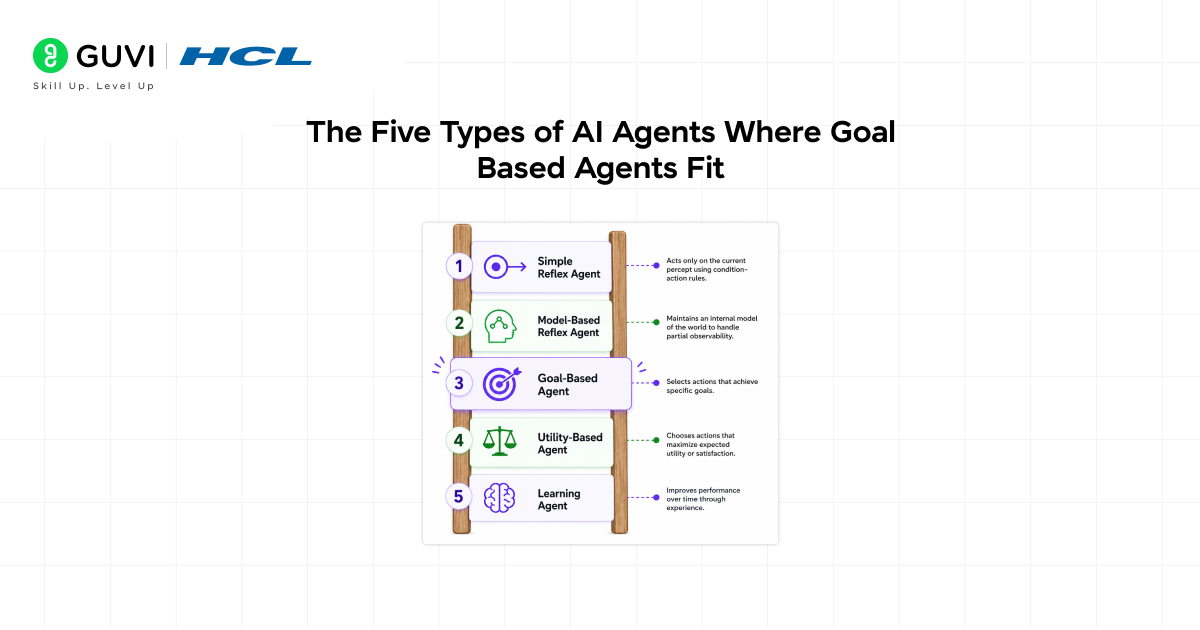
To understand what makes a Goal-Based Agent distinctive, it helps to see it within the full classification of AI agent architectures. Russell and Norvig’s foundational AI framework identifies five types of agents, each more capable than the last.
- Simple Reflex Agent: Reacts to current percepts using condition-action rules. No memory, no planning, no goals. Effective only in fully observable environments.
- Model-Based Reflex Agent: Maintains an internal model of the world to handle partial observability. Still reactive, it selects actions based on the current state, not a goal.
- Goal-Based Agent: Adds goal information to the model-based architecture. Selects actions that lead toward the goal state, using search and planning over multiple steps.
- Utility-Based Agent: Extends goal-based reasoning with a utility function — allowing it to choose between competing goals or compare states that all satisfy the goal but differ in quality.
- Learning Agent: Can improve its performance over time through experience. May use any of the above architectures internally and update its knowledge, goals, or decision-making through feedback.
The Goal-Based Agent is the first architecture that genuinely plans ahead. It knows where it is, it knows where it wants to be, and it uses search algorithms to find a path between the two. This is what elevates it above reactive systems into the realm of genuine problem-solving intelligence.
Goal-Based Agent Architecture: The Key Components
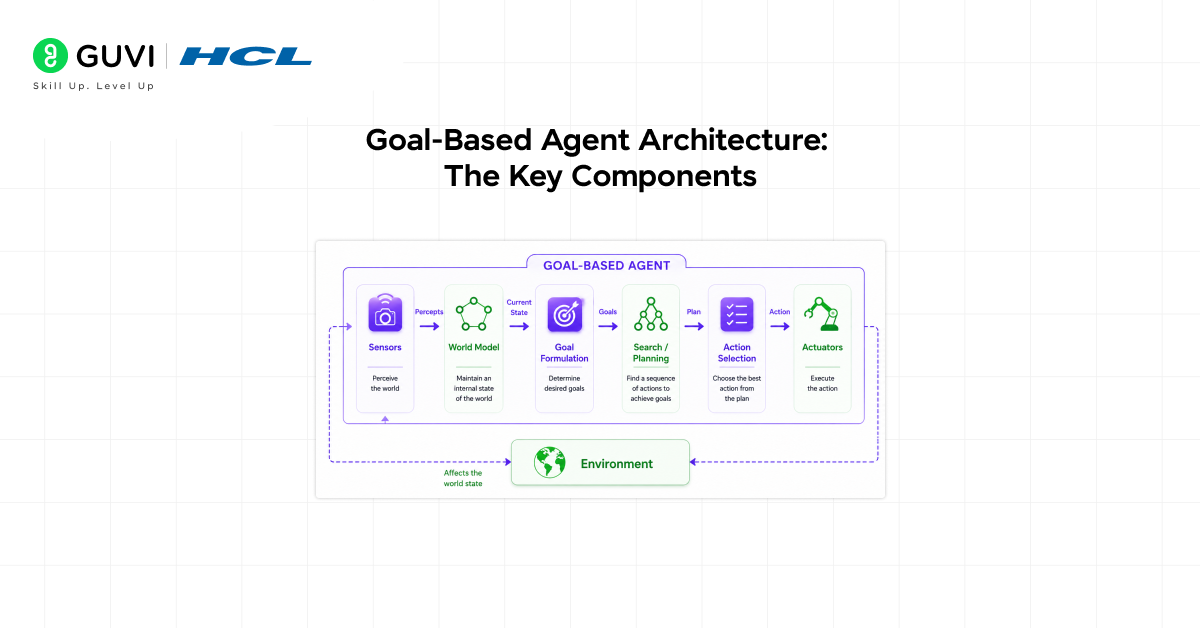
A Goal-Based Agent has a well-defined internal architecture that distinguishes it from simpler agent types. Understanding each component clarifies how the agent moves from perceiving the world to selecting a purposeful, goal-directed action.
1. Sensors and Percepts
The agent perceives its environment through sensors, physical or virtual inputs that provide information about the current state of the world. Percepts are the raw data from which the agent builds its understanding of where it currently is. A navigation agent might receive GPS coordinates and obstacle maps. A game-playing agent might receive the current board configuration.
2. World Model
The world model is the agent’s internal representation of the environment — both its current state and its understanding of how actions cause state transitions. Unlike a simple reflex agent that acts only on present percepts, the goal-based agent uses its world model to reason about what future states would result from different action sequences.
3. Goal Formulation
Goal formulation is the process of defining what the agent is trying to achieve. A goal is a description of a desired state of the world — or a condition that the desired state must satisfy. Goal formulation abstracts away irrelevant details and focuses the agent’s search on the states that matter. In a navigation problem, the goal is a specific destination. In a chess problem, the goal is checkmate.
- Achievement goals: States the agent wants to reach and maintain, e.g., deliver the package to address X.
- Maintenance goals: Conditions the agent must keep true throughout operation, e.g. stay within speed limits while navigating.
- Query goals: Information the agent needs to obtain, e.g. find the shortest available route.
4. Search and Planning
Once the goal is formulated, the agent uses search algorithms to find a sequence of actions — a plan — that transforms the current state into the goal state. This is the computational heart of the Goal-Based Agent. The choice of search algorithm determines how efficiently and effectively the agent finds its solution.
5. Actuators and Actions
Once the plan is found, the agent executes it through actuators — the physical or virtual mechanisms through which it affects the environment. Each action in the plan is executed in sequence, with the agent monitoring for unexpected changes in the world state that might require replanning.
Goal Formulation and Problem Solving in AI
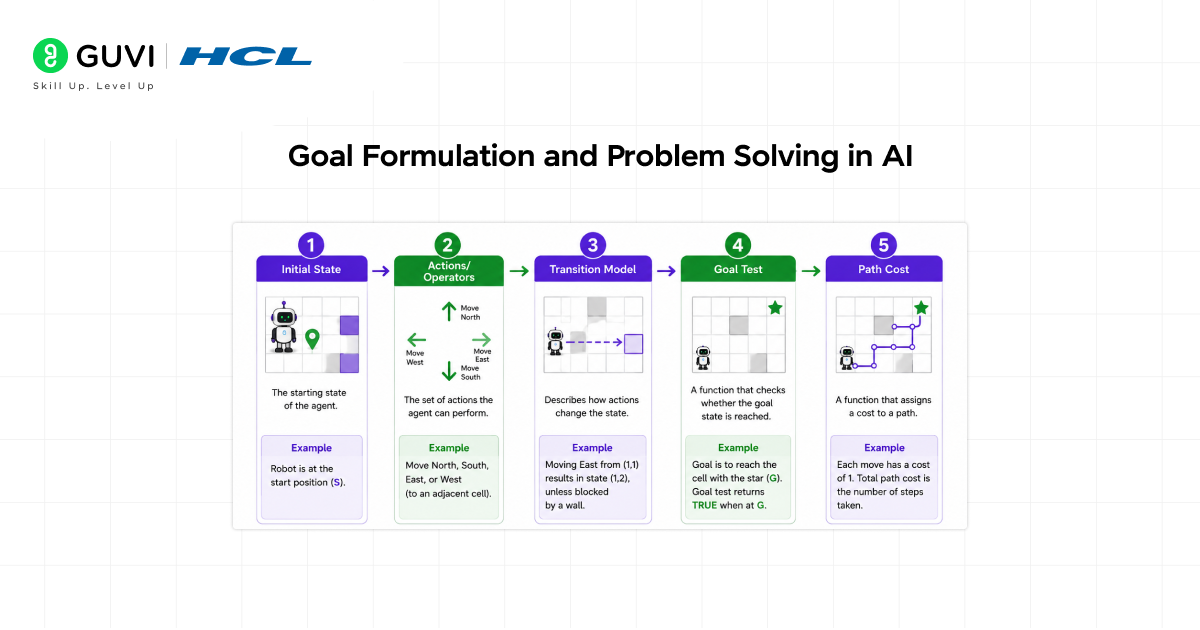
Goal formulation is not just about naming a desired outcome; it is about defining the problem in a way that makes it tractable for search. A well-formulated goal specifies the target state precisely enough for the agent to recognise when it has been achieved, while abstracting away irrelevant details that would make the search space unnecessarily large.
The Five Elements of Problem Formulation
- Initial state: The starting configuration of the agent and its environment. In a navigation problem, the agent’s current location is.
- Actions (operators): The set of actions available to the agent in any given state. In navigation: Move North, Move South, Move East, Move West.
- Transition model: A description of what each action does, and what state results from applying action A in state S. Together with the initial state, this defines the state space.
- Goal test: A function that determines whether a given state satisfies the goal. Simple goals have a single goal state; complex goals have a condition that many states might satisfy.
- Path cost: A function that assigns a cost to each action or sequence of actions. Allows the agent to prefer shorter, faster, or cheaper solution paths when multiple plans achieve the goal.
Together, these five elements define the search problem the agent must solve. Every Goal-Based Agent,t from a game-playing AI to a robotic planner, operates on some version of this formal structure.
Search Algorithms: The Planning Engine of Goal-Based Agents
Search algorithms are what Goal-Based Agents use to find the plan — the sequence of actions from the initial state to the goal state. Different algorithms explore the state space in different ways, with different guarantees about completeness, optimality, time complexity, and memory usage.
Uninformed Search Algorithms
Uninformed search algorithms explore the state space systematically using only the problem’s structure with no additional information about how close any state is to the goal.
- Breadth-First Search (BFS): Explores all states at depth d before exploring states at depth d+1. Guaranteed to find the shallowest solution. High memory usage for large state spaces.
- Depth-First Search (DFS): Explores as deep as possible before backtracking. Low memory usage but not guaranteed to find the optimal solution and can loop infinitely without cycle detection.
- Uniform Cost Search (UCS): Expands the node with the lowest cumulative path cost. Optimal when path costs vary. The foundational algorithm for cost-aware goal-based planning.
- Iterative Deepening DFS (IDDFS): Combines DFS’s low memory footprint with BFS’s completeness guarantee by running DFS to increasing depth limits iteratively.

Informed (Heuristic) Search Algorithms
Informed search algorithms use a heuristic function h(n) to estimate the cost from a given state to the goal. This additional information guides the search toward promising regions of the state space, dramatically reducing the number of nodes explored.
- Greedy Best-First Search: Always expands the node with the lowest estimated cost to the goal h(n). Fast but not guaranteed to find the optimal path.
- A* Search: Expands the node with the lowest f(n) = g(n) + h(n), where g(n) is the actual cost from the start. Optimal and complete when the heuristic is admissible (never overestimates). The most widely used informed search algorithm in goal-based AI systems.
The A* algorithm was first described in 1968 by Peter Hart, Nils Nilsson, and Bertram Raphael. More than five decades later, it remains one of the most influential algorithms in pathfinding and AI planning, powering applications ranging from early video game AI to modern robotic navigation systems and GPS route planners. Its long-lasting impact comes from its powerful balance between optimality and computational efficiency when paired with a strong heuristic.
Real-World Applications of Goal-Based Agents in AI
Goal-Based Agents are not a theoretical construct; they are embedded in AI systems that operate at scale in the real world. Their ability to plan purposefully toward defined objectives makes them the architecture of choice wherever intelligent, multi-step problem-solving is required.
- Navigation and GPS Route Planning: Every navigation system, em from Google Maps to autonomous vehicle path planners, rs is a Goal-Based Agent. The goal is the destination. The world model is the road network. A* or Dijkstra’s algorithm finds the optimal route. The agent replans if the road conditions change.
- Game-Playing AI: Chess engines, puzzle solvers, and game NPCs all use goal-based planning. The goal is checkmate, the solved puzzle, or a specific game state. Search algorithms explore the game tree to find the move sequence that achieves the goal.
- Robotics and Autonomous Systems: Industrial robots, warehouse automation systems, and autonomous drones use goal-based agents to plan collision-free paths, sequence assembly operations, and navigate dynamic environments toward defined task objectives.
- Logistics and Supply Chain Planning: AI planning systems optimise delivery routes, warehouse picking sequences, and production schedules as goal-based planning problems, finding action sequences that achieve delivery or throughput goals within defined constraints.
- Automated AI Assistants: Modern agentic AI systems,s including tool-using language model agents, ts operate as goal-based agents, breaking high-level user objectives into sub-goals and executing multi-step plans using available tools and APIs.
Limitations of Goal-Based Agents in AI
- State space explosion: In complex environments, the number of reachable states grows exponentially. Goal-based agents require efficient search algorithms and heuristics to remain tractable as problem complexity scales.
- Cannot handle competing goals: When multiple valid goals exist or when sub-goals conflict, a goal-based agent has no mechanism for resolving the trade-off. Utility-based reasoning is required to handle competing objectives.
- Limited uncertainty handling: Standard goal-based agents assume a deterministic world actions have predictable outcomes. In stochastic environments, probabilistic planning extensions or more sophisticated agent architectures are required.
- Goal specification difficulty: Defining a goal that precisely captures the desired outcome without allowing solutions that technically satisfy it but miss the intent is a hard engineering and AI alignment problem. Poor goal specification leads to unintended agent behaviour.
- Replanning overhead: When the environment changes unexpectedly, the agent may need to discard its current plan and search for a new one. Frequent replanning can be computationally expensive in dynamic, fast-changing environments.
If you want practical experience working with activation functions, neural networks, and deep learning models, HCL GUVI’s AI and ML Course can help you understand how concepts like sigmoid, backpropagation, and gradient descent are implemented using frameworks such as TensorFlow and PyTorch through hands-on projects.
Conclusion
The Goal-Based Agent is the architecture that elevates AI from reactive systems to genuine problem solvers. By combining a world model, explicit goal formulation, and search-based planning, it can reason about the future, select actions that advance toward a defined objective, and handle novel situations that no fixed rule set could anticipate.
From GPS navigation to chess-playing engines, from warehouse robots to agentic AI assistants, goal-directed behaviour is the common thread running through the most capable AI systems in deployment today. Understanding how goal-based agents think, how they formulate problems, search for plans, and execute actions is foundational knowledge for anyone building intelligent systems.
Goal-Based Agents are not the end of the story. Utility-Based and Learning Agents extend their capabilities further, but they are the essential foundation. Purposeful, goal-directed reasoning is where machine intelligence truly begins.
FAQs
1. What is a Goal-Based Agent in AI?
A Goal-Based Agent is an AI agent that selects actions based on a defined goal it wants to achieve. It uses a world model and search algorithms to plan a sequence of actions from the current state to the goal state, enabling purposeful, forward-looking decisions.
2. How does it differ from a simple reflex agent?
A simple reflex agent reacts to current percepts using fixed condition-action rules — with no memory or planning. A Goal-Based Agent maintains a world model, formulates a goal, and searches for a multi-step plan. It reasons about future states, not just the present one.
3. Which search algorithms do goal-based agents use?
They use both uninformed algorithms (BFS, DFS, Uniform Cost Search) and informed heuristic algorithms (Greedy Best-First, A*). A* is the most widely used; it is optimal and efficient when a good admissible heuristic is available for the problem.
4. What is goal formulation in AI agent design?
Goal formulation is the process of defining what the agent needs to achieve as a precise, testable description of a desired world state. A well-formulated goal focuses the agent’s search on relevant states and allows it to recognise when the goal has been reached.
5. When should you use a utility-based agent instead?
Use a utility-based agent when multiple actions all achieve the goal but differ in quality, when sub-goals compete, or when decisions must balance trade-offs. If any valid solution is acceptable, a Goal-Based Agent is sufficient and simpler to implement.
Success Stories

About the Author
Vishalini Devarajan
An Aerospace Engineer turned content writer, I focus on making complex concepts easy to understand through well-structured, reader-friendly blogs. Whether it’s a technical topic or a non-technical one, I love creating content that is clear, engaging, and impactful.
View all posts by Vishalini Devarajan
Connect with me @








Did you enjoy this article?