


Software Development Articles
How to Read and Understand System Design Diagrams?
System Engineer Roles and Responsibilities: 12 Proven Duties for Growth
SAP Consultant Roles and Responsibilities: 12 Proven Duties for Growth and Success
Network Engineer Roles and Responsibilities: 12 Essential Duties for Success


Get In Touch For Details! Request More Information
Spiral Model in Software Engineering Explained
Aug 06, 2026 3 Min Read 759 Views
(Last Updated)
In software development, the Spiral Model is often mentioned when projects become too complex for traditional planning methods. As requirements change and risks increase, many teams start looking for a smarter way to manage development without losing control.
Unlike basic development approaches, the Spiral Model has gained attention for the way it handles uncertainty in large software projects. Before exploring how it works, it’s worth understanding why this model remains relevant in modern software engineering.
Table of contents
- TL;DR Summary
- What is the Spiral Model in Software Engineering
- Phases of the Spiral Model
- Phase 1: Planning Phase
- Phase 2: Risk Analysis Phase
- Phase 3: Engineering Phase
- Phase 4: Evaluation Phase
- Advantages & Disadvantages of the Spiral Model
- Real-World Applications of the Spiral Model
- a. Banking Software:
- b. Hospital Management Systems:
- c. Space Projects:
- d. Military and Defence Software:
- e. E-learning Platforms:
- Conclusion
- FAQs
- Why is the Spiral Model called a “spiral”?
- What makes the Spiral Model different from other models?
- Can small companies use the Spiral Model?
- Why does the Spiral Model take more time?
- Who gives feedback during the Evaluation Phase?
- Has coding started in the first phase of the Spiral Model?
TL;DR Summary
- This blog helps readers understand the Spiral Model in simple words without confusing technical explanations.
- Explains all phases, examples, advantages, and disadvantages in a step-by-step and easy-to-follow way.
- Helps readers understand where the Spiral Model is actually used in real software development projects.
The Spiral Model was introduced by Barry Boehm in 1986 to improve software development in high-risk projects.
What is the Spiral Model in Software Engineering
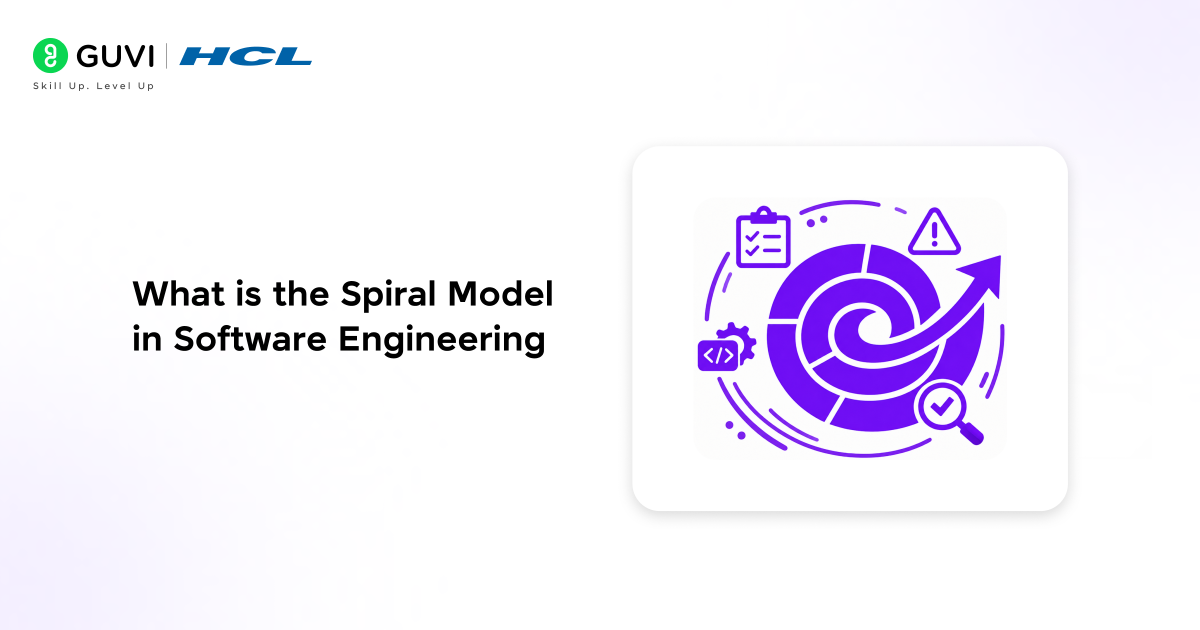
The Spiral Model is a software development method that combines planning, testing, risk analysis, and development in repeated cycles called spirals.
Instead of building the entire software at once, the project is developed step by step, with each cycle helping teams improve the product, identify problems early, and reduce risks before moving forward.
Phases of the Spiral Model
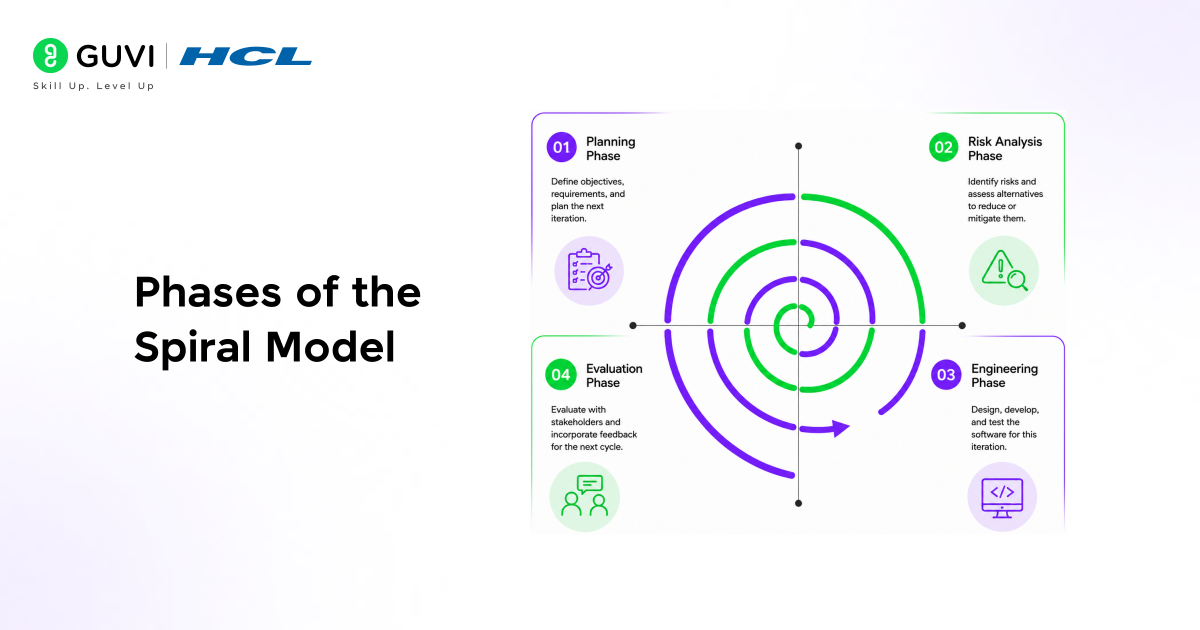
The Spiral Model works by moving through 4 phases iteratively in every cycle, and this process continues until the project is completed. These are the 4 phases:
- Planning Phase
- Risk Analysis Phase
- Engineering Phase
- Evaluation Phase
Phase 1: Planning Phase
In the Planning Phase, the development team first understands the project goals, customer requirements, budget, time, and the overall work needed for the software. This phase helps the team decide what to build, how development will start, and which resources will be required before moving to the next phase.
Example:
If a company wants to build an online banking system, the development team will first discuss features such as account login, money transfers, transaction history, and security measures. They also determine the project timeline, team size, development costs, and which features to develop first.
Phase 2: Risk Analysis Phase
In the Risk Analysis Phase, the development team carefully assesses all potential risks that could arise during software development. These risks can relate to security, technology, budget, or system performance. The main goal of this phase is to find problems early and prepare solutions before development continues.
Example:
While building an online banking system, the development team may realise that weak security can lead to data theft or unauthorised access. To avoid this, they plan to implement stronger security measures, such as OTP verification, data encryption, and secure login systems, before moving forward.
Phase 3: Engineering Phase
The Engineering Phase is where actual software development begins. In this phase, developers begin coding, designers create the interface, and testers verify that the features work properly. Everything planned in earlier phases starts becoming a real software product here.
Example:
In an online banking system, developers create features such as balance checking, fund transfer, and bill payment. At the same time, testers check whether users can log in successfully, transfer money correctly, and use the system without errors.
Phase 4: Evaluation Phase
In the Evaluation Phase, the completed work is shown to the client or users to collect their feedback. This phase helps the development team determine whether the software meets the expected requirements or if any changes are still needed before the next cycle begins.
Example:
After testing an online banking system, the client may request a simpler dashboard design or faster payment processing. Based on this feedback, the development team makes improvements and prepares for the next spiral cycle.

Advantages & Disadvantages of the Spiral Model
Refer to the table below to get a quick overview of the advantages and disadvantages of the Spiral Model:
| Advantages of Spiral Model | Disadvantages of Spiral Model |
| Better risk management during development | Can become expensive for small projects |
| Helps find problems early | Requires strong risk analysis skills |
| Supports changes in requirements easily | The process can become complex |
| Improves software quality through continuous testing | Takes more time to complete |
| Suitable for large and high-risk projects | Not ideal for simple projects |
Real-World Applications of the Spiral Model
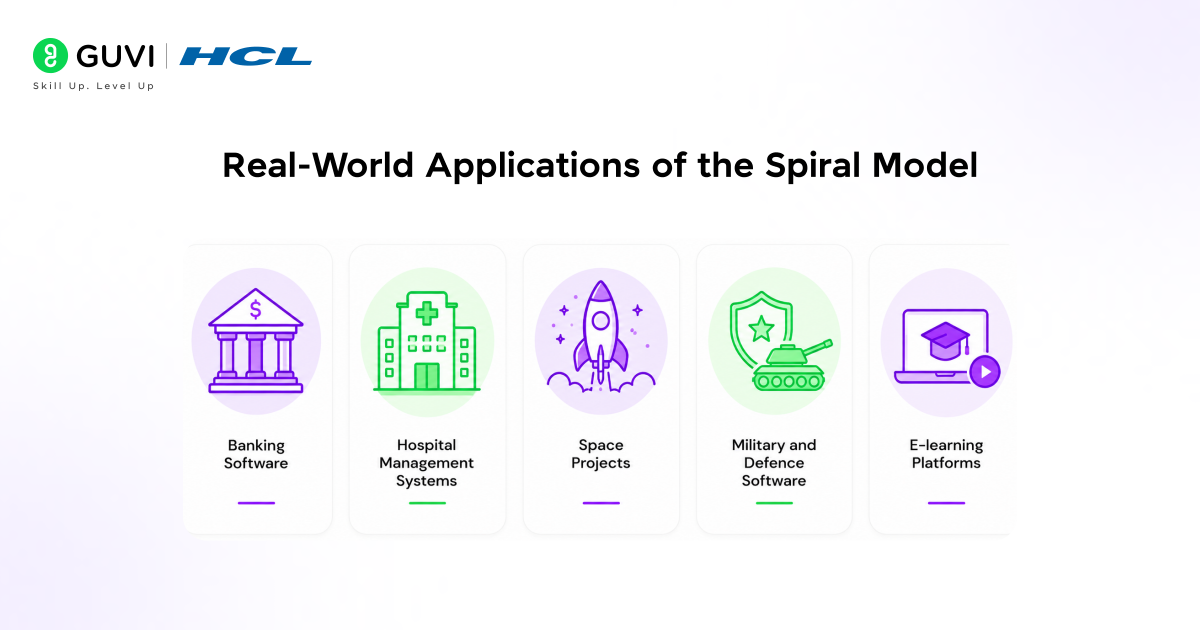
These are the top real-world applications of the Spiral Model in software engineering:
a. Banking Software:
Used where security and safe money transactions are extremely important. The Spiral Model helps developers reduce risks and improve the system incrementally.
b. Hospital Management Systems:
Helpful for software that manages patient records, appointments, and reports, where even small errors can create serious problems.
c. Space Projects:
Used in space and research software because these projects require careful testing and continuous improvements at every stage.
d. Military and Defence Software:
Suitable for defence systems that need high security, accuracy, and reliable performance.
e. E-learning Platforms:
Used in online learning platforms to manage changing features and improve the user experience (UX) over time.
Want to understand how real software projects are planned before the coding even starts? With HCL GUVI’s Software Requirement Engineering Course, you’ll learn how to gather requirements, manage project changes, work with stakeholders, and turn ideas into properly structured software systems like a real industry expert. Join the course and start building real-world software skills today!
Conclusion
The Spiral Model remains important in modern software engineering because many software projects today are large, complex, and constantly changing. Its step-by-step approach helps the development team manage risks early, continuously improve the software, and build more reliable systems without rushing the entire project.
FAQs
Why is the Spiral Model called a “spiral”?
It is called a spiral because the development process progresses through repeated cycles, with each cycle incrementally improving the software.
What makes the Spiral Model different from other models?
The main difference is its strong focus on risk management before proceeding with development.
Can small companies use the Spiral Model?
Small companies can use it, but it is better suited to large projects due to its higher cost, longer development time, and complex process.
Why does the Spiral Model take more time?
The model includes repeated testing, planning, and evaluations in every cycle, which increases development time.
Who gives feedback during the Evaluation Phase?
Usually, clients, users, or stakeholders review the software and share suggestions for improvement.
Has coding started in the first phase of the Spiral Model?
Actual coding typically begins in the Engineering Phase, after planning and risk assessment are completed.
Success Stories








Did you enjoy this article?