


Artificial Intelligence and Machine Learning Articles
Finance Manager to Data Analytics: Career Growth, Salary and Seniority
How to Evaluate LLM Outputs in Production Deployments
AI/ML Skills Gap 2026: Why Companies Can't Find Job-Ready Talent
20 AI/ML Interview Questions Recruiters Can Use Without a Tech Background - Best Guide

Get In Touch For Details! Request More Information

Types of Generative AI: The Complete Beginner Guide
Jun 18, 2026 6 Min Read 1630 Views
(Last Updated)
Ten years ago, generating a realistic human face required a skilled artist and hours of work.
Today it takes a single text prompt and two seconds.
Generating a full song from a mood description. Writing a research summary from a PDF. Creating a product video from a script. Synthesizing a drug candidate from a target protein. All of it is now possible, and all of it runs on generative AI.
But generative AI is not one thing. It is a family of fundamentally different model types, each built on different architectures, trained on different data, optimized for different outputs, and suited to different problems. Treating them as interchangeable leads to wrong tool choices, misaligned expectations, and projects that fail not because generative AI cannot solve the problem but because the wrong type was chosen.
This guide breaks down every major types of generative AI, how each works, what it is best at, where it falls short, and how to choose between them for real applications.
Table of contents
- Quick TL;DR Summary
- What All Generative AI Systems Share
- Type 1: Large Language Models
- Type 2: Generative Adversarial Networks
- Type 3: Diffusion Models
- Type 4: Variational Autoencoders
- Type 5: Audio and Music Generation Models
- Type 6: Video Generation Models
- Type 7: Code Generation Models
- Type 8: Multimodal Generative Models
- Final Thoughts
- FAQs
- What is the difference between GANs and diffusion models for image generation?
- Are large language models the same as generative AI?
- Can generative AI models create content in multiple formats simultaneously?
- What is the biggest limitation shared across all generative AI types?
- How do I choose between generative AI types for a real application?
Quick TL;DR Summary
- Generative AI is a broad category covering multiple model types including large language models, GANs, diffusion models, variational autoencoders, and multimodal systems, each optimized for different content types and tasks.
- Large language models generate text by predicting the next token in a sequence, powering chatbots, code generation, summarization, and reasoning applications.
- GANs and diffusion models are the dominant approaches for image generation, with diffusion models now leading on quality and diversity while GANs retain speed advantages.
- Audio, video, and code generation each have specialized model architectures tuned to the unique structure of those content types.
- Choosing the right type of generative AI depends on the output format required, quality versus speed trade-offs, available compute, and whether the application needs controllable, steerable generation or maximum diversity.
What is Generative AI?
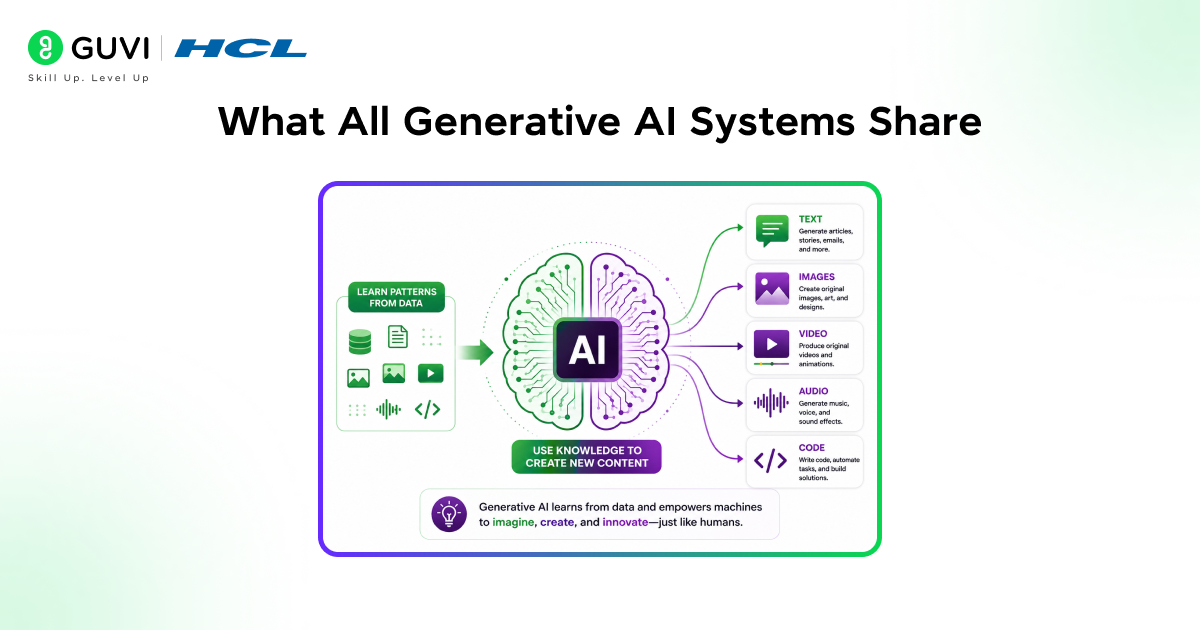
Generative AI is a category of artificial intelligence systems that learn patterns from existing data and use that knowledge to create new and original content. These systems can generate text, images, videos, audio, code, and other forms of media by understanding the structure and relationships within the data they were trained on.
What All Generative AI Systems Share
- They Learn Distributions, Not Rules
Every generative AI system, regardless of type, learns the statistical distribution of its training data. A text model learns the distribution of human language. An image model learns the distribution of visual content. A music model learns the distribution of audio patterns.
Generation is sampling from that learned distribution. The model does not retrieve stored examples. It produces new instances that are statistically consistent with everything it learned during training.
- They Require Large Scale to Produce High Quality Output
Generative models improve dramatically with more data and more compute. A language model trained on a billion tokens produces qualitatively different output than one trained on a billion tokens with ten times the parameters. A diffusion model trained on ten million images generates visibly better content than one trained on one million.
Scale is not a detail. It is a primary driver of generative AI capability, which is why the most capable systems in every category are built and operated by organizations with substantial compute resources.
- They All Face the Same Core Challenge: Controllability
Generating high-quality content is the first challenge. Generating specific high-quality content on demand is the harder one.
Early generative models produced impressive outputs but with limited user control. Modern systems address controllability through conditioning mechanisms that steer generation toward desired attributes, styles, formats, and content without sacrificing quality or diversity.
Read More: Top Generative AI Models 2026
Type 1: Large Language Models
- What They Are
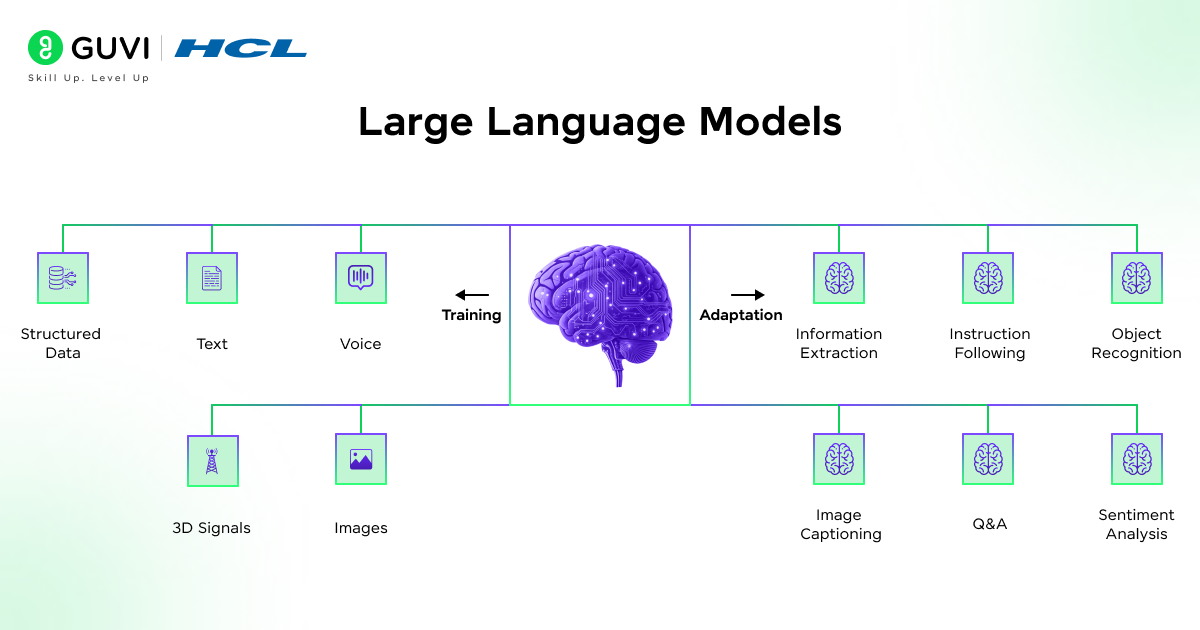
Large language models are transformer-based neural networks trained on massive text corpora using self-supervised learning objectives. They learn statistical patterns in language at extraordinary scale, developing the ability to generate coherent, contextually appropriate text across virtually any domain.
GPT-4, Claude, Gemini, LLaMA, and Mistral are all large language models. They differ in training data, parameter count, architecture details, and fine-tuning approaches but share the same foundational mechanism.
- How They Work
Most large language models use causal language modeling: given all previous tokens in a sequence, predict the next one. Training on billions of documents forces the model to internalize grammar, factual knowledge, reasoning patterns, writing style, and world knowledge because all of these are necessary to predict text accurately across diverse contexts.
At inference time, the model generates text token by token, each prediction conditioned on everything that came before. Sampling strategies including temperature scaling, top-k sampling, and beam search control the trade-off between creativity and coherence in the output.
- What They Excel At
Text generation across formats including articles, emails, reports, and creative writing. Summarization of long documents into concise key points. Question answering drawing on knowledge internalized during training. Code generation across dozens of programming languages. Reasoning through multi-step problems when prompted appropriately. Instruction following for complex, nuanced tasks described in natural language.
GPT-3, released by OpenAI in 2020 with 175 billion parameters, became the first large language model to clearly demonstrate powerful emergent capabilities at scale. One of the most surprising was few-shot learning, where the model could perform entirely new tasks using only a few examples provided in the prompt, without any additional training or weight updates. Researchers had not explicitly trained GPT-3 for this behavior, and many did not predict such capabilities would naturally emerge simply from scaling model size and training data.
Type 2: Generative Adversarial Networks
- What They Are
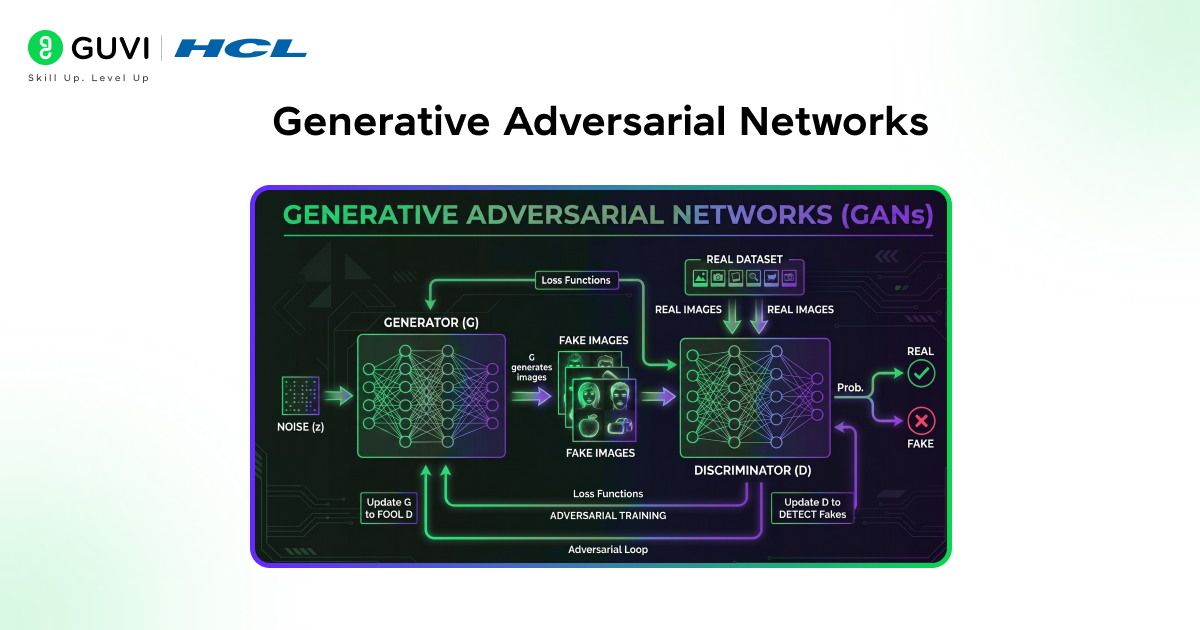
Generative adversarial networks consist of two neural networks trained in competition: a generator that creates synthetic data and a discriminator that tries to distinguish synthetic from real. The generator improves by fooling the discriminator. The discriminator improves by catching the generator. Both improve through competition until the generator produces outputs indistinguishable from real data.
Introduced by Ian Goodfellow in 2014, GANs dominated image generation for nearly a decade before diffusion models surpassed them on quality and diversity benchmarks.
- How They Work
The generator takes a random noise vector as input and maps it to a synthetic data sample through a series of learned transformations. The discriminator receives either real training examples or generator outputs and produces a probability that the input is real.
Training alternates between updating the discriminator to better distinguish real from fake and updating the generator to better fool the discriminator. This adversarial dynamic drives both networks toward increasingly sophisticated capabilities.
- What They Excel At
Fast single-pass generation without iterative denoising. High-resolution face synthesis where StyleGAN produces photorealistic human faces that do not exist. Image-to-image translation tasks like converting sketches to photographs or summer scenes to winter. Super-resolution of low-quality images. Video frame synthesis for specific short-form generation tasks.
Type 3: Diffusion Models
- What They Are
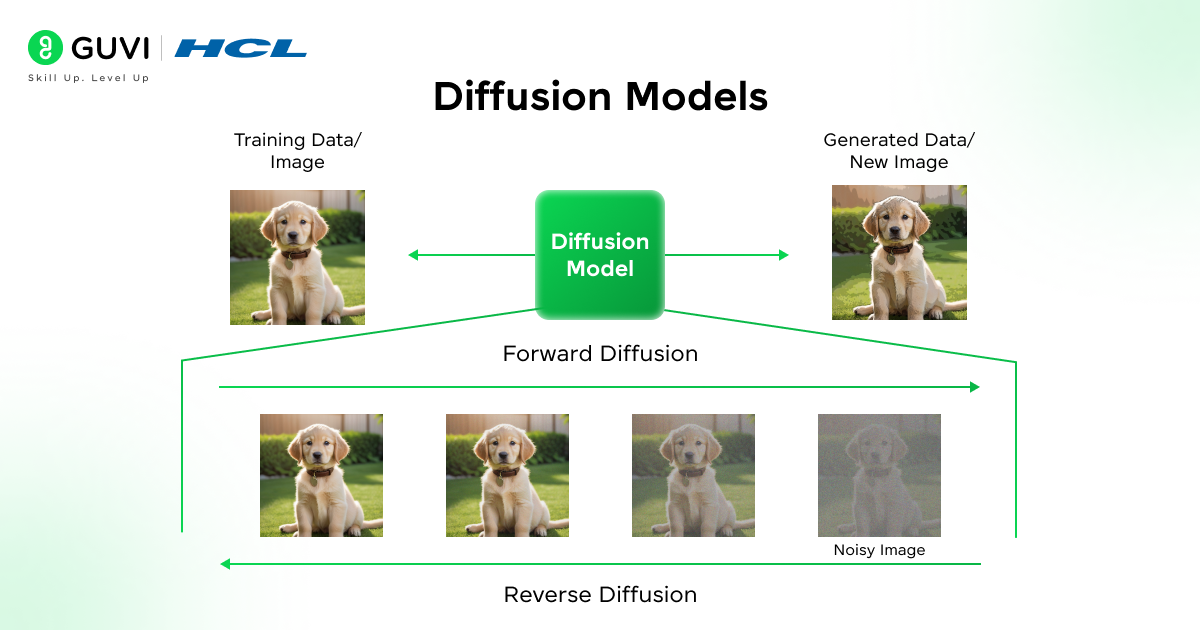
Diffusion models learn to generate data by reversing a gradual noise-adding process. During training, real data is progressively corrupted by adding Gaussian noise across hundreds of steps until only noise remains. A neural network learns to reverse this process, removing noise step by step to recover coherent structure from pure static.
Stable Diffusion, DALL-E 3, Midjourney, and Sora are all built on diffusion model foundations.
- How They Work
The forward process is fixed and mathematical: add a small amount of noise at each of T timesteps according to a predefined schedule. The reverse process is learned: a neural network, typically a U-Net or transformer, takes the current noisy state and predicts what noise was added at that step.
Generation starts from pure Gaussian noise at timestep T and iteratively denoises toward a coherent sample at timestep zero. Text conditioning is injected through cross-attention mechanisms that steer each denoising step toward outputs consistent with the prompt.
- What They Excel At
High-quality, diverse image generation with strong text alignment. Photorealistic synthesis across styles including photography, illustration, and painting. Image editing through inpainting and outpainting. Video generation with temporal coherence across frames. Audio and music generation. Scientific applications including molecular structure generation and protein design.
Type 4: Variational Autoencoders
- What They Are
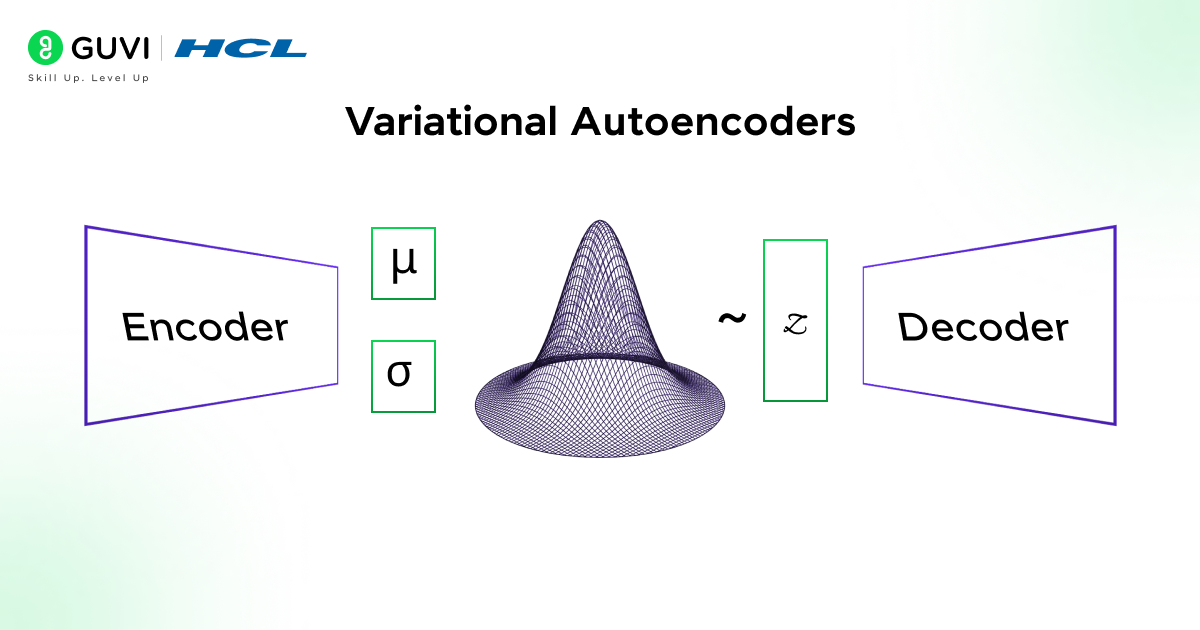
Variational autoencoders learn a compressed latent representation of data by training an encoder that maps inputs to a probability distribution in latent space and a decoder that reconstructs inputs from samples drawn from that distribution. Generation happens by sampling from the latent space and decoding.

VAEs are older than GANs and diffusion models but remain foundational, particularly as the compression stage in latent diffusion model architectures.
- What They Excel At
Learning smooth, structured latent spaces where interpolation between points produces semantically meaningful outputs. Dimensionality reduction that preserves generative structure. Anomaly detection by measuring reconstruction error. Serving as the encoder and decoder stages in more complex generative pipelines.
Type 5: Audio and Music Generation Models
- What They Are
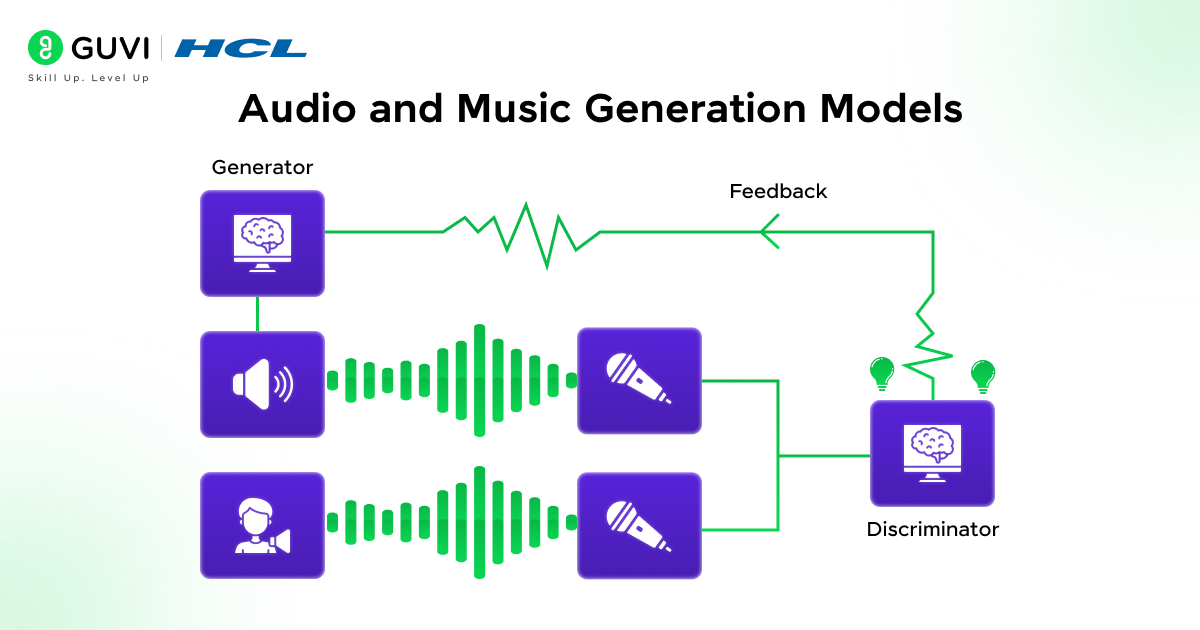
Audio generative models produce speech, music, sound effects, and environmental audio from text descriptions, reference samples, or unconditional sampling. They operate on waveforms directly or on compressed audio representations like mel spectrograms and audio latent codes.
AudioLDM, Stable Audio, MusicGen from Meta, and Suno are leading examples in this category.
- How They Work
Most modern audio generation models adapt the diffusion framework to audio by operating on mel spectrogram latent representations rather than pixel values. Text conditioning through cross-attention steers generation toward described instruments, genres, moods, and sonic characteristics.
Speech synthesis models including neural text-to-speech systems use autoregressive or diffusion approaches to generate natural-sounding speech from text input, conditioned on speaker identity embeddings to control voice characteristics.
- What They Excel At
Music generation across genres from text descriptions. Voice cloning that synthesizes speech in a specific person’s voice from a short reference sample. Sound effect generation for film, game, and media production. Singing voice synthesis. Audio enhancement and restoration of degraded recordings.
Type 6: Video Generation Models
- What They Are
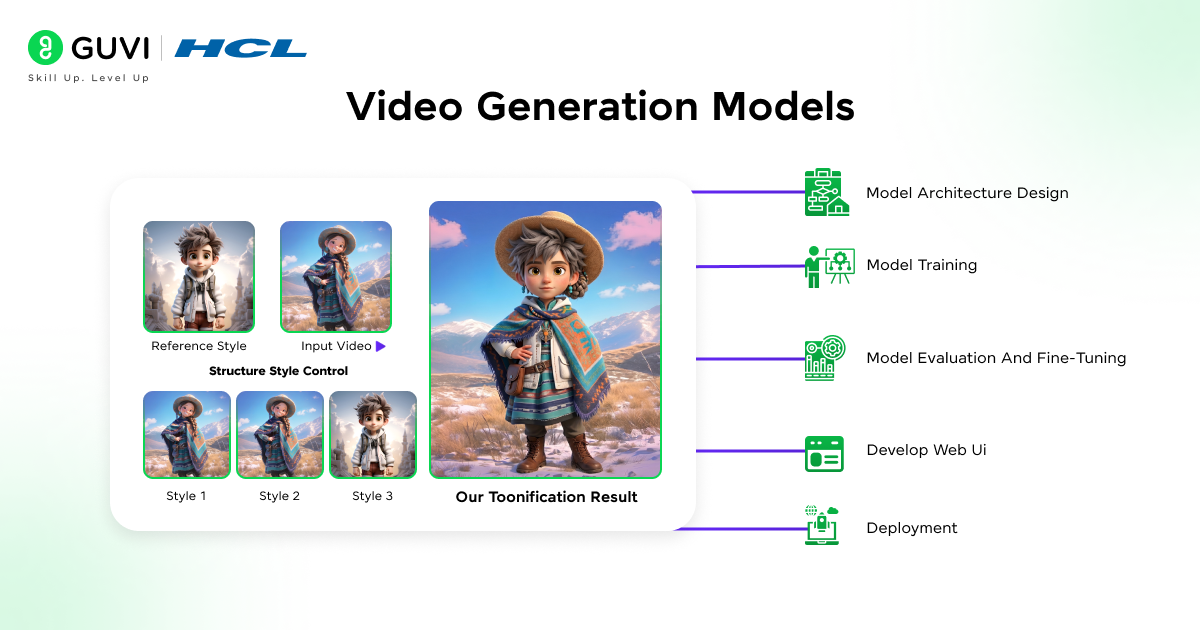
Video generative models produce temporally coherent sequences of frames from text descriptions, image inputs, or reference video clips. They represent the most computationally demanding category of generative AI because they must maintain spatial quality across every frame while ensuring consistent motion, lighting, and object identity through time.
Sora from OpenAI, Runway Gen-3, and Kling are leading examples demonstrating the current state of the art.
- How They Work
Video diffusion models extend image diffusion to three-dimensional data by treating video as a sequence of latent frames and modeling both spatial content within frames and temporal relationships across them.
Temporal attention mechanisms ensure that objects, lighting conditions, and scene geometry remain consistent as the video progresses. Training on large video datasets with caption annotations enables text-to-video generation where the prompt specifies scene content, motion type, camera movement, and visual style.
- What They Excel At
Short-form video generation from text prompts. Camera motion control including zoom, pan, and dolly effects. Video editing through inpainting and style transfer. Consistent character and scene rendering across multiple seconds of output. Generating diverse visual effects that would be expensive or impossible to produce practically.
Sora, introduced by OpenAI in 2024, generates videos with surprisingly consistent physics, camera motion, and character identity by modeling video as interconnected spacetime patches rather than treating it as isolated frame-by-frame generation. This architecture allows the model to capture long-range temporal dependencies more effectively, helping maintain coherence across complex scenes and extended video durations.
Type 7: Code Generation Models
- What They Are
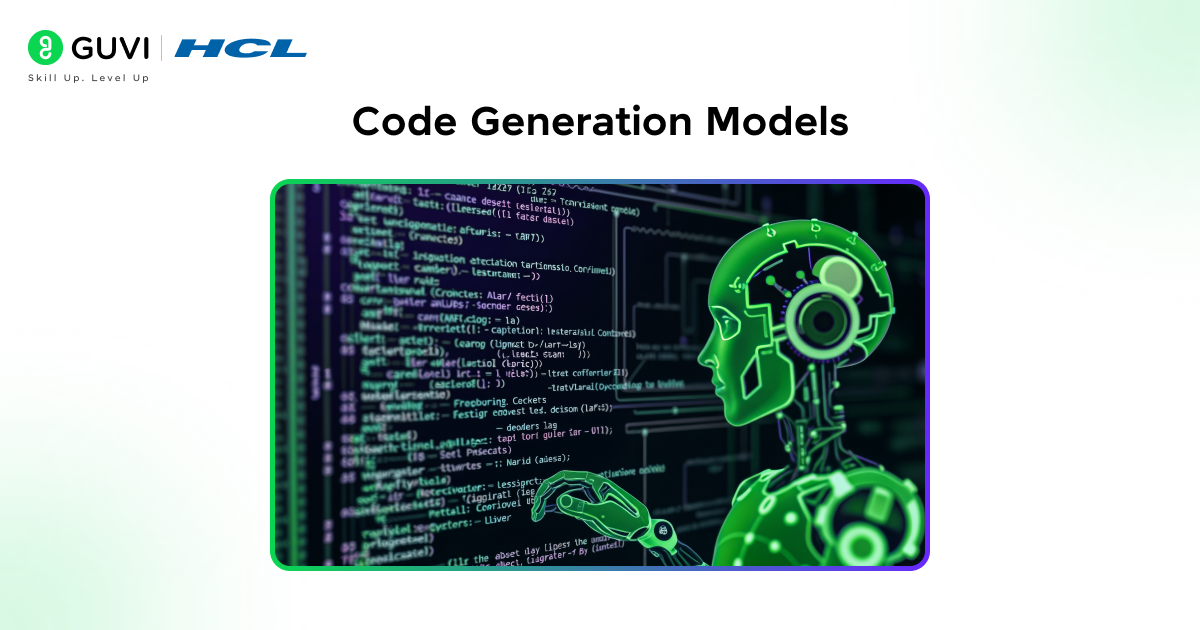
Code generation models produce functional programming code from natural language descriptions, complete partial code, translate between programming languages, explain existing code, and detect bugs. They are large language models fine-tuned or pre-trained on a large corpora of code alongside natural language documentation and comments.
GitHub Copilot, Amazon CodeWhisperer, and Cursor are prominent applications built on code generation foundations using models including GPT-4 and Claude.
- What They Excel At
Autocompleting code from partial implementations. Generating boilerplate and repetitive code structures. Translating algorithms described in natural language into working implementations. Explaining unfamiliar codebases. Suggesting fixes for compiler errors and test failures. Generating unit tests for existing functions.
Type 8: Multimodal Generative Models
- What They Are
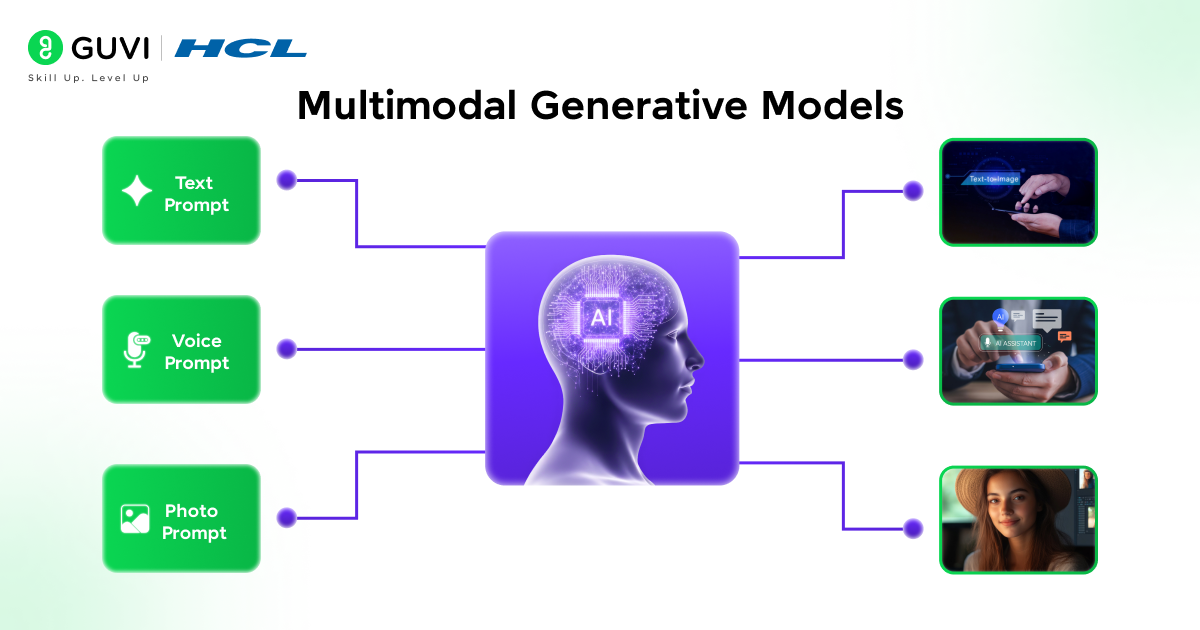
Multimodal generative models process and generate across multiple content types simultaneously. They understand the relationships between text, images, audio, and video and can generate one modality conditioned on inputs from another.
DALL-E 3, GPT-4o, Gemini, and CLIP are examples where understanding across modalities enables richer generation and interaction than single-modality systems can provide.
- How They Work
Multimodal models learn joint representations of different content types by training on paired data: images with captions, videos with transcripts, code with documentation. Contrastive objectives like those used in CLIP align representations of corresponding content across modalities into a shared embedding space where semantically similar content from different types is close together.
Generation then uses these aligned representations for conditioning: a text description steers image generation because the text embedding and the target image embedding occupy the same learned space.
- What They Excel At
Text-to-image generation with strong semantic alignment. Visual question answering those reasons about image content using language. Image captioning and description. Cross-modal search where text queries retrieve relevant images and vice versa. Document understanding that combines visual layout analysis with text comprehension.
To learn more about the different types of Generative AI and how modern AI models create text, images, audio, and more, enroll in this AI and Machine Learning course covering AI fundamentals, Python, deep learning, NLP, and computer vision through hands-on projects and expert guidance with certification.
Final Thoughts
Generative AI is not a single technology. It is a landscape of fundamentally different architectures, each making different trade-offs between quality, speed, controllability, and output type.
Large language models changed what text interfaces could do. GANs proved that machines could synthesize realistic visual content. Diffusion models raised the quality ceiling across images, audio, and video. Multimodal systems connected these capabilities into unified understanding and generation across content types simultaneously.
The practitioners who deploy generative AI most effectively are the ones who treat model selection as a first-principles decision. What output type is required? What quality level is necessary? What latency is acceptable? What control does the user need over the output? Those answers point to the right model type before any implementation begins.
FAQs
1. What is the difference between GANs and diffusion models for image generation?
GANs generate images in a single forward pass, making them faster but prone to training instability and limited diversity. Diffusion models iteratively denoise from random noise, producing higher quality and more diverse outputs at the cost of slower inference.
2. Are large language models the same as generative AI?
No. LLMs are one type of generative AI specialized for text. The broader category also includes image generation models, audio synthesis systems, video generation models, and multimodal architectures.
3. Can generative AI models create content in multiple formats simultaneously?
Yes, through multimodal models like GPT-4o and Gemini that learn joint representations across content types, enabling generation and understanding across text, images, and audio within a single system.
4. What is the biggest limitation shared across all generative AI types?
Controllability. Generating high-quality content at scale is largely solved. Generating specific content that reliably matches user intent and behaves consistently across edge cases remains the active frontier across every generative AI category.
5. How do I choose between generative AI types for a real application?
Start with the required output format. Text points to LLMs, high-quality images to diffusion models, fast image synthesis to GANs, audio to specialized audio models, and cross-modal applications to multimodal systems.
Success Stories

About the Author
Vishalini Devarajan
An Aerospace Engineer turned content writer, I focus on making complex concepts easy to understand through well-structured, reader-friendly blogs. Whether it’s a technical topic or a non-technical one, I love creating content that is clear, engaging, and impactful.
View all posts by Vishalini Devarajan
Connect with me @












Did you enjoy this article?