


Artificial Intelligence and Machine Learning Articles
AI/ML Skills Gap 2026: Why Companies Can't Find Job-Ready Talent
20 AI/ML Interview Questions Recruiters Can Use Without a Tech Background - Best Guide
How Industry-Backed AI/ML Bootcamps Are Changing the AI/ML Hiring Pipeline - Best Guide 2026
From IT Support to AI Engineer: A Realistic Career Switch Guide 2026


Get In Touch For Details! Request More Information
Skills That Remain Valuable Even as AI Advances
May 14, 2026 5 Min Read 1079 Views
(Last Updated)
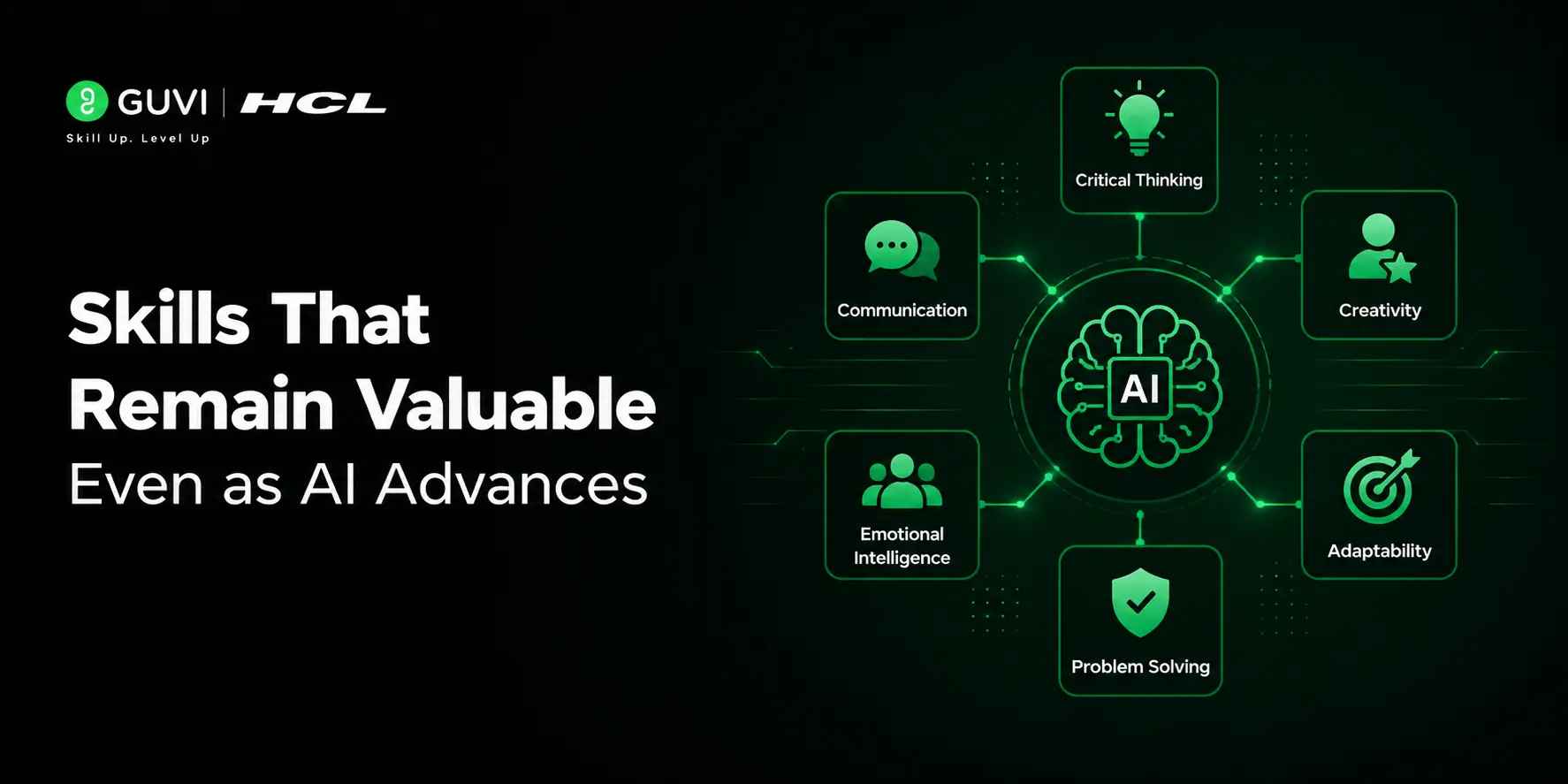
Skills That Remain Valuable Even as AI Advances are becoming the foundation of long-term career success in a rapidly changing digital world. As artificial intelligence continues to automate repetitive tasks and reshape industries, professionals are realizing that technical knowledge alone is no longer enough to stay competitive. Skills like critical thinking, creativity, emotional intelligence, leadership, adaptability, and problem-solving continue to stand out because they are deeply human and difficult for AI to replicate. Whether you are a student, working professional, or career switcher, developing these future-proof skills can help you remain relevant, adaptable, and valuable in the evolving job market driven by AI innovation.
Table of contents
- TL;DR
- Why Some Skills Remain Valuable Even as AI Advances
- Critical Thinking and Complex Problem-Solving
- Emotional Intelligence (EQ) and Interpersonal Skills
- Creativity, Innovation, and Lateral Thinking
- Leadership, Mentorship, and Change Management
- Communication, Negotiation, and Storytelling
- Adaptability and Continuous Learning
- Human Skills vs. AI Capabilities: A Quick Comparison
- Key Takeaways
- Conclusion
- FAQs
- What are the most valuable skills in the age of AI?
- Why are human skills still important even with advanced AI?
- Can AI replace creative jobs completely?
- Which soft skills are future-proof in an AI-driven world?
- How can students prepare for an AI-powered future?
- Is coding still valuable as AI becomes more advanced?
TL;DR
- AI automates tasks, not people — Roles that depend on repetitive, rule-based execution face the highest risk of automation. Roles requiring judgment, creativity, and empathy remain far more resilient.
- Critical thinking is irreplaceable — AI can synthesize data but cannot reason through ethical dilemmas, context-sensitive decisions, or novel challenges the way trained humans can.
- Emotional intelligence (EQ) is a competitive moat — According to the World Economic Forum’s Future of Jobs Report 2025, EQ and interpersonal skills are consistently ranked among the top competencies employers can’t automate.
- Creativity and lateral thinking fuel innovation — Generative AI remixes existing information; humans originate truly new ideas by drawing on culture, intuition, and lived experience.
- Adaptability is the master skill — Professionals who continuously learn, pivot strategies, and stay curious will outpace those who rely on static expertise alone.
Why Some Skills Remain Valuable Even as AI Advances
AI is exceptionally good at processing structured data, identifying patterns, automating repetitive workflows, and generating output based on existing information. What it consistently struggles with is everything that requires context, ambiguity, moral reasoning, and genuine human connection.
Think of it this way: AI is a powerful engine. But an engine still needs a driver, someone who knows where to go, why it matters, and what to do when the road runs out. The skills that remain valuable are the ones that make you the driver, not the passenger.
1. Critical Thinking and Complex Problem-Solving
No skill is more future-proof than the ability to think clearly under pressure. AI can retrieve facts and generate answers, but it cannot evaluate competing priorities, challenge its own assumptions, or make sound decisions in ambiguous situations.
Why it matters: Employers across every industry need professionals who can break down complex problems, evaluate solutions, and make defensible decisions, not just those who can locate information. AI accelerates the information retrieval part; the judgment layer still belongs to humans.
- Root-cause analysis: Identifying why a problem exists rather than just responding to its symptoms. This requires connecting information across domains in ways that AI models, trained on historical data, often miss.
- Scenario planning: Anticipating how decisions play out under different conditions. This involves weighing values, stakeholder interests, and ethical considerations that no algorithm fully captures.
- Challenging assumptions: The best thinkers ask ‘what if this is wrong?’ before acting. AI systems, by design, optimize for patterns; they rarely question the premise.
These are the skills that separate strategic contributors from task processors, a distinction that becomes sharper, not softer, as AI capabilities grow.
Pro Tip: Practice structured thinking frameworks like First Principles Reasoning or the SCAMPER method to sharpen your problem-solving instincts. These build the mental muscles AI cannot replicate.
2. Emotional Intelligence (EQ) and Interpersonal Skills
Emotional intelligence, the ability to recognize, understand, and navigate emotions in yourself and others, is consistently ranked by researchers and employers as one of the most durable human advantages in an AI-saturated workplace.
AI can detect sentiment in text. It cannot sit across from someone who just lost a client, read the hesitation in their voice, and say exactly the right thing. That’s not a small gap. That’s the entire foundation of trust-based relationships.
- Empathy in high-stakes moments: Healthcare, counseling, social work, and leadership all depend on genuine emotional attunement. A nurse practitioner who reads a patient’s fear and adjusts their tone provides care no diagnostic AI can replicate.
- Conflict resolution: Navigating disagreements between people with competing interests requires emotional nuance, patience, and cultural awareness, all deeply human capabilities.
- Building psychological safety: Leaders who create environments where teams feel safe to experiment and speak honestly drive significantly better innovation outcomes. AI cannot build that culture; people do.
3. Creativity, Innovation, and Lateral Thinking
Here’s the truth about generative AI: it is a remix engine, not a creative engine. It generates content by predicting what comes next based on patterns in training data. That’s impressive. But it’s fundamentally backward-looking. Human creativity is forward-looking; it draws on culture, emotion, lived contradiction, and imagination.
When a designer solves a packaging problem by borrowing an insight from architecture, or a strategist reinvents a business model using principles from ecology, that cross-domain lateral thinking produces genuinely new ideas. AI can assist the execution. It cannot originate the spark.
- Design thinking: Approaching problems through the lens of human needs, emotional resonance, and usability. The best product experiences emerge from empathy-first creative processes, not optimization algorithms.
- Narrative and persuasion: Compelling storytelling, the kind that changes minds, builds movements, or lands a pitch, relies on emotional truth and strategic framing that AI writing tools approximate but rarely achieve.
- Conceptual invention: Truly new categories of products, services, or business models don’t come from data trends. They come from people willing to imagine what doesn’t yet exist.
IBM’s 2025 CEO Study found that creativity is the single most important leadership quality for navigating complexity — ranked above integrity and global thinking.
4. Leadership, Mentorship, and Change Management
Leadership has never been about knowing the most information. It’s about guiding people through uncertainty, making decisions with incomplete data, and building organizations that can adapt. None of those responsibilities is going to an algorithm anytime soon.
As AI automates middle layers of execution, the premium on genuine leadership, strategic vision, psychological safety, mentorship, and change navigation increases dramatically.
- Vision casting: Articulating a future that motivates teams to act requires communicating purpose, not just plans. The best leaders connect individual work to meaningful outcomes that AI models cannot grasp.
- Human-to-human mentorship: Developing the next generation of talent requires observing growth, reading the unspoken, and delivering feedback that lands all deeply relational skills.
- Change management: Guiding organizations through technological disruption, including AI adoption itself, requires leaders who can manage fear, resistance, and cultural inertia. That’s irreducibly human work.
Best Practice: Great leaders in the AI era practice ‘collaborative intelligence’ using AI for analysis while reserving human judgment for decisions that affect people’s livelihoods, wellbeing, and dignity.

5. Communication, Negotiation, and Storytelling
Clear, persuasive communication, spoken and written, remains one of the highest-leverage human skills in any professional environment. And while AI can assist with drafts and outlines, the strategic choices of what to say, to whom, and when are firmly human decisions.
In sales, high-stakes deals still close because of human rapport and trust. In leadership, transformational moments happen because someone found the right words at the right time. AI can provide ammunition; only humans can pull the trigger with precision.
- High-stakes negotiation: Reading the room, identifying unstated interests, and adapting in real time during complex negotiations requires a level of social intelligence that AI tools assist but cannot replace.
- Cross-cultural communication: Navigating the nuances of culture, hierarchy, and relational context in global business settings relies on deeply human social knowledge.
- Influence and executive presence: How you carry yourself, frame ideas, and build credibility over time is a distinctly human form of capital that no automation can substitute.
6. Adaptability and Continuous Learning
If there is one meta-skill that amplifies all the others, it’s adaptability. The half-life of specific technical knowledge is shrinking. The professionals who thrive over the next decade won’t be those who mastered a single tool; they’ll be those who continuously learn, unlearn, and relearn.
This isn’t just about taking courses. It’s a mindset orientation toward curiosity, experimentation, and growth that positions you to absorb new capabilities as they emerge, including AI tools themselves.
Human Skills vs. AI Capabilities: A Quick Comparison
Understanding where AI excels and where human skills dominate helps you focus your development efforts strategically.
| Capability | AI Strength | Human Strength |
| Data processing | Exceptional | Moderate |
| Ethical reasoning | Weak | Strong |
| Pattern recognition | Strong | Strong |
| Emotional empathy | None | Exceptional |
| Creative origination | Limited (remix) | Strong |
| Crisis leadership | None | Essential |
| Relationship building | None | Core skill |
| Adaptability | Limited | High potential |
Key Takeaways
- Skills that remain valuable even as AI advances are the human-centric ones: critical thinking, emotional intelligence, creativity, leadership, and adaptability.
- AI augments, not eliminates. The most dangerous professional position is depending solely on task execution. Pair human judgment with AI tools to multiply your impact.
- Emotional intelligence is a strategic differentiator. The ability to build trust, navigate conflict, and lead with empathy becomes more or less important in automated environments.
- Creativity thrives where data ends. Truly novel ideas, business models, and solutions originate in human imagination, not in pattern matching.
- Leadership is the irreplaceable orchestrator. Someone needs to direct AI systems, make values-based decisions, and guide humans through change. That role will always belong to people.
- Adaptability is the multiplier. Those who continuously build new skills, including fluency with AI tools themselves, will compound their advantage over time.
Conclusion
The AI revolution is not coming for your humanity; it’s coming for your task list. The skills that remain valuable even as AI advances are the ones that have always defined the best professionals: clear thinking, genuine empathy, original creativity, and the courage to lead through uncertainty.
The professionals who will thrive are not those who compete with AI at its own game. They’re the ones who use AI as leverage while doubling down on the irreplaceable human skills that machines simply cannot replicate. Invest in those skills today, and the future of work becomes an opportunity, not a threat.
Make sure you understand machine learning fundamentals like Python, SQL, deep learning, data cleaning, and cloud services before we explore them in the next section. You should consider joining HCL GUVI’s Artificial Intelligence & Machine Learning Course, which covers tools like PySpark API, Natural Language Processing, and many more, and helps you get hands-on experience by building real-time projects.
Also, if you want to explore Artificial Intelligence and Machine Learning through a self-paced course, try HCL GUVI’s bundle of Artificial Intelligence Courses.
FAQs
What are the most valuable skills in the age of AI?
The most valuable skills in the AI era are critical thinking, creativity, emotional intelligence, communication, leadership, adaptability, and problem-solving. These human-centric skills are difficult for AI to fully replace and remain essential across industries.
Why are human skills still important even with advanced AI?
AI can automate repetitive and data-driven tasks, but it cannot fully understand human emotions, ethics, creativity, or complex decision-making. Human skills help professionals collaborate, innovate, and lead effectively in real-world situations.
Can AI replace creative jobs completely?
No, AI can support creative work by generating ideas or automating simple tasks, but human creativity, originality, storytelling, and emotional connection still play a major role in creative industries like design, marketing, filmmaking, and writing.
Which soft skills are future-proof in an AI-driven world?
Soft skills such as communication, adaptability, emotional intelligence, teamwork, leadership, and critical thinking are considered future-proof because they help individuals navigate changing technologies and workplace environments.
How can students prepare for an AI-powered future?
Students can prepare by combining technical skills with human-centered abilities. Learning AI tools, coding, and data literacy alongside communication, creativity, and problem-solving skills can improve career opportunities significantly.
Is coding still valuable as AI becomes more advanced?
Yes, coding remains valuable because developers are still needed to build, customize, manage, and improve AI systems. However, combining coding knowledge with analytical thinking and domain expertise will become even more important.
Success Stories

About the Author
Kirupa
An avid fiction reader and a health science graduate who found writing most at home. I have worked as a freelancer with a diverse range of brands and projects, turning complex ideas into relatable content. You can find me at GUVI, in the exciting world of EdTech, where I continue to blend my words with creativity and clarity.
View all posts by Kirupa
Connect with me @






Did you enjoy this article?