


Artificial Intelligence and Machine Learning Articles
How to Evaluate LLM Outputs in Production Deployments
AI/ML Skills Gap 2026: Why Companies Can't Find Job-Ready Talent
20 AI/ML Interview Questions Recruiters Can Use Without a Tech Background - Best Guide
How Industry-Backed AI/ML Bootcamps Are Changing the AI/ML Hiring Pipeline - Best Guide 2026


Get In Touch For Details! Request More Information
How We Made v0 an Effective Coding Agent
Aug 05, 2026 5 Min Read 777 Views
(Last Updated)
Developers have been playing with AI code programming for decades. Autocomplete, prompt-based code generation and more: we’ve talked about code generation for years, with one promise in mind: code faster, build better.
In practice, though, most tools didn’t.
They wrote code fragments, not programs.
They replied, but didn’t understand the intent.
They helped, but they didn’t work with us.
This is where v0 comes in.
Rather than viewing AI as a passive assistant, we wanted to make it an intelligent coding agent that can understand context, learn from feedback and grow with the programmer. We didn’t just want to code faster, we wanted to change the nature of coding.
In this blog, we explore how v0 became a successful coding agent, including the principles, design choices and processes that made it possible.
Quick answer:
v0 is an AI-powered coding agent developed by Vercel that transforms natural language into production-ready code. What makes it effective is not just code generation but its ability to understand context, iterate intelligently, and align with real-world development workflows.
Table of contents
- The Problem with Traditional AI Coding Tools
- No Understanding of Context
- One-Shot Generation
- No Real Integration with Workflows
- The Vision Behind v0
- Principles That Made v0 Effective
- Context is Everything
- Progressive Development, Not One-Shot
- Opinionated but Flexible Outputs
- Designed for Frontend and Full-Stack Workflows
- Integrated into the Ecosystem
- How v0 Improves Developer Productivity
- Faster Prototyping
- Reduced Cognitive Load
- Interactive AI Collaboration
- Consistent Code Quality
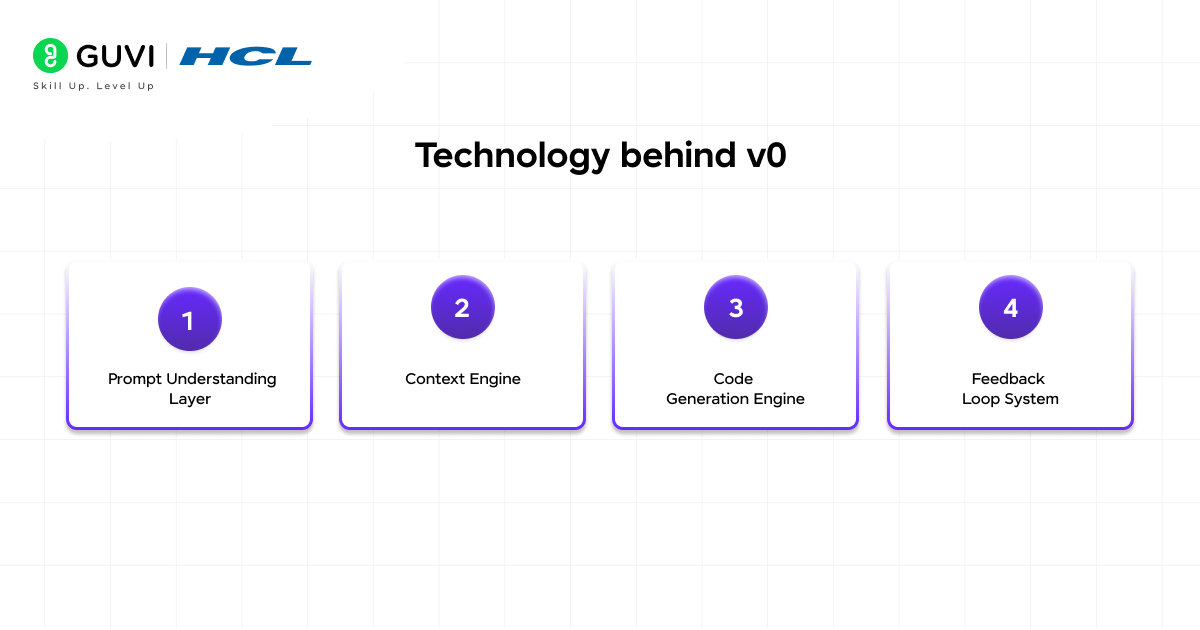
- Technology behind v0
- Prompt Understanding Layer
- Context Engine
- Code Generation Engine
- Feedback Loop System
- Real-World Workflow with v0
- Step 1: Describe the Idea
- Step 2: Produce a Draft
- Step 3: Refine the Output
- Step 4: Integrate Backend
- Step 5: Deploy
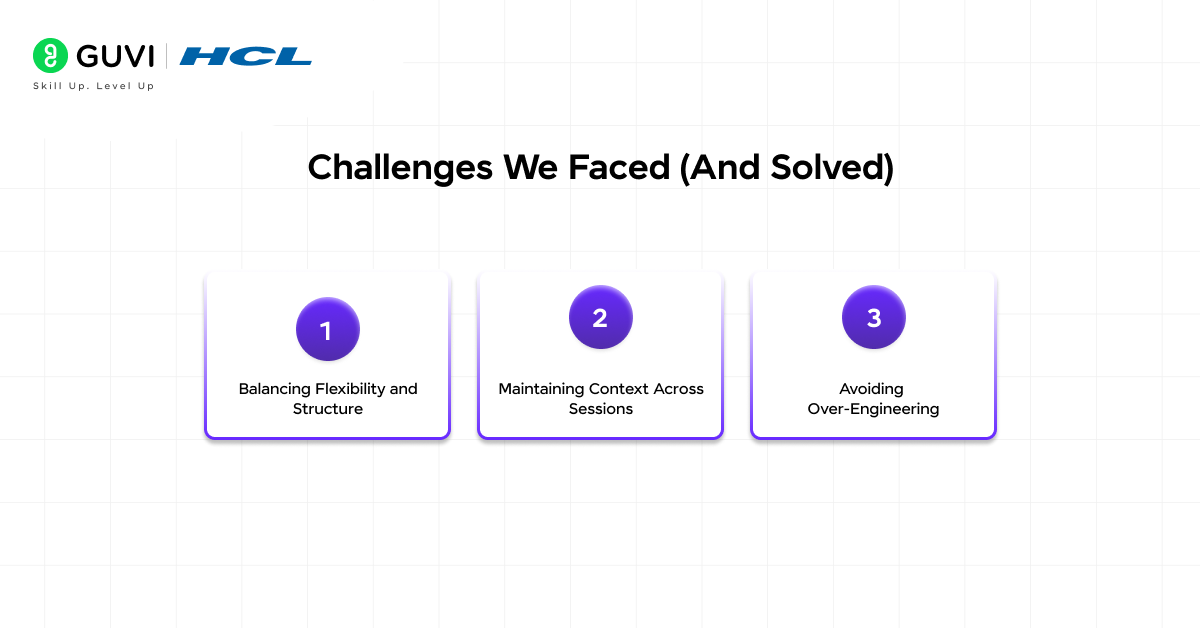
- Challenges We Faced (And Solved)
- Balancing Flexibility and Structure
- Maintaining Context Across Sessions
- Avoiding Over-Engineering
- Why v0 is Better than Other AI
- The Future of Coding Agents
- Wrapping it Up
- FAQs
- What is v0 and how does it work?
- How is v0 different from other AI tools?
- Can beginners use v0 effectively?
The Problem with Traditional AI Coding Tools
In creating v0, it was crucial to identify the flaws in the current approach.
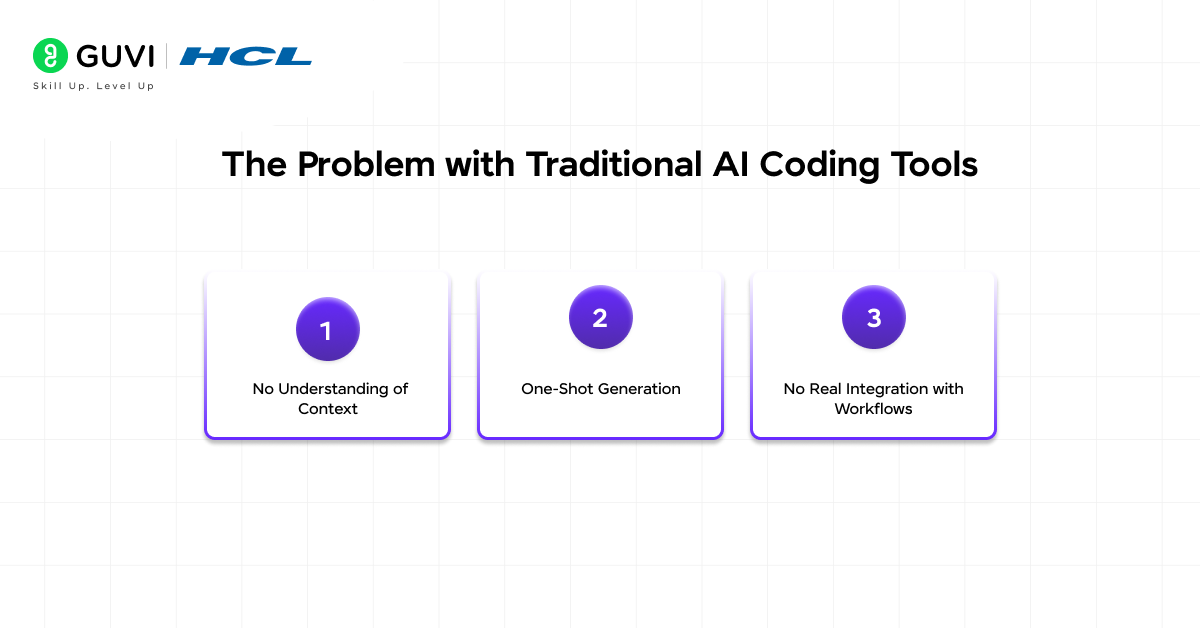
1. No Understanding of Context
Current AI tools are stand-alone. They respond to a single prompt without understanding:
- The broader application structure
- The developer’s intent
- Dependencies between components
This results in fragmented output that needs heavy manual stitching.
2. One-Shot Generation
Traditional tools treat coding as a one-time request:
“Generate a login form”
But real development is iterative:
- You refine UI
- Adjust logic
- Fix edge cases
Without iteration, generated code is not useful.
3. No Real Integration with Workflows
Programmers don’t code in isolation. They use:
- Frameworks
- Design systems
- Deployment pipelines
Most AI tools don’t consider this ecosystem, so their results are useless.
You can also check out: Build Smarter Workflows with Notion and v0 (2026 Guide)
The Vision Behind v0
Our mission was simple, but ambitious:
To create a coder that acts more like a human, rather than generator.
This meant changing the way AI works with code.
Instead of:
Prompt → Output
We designed:
Prompt → Understanding → Iteration → Refinement → Output
This has evolved v0 into a system that:
- Understands project context
- Provides continuity in conversations
- Improves outputs over time
Principles That Made v0 Effective
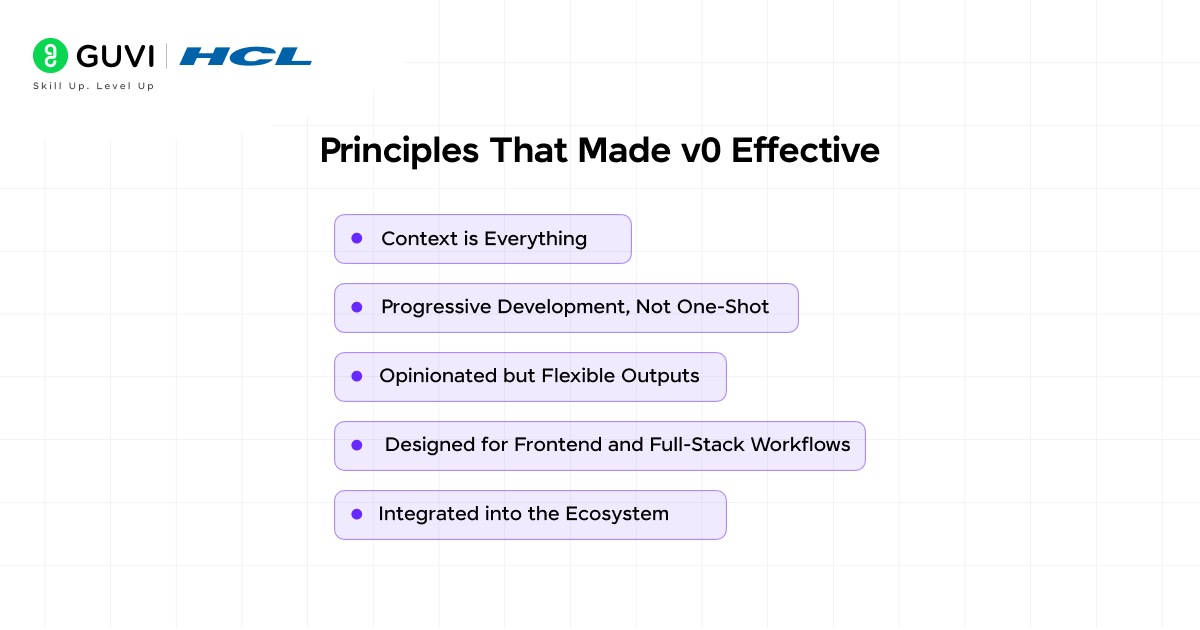
1. Context is Everything
Context is key to v0
v0 doesn’t treat each prompt in isolation, it:
- Tracks previous interactions
- Understands component hierarchies
- Adapts to existing codebases
Which means it can generate code that’s not just functional, but also fits.
2. Progressive Development, Not One-Shot
Software development is iterative and that’s a good thing.
v0 is iterative and that means developers can:
- Refine outputs step-by-step
- Request modifications
- Build on previous results
For example:
- Generate a UI component
- Improve styling
- Add state management
- Connect APIs
Build on each step like when you code.
3. Opinionated but Flexible Outputs
A common issue with AI generated code is that it’s not always consistent.
v0 solves this by:
- Following best practices by default
- Generating structured, readable code
- Aligning with modern frameworks
And it’s flexible enough to be used with:
- Custom requirements
- Different tech stacks
4. Designed for Frontend and Full-Stack Workflows
v0 is tailored for:
- UI development
- Component-based architecture
- Full-stack integration
This makes it well-suited for:
- Rapid prototyping
- Building production-ready interfaces
5. Integrated into the Ecosystem
The fact v0 is part of the Vercel ecosystem is a huge benefit.
It understands:
- Deployment workflows
- Performance considerations
- Modern web architecture
This allows the code to be not only functional, but deployable.
You can also check out: How to Prompt v0: A Beginner-Friendly Guide to Better AI App Building
How v0 Improves Developer Productivity
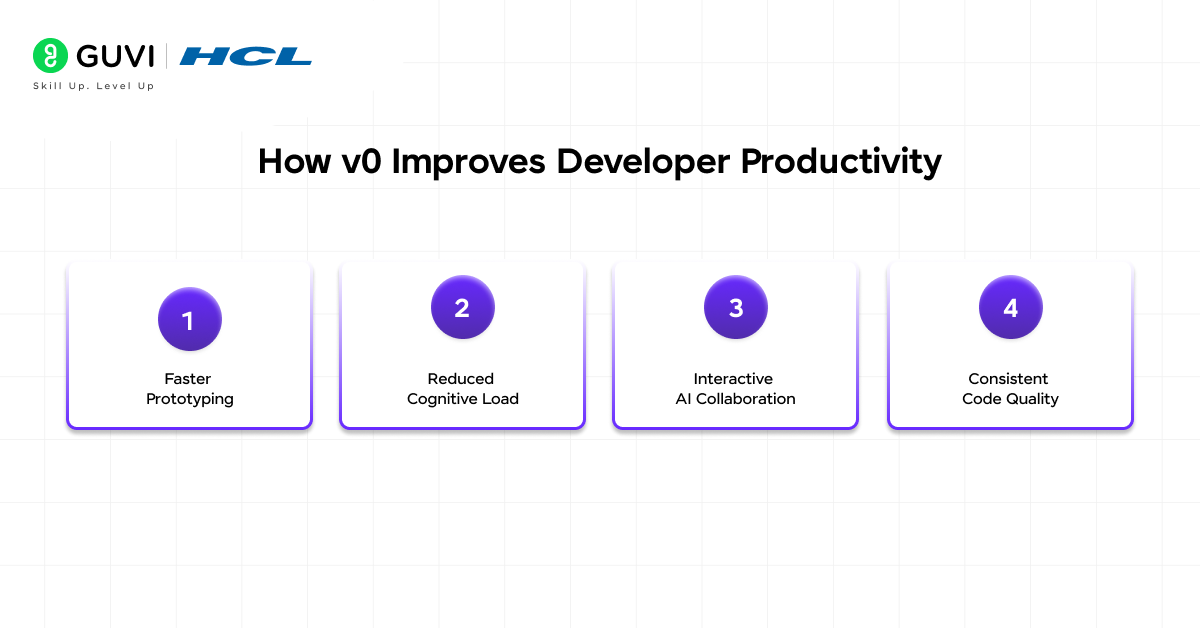
1. Faster Prototyping
v0 accelerates the development process by eliminating the need for manual setup and configuration tasks, allowing developers to go from concept to code more quickly.
- Create UI in minutes, not hours: Developers can describe a feature in natural language, and v0 generates a working interface, allowing instant visualization and quicker validation of ideas.
- Skip boilerplate setup and repetitive coding tasks: v0 allows developers to skip writing the same lines of code for layout, components and configurations, and focus on development.
- Innovate and design features faster: With the basics taken care of, developers can concentrate more on designing the user experience and creating new product features.
2. Reduced Cognitive Load
In today’s development environment, developers must juggle various layers of complexity, which can slow down efficiency and introduce mistakes.
- No need to remember syntax and framework-specific rules: v0 code follows the best practices, so there’s no need to keep all the rules in mind.
- Manages structure and organization: Developers can focus on what needs to be done without thinking about how to properly arrange elements or organize files as v0 provides a clean and logical structure by default.
- Enables developers to focus on design and problem-solving: : By removing low-level distractions, it shifts attention to higher-impact tasks like architecture, logic, and user experience.
3. Interactive AI Collaboration
v0 is an interactive AI tool, unlike existing ones: it enables a more collaborative development experience.
- Provides a pair programmer that learns from your feedback: Developers can refine outputs step by step, and v0 adapts based on feedback rather than restarting from scratch.
- Offers real-time suggestions and optimisations: From code refactoring to better user experience, to bug fixing, v0 can offer instantaneous feedback to speed up decision making.
- Creates an interactive development experience instead of a static one: This ongoing dialogue makes coding more dynamic and less mechanical, similar to working with a teammate.
4. Consistent Code Quality
Consistency and quality of the code is crucial in developing scalable systems.
- Produces clean, readable and maintainable code: This means that even the initial code is understandable and can be easily changed.
- Reduces common errors and inconsistencies across the codebase: By following standardized patterns, v0 minimizes issues that typically arise from manual coding.
- Simplifies maintenance and scaling: High quality and consistency make it easier to maintain and scale the application over time.
Technology behind v0
In order to be an effective coding agent, v0 is comprised of several systems.
1. Prompt Understanding Layer
This translates user requests into commands.
- Understands natural language with great accuracy: It can interpret the developer’s request even if it isn’t highly technical.
- Understands the intent, constraints, and the desired outcome: It will generate the right kind of code that is relevant to the task and not some generic response.
- Eliminates vagueness in code generation: By precisely stating what must be developed, it enhances the relevance and usability of the output.
v0 by Vercel wasn’t built just to generate code—it was designed to mirror how developers actually think.
Instead of one-shot outputs, it follows an iterative loop (understand → generate → refine), closely matching real-world development workflows.
This shift is why modern AI tools are evolving from autocomplete assistants into true pair programmers, working alongside developers within platforms like Vercel.

2. Context Engine
The Context Engine enables v0 to “learn” and build knowledge over time.
- Maintains awareness of previous prompts and generated code: The system can pick up where the last development session ended.
- Knows how different parts of a project are connected: New changes are added seamlessly without disrupting the project.
- Provides a seamless development experience: This makes it easier for coders to work.
3. Code Generation Engine
This is the code generator.
- Produces code that is compliant with frameworks and ready for production: The generated code is not only functional but also follows current best practices.
- Follows scalable architectural patterns: This means that the code will be able to scale as the project evolves.
- Optimises speed with quality of code generation: Code is generated quickly without sacrificing quality.
4. Feedback Loop System
Developing is an iterative process, and our system supports iterative improvement.
- Allows developers to refine outputs step by step: Instead of regenerating everything, changes can be made incrementally.
- Improves results through iteration: Each update becomes more aligned with the developer’s intent.
- Provides a familiar coding-like development process: This makes v0 easy to work with.
You can also check out: How Vercel built the v0 iOS app
Real-World Workflow with v0
This is how v0 is used in the real world:
Step 1: Describe the Idea
They write a brief description in natural language such as “Build a responsive dashboard with charts and a sidebar” without being concerned about the technical complexity.
Step 2: Produce a Draft
v0 generates a full starting template with layout, components and styling, providing a running start.
Step 3: Refine the Output
Users can then ask for enhancements like “Make the sidebar collapsibler” or “Add dark mode”, and v0 makes changes to the already generated code.
Step 4: Integrate Backend
The generated frontend can be extended by connecting APIs or backend services, making the application fully functional.
Step 5: Deploy
Through integration with Vercel, deployment is fast and simple, allowing developers to get their product to market faster.
Challenges We Faced (And Solved)
1. Balancing Flexibility and Structure
- Excessive structure stifles innovation and flexibility. Developers need freedom to customize outputs based on unique requirements.
- Too much flexibility results in inconsistent and unreliable code. With no structure, results can be unpredictable.
Solution: Implement controlled flexibility with strong default patterns that ensure consistency while allowing customization.
2. Maintaining Context Across Sessions
- Without memory, the system behaves like a stateless tool. Developers would have to re-input commands, reducing productivity.
- Lack of context disrupts the workflow. It interrupts the development process, making it less efficient.
Solution: Apply persistent context management to allow v0 to remember context from the past.
3. Avoiding Over-Engineering
- AI can produce overly complex code. This is difficult to understand.
- High levels of abstraction make the code less practical. Developers prefer simple and direct solutions.
Solution: Focus on generating clean, simple, and practical code tailored for real-world use cases.
Why v0 is Better than Other AI
- Recognises entire development processes, not just individual tasks. This makes it more practical.
- Enables iterative coding rather than one-off tasks. It also allows continuous improvement.
- Generates deployable code that can be used. This reduces the gap between idea and implementation.
The Future of Coding Agents
- More of the development process will be handled by AI agents. Planning, coding, deployment will be more automated.
- They will be more integrated into DevOps processes. AI will help with testing, deployment and monitoring.
- Debugging and optimization will become more intelligent and automated, minimizing human effort.
Master concepts like machine learning, deep learning, and real-world AI applications with GUVI’s AI & ML Course. Gain hands-on experience, work on industry-level projects, and learn how to use tools like v0 to boost your developer productivity.
Wrapping it Up
Every developer has had that same experience of sitting in front of a blank screen, knowing exactly what they want to build, but not wanting to deal with repetitive setup.
V0 assists with this by doing all the heavy lifting so developers can concentrate on what really matters: ideas, logic, and creativity.
What makes V0 so successful is that it fits seamlessly into the way developers actually work. It doesn’t replace developers; rather, it is a companion that works alongside developers, adapting to their needs and evolving with each interaction. Combined with platforms like Vercel, it creates a seamless path from concept to deployment.
On a personal level, it changes coding from being a stressful process to one that flows freely and is much more enjoyable to do. That is probably the biggest thing that makes V0 such a significant improvement for working developers and how coding feels to them.
FAQs
1. What is v0 and how does it work?
V0 is a coding assistant that utilizes artificial intelligence (AI) technology developed by Vercel that allows users to produce coded output based on natural language inputs.
2. How is v0 different from other AI tools?
The primary difference between v0 and most commonplace types of AI is that, as it relates to programming, v0 is capable of recognizing context, allowing users to continuously refine the output, and aligns with the standard workflow of developers.
3. Can beginners use v0 effectively?
Yes, beginners can use v0 to learn faster by generating structured code and understanding best practices, while experienced developers can use it to speed up development.
Success Stories

About the Author
Vishalini Devarajan
An Aerospace Engineer turned content writer, I focus on making complex concepts easy to understand through well-structured, reader-friendly blogs. Whether it’s a technical topic or a non-technical one, I love creating content that is clear, engaging, and impactful.
View all posts by Vishalini Devarajan
Connect with me @













Did you enjoy this article?