


Programming Languages Articles
Product Manager Portfolio: How to Build The Best One That Gets You Hired in 2026
Code Review Best Practices: How to Give and Receive Feedback Effectively


Get In Touch For Details! Request More Information
Best Coding Platform Websites in 2026: Top Picks to Learn and Practice
Sep 26, 2026 5 Min Read 1369 Views
(Last Updated)
Coding platform websites make it much easier to learn and practice programming, but with so many options, choosing one can feel confusing. Some are built for beginners, while others are better for problem-solving and skill-building.
In this post, we’ve listed the best ones and explained what each is good for, so you can pick the right platform and start coding without wasting time.
Quick Answer: The best coding platform websites depend on your goal:
- For interview practice: HCL GUVI CodeKata, LeetCode, HackerRank
- For learning from scratch: Codecademy, freeCodeCamp, The Odin Project
- For language mastery: Exercism
- For contests: CodeChef, Codeforces
- For gamified practice: Codewars
Table of contents
- What is a Coding Platform Website?
- Best Coding Platform Websites: A Clear Review of Each Platform
- HCL GUVI CodeKata
- LeetCode
- HackerRank
- Codecademy
- freeCodeCamp
- Codewars
- Exercism
- CodeChef
- The Odin Project
- Codeforces
- Coding Platform Websites Compared: Overview
- How to Choose Between Coding Platform Websites
- Conclusion
- FAQs
- Which platform is best for coding interview preparation?
- What are the best coding platform websites for beginners?
- How many coding platform websites should I use?
- Can I practice coding without installing anything?
- Are there free coding platform websites?
- Do coding platform websites give certificates?
What is a Coding Platform Website?
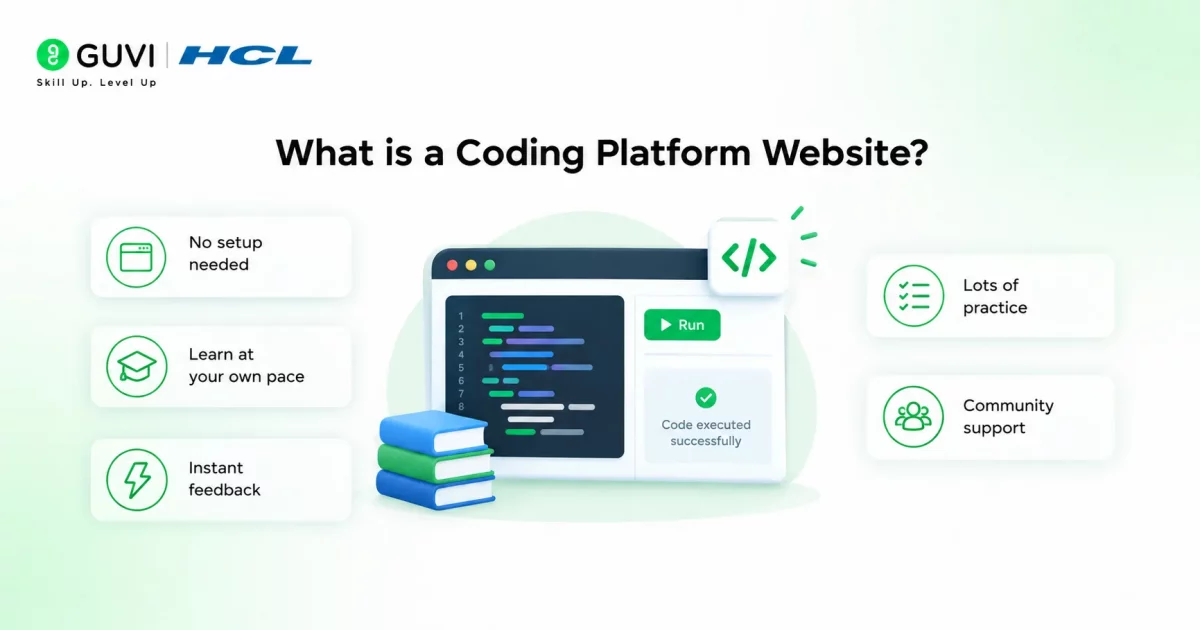
A coding platform website is an online tool where you can learn, practice, and test your code without installing anything on your computer.
It offers lessons, coding challenges, and a built-in editor to run your code, so you can build your skills and get instant feedback.
Advantages of Coding Platform Websites:
- No setup needed: Start coding right in your browser.
- Learn at your own pace: Lessons and courses for every level.
- Instant feedback: Run your code and see results right away.
- Lots of practice: Coding challenges to sharpen your skills.
- Community support: Learn from other coders and get help when stuck.
Ready to build a career in software engineering? Move from learning to building with HCL GUVI’s Software and AI Engineer Programme. Choose the Full Stack or Backend track, build AI-powered projects with mentors from product companies, and get one-on-one mock interviews and an IITM Pravartak certification. Explore the programme and apply now!
Best Coding Platform Websites: A Clear Review of Each Platform
Here are the best coding platform websites, what each offers, and key details about them:
1. HCL GUVI CodeKata
Link: CodeKata
Category: Coding practice and interview preparation
Best for: Learners preparing for coding interviews with company-style problems
CodeKata is HCL GUVI’s coding practice platform, built for learners who want to improve their problem-solving and prepare for coding interviews.
HCL GUVI’s CodeKata has a large set of problems curated by industry experts, including questions asked by companies such as Amazon and Walmart.
Key features:
- 1500+ coding problems
- Support for 16+ coding languages
- Performance tracking that builds a coding profile you can show during job applications
- Geekoins earned by practicing, which can be redeemed for rewards
- Other practice tools on the same platform: WebKata for web development, SQLKata for SQL, FixTheCode for debugging, and a free online compiler
Also Read: HackerRank vs LeetCode vs GUVI: Best Coding Platform for Students
2. LeetCode
Link: LeetCode
Category: Coding practice and interview preparation
Best for: Learners preparing for technical interviews at product companies
LeetCode is one of the most widely used platforms for technical interview preparation. It focuses on data structures and algorithms, with problems labeled Easy, Medium, or Hard, and lets users write and test solutions in the browser in C++, Java, Python, JavaScript, and several other languages.
Key features:
- Problems sorted by difficulty and topic, such as arrays, trees, graphs, and dynamic programming
- Weekly contests with a global ranking
- Study plans, including the LeetCode 75 list, that group questions into a fixed path
- Company-wise question lists for targeted interview practice
- Discussion forum and solution write-ups to compare different approaches
- Playground for running code without solving a specific problem
3. HackerRank
Link: HackerRank
Category: Coding practice, skill certification, and interview preparation
Best for: Learners who want interview prep kits, skill certifications, and mock interviews
HackerRank organizes its practice content into domain tracks, so a learner can work on one subject at a time instead of solving random problems.
Alongside coding challenges, it offers structured interview preparation kits and skill certifications, and every challenge is solved in a built-in browser editor that supports languages such as C++, Java, Python, and JavaScript.
Key features:
- Domain tracks covering algorithms, data structures, mathematics, SQL, and functional programming
- Interview Preparation Kit with challenges grouped around commonly tested concepts
- Skill certifications that can be added to a resume or LinkedIn profile
- Mock interviews and timed challenges for interview practice
- Discussion and editorial sections that give hints and solutions when you are stuck
4. Codecademy
Link: Codecademy
Category: Interactive coding courses and learning paths
Best for: Beginners who want guided lessons and structured learning paths
Most coding platforms start with problems to solve. Codecademy starts with lessons. Each concept is taught in a short lesson with a built-in browser editor beside it, so learners write code and see the result straight away, without installing anything. It covers languages such as Python, JavaScript, SQL, Java, C++, HTML, and CSS.
Key features:
- Interactive lessons with an in-browser code editor and instant feedback
- Skill Paths and Career Paths that put courses in a fixed order
- Quizzes and hands-on projects to practice what each lesson teaches
- Certificates of completion for finished courses and paths
- Community forums for asking questions and getting help
5. freeCodeCamp
Link: freeCodeCamp
Category: Project-based learning and certifications
Best for: Self-paced learners who want to build projects and earn certifications in web development
freeCodeCamp is a nonprofit learning platform founded in 2014 by Quincy Larson. Its curriculum is self-paced and project-based, so it measures progress by what learners build rather than by videos watched.
It covers full-stack web development, machine learning, math, and computer science, and its community includes a forum, a YouTube channel, and its own technical publication.
Key features:
- Certifications that require building projects, with newer ones also including an exam
- Curriculum topics including HTML, CSS, JavaScript, React, and relational databases
- Coding interview prep section for data structures and algorithms practice
- Self-paced structure with no fixed schedule
- Forum, YouTube tutorials, and written articles for extra support
6. Codewars
Link: Codewars
Category: Gamified coding challenges
Best for: Learners who enjoy gamified challenges and comparing solutions with other coders
Codewars borrows its vocabulary from martial arts. Coding challenges are called kata, users are called warriors, and progress is measured in ranks that start at 8 kyu and count down to 1 kyu before moving up through the dan levels.
The community writes every kata, and once you solve one, you can see how other warriors approached the same problem.
Key features:
- Kata that range from language fundamentals to complex problem-solving
- Kyu and dan ranking system for both users and challenges
- Honor points earned through solving, translating, and contributing kata
- Solutions from other users visible after you complete a kata
- Collections for building your own training routines
- Community-created kata that go through a beta stage for feedback before release
7. Exercism
Link: Exercism
Category: Language practice with mentoring
Best for: Learners who want to master a specific programming language with mentor feedback

Exercism is built around one idea: improving a programming language through practice and human feedback.
Learners join a language track, solve exercises until all tests pass, and can then request feedback from a volunteer mentor. It is an open-source, not-for-profit project maintained by contributors worldwide.
Key features:
- More than 80 language tracks, from popular languages to less common ones
- Exercises that unlock as you complete earlier ones
- Volunteer mentors who review solutions and start a conversation with you
- Command-line workflow to download and submit exercises from your terminal
- Automated analysis of submitted code
8. CodeChef
Link: CodeChef
Category: Competitive programming and contests
Best for: Learners who want to compete in rated contests and build competitive programming skills
CodeChef is a competitive programming platform based in India, where the main event is the rated contest.
Contest performance determines your star rating (1 to 7 stars), and users are placed in divisions so they compete against similar-level players. Between contests, the platform offers practice problems, learning courses, and roadmaps.
Key features:
- Rated contests, including the Starters series
- Star ratings and four divisions based on your overall rating
- Practice problems arranged by difficulty and topic
- Roadmaps and courses, such as the guided path to reach 5 stars
- Editorials that explain the best approach to contest problems
- Skill tests for Python, C, C++, Java, and DSA concepts
9. The Odin Project
Link: The Odin Project
Category: Full-stack web development curriculum
Best for: Beginners who want a project-based path into full-stack web development
The Odin Project is an open-source curriculum for learning full-stack web development, created by Erik Trautman. It has no video course or bootcamp cohort.
The curriculum links lessons to carefully chosen resources across the web, with projects between them, and learners can add finished projects to a portfolio. Learners start with a Foundations course, then pick a path: Full Stack JavaScript or Full Stack Ruby on Rails.
Key features:
- Foundations course that covers the basics of web development
- Full Stack JavaScript path that goes from front-end work to Node.js, Express, and PostgreSQL
- Full Stack Ruby on Rails path that starts with Ruby and databases
- Projects throughout, from simple scripts to deployed websites
- Job-seeking guidance covering resumes, portfolios, and technical interview prep
- Discord community for asking questions and getting help from other learners
10. Codeforces
Link: Codeforces
Category: Competitive programming contests
Best for: Coders who want regular timed contests and a strong competitive programming community
Codeforces is a contest-first platform. Timed rounds run regularly, and each round is split by division so that participants compete against people close to their own rating.
In a regular round, participants get a set of problems and a few hours to solve them, and the results change their rating and title.
Key features:
- Regular rated rounds in Div. 1, Div. 2, Div. 3, and Div. 4 formats, along with Educational rounds
- Rating system with titles that go from Newbie up to Legendary Grandmaster
- Problem set with filters for difficulty rating and topic tags
- Gym section for virtual contests and team training
- Blogs and editorials where the community explains solutions and discusses problems
Coding Platform Websites Compared: Overview
This table summarizes the category, focus, and best use case of each of the coding platform websites covered above:
| Platform | Category | Best For | Main Focus | Primary Feature | Website Link |
|---|---|---|---|---|---|
| HCL GUVI CodeKata | Coding practice and interview preparation | Interview practice | Interview-style problem solving | 1500+ coding problems | HCL GUVI CodeKata |
| LeetCode | Coding practice and interview preparation | Interview preparation | Data structures and algorithms | Problems sorted by difficulty and topic | LeetCode |
| HackerRank | Coding practice, skill certification, and interview preparation | Skill certifications | Domain tracks and interview preparation | Interview Preparation Kit | HackerRank |
| Codecademy | Interactive coding courses and learning paths | Beginners | Lesson-based learning | In-browser code editor with instant feedback | Codecademy |
| freeCodeCamp | Project-based learning and certifications | Web development learners | Web development curriculum | Certifications based on projects | freeCodeCamp |
| Codewars | Gamified coding challenges | Gamified practice | Kata-based skill training | Kyu and dan ranking system | Codewars |
| Exercism | Language practice with mentoring | Language mastery | Language-specific practice | Volunteer mentor feedback | Exercism |
| CodeChef | Competitive programming and contests | Contest participation | Rated contests and practice | Star ratings and divisions | CodeChef |
| The Odin Project | Full-stack web development curriculum | Full-stack beginners | Web development projects | Full Stack JavaScript and Ruby on Rails paths | The Odin Project |
| Codeforces | Competitive programming contests | Competitive programmers | Timed contest rounds | Division-based rated rounds | Codeforces |
How to Choose Between Coding Platform Websites
The right pick depends on what you want from coding platform websites, so start with your goal and match it to the platform’s focus.
- Learning from scratch: Choose a platform with guided lessons or a full curriculum, such as Codecademy, freeCodeCamp, or The Odin Project.
- Preparing for interviews: Pick a platform built around interview-style problems, such as HCL GUVI CodeKata, LeetCode, or HackerRank.
- Mastering one language: Exercism lets you work through a single language track and get feedback from mentors.
- Competing in contests: CodeChef and Codeforces focus on rated, timed contests.
- Practicing in a fun way: Codewars turns practice into ranked challenges and lets you compare your solution with other coders.
Quick Suggestion: Pair one learning platform with one practice platform. A learning platform teaches you the concepts, and a practice platform helps you apply them by solving problems.
Conclusion
Coding platform websites give you the tools, but the progress comes from the time you spend on them. Choose the one that fits your goal right now, whether that is learning a language, preparing for interviews, or entering contests. You can switch anytime, and the skills you build will stay with you.
FAQs
1. Which platform is best for coding interview preparation?
HCL GUVI CodeKata, LeetCode, and HackerRank focus on interview-style problems.
2. What are the best coding platform websites for beginners?
Codecademy, freeCodeCamp, and The Odin Project are good starting points because of their guided lessons and structured paths.
3. How many coding platform websites should I use?
Two is enough: one to learn concepts and one to practice by solving problems.
4. Can I practice coding without installing anything?
Yes, most coding platform websites let you write and run code right in your browser.
5. Are there free coding platform websites?
Yes, freeCodeCamp, Exercism, and The Odin Project are all free to learn from.
6. Do coding platform websites give certificates?
Some do, like freeCodeCamp and HackerRank, but The Odin Project and Exercism do not.
Success Stories








Did you enjoy this article?