


Artificial Intelligence and Machine Learning Articles
AI/ML Skills Gap 2026: Why Companies Can't Find Job-Ready Talent
20 AI/ML Interview Questions Recruiters Can Use Without a Tech Background - Best Guide
How Industry-Backed AI/ML Bootcamps Are Changing the AI/ML Hiring Pipeline - Best Guide 2026
From IT Support to AI Engineer: A Realistic Career Switch Guide 2026


Get In Touch For Details! Request More Information
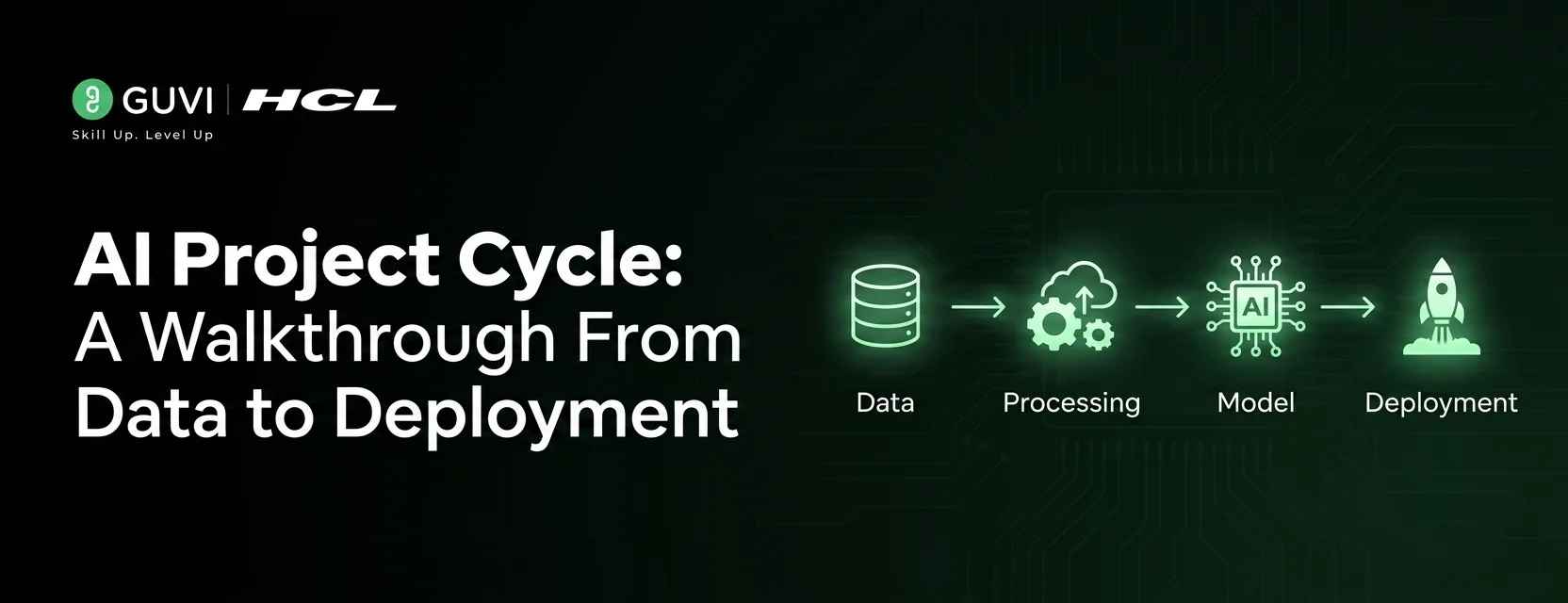
AI Project Cycle: A Walkthrough From Data to Deployment
Sep 09, 2026 5 Min Read 1304 Views
(Last Updated)
What if the next AI system you use, whether it is recommending your next movie or detecting fraud in your bank account, could be built by you?
Artificial Intelligence is no longer limited to research labs or big tech companies. It is actively shaping how businesses operate, how decisions are made, and how real-world problems are solved. But behind every smart AI system lies a structured process that most beginners overlook.
Building an AI solution is not just about writing code or training a model. It is about understanding a problem deeply, working with messy real-world data, making the right technical choices, and continuously improving the system after deployment.
This is where the AI Project Cycle comes in.
In this blog, you will walk through each stage of the AI project cycle, from problem definition to deployment and monitoring, with simple explanations and relatable analogies. By the end, you will not just understand how AI systems work, but how they are actually built and improved in the real world.
Quick Answer:
The AI Project Cycle is a structured, iterative process that lets you build real-world AI systems from scratch. It goes beyond coding, focusing on problem definition, data, modeling, deployment, and continuous improvement to create impactful, scalable, and reliable intelligent solutions.
Table of contents
- What Is the AI Project Cycle?
- Step-by-Step Guide to the AI Project Cycle
- Stage 1: Problem Definition
- Stage 2: Data Acquisition
- Stage 3: Data Preparation
- Stage 4: Feature Engineering
- Stage 5: Model Selection and Training
- Stage 6: Model Evaluation and Refinement
- Stage 7: Deployment
- Stage 8: Monitoring and Maintenance (MLOps)
- Tools Used in the AI Project Cycle
- Key Tips for Building Successful AI Projects
- Conclusion
- FAQs
- What tools are commonly used across the AI project lifecycle?
- How long does it take to complete an AI project?
- What skills are required to work on AI projects?
- What job roles can I apply for after completing an AI & ML course?
- How do I choose the best AI course for my career goals?
What Is the AI Project Cycle?
The AI Project Cycle is the structured process you follow when building an AI system from scratch. It provides a clear framework for implementation, starting with identifying a problem and then transforming raw, unprocessed data through a series of stages into a functional intelligent system. The process does not end after deployment, it continues to evolve as the system learns and improves over time. Unlike traditional project plans that follow a linear path, the AI Project Cycle consists of interconnected, repeating stages. This is why it is often referred to as an iterative process. Each stage builds on the previous one and feeds into the next.
Step-by-Step Guide to the AI Project Cycle
Stage 1: Problem Definition
This is the most critical stage of the AI project lifecycle. Before collecting data or building models, you must define a clear, measurable problem statement.
What this involves:
- Identifying the business or real-world objective
- Defining success metrics (KPIs) such as accuracy, precision, recall, or ROI
- Understanding constraints like data availability, latency, cost, and scalability
- Validating whether Artificial Intelligence is the right solution (not every problem needs AI)
Why it is important: Poorly defined problems lead to misaligned models, wasted resources, and failed deployments. Many AI projects fail due to incorrect problem framing rather than poor execution.
Example: If you are building a fraud detection system for a banking app, the problem is not just “detect fraud.” It must be defined clearly as: “Identify fraudulent transactions in real time with less than 2% false positives.” This clarity directly guides model design and evaluation.
Master the complete AI project cycle from data to deployment with structured, industry-led learning. Join HCL GUVI’s Artificial Intelligence and Machine Learning Course to learn through live online classes by industry experts and Intel engineers, build expertise in Python, ML, MLOps, Generative AI, and Agentic AI, and gain hands-on experience with 20+ industry-grade projects, 1:1 doubt sessions, and placement support with 1000+ hiring partners.
Stage 2: Data Acquisition
Once the problem is defined, the next step is to gather relevant data required to train the model.
Types of data:
- Structured data: Tables, databases, spreadsheets
- Unstructured data: Images, videos, audio, text
Sources:
- Internal systems (databases, logs, APIs)
- External sources (open datasets, web scraping, third-party providers)
Best practices:
- Ensure data relevance and alignment with the problem
- Check for data completeness and coverage
- Maintain data privacy and compliance standards
Why it is important: The quality of your data directly impacts model performance. Even the best algorithm cannot compensate for poor or irrelevant data.
Example: For a movie recommendation system, data may include user watch history, ratings, search queries, and viewing time. Without this behavioral data, the model cannot learn user preferences effectively.
Stage 3: Data Preparation
Raw data is often incomplete, inconsistent, and noisy. Data preparation transforms it into a usable format for model training.
Key steps:
- Remove duplicates and irrelevant records
- Handle missing values (imputation or removal)
- Standardize formats, units, and data types
- Perform data transformation and normalization
- Split data into training, validation, and test sets
Why it is important: Clean, well-structured data improves model accuracy and stability. This stage typically consumes 6070% of total project time.
Core principle: Garbage in, garbage out. Poor input data leads to poor predictions.
Example: In a house price prediction model, if some entries have missing prices, inconsistent units (sq. ft vs sq. meters), or duplicate listings, the model will learn incorrect patterns unless this data is cleaned.
Stage 4: Feature Engineering
Feature engineering involves selecting and transforming variables that help the model learn patterns effectively.
What this includes:
- Feature selection: Choosing the most relevant variables
- Feature extraction: Creating new features from existing data
- Encoding categorical variables (e.g., one-hot encoding)
- Scaling and normalization
Why it is important: Well-engineered features significantly improve model performance, interpretability, and efficiency.
Example: In a ride-sharing app, instead of using raw timestamps, you can create features like “peak hour,” “weekend,” or “distance to nearest driver.” These engineered features help the model make better predictions about ride demand.
Stage 5: Model Selection and Training
This stage involves selecting appropriate algorithms and training them on prepared data.
Key components:
- Choosing the right algorithm (e.g., regression, decision trees, neural networks)
- Training the model on labeled or unlabeled data
- Performing hyperparameter tuning
- Avoiding overfitting and underfitting
Process:
Model training is iterative:
- Train → Evaluate → Tune → Retrain
Why it is important: The effectiveness of this stage depends on both data quality and algorithm choice.
Example: For an email spam classifier, you may start with a simple Naive Bayes model, evaluate its performance, then switch to more advanced models like Random Forest or deep learning if accuracy is not sufficient.
Stage 6: Model Evaluation and Refinement
Before deployment, the model must be rigorously tested on unseen data.
Evaluation metrics:
- Accuracy
- Precision and Recall
- F1 Score
- ROC-AUC (for classification)
- RMSE/MAE (for regression)
What happens here:

- Validate performance on test datasets
- Identify bias and variance issues
- Fine-tune model parameters or revisit earlier stages
Why it is important: A model that performs well on training data may fail in real-world scenarios. Evaluation ensures reliability and robustness.
Example: In a loan approval system, a model with high accuracy but poor recall may fail to detect risky applicants. Evaluation helps balance such trade-offs to avoid financial losses.
Stage 7: Deployment
Deployment is where the trained model is integrated into a real-world system.
What deployment involves:
- Packaging the model into an API or service
- Integrating with applications or business systems
- Enabling real-time or batch predictions
Key considerations:
- Scalability
- Latency
- Security
- Monitoring readiness
Why it is important: A model creates value only when it is used in production.
Example: A recommendation model is deployed inside an e-commerce app where it suggests products in real time based on user behavior, directly influencing sales and user engagement.
Stage 8: Monitoring and Maintenance (MLOps)
Deployment is not the end. AI systems require continuous monitoring and updates.
What this includes:
- Tracking model performance over time
- Detecting data drift and model drift
- Retraining models with new data
- Managing pipelines using MLOps practices
Key risks:
- Changing user behavior
- Evolving data distributions
- External factors like economic or environmental changes
Why it is important: Unmonitored models degrade over time, leading to inaccurate or biased predictions.
Example: A food delivery demand prediction model trained before a festival season may become inaccurate during peak holidays. Continuous monitoring helps detect this shift and retrain the model accordingly.
Tools Used in the AI Project Cycle
- Data Collection Tools: APIs, web scraping tools (BeautifulSoup, Scrapy), public datasets (Kaggle, Google Dataset Search)
- Data Processing & Analysis: Pandas, NumPy for cleaning, transformation, and exploratory data analysis
- Visualization Tools: Matplotlib, Seaborn, Power BI for identifying patterns and insights
- Machine Learning Frameworks: Scikit-learn for classical ML, TensorFlow and PyTorch for deep learning
- Feature Engineering Tools: Featuretools, Scikit-learn pipelines for automated feature creation and transformation
- Model Deployment Platforms: Docker, Flask/FastAPI for APIs, AWS, Azure, GCP for scalable deployment
- Version Control & Experiment Tracking: Git, MLflow, Weights & Biases for tracking experiments and model versions
- MLOps & Monitoring Tools: Kubernetes, Airflow, Prometheus for pipeline orchestration and performance monitoring
Key Tips for Building Successful AI Projects
- Start with a Clear Objective: Define measurable goals and success metrics before touching data
- Focus on Data Quality: High-quality, relevant data matters more than complex algorithms
- Iterate Continuously: Treat model building as an iterative process, not a one-time task
- Avoid Overfitting Early: Keep models simple initially and increase complexity gradually
- Track Everything: Maintain logs of experiments, parameters, and results for reproducibility
- Think About Deployment Early: Design your model keeping real-world constraints like latency and scalability in mind
- Monitor Post-Deployment: Continuously track performance to detect drift and maintain accuracy
- Align with Business Value: Ensure the AI solution solves a real problem and delivers measurable impact
Conclusion
The AI Project Cycle is not a one-time process, it is a continuous loop that evolves with data, users, and real-world conditions. From defining the right problem to deploying and maintaining a model, every stage plays a critical role in determining the success of an AI system. Skipping or rushing through any step can lead to inaccurate predictions, wasted resources, or systems that fail in production.
What truly sets successful AI projects apart is not just technical expertise, but the ability to think iteratively, adapt quickly, and continuously improve. As new data flows in and environments change, models must be refined, retrained, and monitored to stay relevant and reliable.
If you understand and apply this cycle effectively, you are not just building models, you are building intelligent systems that create real-world impact.
I’m Vaani Mathur, a third-year AI and ML student at Manipal University, Jaipur who enjoys building practical AI-driven solutions with Python, Data Science, and Web Development while constantly experimenting with new ideas and technologies.
FAQs
What tools are commonly used across the AI project lifecycle?
Popular tools include Python libraries like Pandas and NumPy for data handling, Scikit-learn and TensorFlow for model building, and platforms like AWS or Azure for deployment and scaling. The exact stack depends on project complexity and use case.
How long does it take to complete an AI project?
Timelines vary widely based on scope, data availability, and complexity. A simple project may take a few weeks, while production-grade systems with deployment and MLOps can take several months.
What skills are required to work on AI projects?
Core skills include programming (Python), data analysis, machine learning concepts, statistics, and basic understanding of cloud and deployment systems. Problem-solving and domain knowledge are equally important for success.
What job roles can I apply for after completing an AI & ML course?
You can apply for roles such as AI Engineer, Machine Learning Engineer, Data Scientist, NLP Engineer, Computer Vision Engineer, and AI Developer. To prepare for these roles, consider a project-based AI & ML Programme with career support.
How do I choose the best AI course for my career goals?
Choose an AI course based on your career goals, curriculum, hands-on projects, mentor support, industry tools, and placement assistance. A structured AI & ML Programme can help you build practical skills and a strong portfolio.
Success Stories

About the Author
HCL GUVI
This article was selected and published as part of the HCL GUVI AI Blogathon 2026, an initiative designed to encourage students, AI enthusiasts, and aspiring tech writers to simplify complex AI concepts through impactful technical content. The contest recognized high-quality, original, and insightful AI-focused blogs, with selected authors receiving publication opportunities on the HCL GUVI blog platform along with official author credits and recognition.
View all posts by HCL GUVI
Connect with me @












Did you enjoy this article?