


Artificial Intelligence and Machine Learning Articles
AI/ML Skills Gap 2026: Why Companies Can't Find Job-Ready Talent
20 AI/ML Interview Questions Recruiters Can Use Without a Tech Background - Best Guide
How Industry-Backed AI/ML Bootcamps Are Changing the AI/ML Hiring Pipeline - Best Guide 2026
From IT Support to AI Engineer: A Realistic Career Switch Guide 2026


Get In Touch For Details! Request More Information
Build Multi-Domain RAG Systems with Dedicated Knowledge Bases
Jul 09, 2026 3 Min Read 882 Views
(Last Updated)
Multi-Domain RAG systems are frequently seen as an efficient way to organise different types of information within a unified AI system, particularly when domains need to interact within a single location. The design of such a system can significantly impact its performance in practice.
In this blog, we will look at what Multi-Domain RAG is, its main advantages, the importance of specialised knowledge bases, and how such a system is actually built.
Table of contents
- Quick TL;DR Summary
- What is a Multi-Domain RAG System
- For Example:
- Key Benefits
- Why Use Dedicated Knowledge Bases
- Knowledge Base Definition
- Why are dedicated knowledge bases required?
- How to Build a Multi-Domain RAG System
- Step 1: Collect Domain Data
- Step 2: Create Separate Knowledge Bases
- Step 3: Convert Data into Embeddings
- Step 4: Build the Retriever System
- Step 5: Connect with LLM
- Step 6: Add Query Routing (Multi-Domain Logic)
- Conclusion
- FAQs
- How does a Multi-Domain RAG system pick the right knowledge base?
- Why are dedicated knowledge bases important in RAG systems?
- Can one RAG system handle multiple domains?
- How does retrieval improve AI responses?
- How is data prepared for different domains?
- Where are Multi-Domain RAG systems used?
Quick TL;DR Summary
- Understand what Multi-Domain RAG Systems are and how they use dedicated knowledge bases to improve AI accuracy.
- Learn the key benefits and real-world examples that show how different domains can work together in one smart system.
- Get a simple step-by-step idea of how to build a Multi-Domain RAG System without confusion.
What is a Multi-Domain RAG System
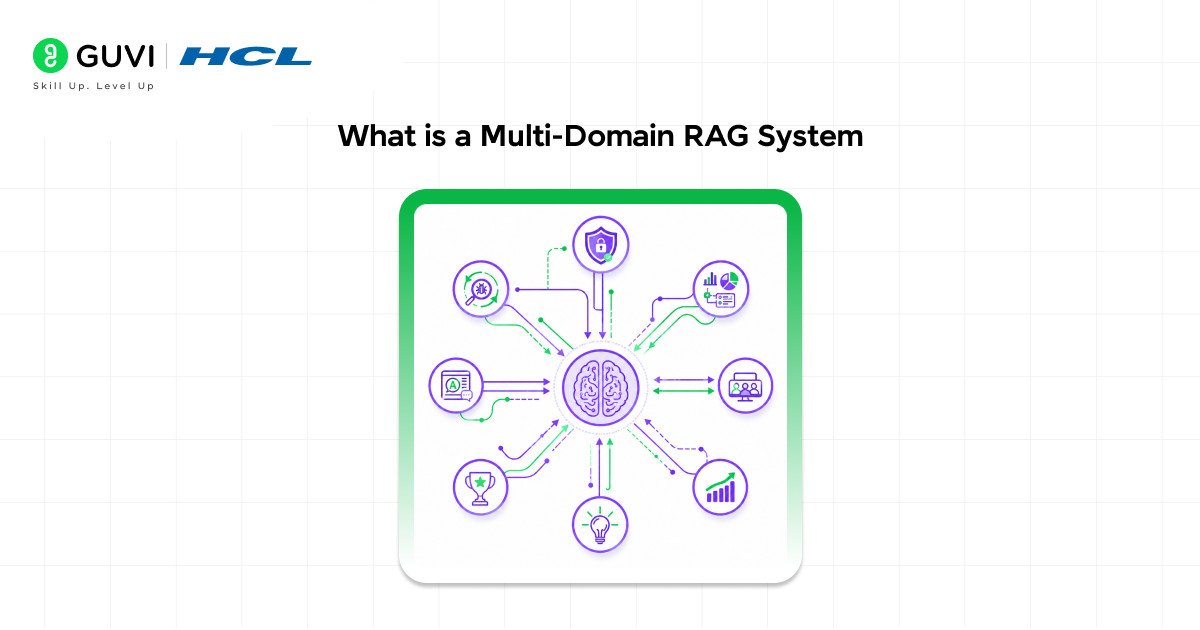
The Multi-Domain RAG System is an AI system that can access knowledge from multiple domains or subjects, such as finance, health, or education, within a single system.
Instead of storing everything in a single place, it connects to multiple knowledge bases for different domains, selecting the relevant one based on the user’s query to obtain the right information. This enables the AI to give more accurate and relevant answers to different questions.
For Example:
Think of an e-commerce website Q&A chatbot. If a user asks about “order delivery,” it pulls information from the logistics knowledge base. If they ask about the “refund policy,” use the support or policy knowledge base. This way, the system gives the right answer without mixing different types of information.
Key Benefits
- Better Accuracy: Uses correct domain data for precise answers.
- Clean Structure: Keeps data separated by topic.
- Faster Responses: Gets information from relevant sources quickly.
- Easy Scaling: New domains can be added at any time.
- More Reliable: Reduces wrong answers by using focused keywords.
Also Read: RAG vs LLM: Key Technical Differences Explained
Start your AI/ML journey today with our free resource—learn through actionable lessons and real-world applications: AI/ML Email Course
Why Use Dedicated Knowledge Bases
Knowledge Base Definition
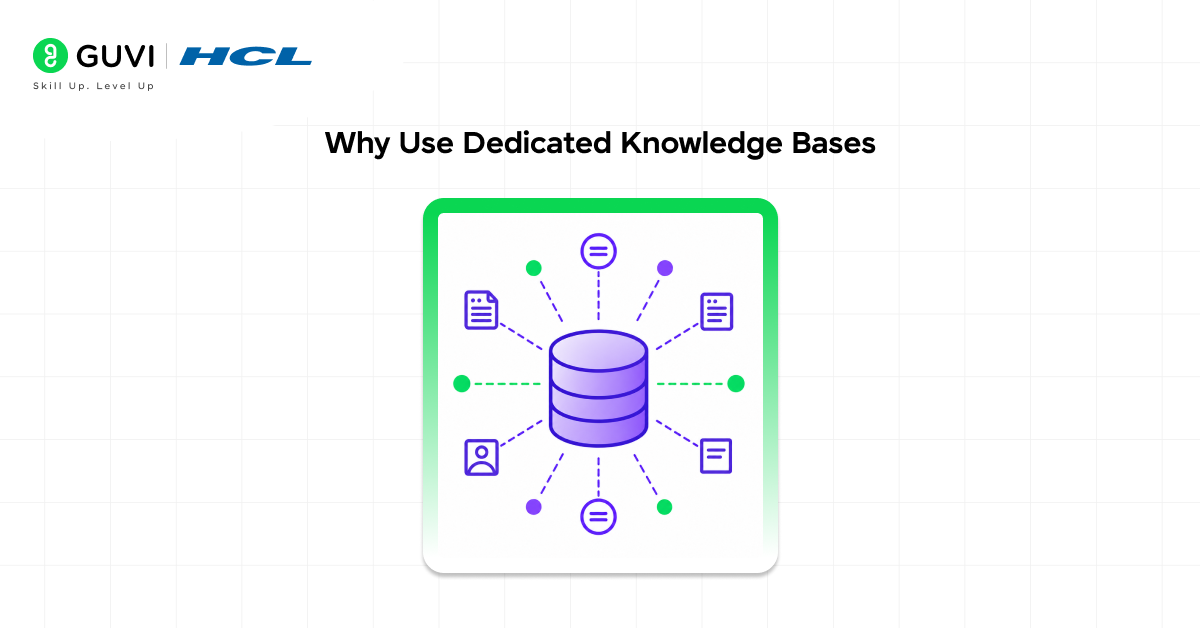
A knowledge base is a set of knowledge stored in a machine-readable format (e.g., databases, JSON files, vector embeddings, or structured documents) that can be queried by an AI system. In a RAG system, it acts as the model’s memory before answering.
Why are dedicated knowledge bases required?
In a Multi-Domain RAG, separate knowledge bases are required, since each domain (e.g., healthcare, finance, education, legal) contains vastly different types of information. If they were not separated out, the system could become very sophisticated and start retrieving irrelevant information.
For example:
If medical and financial data are combined, a question about “loan interest” might inadvertently pull in health-related information, leading to incorrect answers.
By separating the knowledge bases per domain, the Multi-Domain RAG system becomes much more accurate and stable. Each query is linked to the appropriate domain source; this helps the AI focus on the correct context. As a result, the entire system becomes more reliable in real-world applications, with greater relevance and fewer errors.

How to Build a Multi-Domain RAG System
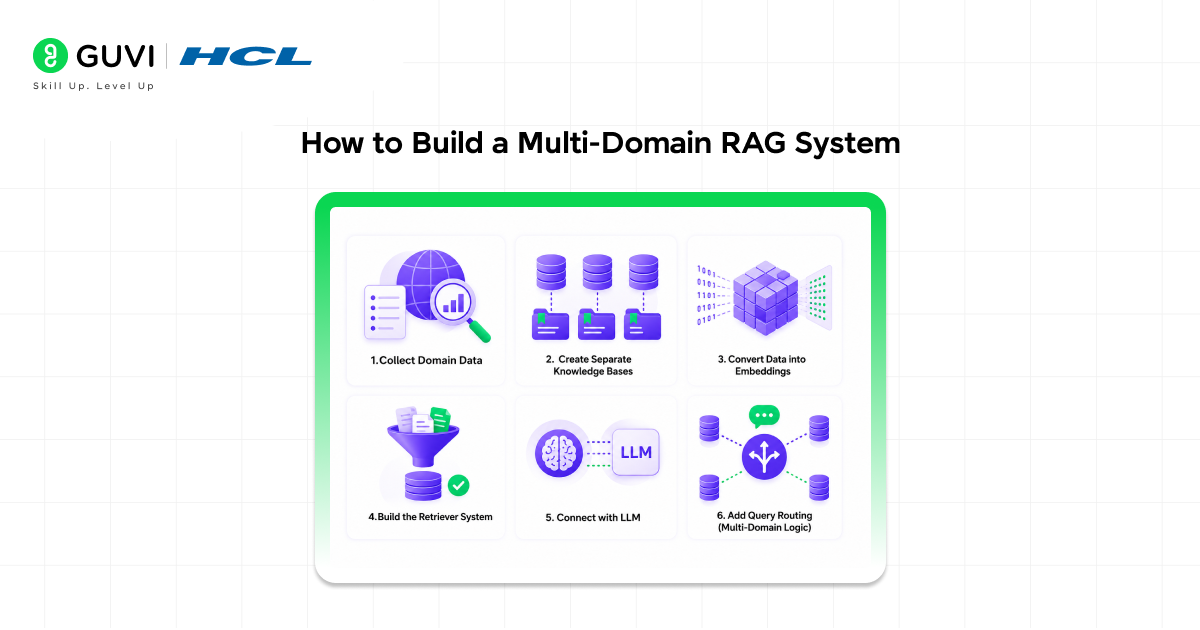
These are the following steps to build a Multi-Domain RAG System:
Step 1: Collect Domain Data
- Collect data separately for each domain (finance, health, education, etc.)
- Use trusted and clean sources
- Keep only relevant information for each domain
Step 2: Create Separate Knowledge Bases
- Store each domain’s data in its own knowledge base
- Never mix different domain information
- Structure it properly so it’s easy to search later
Step 3: Convert Data into Embeddings
- Break content into small chunks
- Convert text into embeddings (vector form)
- Store in a vector database for quick search
Step 4: Build the Retriever System
- Set up a system to search for relevant data
- Match the user query with the correct domain
- Pull only useful and related information
Step 5: Connect with LLM
- Send retrieved data to the AI model
- The model uses it as a context for answers
- Ensures responses are accurate and grounded
Step 6: Add Query Routing (Multi-Domain Logic)
- Detect which domain the question belongs to
- Route it to the correct knowledge base
- Avoid mixing information from different domains
If you aspire to be part of top global tech brands, you need an ed-tech partner you can trust. And HCL GUVI is that partner, a leading upskilling platform, that provides reliability through its Intel & IITM Pravartak Certified Artificial Intelligence (AI) and Machine Learning Course. Join this comprehensive program and become a certified AI / ML expert.
Conclusion
Multi-Domain RAG shows that a well-organised knowledge base can truly revolutionise how AI processes information across various fields. When everything is properly structured, multi-domain handling definitely stabilises, and stabilisation brings predictability and trust in a practical use case. It is not the model that is important, but the knowledge that underlies it. When the system is properly set up, multi-domain processing becomes simple and effective.
FAQs
How does a Multi-Domain RAG system pick the right knowledge base?
It matches the user query with the most relevant domain using a retrieval step.
Why are dedicated knowledge bases important in RAG systems?
They keep information organised by topic and improve overall answer accuracy.
Can one RAG system handle multiple domains?
A single pipeline can handle multiple domains using a proper routing or classification layer.
How does retrieval improve AI responses?
It pulls relevant context from stored data, so the answer becomes more accurate and grounded.
How is data prepared for different domains?
Data is cleaned, separated by topic, and converted into embeddings for storage.
Where are Multi-Domain RAG systems used?
They are used in chatbots and enterprise systems that handle mixed-topic user queries.
Success Stories






Did you enjoy this article?