


Artificial Intelligence and Machine Learning Articles
AI/ML Skills Gap 2026: Why Companies Can't Find Job-Ready Talent
20 AI/ML Interview Questions Recruiters Can Use Without a Tech Background - Best Guide
How Industry-Backed AI/ML Bootcamps Are Changing the AI/ML Hiring Pipeline - Best Guide 2026
From IT Support to AI Engineer: A Realistic Career Switch Guide 2026
Get In Touch For Details! Request More Information
Understanding AI Agent Architecture: How It Works
Jul 02, 2026 2 Min Read 796 Views
(Last Updated)
AI Agent Architecture is the basic skeleton that governs how an AI System functions internally. All AI systems follow a certain process whenever producing output or responding to an input.
In this blog, we will go through this structure and explore it in detail. As you read it, the easier it will be to see how it all fits together and what is really happening behind the scenes. So, let’s get started.
Quick TL;DR Summary
- This blog helps you explore what AI Agent Architecture really means in simple words and why it matters.
- You’ll understand the main components of AI Agent Architecture and how each part works together.
- It walks you through how AI Agent Architecture works, step by step, in an easy-to-understand way.
- You also get to explore different types of AI Agent Architecture and how they are used.
Table of contents
- Let's Understand: AI Agent Architecture
- For example:
- Key Components of AI Agent Architecture
- Perception
- Reasoning
- Memory
- Planning
- Action
- How AI Agent Architecture Works
- Phase 1: Input Processing (Perception)
- Phase 2: Reasoning and Context Handling
- Phase 3: Planning and Decision Logic
- Phase 4: Execution and Output Generation
- Conclusion
- FAQs
- Is AI Agent Architecture difficult for beginners to learn?
- Do you need coding knowledge to understand AI Agent Architecture?
- Can AI Agent Architecture be used in small projects?
- How is AI Agent Architecture different from traditional software design?
- Why are there different types of AI Agent Architecture?
- Where can you see AI Agent Architecture in real life?
Let’s Understand: AI Agent Architecture
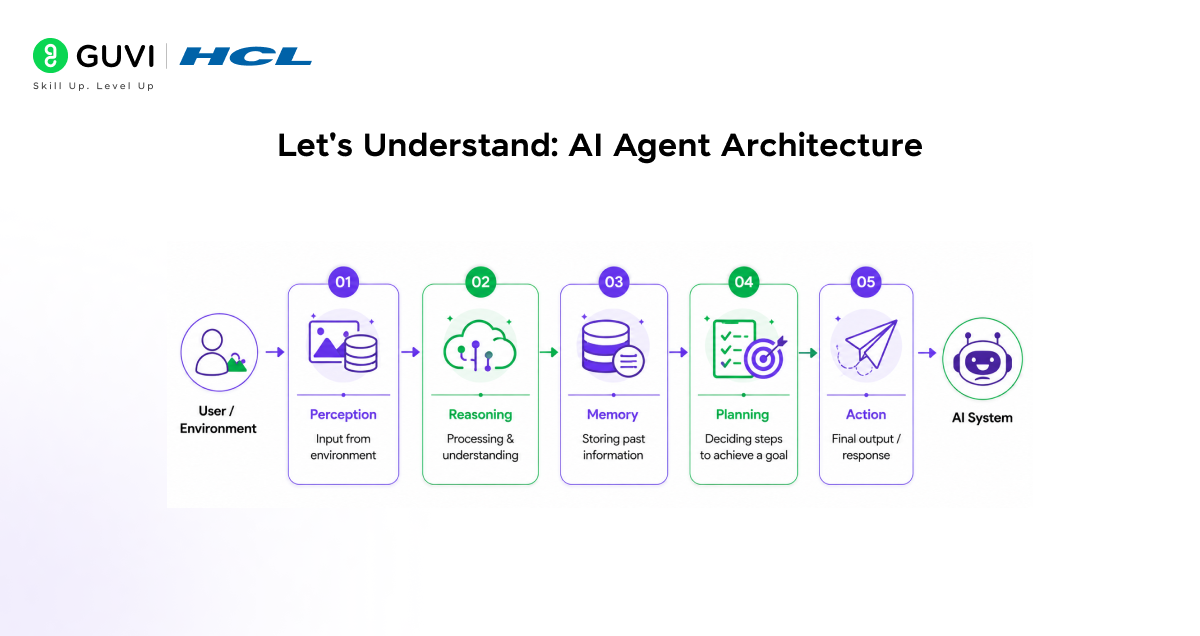
AI Agent Architecture is the fundamental framework for a system, depicting its operation from input to output. It specifies how the system interprets received inputs and responds to them systematically.
For example:
Imagine you type a question into a Chatbot, and you get a reply. There is a structure (the AI Agent Architecture) that processes that and chooses a reply.
Key Components of AI Agent Architecture
1. Perception
Takes input from the environment, like reading text, images, or data.
2. Reasoning
Thinks about the input and decides what it means.
3. Memory
Stores past information so the system can use it later.
4. Planning
Decides what steps to take to achieve a goal.
5. Action
Decides what steps to take to achieve a goal.
Explore AI/ML with our free resource—practical lessons, real-world examples, and concepts you can actually apply: AI/ML Email Course
Also Read: Types of AI Agents: A Practical Guide with Examples
How AI Agent Architecture Works
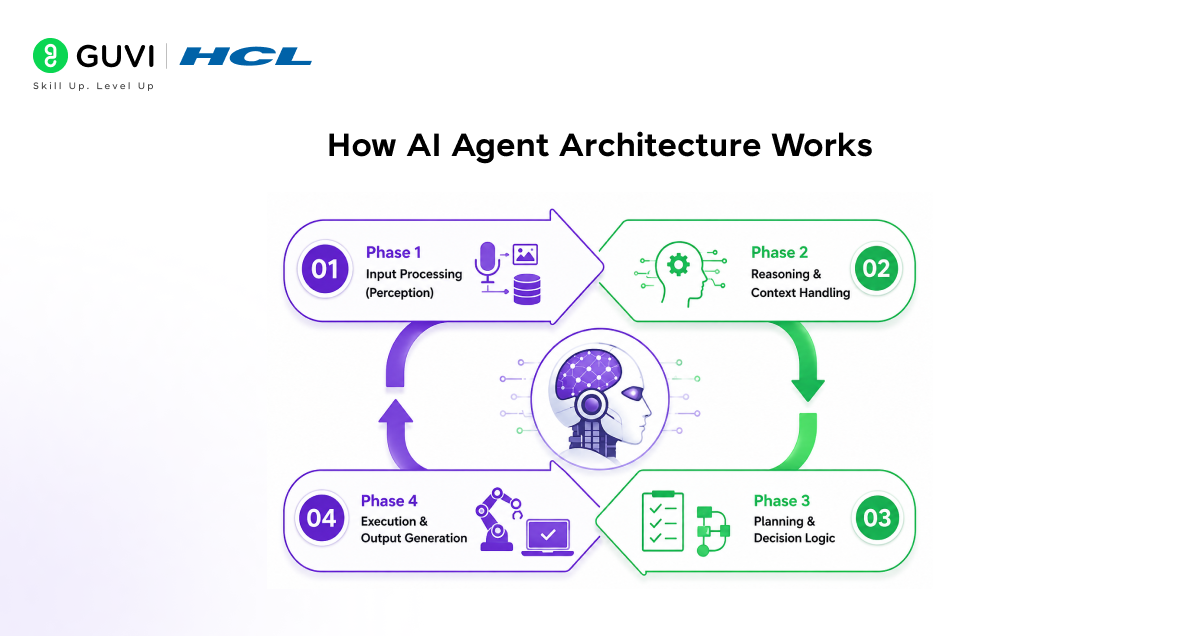
Here are the key phases that explain how AI Agent Architecture works:
Phase 1: Input Processing (Perception)
The initial step is the introduction of environmental data into the system, for example, by an end-user via a question, by a sensor, or through an external application programming interface (API).
This data is unrefined, so the first step a system takes is to prepare it and translate it into a well-organised format. This operational stage defines the data by improving its quality and understanding its semantics.
Phase 2: Reasoning and Context Handling
When processing the input, reasoning is used to understand its meaning. The system does not simply analyse the current input; it also uses context, previous data, and input processing to infer meaning, improve decision-making, and increase the likelihood of an appropriate response.
Phase 3: Planning and Decision Logic
The system then analyses what to do next, once it has received the input and the context. It does this by formulating a plan that entails choosing the best course of action and using rules rather than acting randomly.

This step allows the system to be more precise in its output and more directed toward the end goal.
Phase 4: Execution and Output Generation
In this final stage, the system executes the programmed action using the designated tool, model, or function and generates an output. This output can take the form of an answer, a suggestion, or confirmation that a task has been completed.
Once the output is produced and delivered, the system is ready to receive additional input.
Build real AI skills with HCL GUVI’s Intel & IITM Pravartak Certified AI/ML Course. In 4–6 months, you’ll learn through live sessions with industry mentors and Intel experts. Work on 20+ projects and complete 1 capstone while learning Python, Machine Learning, and Generative AI. With 1:1 doubt support, flexible batches, and access to 1000+ hiring partners, the course is designed to get you job-ready.
Conclusion
Once you get an idea of how everything fits together, the architecture of an AI Agent is not really that daunting. It is nothing more than a way of seeing how a system presents input, processes it, plans and produces output. With each stage laid out step by step, the entire thing makes perfect sense. Basically, it is a way of conceptualising how an AI system works and interacts with the outside world.
FAQs
Is AI Agent Architecture difficult for beginners to learn?
It becomes easy when you understand each part step by step instead of all at once.
Do you need coding knowledge to understand AI Agent Architecture?
Basic concepts can be understood without coding, but practical use often involves programming.
Can AI Agent Architecture be used in small projects?
It fits both small and large projects, depending on how complex the system needs to be.
How is AI Agent Architecture different from traditional software design?
It focuses more on decision-making, learning, and reacting to the environment.
Why are there different types of AI Agent Architecture?
Different architectures are designed to solve different kinds of problems and tasks.
Where can you see AI Agent Architecture in real life?
It is commonly used in systems such as chatbots, smart assistants, and automated decision-making tools.
Success Stories






Did you enjoy this article?