


Electric Vehicle Articles
What is Vehicle-to-Grid Technology : How EVs Can Power the Grid
What is a Battery Management System? BMS Working, Uses & EV Role
EV Infrastructure in India: Best Components, Charging Network, Challenges & Future (2026 Guide)


Get In Touch For Details! Request More Information
BaaS in EV: Meaning, Benefits, Challenges & How It Works
Sep 24, 2026 4 Min Read 2503 Views
(Last Updated)
Electric vehicles are becoming more popular, but their high upfront cost remains a concern for many buyers. A major part of that cost comes from the battery.
Battery as a Service (BaaS) offers a different approach. Instead of purchasing the battery along with the EV, users can lease or subscribe to it separately. Some BaaS models also support battery swapping, allowing drivers to exchange a depleted battery for a charged one within minutes.
So, how does BaaS in EV work, and can it make electric vehicles more affordable and convenient? Let’s find out.
Table of contents
- TL;DR Summary
- What Is BaaS in EVs?
- Why the BaaS Model Was Introduced
- Problem 1: High Upfront Cost
- Problem 2: Range Anxiety
- Problem 3: Battery Degradation
- Problem 4: Long Charging Time
- How Does BaaS Work?
- Key Benefits of BaaS in EVs
- Challenges and Limitations of BaaS
- BaaS vs Traditional EV Ownership — Which Is Better?
- Final thoughts:
- FAQs
- What is Battery as a Service (BaaS) in EVs?
- How does BaaS work in electric vehicles?
- Why is BaaS important for EV adoption?
- What are the advantages of using BaaS in EVs?
- What are the challenges of the BaaS model?
TL;DR Summary
- BaaS in EV stands for ‘Battery as a Service’, where the battery is offered separately from the electric vehicle.
- Users typically lease or subscribe to the battery instead of paying its full cost upfront.
- In battery-swapping models, depleted batteries can be exchanged for charged ones within minutes.
- BaaS can lower the upfront cost of EVs and reduce concerns around charging time and battery degradation.
- Its wider adoption still depends on factors such as swapping infrastructure, battery standardization, and service availability.
What Is BaaS in EVs?
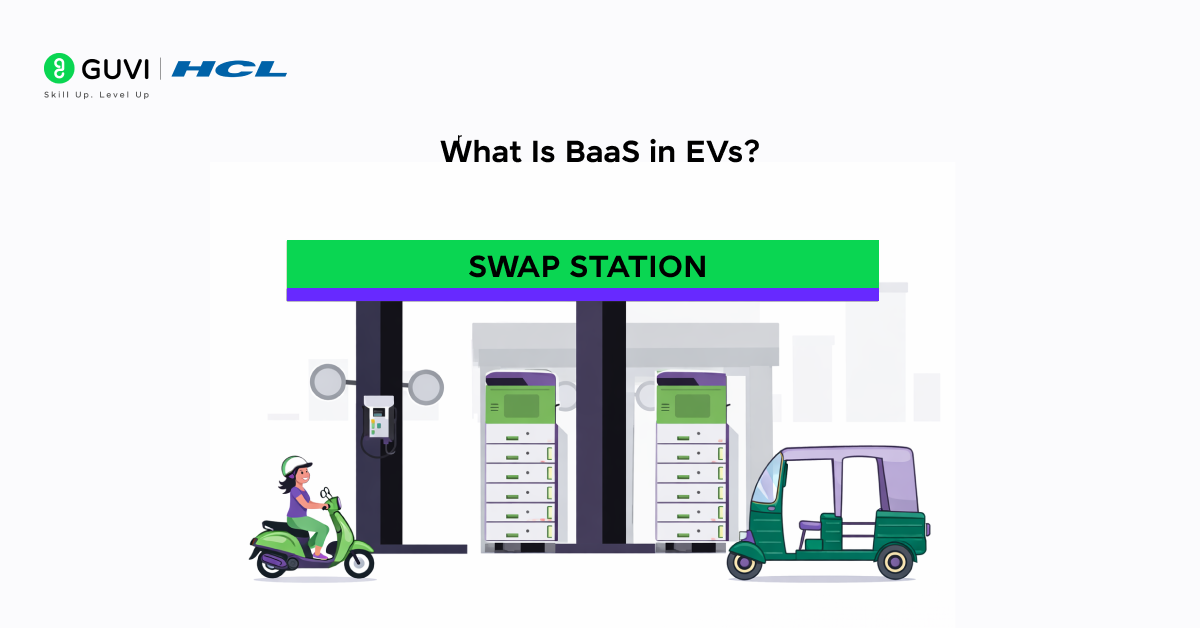
Battery as a Service (BaaS) is a model where the battery is offered separately from the electric vehicle. Instead of paying for the battery as part of the vehicle’s purchase price, users lease or subscribe to it through the manufacturer or a BaaS provider.
Some BaaS models also support battery swapping, where a depleted battery can be exchanged for a charged one at a swapping station instead of waiting for it to recharge.
In simple terms, BaaS in EVs can reduce the initial cost of buying an electric vehicle while shifting battery ownership and management to the service provider.
Why the BaaS Model Was Introduced
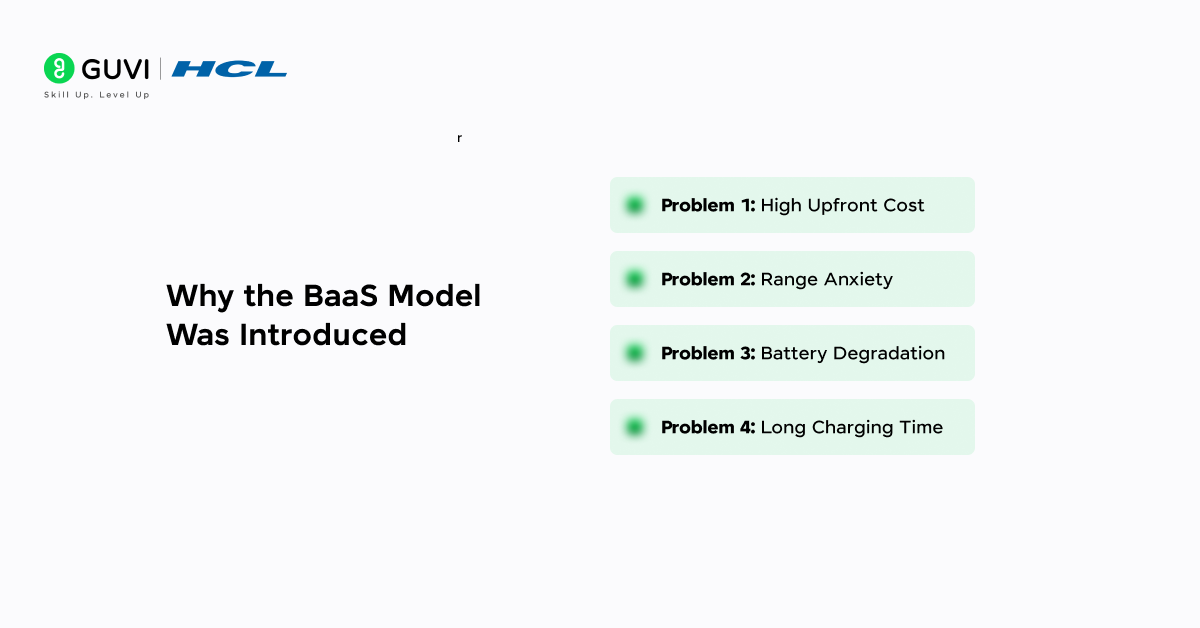
To understand why BaaS is needed, you should know the main problems with traditional EV ownership.
Problem 1: High Upfront Cost
EVs are extremely costly, and a large portion of the cost is the battery itself. This makes millions of potential customers stay away from EVs.
Problem 2: Range Anxiety
There is a fear of running out of battery with no nearby charging station in sight. This fear alone makes many people stay away from EVs.
Problem 3: Battery Degradation
EV batteries don’t last forever. Over time, they lose their ability to hold charge. After a few years, the range may reduce a lot, and replacing the battery is very expensive.
Problem 4: Long Charging Time
It takes 20-45 minutes even with fast chargers for you to get a meaningful charge for your battery.
BaaS can help address these concerns by lowering upfront costs and shifting battery management to the provider. When combined with battery swapping, it can also reduce charging time and range concerns.
How Does BaaS Work?
This is how BaaS works in a series of steps:
Step 1 — Buy the Vehicle Without the Battery
You buy an EV, which is relatively cheaper since the battery is not included in the price of the vehicle.
Step 2 — Subscribe to a Battery Plan
You subscribe to a battery plan, which is usually offered by the manufacturer or a battery-as-a-service provider.
Step 3 — Drive Normally
You use your EV like a regular vehicle. The battery just powers the vehicle while you drive.
Step 4 — Charge or Swap the Battery
Depending on the BaaS model, you may charge the battery normally or use a swapping station. In a battery-swapping setup, a depleted battery can be replaced with a charged one within minutes.
Step 5 — Battery Is Maintained by the Provider
You don’t have to worry about battery degradation, maintenance, or replacement costs. This is all taken care of by the provider.
Battery swapping is over a century old! The idea of exchanging a depleted EV battery for a charged one was proposed as early as 1896, and by 1912, some battery swaps reportedly took just three minutes.
Key Benefits of BaaS in EVs
- Lower Purchase Price
Since the battery cost is not included at the time of purchase, the overall cost of purchase of an EV comes down. This makes EVs accessible to a much larger customer base.
- No Battery Degradation Worries
Since the battery is owned and managed by the BaaS provider, users have less responsibility for battery degradation, maintenance, and replacement.
- Faster Than Charging
In BaaS models that support battery swapping, a depleted battery can be replaced with a charged one within minutes, reducing the waiting time associated with charging.
- Provider-Managed Battery Replacement
Since the service provider manages the battery, replacement and battery-health management are handled according to the terms of the subscription plan. This reduces the burden of managing an ageing battery for the user.
- Better for the Environment
Since the battery is managed centrally, it ensures maximum utilization of the battery by charging it during off peak hours and utilizing clean energy. In addition, battery degradation is also minimized through proper maintenance.

Challenges and Limitations of BaaS
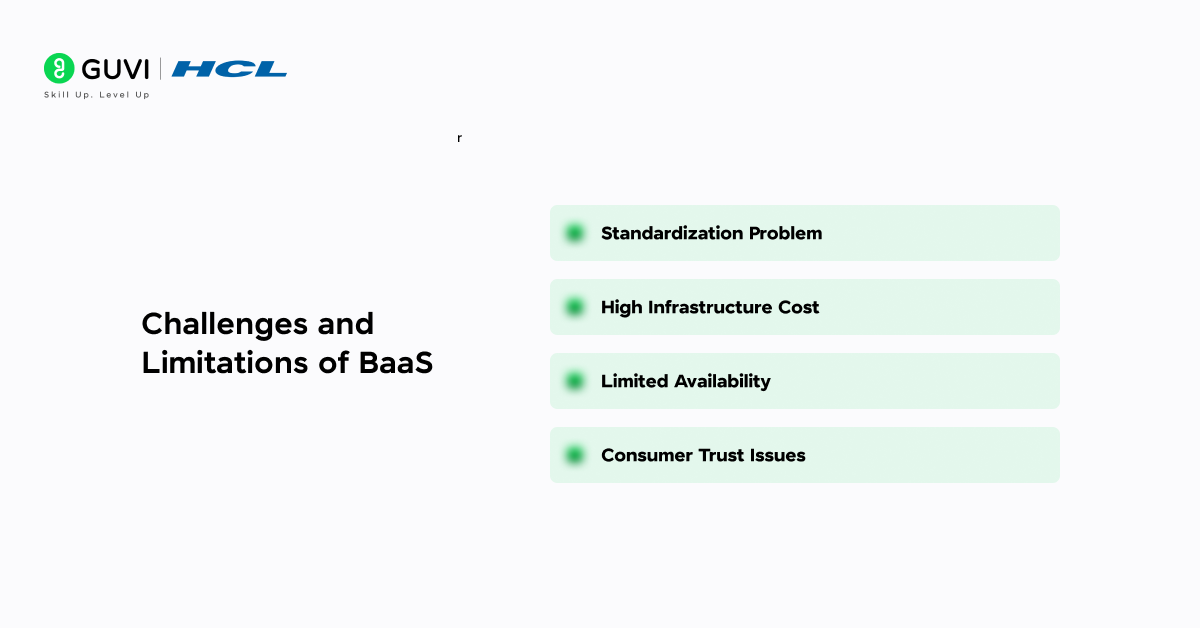
No model is perfect, and BaaS also has some challenges.
- Standardization Problem
Different EV brands use different battery sizes and designs, making it difficult to create a common system. Many manufacturers are also unwilling to change their battery designs. - High Infrastructure Cost
Setting up battery swap stations requires a lot of investment in land, equipment, and logistics. This makes large-scale expansion slow and expensive. - Limited Availability
BaaS and battery swapping are still not widely available globally. Adoption is currently strongest in China and parts of Asia, with smaller networks in some European markets. In many regions, the required infrastructure is still developing. - Consumer Trust Issues
Some users are not comfortable not owning the battery. They also have concerns about data privacy, subscription plans, and what will happen if the service stops.
BaaS vs Traditional EV Ownership — Which Is Better?
Here is a quick comparison between traditional EVs and the BaaS model:
| Feature | Traditional EV | BaaS Model |
| Upfront Cost | Higher | Lower |
| Battery Ownership | Yes | BaaS Provider |
| Charging/ Swap Time | 20–60 mins | Under 5 mins |
| Battery Degradation Risk | Primarily owner bears it | Primarily provider manages it |
| Battery Replacement | Owner’s responsibility | Managed according to BaaS plan |
| Availability | More widely available | Limited regions |
| Ongoing Cost | Charging costs | Subscription/rental + charging or swapping costs |
The best option depends on your circumstances. If you drive often, live in a BaaS supported area, and wish to have a lower upfront cost , BaaS is a great option worth considering. If you prefer to have full ownership and live in a non-swap station area, then traditional ownership may be more practical.
If you’re serious about building a career in the electric vehicle industry, HCL GUVI’s Advanced Programme in Electric Vehicle Technology Course by CEP, IIT Delhi is exactly where you need to be. This 6-month live online programme covers everything from battery systems and BMS to power electronics, EV chargers, and Indian EV policies, taught directly by IIT Delhi faculty and domain experts. You also get the opportunity for an in-person campus immersion at IIT Delhi and earn a prestigious e-certificate from CEP, IIT Delhi — a credential that genuinely strengthens your profile.
Final thoughts:
BaaS can help address some of the key concerns around EV ownership by lowering upfront costs and shifting battery management to the service provider. In models that support battery swapping, it can also significantly reduce the time spent waiting for a battery to charge.
While there are challenges like infrastructure and standardization, it is already making an impact in places like Shanghai, Taipei, and Delhi.
The future of EVs may not just be about better batteries, but about owning them in a smarter way.
FAQs
1. What is Battery as a Service (BaaS) in EVs?
Battery as a Service (BaaS) is a model where the battery is not included in the electric vehicle’s purchase price. Instead, users may also be able to swap the battery at designated stations, depending on the BaaS model.
2. How does BaaS work in electric vehicles?
With BaaS, users pay a subscription or usage fee for the battery while the service provider manages its ownership and maintenance. Depending on the BaaS model, users can charge the battery normally or swap a depleted battery for a charged one at a swapping station.
3. Why is BaaS important for EV adoption?
BaaS makes electric vehicles more affordable by reducing the upfront cost. It also solves key issues like long charging time, range anxiety, and battery degradation, making EV ownership more convenient and practical.
4. What are the advantages of using BaaS in EVs?
The main advantages of BaaS include a lower upfront EV cost, reduced responsibility for battery maintenance and degradation, and provider-managed battery replacement. In models that support battery swapping, it can also significantly reduce charging wait times.
5. What are the challenges of the BaaS model?
BaaS faces challenges such as high infrastructure costs for swapping stations, lack of standardization across different EV models, limited availability in many regions, and concerns related to battery ownership and subscription dependency.
Success Stories

About the Author
Lukesh S
A professional content writer who has experience in freelancing and now working as a Technical Content Writer at HCL GUVI having sound knowledge in Blog Writing and Creative Writing!
View all posts by Lukesh S
Connect with me @







Did you enjoy this article?