


Python Articles
Freelancing as a Python Developer: Getting Your First Client
Common Python Mistakes Beginners Make And How to Fix Them
Python Best Practices: Writing Clean, Maintainable Code Like a Pro
How to Build a Python Developer Portfolio That Gets You Hired


Get In Touch For Details! Request More Information
Python’s Key Syntax and Semantic Features for New Learners
Mar 11, 2026 5 Min Read 1098 Views
(Last Updated)
Have you ever written a Python program that looked perfectly fine but behaved in a way you didn’t expect? That moment of confusion is where most Python learners realize something important: understanding Python isn’t just about knowing how to write code, it’s about knowing how Python interprets that code.
Python’s popularity comes from its clean syntax and readable style, but its real power lies in the semantics that govern how variables, data, and logic actually work at runtime.
In this article, we’ll walk through Python’s most important syntax rules, then move into the semantic concepts that shape how Python code behaves at runtime. Along the way, you’ll see examples, explanations, and practical insights you won’t get from surface-level tutorials. So, let us get started!
Quick Answer:
Python’s key syntax features define how code is written, such as indentation, variables, and control flow, while its semantic features determine how that code behaves at runtime, including dynamic typing, mutability, and name binding. Together, they make Python readable, flexible, and beginner-friendly.
Table of contents
- Understanding Syntax and Semantics in Python
- Python’s Indentation-Based Syntax: Why Whitespace Is Non-Negotiable
- Variables and Name Binding: How Python Really Handles Assignment
- Python’s Dynamic Typing: Flexibility with Responsibility
- Core Data Types and Their Semantic Differences
- Numbers and Immutability
- Strings as Sequences
- Lists, Tuples, Sets, and Dictionaries
- Control Flow: Making Decisions and Repeating Work
- Conditional Logic with if
- Looping the Pythonic Way
- Functions: Encapsulating Behavior Clearly
- Exception Handling: Errors as First-Class Concepts
- Duck Typing: Behavior Over Type
- Mutability, Side Effects, and Shared State
- Object-Oriented Semantics in Python
- Pythonic Code and the Zen of Python
- How to Learn Python Syntax and Semantics Effectively
- Conclusion
- FAQs
- What is the difference between syntax and semantics in Python?
- Why does Python use indentation instead of brackets?
- What does dynamic typing mean in Python?
- Why are lists mutable but strings immutable in Python?
- What is duck typing in Python with a simple explanation?
Understanding Syntax and Semantics in Python
Python is often described as a “beginner-friendly” language, but that description can be misleading. Python isn’t easy because it lacks power. It’s easy because its syntax and semantics are intentionally designed to reduce mental overhead.
Once you understand how Python thinks about structure, data, and execution, writing correct code becomes far more intuitive.
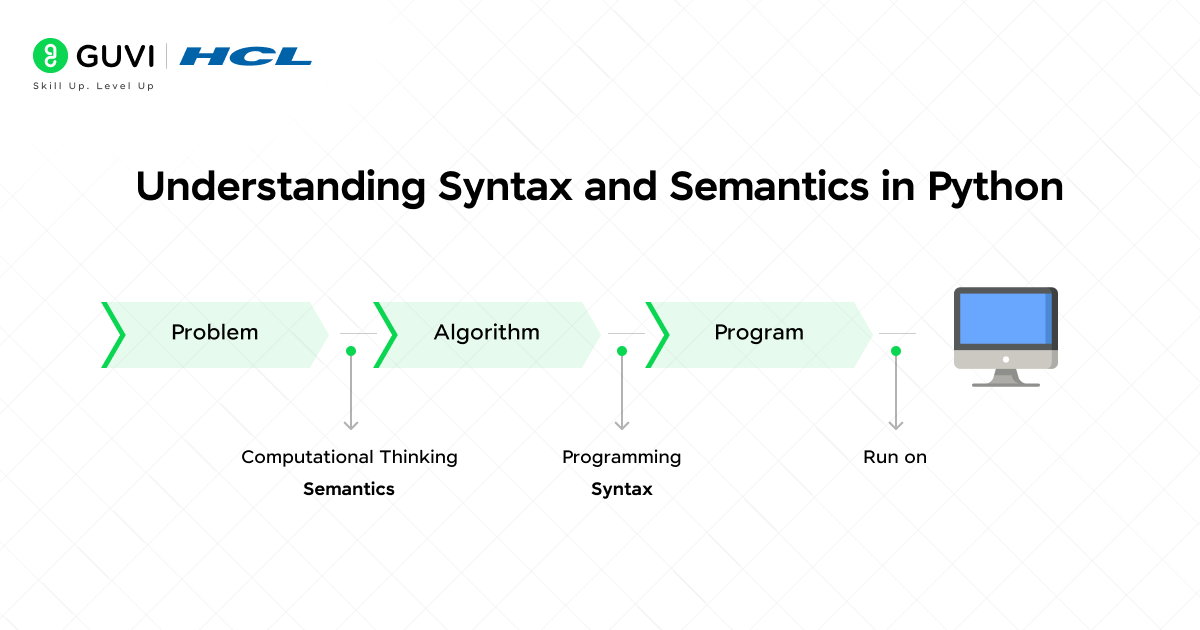
Syntax is about how Python code is written. Semantics is about what that code actually means when Python runs it.
You can write syntactically correct code that behaves incorrectly if you misunderstand semantics. Most beginner bugs come from this exact gap.
Think of it this way:
- Syntax answers: Is this valid Python?
- Semantics answers: What does Python do with this?
Both matter equally.
If you are just now starting your journey on Python, then this blog is for you – Python Beginner Roadmap: Basics to Web in 3 Months
Python’s Indentation-Based Syntax: Why Whitespace Is Non-Negotiable
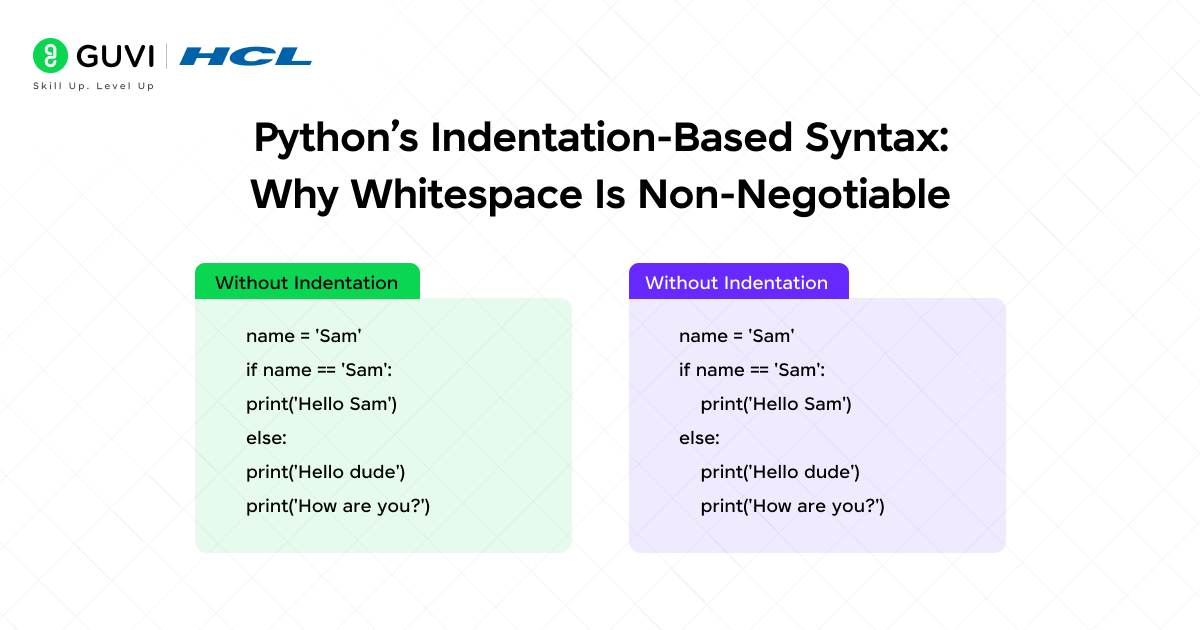
One of Python’s most distinctive syntax features is its use of indentation to define blocks of code. This is not a stylistic choice. It is a core syntactic rule.
In Python, indentation replaces braces or keywords used in other languages. A block exists because of its indentation level, not because of symbols.
if score >= 50:

    print("Pass")

    print("Well done")

else:

    print("Fail")
Here’s what’s happening semantically:
- Everything indented under if belongs to that condition.
- The else aligns with if, meaning it’s part of the same decision structure.
This design forces consistency and improves readability, especially for beginners. You don’t have to visually track opening and closing braces across long files. Python’s structure is visible immediately.
That said, indentation errors are unforgiving. Mixing tabs and spaces or misaligning a block will raise an error before your program even runs. Most developers solve this by configuring their editor to insert four spaces automatically.
Variables and Name Binding: How Python Really Handles Assignment
When you assign a value to a variable in Python, you are not placing data into a container. You are binding a name to an object.
This distinction is subtle but extremely important.
x = 10
What Python actually does:
- Creates an integer object with value 10
- Binds the name x to that object
Now consider this:
a = [1, 2, 3]
b = a
b.append(4)
After this runs, both a and b refer to the same list object. There is no copy unless you explicitly create one.
This explains many beginner bugs and also explains why Python behaves the way it does with mutable data structures. Once you internalize name binding, Python’s behavior becomes predictable instead of confusing.
Python’s Dynamic Typing: Flexibility with Responsibility
Python is dynamically typed, meaning variable types are determined at runtime rather than during compilation.
x = 5
x = "hello"
This is valid Python.
Semantically, Python does not care what type x had previously. It only cares about what x refers to right now. This makes Python flexible and fast to write, but it also shifts responsibility to you as the developer.
Dynamic typing means:
- Faster prototyping
- Less boilerplate
- Greater risk of runtime errors if assumptions are wrong
Modern Python addresses this with optional type hints:
def add(a: int, b: int) -> int:

    return a + b
Type hints don’t change runtime behavior, but they improve readability, tooling, and maintainability. Many professional Python codebases now use them extensively.
If you want to read more about how Python works and its use cases, consider reading HCL GUVI’s Free Python eBook: A Beginner’s Guide to Coding & Beyond, which covers the key concepts of Python, including OOPs, File Handling, and even database connectivity.
Core Data Types and Their Semantic Differences
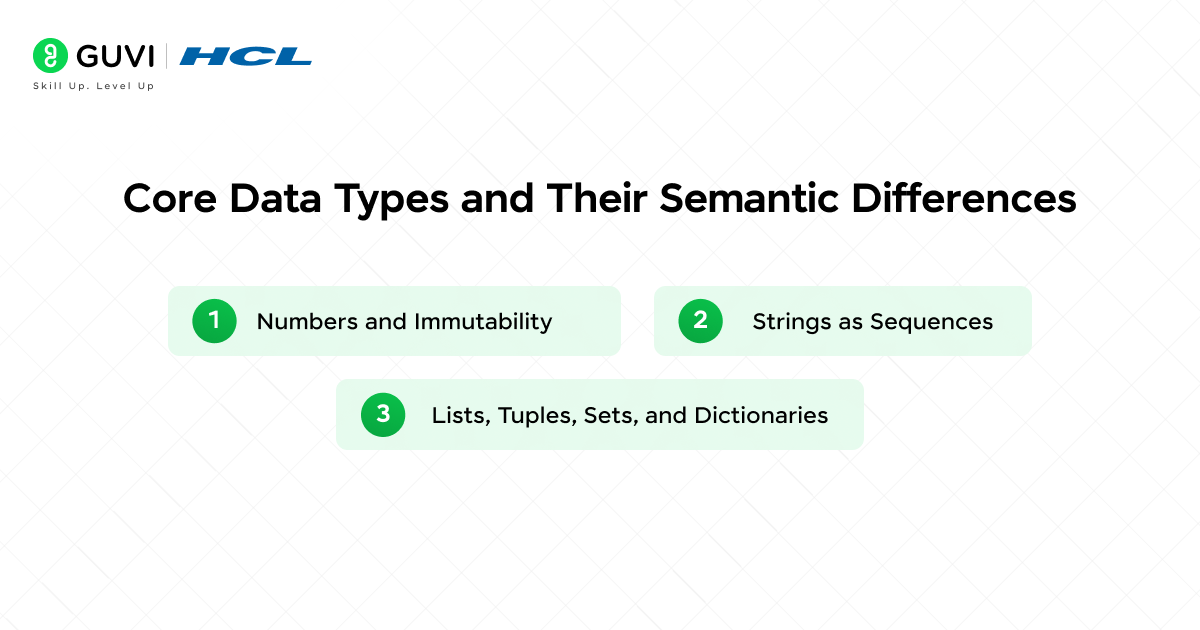
Python’s built-in data types are simple on the surface, but their behavior differs in important ways.
1. Numbers and Immutability
Integers, floats, and strings in Python are immutable. Once created, they cannot be changed.
x = 10
x += 1
This does not modify the original object. It creates a new integer and rebinds x to it.
Understanding immutability helps explain:
- Why strings don’t change in place
- Why integers are safe to share across references
2. Strings as Sequences
Strings are sequences of characters, which means they support indexing, slicing, and iteration.
word = "python"

print(word[0])

print(word[1:4])
However, because strings are immutable, operations that appear to “modify” them actually create new strings.
This design prevents accidental data corruption and improves performance in many scenarios.
3. Lists, Tuples, Sets, and Dictionaries
Python’s collection types each serve a different semantic purpose.
Lists are ordered and mutable. Tuples are ordered but immutable. Sets store unique values without order. Dictionaries map keys to values.
Choosing the right collection is not just about syntax. It’s about intent.
For example:
- Use tuples when data should not change.
- Use lists when order matters and changes are expected.
- Use dictionaries when fast lookup by key is required.
Python’s semantics reward clarity of intent.
Control Flow: Making Decisions and Repeating Work
1. Conditional Logic with if
Python’s conditional syntax is intentionally minimal.
if temperature > 30:

    print("Hot")

elif temperature > 20:

    print("Warm")

else:

    print("Cool")
Semantically, Python evaluates conditions top to bottom and executes the first matching block. There is no implicit fall-through. This reduces accidental logic errors common in other languages.

2. Looping the Pythonic Way
Python’s for loop iterates over items, not indices.
for item in items:

    process(item)
This semantic choice prioritizes readability and correctness. When you need indices, Python provides tools like enumerate() instead of forcing index-based loops.
While loops still exist, but in Python they are used when repetition depends on a condition rather than a sequence.
Functions: Encapsulating Behavior Clearly
Functions are central to writing maintainable Python code. They define behavior, limit scope, and reduce duplication.
def calculate_total(price, tax_rate=0.05):

    return price + (price * tax_rate)
Default arguments make APIs easier to use, but Python evaluates them once at definition time. This is why mutable default arguments can cause bugs.
Understanding this semantic detail prevents subtle errors that are hard to debug later.
If you want to learn how to write user-defined functions in Python, consider reading – Writing User-defined Functions in Python
Exception Handling: Errors as First-Class Concepts
Python treats errors as objects. Exceptions can be raised, caught, passed around, and rethrown.
try:

    result = int(user_input)

except ValueError:

    print("Invalid number")
This approach separates normal logic from error-handling logic, keeping code clean and expressive. Catching specific exceptions is a best practice because it avoids hiding real bugs.
Duck Typing: Behavior Over Type
Python follows duck typing: if an object behaves like what you need, Python accepts it.
def print_length(obj):

    print(len(obj))
Anything that defines __len__ works here, regardless of type. This makes Python code flexible and extensible, but it also requires good documentation and testing.
Mutability, Side Effects, and Shared State
One of the most important semantic concepts in Python is mutability. Mutable objects can change in place, which means functions can affect data outside their local scope.
This is powerful but dangerous if misunderstood.
The safest Python code:
- Avoids unnecessary mutation
- Clearly documents side effects
- Uses immutable data where possible
Professional Python developers think carefully about what should change and what should not.
Object-Oriented Semantics in Python
Python supports object-oriented programming, but it does not force it. Classes are tools, not requirements.
class User:

    def __init__(self, name):

        self.name = name

    def greet(self):

        return f"Hello, {self.name}"
Python favors composition over inheritance and encourages simple class hierarchies. Overengineering with deep inheritance trees often causes more problems than it solves.
Pythonic Code and the Zen of Python
Python has a philosophy, not just a syntax. You can view it by running:
import this
Some principles matter deeply for beginners:
- Readability counts
- Simple is better than complex
- Explicit is better than implicit
Writing Pythonic code means choosing clarity over cleverness. Code is read far more often than it is written.
How to Learn Python Syntax and Semantics Effectively
If you want to move beyond tutorials, focus on:
- Reading real code
- Writing small programs daily
- Debugging your own mistakes
- Explaining concepts in your own words
Syntax can be memorized. Semantics must be understood.
If you want to learn more about Python through a structured course material, consider enrolling in HCL GUVI’s Free Self-Paced IITM Pravartak Certified Python Course that lets you start from scratch and gradually move towards the level where you can write programs to gather, clean, analyze, and visualize data.
Conclusion
In conclusion, mastering Python is less about memorizing keywords and more about developing an intuition for how the language thinks. Once you understand why indentation defines structure, how name binding affects data, and what dynamic typing really means in practice, Python stops feeling unpredictable and starts feeling deliberate.
The syntax becomes a tool for clarity, and the semantics become your guide for making better design decisions. As you continue learning, focus on reading code, writing small programs, and questioning why Python behaves the way it does. That mindset is what separates someone who can write Python from someone who truly understands it.
FAQs
1. What is the difference between syntax and semantics in Python?
Syntax refers to the rules for writing valid Python code, such as indentation and keywords. Semantics explains what that code actually does when Python executes it. Most beginner mistakes happen due to misunderstanding semantics, not syntax.
2. Why does Python use indentation instead of brackets?
Python uses indentation to define code blocks to improve readability and reduce visual clutter. This design forces consistent structure and makes logic easier to follow. Incorrect indentation causes errors because it directly affects program flow.
3. What does dynamic typing mean in Python?
Dynamic typing means Python determines variable types at runtime, not beforehand. A variable can reference different data types during execution. This offers flexibility but requires careful coding to avoid runtime errors.
4. Why are lists mutable but strings immutable in Python?
Lists are designed to be changed in place for efficiency and flexibility. Strings are immutable to ensure safety, performance optimization, and predictable behavior. This design choice helps prevent unintended side effects in programs.
5. What is duck typing in Python with a simple explanation?
Duck typing focuses on what an object can do rather than what type it is. If an object supports the required methods, Python allows it. This makes Python code flexible and easier to extend.
Success Stories

About the Author
Lukesh S
A professional content writer who has experience in freelancing and now working as a Technical Content Writer at HCL GUVI having sound knowledge in Blog Writing and Creative Writing!
View all posts by Lukesh S
Connect with me @








Did you enjoy this article?