


Python Articles
Excel SQL Python for BPO Professionals Best Guide to Move Into Data Science
Go vs Python for Forward Deployed Engineering Workloads
Python for Forward Deployed Engineers: What You Actually Need to Know
Freelancing as a Python Developer: Getting Your First Client


Get In Touch For Details! Request More Information
Why is Python an Interpreted Language? Explained with Examples (2026)
Aug 31, 2026 7 Min Read 3661 Views
(Last Updated)
Why does Python let you run code instantly without asking you to compile anything first, yet still behave differently from traditional scripting languages? This apparent simplicity hides a carefully designed execution model that prioritizes flexibility, portability, and developer productivity. Python’s interpreted nature shapes how programs are written, executed, debugged, and scaled, making it a defining characteristic of the language rather than a limitation.
Explore the full guide below to understand why Python is an interpreted language and how its execution model works internally.
Quick Answer: Python is called an interpreted language because developers can execute .py files directly without manually compiling them into standalone machine-code executables first.
However, Python does perform compilation internally. In CPython, source code is parsed and compiled into bytecode, which is then executed by CPython’s bytecode interpreter. This is why Python is more accurately described as using a compile-then-interpret execution model rather than being purely interpreted.
Table of contents
- What Does “Interpreted Language” Mean?
- Why Is Python Called an Interpreted Language?
- How Python Code Is Executed Internally?
- Step 1: Source Code Parsing
- Step 2: Compilation to Bytecode
- Step 3: Execution by the Python Virtual Machine (PVM)
- Python vs Compiled Languages
- Python vs C / C++
- Python vs Java
- Interpreted vs Compiled Languages- Step by Step Difference
- How a Compiled Language Works
- How Python Works
- Interpreted vs Compiled Languages: Quick Comparison
- Is Python Really Interpreted? The Bytecode Truth
- Does Python Use JIT Compilation?
- Example: How Python Compiles Code to .pyc and Executes It
- Why Is Python Still Called an Interpreted Language?
- Advantages of Python Being Interpreted
- Is Python Purely Interpreted or Hybrid?
- Real-World Implications for Python Developers
- Common Misconceptions About Interpreted Languages
- Conclusion
- FAQs
- Is Python fully interpreted?
- Why doesn’t Python generate executables by default?
- Does Python compile code internally?
- How does bytecode improve performance?
What Does “Interpreted Language” Mean?
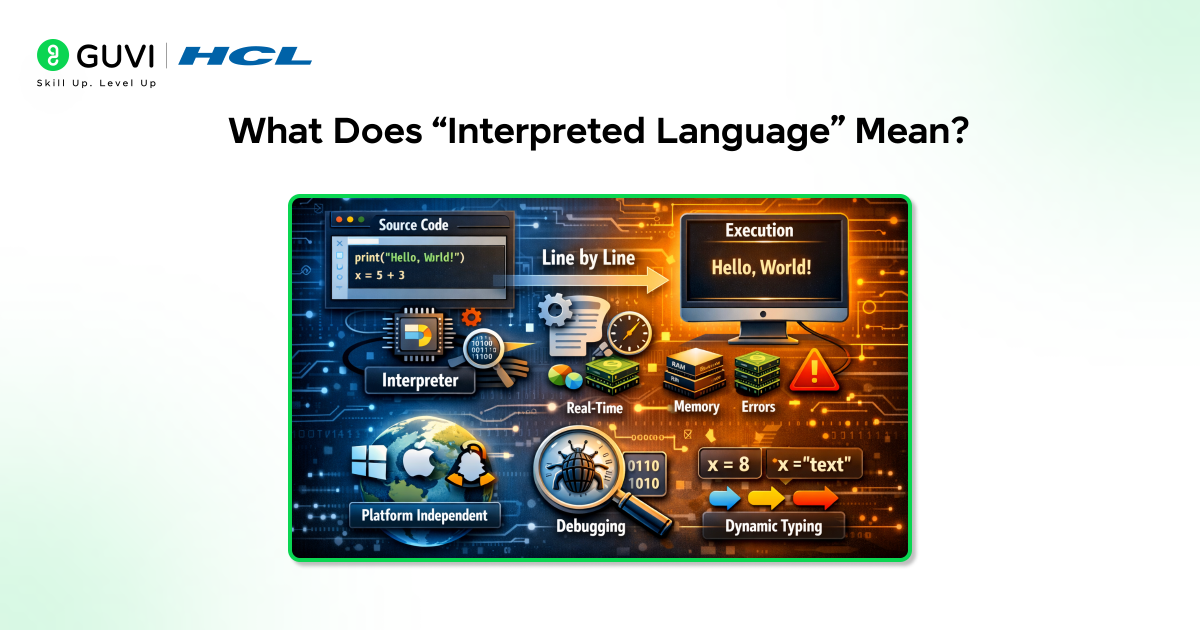
An interpreted language is one in which program instructions are executed by a runtime engine rather than being transformed into standalone machine code ahead of time. Source code is processed and run through an interpreter that reads, analyzes, and executes instructions dynamically. Unlike traditional compiled languages, execution happens under the control of a runtime system that manages memory, types, and execution flow during program runtime.
Why Is Python Called an Interpreted Language?
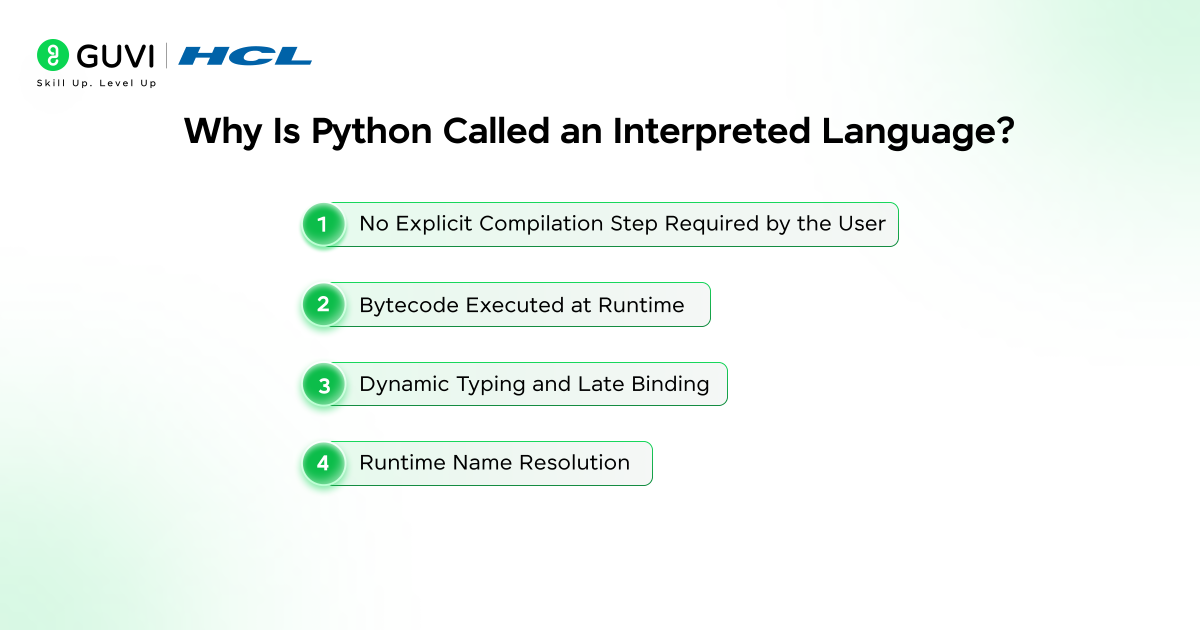
- No Explicit Compilation Step Required by the User
Python developers do not manually compile code before execution. When you run a .py file, Python automatically handles all preprocessing internally. This creates the experience of direct execution, which is why Python is commonly described as interpreted.
- Bytecode Executed at Runtime
Python source code is first converted into bytecode, an intermediate representation that is not tied to any specific hardware architecture. This bytecode is then executed at runtime by the Python Virtual Machine, rather than being translated into native machine instructions ahead of time.
- Dynamic Typing and Late Binding
Python determines variable types, method bindings, and object behavior at runtime. Because these decisions depend on actual values during execution, Python cannot fully resolve program behavior during a static compile phase, reinforcing its interpreted nature.
- Runtime Name Resolution
Identifiers such as variables, functions, and attributes are resolved dynamically using runtime symbol tables. Python looks up names during execution rather than fixing references at compile time, which aligns with an interpreted execution model.
Reading that Python executes code line-by-line is one thing; running a script with a deliberate error partway through and seeing exactly where it stops is what makes the concept concrete. HCL GUVI’s online IDE lets you test this instantly.
How Python Code Is Executed Internally?
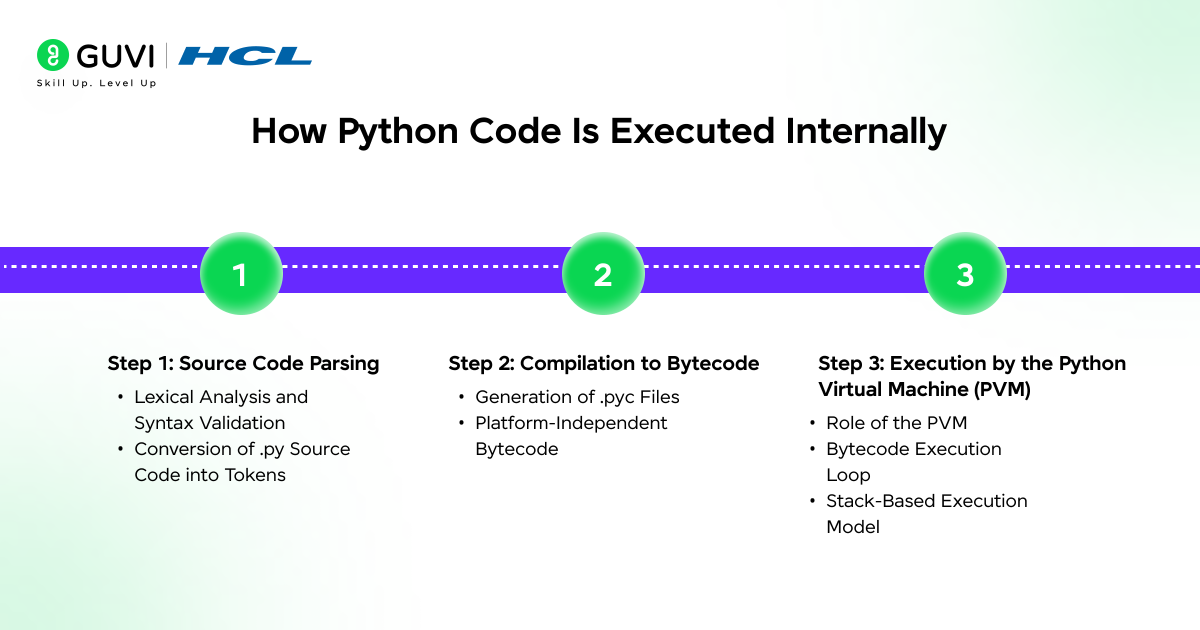
Step 1: Source Code Parsing
- Lexical Analysis and Syntax Validation
Python begins by reading the source code and performing lexical analysis. The interpreter breaks the code into tokens (keywords, identifiers, operators, literals) and validates the syntax according to Python’s grammar rules. Any syntax errors are detected at this stage before execution begins.
- Conversion of .py Source Code into Tokens
The tokenizer converts raw text into a structured token stream. This token stream feeds the parser, which constructs an internal representation of the program structure. This ensures that only syntactically valid programs proceed to execution.
Step 2: Compilation to Bytecode
- Generation of .pyc Files
Once parsing succeeds, Python compiles the code into bytecode. This bytecode may be cached in .pyc files inside the __pycache__ directory. These cached files allow Python to skip recompilation on subsequent runs if the source code has not changed.
- Platform-Independent Bytecode
Python bytecode is designed to be portable across operating systems and hardware architectures. This is a key reason Python programs can run unchanged on different platforms, provided a compatible Python interpreter is available.
Step 3: Execution by the Python Virtual Machine (PVM)
- Role of the PVM
The Python Virtual Machine is the runtime engine responsible for executing bytecode instructions. It abstracts away hardware details and provides services such as memory management, garbage collection, and exception handling.
- Bytecode Execution Loop
The PVM runs a continuous execution loop that fetches bytecode instructions, decodes them, and executes the corresponding operations. This loop controls program flow, method calls, and error handling during runtime.
- Stack-Based Execution Model
Python uses a stack-based execution model. Operands are pushed onto a stack, operations are performed using stack values, and results are pushed back onto the stack. This design simplifies the interpreter and enables consistent execution across platforms.
Python vs Compiled Languages
Python vs C / C++
- Ahead-of-Time Compilation vs Runtime Execution
C and C++ use ahead-of-time (AOT) compilation, where source code is translated directly into native machine code before execution. The resulting binary is optimized for a specific CPU architecture and operating system. Python, in contrast, performs compilation to platform-independent bytecode and executes it at runtime using the Python Virtual Machine (PVM). This runtime execution model prioritizes flexibility and portability over hardware-specific optimization.
- Performance Differences
Because C and C++ execute native machine code, they generally achieve much higher raw performance and lower execution latency. Python’s bytecode execution introduces interpretation overhead, making it slower for CPU-intensive tasks. However, Python mitigates this gap through optimized C-based standard libraries, native extensions, and integration with compiled modules where performance is critical.
- Platform Dependency
C and C++ binaries are platform-dependent. A program compiled for one operating system or architecture must be recompiled for another. Python programs, by contrast, are source- and bytecode-portable. The same .py file can run across platforms as long as a compatible Python interpreter is available, significantly simplifying cross-platform development and deployment.
Python vs Java
- Bytecode Comparison
Both Python and Java compile source code into bytecode, but the role and lifecycle of that bytecode differ. Java bytecode is designed for long-lived execution and heavy optimization, while Python bytecode is lightweight and closely tied to the interpreter’s execution model. Python bytecode is regenerated frequently and optimized for flexibility rather than aggressive performance tuning.
- JVM vs PVM
The Java Virtual Machine (JVM) is a highly optimized runtime that includes advanced features such as Just-In-Time (JIT) compilation, adaptive optimization, and sophisticated garbage collection. The Python Virtual Machine (PVM) focuses on simplicity and dynamic behavior, executing bytecode in a stack-based loop without native JIT compilation in standard implementations.
- Interpretation vs JIT Compilation
Java relies heavily on JIT compilation, converting frequently executed bytecode paths into native machine code at runtime to improve performance. Standard Python interpreters execute bytecode directly without JIT, which preserves dynamic features but limits execution speed. Some Python implementations introduce JIT-like optimizations, but they are not part of the core execution model.
Want to go beyond reading and actually apply Python slicing in real code? Explore HCL GUVI’s Python Hub to learn core Python concepts with practical examples, hands-on explanations, and structured practice, all in one place.
Interpreted vs Compiled Languages- Step by Step Difference
The main difference between interpreted and traditionally compiled languages is when and how source code reaches the processor.
How a Compiled Language Works
A traditional compiled language such as C generally follows this process:
Step 1: The developer writes source code.
Step 2: A compiler analyses the complete program.
Step 3: The compiler translates the source into native machine code.
Step 4: A platform-specific executable is created.
Step 5: The operating system loads that executable and the CPU runs the machine instructions.
The simplified flow is:
Source Code → Compiler → Native Machine Code → Executable → CPU
Because much of the translation work happens before execution, compiled programs can achieve very high performance.
How Python Works
CPython follows a different path:
Step 1: You write Python code in a .py file.
Step 2: Python parses the source code and checks its syntax.
Step 3: CPython compiles the code into an intermediate form called bytecode.
Step 4: The bytecode may be cached in a .pyc file when modules are imported.
Step 5: CPython’s bytecode interpreter executes the instructions at runtime.
The simplified flow becomes:
Python Source Code → Parsing → Bytecode Compilation → Bytecode Interpreter → Execution
This internal compilation happens automatically. Developers therefore do not normally run a separate compilation command before executing a Python program.
Python’s own documentation describes Python as an interpreted language while noting that the distinction between interpreted and compiled languages becomes blurry because Python includes a bytecode compiler.
Interpreted vs Compiled Languages: Quick Comparison
| Language | Interpreted/Compiled | Speed | Flexibility | Example |
|---|---|---|---|---|
| Python | Interpreted with automatic bytecode compilation | Moderate | Very high | Data analysis script |
| C | Compiled to native machine code | Very high | Lower runtime flexibility | Operating system component |
| C++ | Compiled to native machine code | Very high | Medium | Game engine |
| Java | Compiled to bytecode, then executed/JIT-compiled by JVM | High after runtime optimisation | High | Enterprise application |
| JavaScript | Interpreted and JIT-compiled by modern engines | High for many web workloads | Very high | Interactive web application |
Speed in this table is a general comparison only. Real performance depends on the program, runtime, compiler, libraries and workload.
Is Python Really Interpreted? The Bytecode Truth
Yes, Python is correctly described as an interpreted language, but saying that Python “does not compile” is incorrect.
In the most widely used implementation, CPython, source code goes through both compilation and interpretation.
Consider:
print("Hello, Python!")CPython does not normally send that source text directly to the CPU one line at a time.

Instead, the process is closer to:
.py source file
      ↓
Parser
      ↓
Python code object / bytecode
      ↓
CPython bytecode interpreter
      ↓
Program executes
The bytecode contains instructions understood by the Python runtime rather than native instructions designed directly for a particular processor.
This distinction explains why Python can be both:
- Compiled internally, because source code is converted into bytecode.
- Interpreted at runtime, because the bytecode is executed by the Python runtime rather than being distributed as a conventional native executable.
It is therefore more accurate to say:
Python is interpreted from the developer’s perspective but uses an internal compilation-to-bytecode stage before execution.
Another important detail is that Python bytecode is tied to the Python implementation and bytecode version. A .pyc generated by one CPython version should not be assumed to work with every other Python version.
Does Python Use JIT Compilation?
Standard CPython still uses its bytecode interpreter as its normal execution model in Python 3.14.
However, modern CPython also includes an experimental Just-in-Time compiler that can be enabled in specially configured builds. It is not the default execution mode, so Python should not be described as relying on JIT compilation in the same way that modern JVM implementations typically do.
Example: How Python Compiles Code to .pyc and Executes It
You can see Python’s hidden compilation stage yourself.
Create a file called example.py:
def greet(name):
    print(f"Hello, {name}!")

greet("Python")
Normally, running:
python example.pyexecutes the program without requiring you to create a compiled file manually.
Importantly, running a top-level script this way does not normally create a .pyc file for that script.
To explicitly compile it into bytecode, use Python’s built-in py_compile module:
python -m py_compile example.pyPython creates a bytecode cache file inside __pycache__.
With CPython 3.14, it may look like:
__pycache__/
└── example.cpython-314.pyc
The exact filename depends on the Python implementation and version.
You can ask Python for the expected cache path:
python -c "import importlib.util; print(importlib.util.cache_from_source('example.py'))"Then import the module:
python -c "import example"Output:
Hello, Python!When an imported module has a valid cached .pyc, Python’s import system can use the compiled bytecode instead of recompiling unchanged source code.
This reveals the actual process:
example.py
   ↓
py_compile
   ↓
example.cpython-314.pyc
   ↓
Python runtime
   ↓
Hello, Python!
The purpose of .pyc caching is primarily to speed up module loading, not to make Python execute like a traditional native compiled language.
Why Is Python Still Called an Interpreted Language?
Python remains classified as interpreted because developers normally:
- Run source files directly
- Do not manually create native executables
- Depend on the Python runtime during execution
- Resolve many names and object behaviours dynamically
- Can execute code interactively through the REPL
- Receive many errors while the program is running
The existence of bytecode does not make Python equivalent to C or C++.
A better distinction is:
C/C++: Source → native machine code before execution
CPython: Source → bytecode automatically → bytecode executed by the Python runtime
That automatic runtime-controlled execution is the main reason Python continues to be described as an interpreted language.
Advantages of Python Being Interpreted
- Faster Development and Iteration
Python’s interpreted nature eliminates manual build and compile steps. Developers can write code and run it immediately, enabling rapid prototyping, quick experimentation, and shorter feedback loops during development.
- High Portability Across Platforms
Because Python code is executed by an interpreter, the same source code runs consistently across operating systems and hardware architectures. This portability reduces platform-specific maintenance and simplifies distribution.
- Easier Debugging and Testing
Runtime execution allows errors to surface with detailed stack traces and contextual information. Python’s dynamic execution model supports interactive debugging, unit testing, and incremental code validation without recompilation.
- Interactive Execution (REPL Support)
Python’s interpreter enables an interactive Read–Eval–Print Loop (REPL). Developers can execute statements, inspect objects, and test logic in real time, which is invaluable for learning, debugging, and exploratory programming.
Is Python Purely Interpreted or Hybrid?
Python is not purely interpreted; it follows a hybrid execution model that combines compilation and interpretation. When a Python program runs, the source code is first compiled into intermediate bytecode, which is then executed by the Python Virtual Machine (PVM). This design places Python between traditional interpreted languages and fully compiled languages, enabling both flexibility and reasonable performance.
In practice, Python is often described as “interpreted but compiled” because compilation happens implicitly and automatically, without a user-visible build step. The generated bytecode is cached in .pyc files, allowing subsequent executions to skip recompilation when the source code has not changed. This hybrid approach reduces startup overhead, improves execution efficiency, and preserves Python’s dynamic runtime behavior.
Real-World Implications for Python Developers
- When Interpretation Helps Productivity
Interpretation enables rapid iteration, interactive development, and immediate feedback through REPLs and notebooks. Developers can test logic incrementally, debug live objects, and modify behavior without recompilation, which significantly accelerates development cycles.
- When Performance Optimization Is Needed
For compute-heavy workloads, interpretation overhead becomes visible. Tight loops, numerical computation, and high-throughput systems may require optimization strategies such as algorithmic improvements, vectorization, or moving hot paths out of pure Python.
- Use of C Extensions, PyPy, and JIT Compilers
Python’s hybrid model allows performance-critical sections to be offloaded to C extensions, Cython, or NumPy, while higher-level logic remains in Python. Alternative runtimes like PyPy introduce JIT compilation, and tools like Numba compile Python functions to machine code at runtime.
Ready to move from understanding Python slicing to building real-world Python programs? Enroll in HCL GUVI’s Python Course and learn with 100% online, self-paced lessons, full lifetime access, industry-recognised certification at an affordable fee, dedicated forum support for doubt-clearing, and access to 4 gamified practice platforms designed to make learning stick.
Common Misconceptions About Interpreted Languages
- “Interpreted means slow”
Interpretation adds overhead, but modern runtimes use bytecode caching, optimized interpreters, and JIT compilation to narrow the performance gap, making Python practice practical and efficient even for large-scale, real-world applications.
- “Python does not compile at all”
Python always compiles source code to bytecode before execution; this step is just implicit and automatic.
- “Compiled languages have no runtime overhead”
Compiled programs still incur runtime costs from memory management, dynamic dispatch, garbage collection, and system calls.
- “Python cannot be optimized”
Python supports multiple optimization paths, including JIT runtimes, native extensions, and hybrid architectures.
- “Interpreted languages cannot scale”
Python scales effectively when used with the right architecture, leveraging optimized libraries, parallelism, and compiled components.
Want a deeper, visual-first understanding of how Python executes code internally? Download HCL GUVI’s Python eBook to master core Python concepts with clear explanations and practical insights.
Conclusion
Python’s interpreted nature is not a weakness but a carefully chosen design that balances flexibility, portability, and developer speed. By combining implicit compilation to bytecode with runtime execution, Python delivers fast iteration, dynamic behavior, and cross-platform consistency. While this model introduces performance trade-offs, it enables powerful features like introspection and rapid prototyping. Understanding this execution model helps developers write better Python, optimize wisely, and choose the right tools as applications scale.
FAQs
Is Python fully interpreted?
No. Python is not purely interpreted. Source code is first compiled into bytecode, which is then executed by the Python Virtual Machine (PVM) at runtime.
Why doesn’t Python generate executables by default?
Python prioritizes portability and dynamic behavior. Generating native executables would reduce flexibility and break Python’s cross-platform execution model.
Does Python compile code internally?
Yes. Python automatically compiles source code into bytecode (.pyc) before execution, without requiring an explicit compile step.
How does bytecode improve performance?
Bytecode avoids re-parsing source code on every run, enabling faster execution by allowing the interpreter to execute optimized, preprocessed instructions.
Success Stories

About the Author
Vaishali
I'm a seasoned writer with four years of experience across technical, non-technical, and just about every genre or niche you can imagine. Adaptable and curious, I enjoy exploring new topics and making information engaging and easy to understand. Fueled by a steady stream of tea, I approach each project with creativity, reliability, and genuine enthusiasm for storytelling.
View all posts by Vaishali
Connect with me @






Did you enjoy this article?