


Java Articles
How to Run Java in Visual Studio Code?
Why Large Enterprises Still Rely on Java: Legacy Systems, Stability & Scale
Java + Spring Boot in 2026: What You Need to Know to Get Hired

Get In Touch For Details! Request More Information
What’s New in Spring Boot 4 (3.2+): A Beginner-Friendly Guide
Sep 29, 2025 2 Min Read 2314 Views
(Last Updated)
If you’re just starting your Java developer journey and diving into the world of Spring Boot, you’ve probably heard that Spring Boot 4 is the “next big thing.” Well, technically, it’s Spring Boot 3.2+, but many people casually call it Spring Boot 4 due to major upgrades and future direction.
In this blog, we’ll break down the standout features of Spring Boot 3.2+ (a.k.a. 4.0) in simple terms, so freshers and early-career developers can quickly grasp what’s new and why it matters
Table of contents
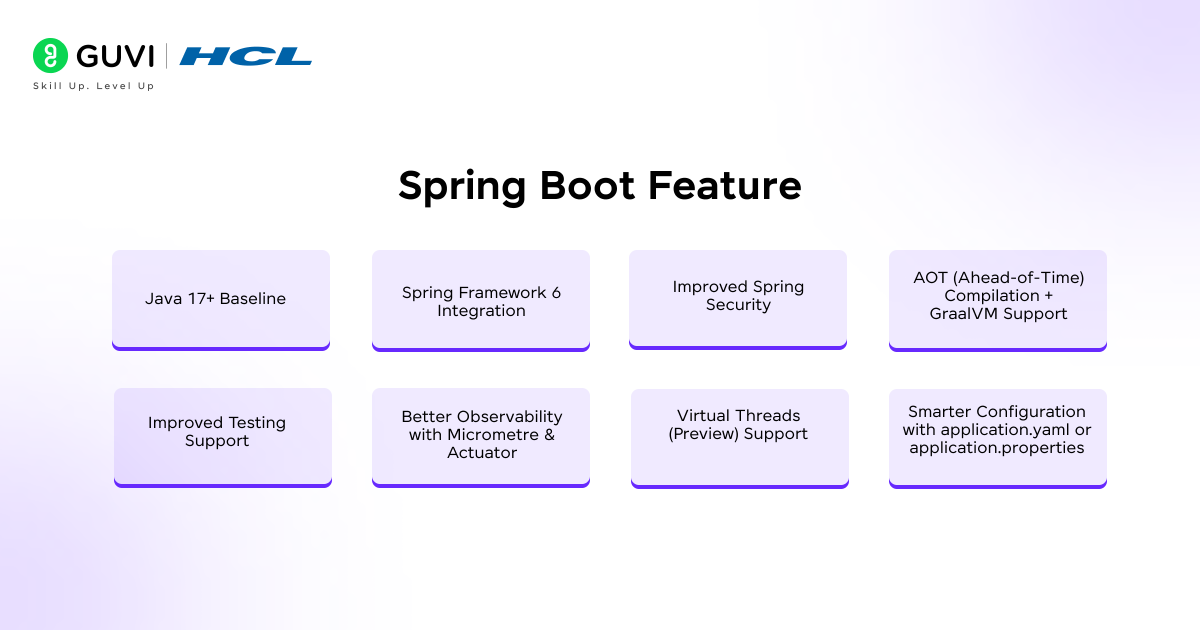
- Spring Boot 4 Features You Should Know
- Java 17+ Baseline
- Why does it matter to you?
- Spring Framework 6 Integration
- Why does it matter to you?
- Improved Spring Security
- Why does it matter to you?
- AOT (Ahead-of-Time) Compilation + GraalVM Support
- Why does it matter to you?
- Improved Testing Support
- Why does it matter to you?
- Better Observability with Micrometre & Actuator
- Why does it matter to you?
- Virtual Threads (Preview) Support
- Smarter Configuration with application.yaml or application.properties
- Summary: Why Should Freshers Care?
- Most Used Java Versions with Spring Boot
- Final Thoughts
Spring Boot 4 Features You Should Know
1. Java 17+ Baseline
Spring Boot 3 requires Java 17 or later. This means:
- You get to use modern Java features like:
- record classes
- Pattern matching in instanceof
- Sealed classes
- Switch expressions
- Cleaner and more expressive code
Why does it matter to you?
You’ll write less code and your apps will be faster.
2. Spring Framework 6 Integration
Spring Boot 3.2+ is built on top of Spring Framework 6, which introduces:
- Jakarta EE 10 namespace migration
(javax.* → jakarta.*)
- Better support for ahead-of-time (AOT) compilation
- Full support for virtual threads (preview feature in Java 21)
Why does it matter to you?
Spring apps are now more modern and lightweight, perfect for cloud-native development.
3. Improved Spring Security
Spring Security is now smarter:
- More flexible authorization
- Built-in support for OAuth 2.1
- Better configuration using DSLs
Why does it matter to you?
Creating secure login, JWT authentication, or role-based access is easier and cleaner now.
4. AOT (Ahead-of-Time) Compilation + GraalVM Support
Spring Boot 3.2+ apps can be compiled ahead of time to native binaries using GraalVM.
Benefits:
- Start instantly (no JVM warm-up)
- Use less memory
- Great for microservices or cloud functions
Why does it matter to you?
Your app will be blazing fast, even on limited hardware or cloud platforms.
5. Improved Testing Support
Spring Boot 4 now supports:
- Test containers out of the box
- Better support for JUnit 5
- Smarter auto-configuration for mock beans and test slices
Why does it matter to you?
Writing tests is easier, and integrating with Docker databases is plug-and-play.
6. Better Observability with Micrometre & Actuator
Spring Boot 4 integrates:
- Micrometer 1.12+
- Better observability with OpenTelemetry support
- Custom health indicators and metrics
Why does it matter to you?
You can monitor your app in production (CPU, memory, logs, endpoints) with ease.
7. Virtual Threads (Preview) Support
If you’re using Java 21, Spring Boot 4 has experimental support for virtual threads.
Why is this cool?
- Handle thousands of requests without creating thousands of threads
- Better performance with less memory
8. Smarter Configuration with application.yaml or application.properties
- More flexible profile-specific configurations
- Support for config data import
- Cleaner handling of environment variables
Summary: Why Should Freshers Care?
| Feature | Benefit |
| Java 17+ | Modern Java syntax and performance |
| Spring 6 | More modular, cleaner architecture |
| AOT/GraalVM | Fast, lightweight native apps |
| Virtual Threads | Better concurrency handling |
| Actuator + Micrometer | Monitor app health easily |
| Testcontainers | Easy testing with real DBs |
| Jakarta EE | Prepares you for the future of Java Enterprise |

Most Used Java Versions with Spring Boot
Knowing which Java versions are common helps guide your learning:
- Java 8: Still used in legacy projects
- Java 17 (LTS): Stable and widely adopted
- Java 21 (LTS): Future-proof and quickly gaining popularity
For freshers, learning Java 17 or 21 will ensure long-term career relevance.
If you want to learn more about Full-stack development and become well-versed in Backend Development, consider enrolling in HCL GUVI’s IIT-M Pravartak certified Full-Stack Development Course with AI Tools, which provides you with all the resources and guidance to have a successful full-stack career!
Final Thoughts
Spring Boot 3.2+ (often called Spring Boot 4) is not just an upgrade; it’s a step into the future of Java development. From modern Java features to cloud-native readiness, it’s designed to make your apps faster, smarter, and easier to manage.
As a fresher, learning these features will not only sharpen your coding skills but also give you a real edge in interviews and real-world projects. Companies want developers who can work with the latest tools, and Spring Boot 3.2+ makes that learning curve beginner-friendly.
So, if you’ve been waiting to dive into Spring Boot now is the perfect time.
Success Stories

About the Author
Chittaranjan Ghosh
Java Corporate Trainer with 9+ years of experience, currently honing skills and inspiring learners at GUVI. Passionate about simplifying complex concepts and empowering the next generation of developers. Let's code and grow together!
View all posts by Chittaranjan Ghosh
Connect with me @










Did you enjoy this article?