


Javascript Articles
Arrow Functions in JavaScript: A Complete Guide
Lexical Scope in JavaScript: A Simple and Easy Guide
What is Higher Order Function in Javascript
Is JavaScript Single-Threaded or Multi-threaded? A Clear Explanation


Get In Touch For Details! Request More Information

Have you ever wished your functions were more flexible without rewriting the same logic again and again? In modern JavaScript development, especially in functional and frontend-heavy codebases, developers look for ways to make functions more reusable, composable, and expressive. This is where currying comes in.
While currying is not mandatory in JavaScript, understanding it significantly improves how you reason about functions and composition. Let’s learn more:
Quick Answer:
Currying in JavaScript is a functional technique that transforms a function with multiple arguments into a chain of single-argument calls. It improves reusability, predictability, and composition by deferring execution until all inputs are provided. Commonly used in functional programming, currying helps build cleaner APIs, reusable utilities, and composable data-processing pipelines when applied thoughtfully.
Table of contents
- What Does Currying Mean in JavaScript?
- Basic Example of Currying in JavaScript
- Benefits of Currying in JavaScript
- Deterministic Function Behavior Through Fixed Arity Resolution
- Reduced Dependency on Shared State and External Context
- Improved Test Granularity and Behavioral Isolation
- Clearer API Contracts Through Progressive Argument Disclosure
- Practical Use Cases of Currying
- Function Reusability
- Configuration and Defaults
- Event Handling and Context Binding
- Functional Composition and Data Processing
- How Currying Works Internally?
- Step 1: JavaScript Parses the Original Function Signature
- Step 2: Currying Wraps the Original Function
- Step 3: First Invocation Creates an Execution Context
- Step 4: Closures Preserve Arguments Across Calls
- Step 5: Subsequent Calls Accumulate Arguments
- Step 6: Arity Check Determines When Execution Happens
- Step 7: Final Invocation Triggers the Original Function
- Step 8: Call Stack Unwinds and Memory Is Released
- Step 9: Partial Evaluation Enables Function Reuse
- Currying vs Partial Application
- Implementing Currying in JavaScript
- Manual Currying
- Generic Curry Utility Function
- Currying with Arrow Functions
- Currying in Popular JavaScript Libraries
- Trade-Offs and Limitations of Currying
- Best Practices for Using Currying
- Conclusion
- FAQs
- Does currying work with functions that use default or rest parameters?
- Can curried functions be used safely in large production codebases?
- Does currying change how memory is managed in JavaScript?
What Does Currying Mean in JavaScript?
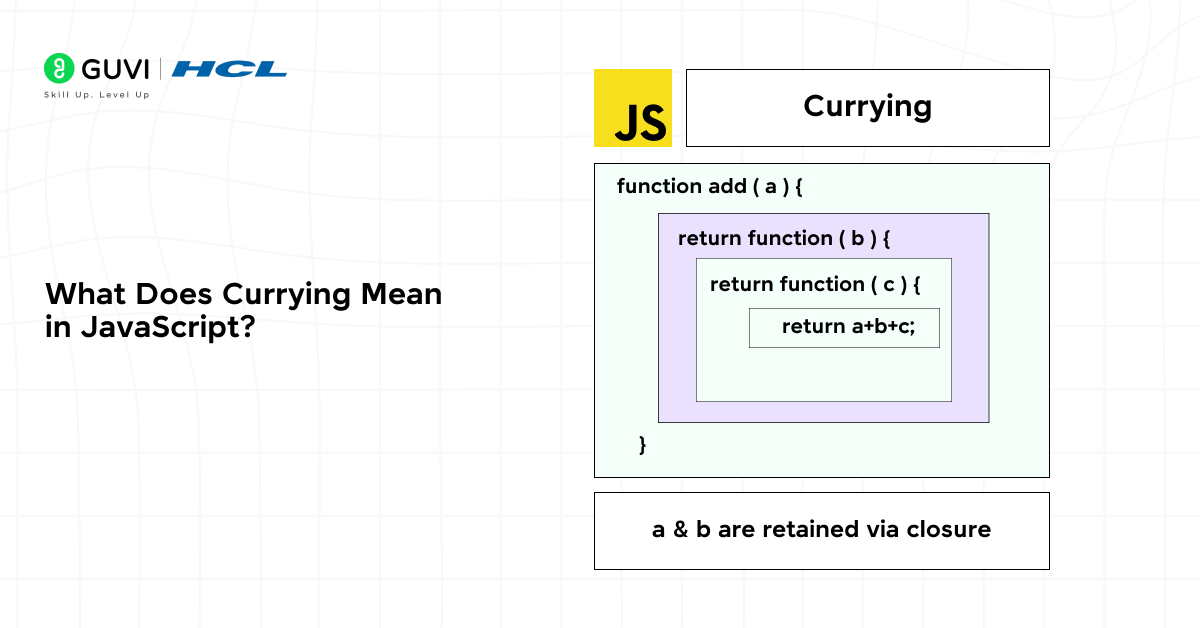
Currying in JavaScript refers to a functional technique where a function that expects multiple arguments is restructured to accept one argument at a time through a sequence of returned functions. The concept originates in functional programming theory, where functions are treated as composable units and argument application is separated from execution to improve clarity and reuse.
Basic Example of Currying in JavaScript
A traditional JavaScript function receives all required arguments in a single call and executes immediately.
function multiply(a, b) {

  return a * b;

}

multiply(2, 5);

A curried version restructures the same logic into a sequence of single-argument functions.

function curriedMultiply(a) {

  return function (b) {

    return a * b;

  };

}

curriedMultiply(2)(5);
Each function call returns another function until all required arguments are supplied. The first call stores the value of a inside a closure and returns a new function that expects the next argument. The second call receives b, combines it with the previously stored value, and then executes the original logic. Arguments are accumulated across calls through closures rather than passed together in one invocation, which allows execution to remain deferred until the full input set becomes available.
Benefits of Currying in JavaScript
1. Deterministic Function Behavior Through Fixed Arity Resolution
Currying enforces a deterministic execution model by tying function evaluation directly to arity resolution rather than call structure. Each argument is validated implicitly through position and count, which removes ambiguity around optional parameters and overloaded signatures. This strict alignment between argument order and execution reduces hidden branching logic. It also makes function behavior easier to reason about at both development and review stages.
2. Reduced Dependency on Shared State and External Context
Curried functions rely on lexical scope to preserve values, which limits the need for shared mutable state or external variables. Captured arguments remain isolated within their execution context and cannot be altered after assignment, which reduces unintended coupling between function calls. It supports safer refactoring and lowers the risk of cross-function side effects in larger codebases.
3. Improved Test Granularity and Behavioral Isolation
Currying allows intermediate function states to be tested independently before full execution occurs. Each partially applied function represents a valid logical unit with a defined responsibility and predictable output once remaining inputs are supplied. This structure supports granular testing strategies where configuration logic and execution logic are validated separately, which improves test clarity and failure diagnosis.
4. Clearer API Contracts Through Progressive Argument Disclosure
A curried function exposes its required inputs progressively rather than all at once, which makes the expected data flow explicit through usage rather than documentation alone. Each invocation communicates what the function still requires, which reduces misuse and improves self-documentation. This progressive disclosure strengthens API contracts and guides correct usage patterns without additional runtime checks.

Practical Use Cases of Currying
1. Function Reusability
Currying improves function reusability by restructuring how arguments are supplied across calls, which allows shared inputs to be captured early and preserved through closures. The initial invocation fixes common parameters and returns a new function that represents a partially evaluated version of the original logic, so repeated execution no longer requires re-passing the same values. It reduces duplication and makes reuse explicit because each returned function reflects a specific behavioral configuration.
2. Configuration and Defaults
The same staged argument model extends naturally to configuration handling, where early arguments define stable behavior and later arguments provide variable data. A curried function stores configuration values in its lexical scope during the first call. It keeps them isolated from runtime inputs supplied during execution. It further clarifies intent because configuration remains fixed across calls, while execution responds only to changing data.
3. Event Handling and Context Binding
That separation becomes especially useful in event-driven code, where contextual information often needs to remain constant while events vary over time. Currying captures contextual values such as identifiers or state during setup and returns an event handler that receives the event object during execution. This flow keeps contextual binding explicit and avoids recreating closures inside listeners, which improves traceability and predictability in event handling logic.
4. Functional Composition and Data Processing
Because currying produces functions that accept a single input at execution time, these functions integrate cleanly into functional data pipelines. Preconfigured curried functions fit directly into array processing methods because required parameters have already been resolved earlier in the call chain. The seamless alignment preserves a clear flow of data through each transformation step and keeps functional composition readable and controlled.
Struggling to understand advanced JavaScript concepts like currying and function composition? Build a strong foundation with HCL GUVI’s JavaScript course and learn core JavaScript concepts step by step through practical, easy-to-follow lessons.
How Currying Works Internally?
Currying works by splitting argument intake across multiple execution contexts, while deferring function execution until all required parameters are available. Here is a step-by-step guide explaining how currying works internally in JavaScript:
Step 1: JavaScript Parses the Original Function Signature
function sum(a, b, c) {

  return a + b + c;

}
Internally:
- JavaScript records the function’s arity (sum.length === 3)
- The function object is created with a reference to its lexical scope
- No execution happens at this stage
This arity becomes essential for determining when a curried function should execute.
Step 2: Currying Wraps the Original Function
const curriedSum = curry(sum);Internally:
- A wrapper function is created
- The original function (sum) is preserved inside a closure
- An empty argument list is initialized
- No arguments are applied yet
The wrapper controls argument collection and execution timing.
Step 3: First Invocation Creates an Execution Context
curriedSum(1);Internally:
- A new execution context is pushed onto the call stack
- The argument [1] is stored inside the closure
- Execution is deferred because collected arguments < arity
- A new function is returned
Nothing is computed yet.
Step 4: Closures Preserve Arguments Across Calls
The returned function retains access to:
- Previously collected arguments
- The original function reference
- Its lexical environment
JavaScript keeps this data alive as long as a reference exists, enabling deferred execution.
Step 5: Subsequent Calls Accumulate Arguments
curriedSum(1)(2);Internally:
- A new execution context is created
- Previous arguments are retrieved from the closure
- New arguments are appended: [1, 2]
- Execution is still deferred
Each call extends state rather than replacing it.
Step 6: Arity Check Determines When Execution Happens
if (args.length >= fn.length) {

  return fn(...args);

}
Internally:
- JavaScript compares collected arguments with required parameters
- Execution happens only when arity is satisfied
- This guarantees predictable, deterministic behavior
Step 7: Final Invocation Triggers the Original Function
curriedSum(1)(2)(3);Internally:
- All arguments are resolved
- A new execution context is created for sum
- The function executes with a complete scope
- The return value is produced
The curried chain collapses into a single result.
Step 8: Call Stack Unwinds and Memory Is Released
After execution:
- Execution contexts are popped off the call stack
- Closures without references become garbage-collectable
- No shared state leaks across invocations
Each curried call remains isolated.
Step 9: Partial Evaluation Enables Function Reuse
const addOne = curriedSum(1);Internally:
- addOne stores a partially evaluated closure
- Future calls reuse previously captured arguments
- Earlier arguments are not recomputed
This is how currying enables specialization.
Currying vs Partial Application
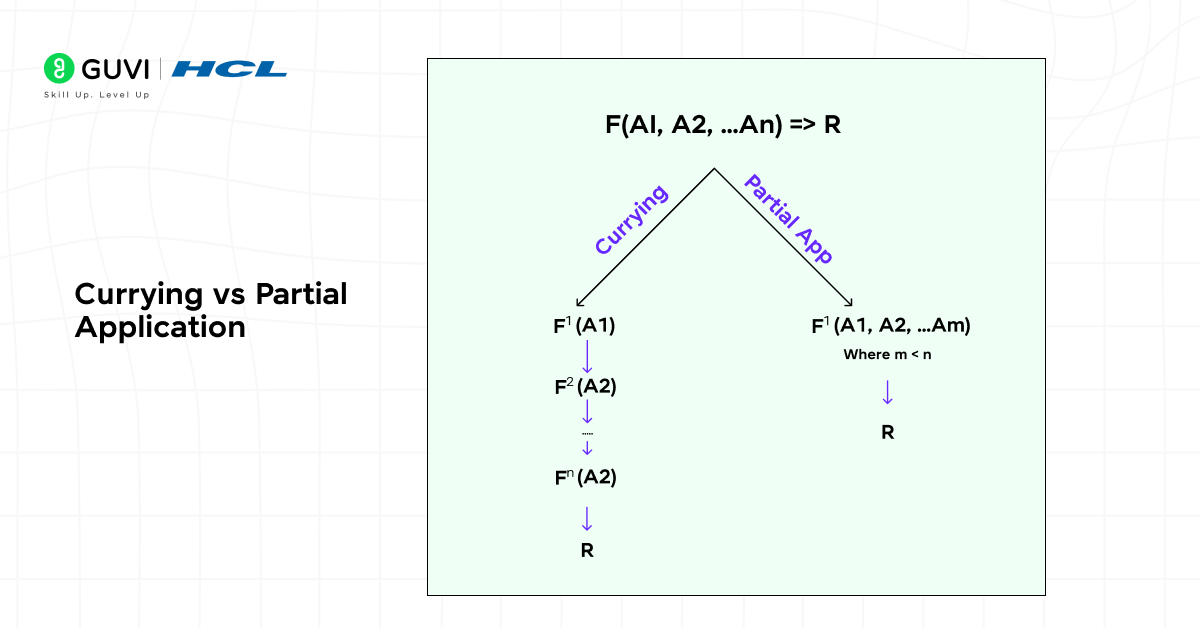
Currying and partial application differ in how they handle arguments and trigger execution, even though both reduce repeated parameter passing. Currying accepts one argument per call and delays execution until full arity is met, which creates a fixed and predictable evaluation path tied directly to arity resolution. Partial application applies one or more arguments upfront and returns a function for the remaining inputs, so execution depends on how many values are prefilled rather than on a strict call sequence.
| Factor | Currying | Partial Application |
| Definition | Converts a function into chained single-argument calls | Pre-applies some arguments to a function |
| Argument handling | One argument per invocation | One or more arguments at once |
| Execution timing | Executes only after full arity is met | Executes when remaining arguments are provided |
| Strictness | Enforces a fixed call sequence | Allows flexible argument grouping |
| Role of arity | Execution tightly bound to arity | Arity plays a limited role |
| Best suited for | Functional composition and pipelines | Convenience and parameter reuse |
Implementing Currying in JavaScript
Currying in JavaScript can be implemented through explicit function definitions or generalized helpers, depending on the level of flexibility and reuse required. Each approach relies on closures, controlled argument intake, and deferred execution, but differs in how much abstraction it introduces and how execution rules are enforced.
1. Manual Currying
Manual currying defines the structure of argument flow directly in code, which keeps execution logic explicit and tightly controlled. This approach suits functions with a fixed number of parameters, where clarity of evaluation order matters more than flexibility.
- Writing Curried Functions by Hand
Hand-written curried functions accept one parameter at a time and return another function until all required inputs are available. Each returned function captures the previously supplied value within its lexical scope, which allows the final function to execute with access to all arguments. This structure makes the dependency between arguments clear and prevents premature execution.
- Nested Function Patterns
Nested function patterns represent each required argument as a distinct execution step. Every nested level forms a new scope that preserves earlier values and waits for the next input. This pattern enforces strict argument order and predictable execution, though deeper nesting can increase cognitive load as function arity grows.
2. Generic Curry Utility Function
Generic curry utilities abstract manual currying into a reusable mechanism that works across multiple functions. Rather than defining nested functions manually, a curry helper dynamically accumulates arguments and decides when execution should occur.
- Reusable Curry Helper
A reusable curry helper stores a reference to the original function and maintains an internal list of collected arguments. Each invocation adds new arguments to this list and re-evaluates execution readiness. This design reduces repetition and standardizes currying behavior across a codebase.
- Handling Variable Argument Lengths
Generic curry helpers support flexible invocation patterns by allowing arguments to arrive in different groupings. Arguments may be supplied one at a time or in batches, while execution remains deferred until sufficient inputs are collected. This flexibility allows curried functions to adapt to varied calling styles without breaking correctness.
- Role of Function Arity (length Property)
Function arity, exposed through the length property, determines how many parameters a function expects before execution should occur. Curry utilities rely on this value to compare collected arguments against required inputs. Functions that use default parameters or rest parameters require careful consideration because their arity may not reflect actual logical requirements.
Currying with Arrow Functions
Arrow functions offer a concise syntax for writing curried functions, which makes them suitable for small utilities and configuration-first logic. They preserve closure behavior while reducing syntactic overhead.
- Syntax Simplification
Arrow-based currying removes explicit function declarations and return statements, which shortens code and keeps focus on data flow. Each arrow represents a single-cope function that captures its argument and returns the next stage of execution.
- Readability Trade-Offs
Readability can suffer as arrow-based currying becomes more complex. Deeply nested arrows reduce visual structure and make execution paths harder to trace during debugging. This trade-off becomes more pronounced when functions perform non-trivial logic.
- Common Arrow-Based Currying Patterns
Arrow-based currying works best for small, predictable functions such as configuration builders, predicates, and simple data transformers. These patterns benefit from compact syntax while maintaining clear argument flow, provided nesting depth remains limited.
Currying in Popular JavaScript Libraries
- Lodash and Explicit Currying Utilities: Lodash provides currying through utility functions such as _.curry, where developers explicitly convert a function into a curried version. The library relies on function arity to decide when execution should occur and supports flexible invocation patterns.
- Ramda and Auto-Curried Functions: Ramda treats currying as a default behavior rather than an opt-in feature. Most Ramda functions are auto-curried, which means they can be called with any number of arguments and will return a new function until all required parameters are provided.
- Lazy Evaluation Through Deferred Execution: Auto-curried functions in libraries like Ramda support lazy evaluation by postponing execution until the complete argument set is available. This behavior allows functions to be composed first and executed later.
Trade-Offs and Limitations of Currying
- Increased Cognitive Load for Beginners: Currying introduces multiple layers of function calls, which can obscure control flow in software development environments where closures and deferred execution are less familiar. Understanding when logic actually runs requires a solid grasp of function evaluation order and scope retention to maintain clarity and reliability in complex codebases.
- Over-Nesting and Readability Constraints: Deeply curried functions can lead to nested call chains that are harder to read and reason about, especially when combined with arrow functions. Excessive nesting shifts complexity from argument management to mental tracing of execution paths.
- Debugging and Stack Trace Interpretation: Debugging curried functions can become difficult because errors often surface several calls away from their source. Stack traces may reference intermediate wrapper functions rather than the original logic, which complicates root-cause analysis.
- Performance Overhead in Hot Paths: Each curried call introduces additional function invocations and closure allocations. In performance-sensitive sections of code, this overhead can accumulate and affect runtime efficiency compared to direct function calls.
Best Practices for Using Currying
- Limit Currying to Stable Utility Functions: Currying works best for pure functions with fixed arity and predictable behavior. Applying it to core utilities rather than ad-hoc business logic keeps complexity contained.
- Avoid Deep Currying in High-Complexity Logic: Functions with many parameters or conditional execution paths often become harder to follow when curried. Flattening such logic improves maintainability and reduces cognitive load.
- Use Arity-Conscious Curry Helpers: Generic curry utilities should respect function arity and avoid implicit execution. This prevents accidental invocation and keeps evaluation timing explicit.
- Balance Functional Clarity With Readability: Currying should improve code comprehension rather than obscure it. Evaluating whether a curried form communicates intent more clearly than a direct function call helps maintain long-term code quality.
Conclusion
Currying in JavaScript offers a structured way to control how functions accept data and when they execute, which helps developers learn JavaScript with a stronger focus on execution flow and composition. It shifts argument handling from a single call to a deliberate sequence, which improves predictability, clarity, and reuse in well-designed codebases. Although currying adds abstraction, it proves valuable when applied thoughtfully to utilities and functional flows, strengthening how developers reason about functions and execution order.
FAQs
Does currying work with functions that use default or rest parameters?
Currying can work with such functions, but default and rest parameters affect function arity, which many curry helpers rely on to decide execution timing. When defaults or rest parameters are present, the length property may not reflect actual logical requirements, so custom curry logic or explicit wrappers are often required.
Can curried functions be used safely in large production codebases?
Curried functions are safe in production when applied to pure, stable utilities with fixed behavior. Issues arise mainly when currying is applied to complex business logic, where deep call chains and implicit execution paths can reduce maintainability and complicate debugging.
Does currying change how memory is managed in JavaScript?
Currying does not change JavaScript’s memory model, but it affects how long certain values remain in memory. Arguments captured through closures stay allocated as long as the returned functions are referenced. Once those references are released, the garbage collector cleans up the associated closures, which keeps memory usage predictable when curried functions are used correctly.
Success Stories

About the Author
Vaishali
I'm a seasoned writer with four years of experience across technical, non-technical, and just about every genre or niche you can imagine. Adaptable and curious, I enjoy exploring new topics and making information engaging and easy to understand. Fueled by a steady stream of tea, I approach each project with creativity, reliability, and genuine enthusiasm for storytelling.
View all posts by Vaishali
Connect with me @

















Did you enjoy this article?