


Data Structure Articles
What is an Algorithm? A Simple Guide for Beginners
Difference between Algorithm and Program: What Sets Them Apart
What Are the Characteristics of an Algorithm? Definition, Features, and Examples


Get In Touch For Details! Request More Information
Types of Data Structures in Python That Every Coder Should Know!
Nov 25, 2025 6 Min Read 1101 Views
(Last Updated)
Python stands as the most popular programming language in 2025, with a 25.35% rating according to the Tiobe Index. As you develop your programming skills, understanding data structures in Python becomes essential for writing efficient and maintainable code.
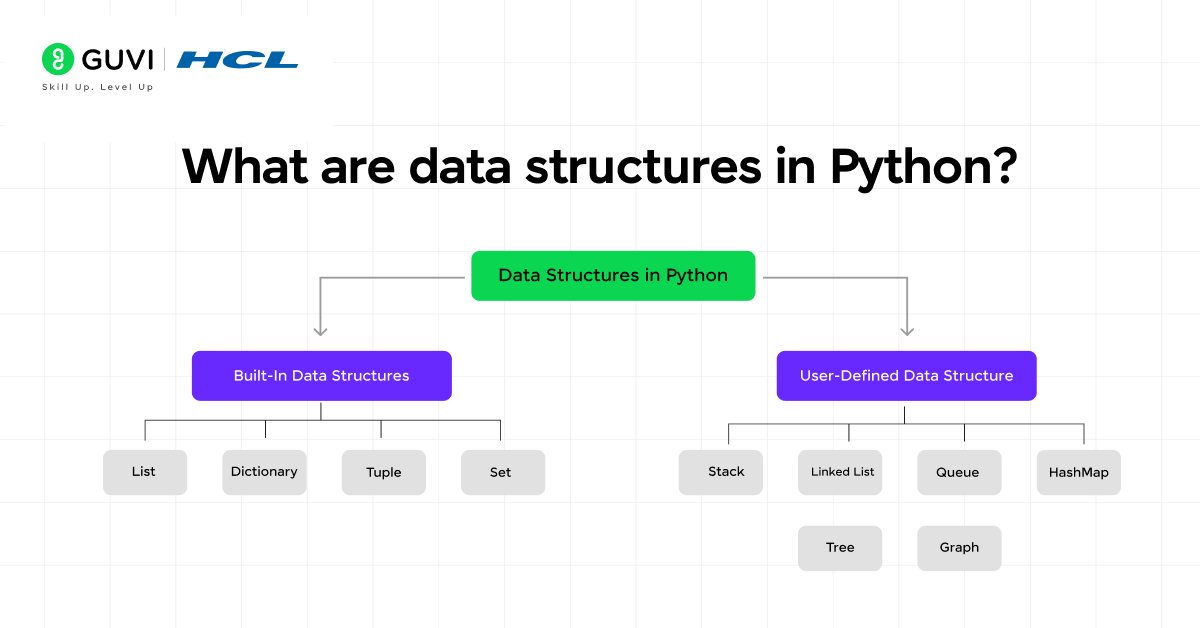
Data structures are simply ways of storing and organizing data so it can be used efficiently. Python offers four built-in data structures: lists, dictionaries, tuples, and sets. These fundamental building blocks allow you to solve real-world problems more effectively and with better performance.
In this beginner-friendly guide, you’ll learn what data structures are, why they matter, and how to use them effectively in your Python projects. We’ll explore both built-in and advanced structures to help enhance your programming skills and create applications efficiently. Let’s get right to it!
Table of contents
- What Are Data Structures in Python?
- Why they matter in real-world coding
- How Python handles data structures
- 8 Essential Data Structures Every Python Programmer Should Know
- Lists
- Tuples
- Sets
- Dictionaries
- Stacks
- Queues
- Trees
- Graphs
- Understanding Built-in vs Advanced Data Structures
- 1) Built-in: lists, tuples, sets, dictionaries
- 2) Advanced: stacks, queues, trees, graphs
- 3) When to use which type
- Real-World Applications and Interview Relevance
- 1) Common use cases in web, AI, and data science
- 2) Top interview questions by structure
- 3) How to prepare for data structure interviews
- Concluding Thoughts…
- FAQs
- Q1. What are the essential data structures every Python programmer should know?
- Q2. How do data structures impact performance and memory in Python?
- Q3. What's the difference between built-in and advanced data structures in Python?
- Q4. How important are data structures for technical interviews?
- Q5. What are some real-world applications of data structures in Python?
What Are Data Structures in Python?
Data structures are particular formats for organizing data in a computer so it can be used effectively. They define the relationship between the data and the operations that can be performed on that data. Specifically, when your data is properly structured, you can quickly find what you need without wasting computational resources.
Consider this practical example: If your desk is cluttered with various documents—invoices, reports, and client notes—you might organize them into labeled folders. This organizational system mirrors what data structures do in programming—they help keep information tidy and accessible, making your coding tasks more efficient.
Why they matter in real-world coding
Beyond theoretical importance, data structures have practical applications that impact your day-to-day coding. Furthermore, choosing the right data structure drastically affects performance, scalability, and maintainability:
- Performance optimization: The right data structure can optimize time complexity for essential operations like searching, inserting, and deleting data
- Memory efficiency: Using memory-efficient structures allows your applications to handle larger datasets without slowdown
- Problem-solving power: Some complex problems simply cannot be solved effectively without the appropriate data structure
Notably, real-world applications like databases, search engines, and real-time systems require data structures that can efficiently handle millions of records. This efficiency becomes particularly important when working with large-scale applications where performance directly affects user experience.
How Python handles data structures
Python offers a unique approach to data structures compared to other programming languages. First, Python ships with several built-in data structures in its standard library that handle the most common scenarios.
Python’s data structures fall into two categories:
- Mutable: Structures you can modify after creation (lists, dictionaries, sets)
- Immutable: Structures you cannot modify after creation (tuples)
- As a result of Python’s design philosophy, operations that modify mutable data structures (like insert, remove, or sort in lists) return None rather than returning the modified structure—a consistent design principle for all mutable structures in Python.
- Python’s implementation differs from other languages in naming conventions. For instance, in Java, a list isn’t just a list—it’s either a LinkedList or an ArrayList. Python simplifies this with more general names, although the underlying implementations are still optimized.
- Python dictionaries deserve special mention as they’re highly optimized hash table implementations that provide O(1) time complexity for lookup, insert, update, and delete operations in the average case. This optimization makes dictionaries extremely efficient for storing and retrieving data, which is why they’re used extensively throughout the language.
By understanding these fundamental structures and how Python implements them, you’ll be better equipped to write efficient code and tackle more complex programming challenges.
8 Essential Data Structures Every Python Programmer Should Know
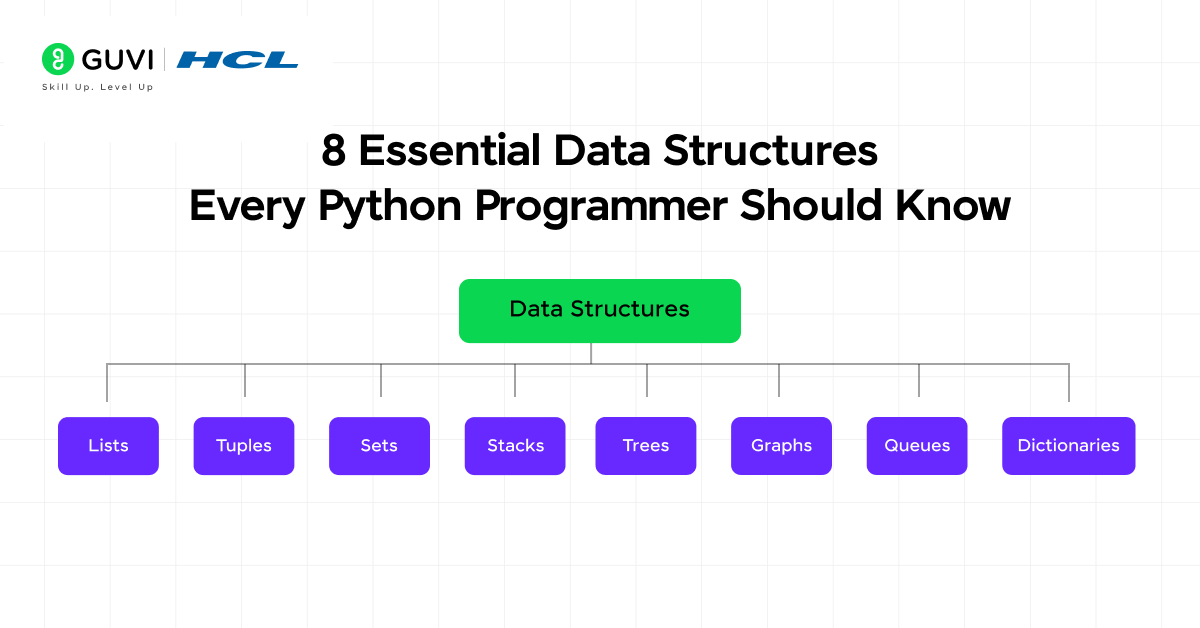
Understanding the right data structures gives you powerful tools to solve programming challenges efficiently. Let’s explore eight essential data structures every Python programmer should master.

1. Lists
Lists are array-like structures that store ordered collections of items. Unlike arrays in other languages, Python lists can hold different data types in the same list. They’re dynamic, mutable, and allow operations like appending, inserting, and removing elements.
friends = [“Aliyan”, “Humayoon”, “Mudasar”]
friends.append(“Rahim”) # Add an item
friends.remove(“Mudasar”) # Remove an item
Lists shine when you need to store collections of related items that you’ll modify frequently. Their ordered nature makes them perfect for maintaining sequences where position matters.
2. Tuples
Tuples work similarly to lists with one crucial difference: they’re immutable. Once created, you cannot modify a tuple’s contents. This immutability makes them faster and safer when you need data that shouldn’t change.
coordinates = (1, 5) # Creating a tuple
Use tuples when you need to ensure data remains constant throughout your program. They can also be used as dictionary keys (unlike lists) and typically use less memory than lists.
3. Sets
Sets are unordered collections that store unique elements only. They automatically eliminate duplicates, making them perfect for removing redundant data.
numbers = {1, 2, 3, 3, 4} # Creates {1, 2, 3, 4}
Sets excel at membership testing and mathematical operations like union and intersection. They’re significantly faster than lists when checking if an element exists within the collection.
4. Dictionaries
Dictionaries store data as key-value pairs, making them ideal for quick lookups. Each key must be unique and immutable (strings, numbers, or tuples containing only immutable types).
student = {“name”: “Alice”, “age”: 25}
student[“grade”] = “A” # Adding new key-value pair
Dictionaries provide constant-time performance for accessing, inserting, and deleting elements, regardless of size. They’re built on highly optimized hash tables, making lookups extremely efficient.
5. Stacks
Stacks follow the Last-In-First-Out (LIFO) principle—similar to a stack of plates where you add and remove from the top. The two primary operations are push (add) and pop (remove).
stack = []
stack.append(1) # Push
stack.pop() # Pop
Stacks are perfect for tracking states, implementing undo features, or managing function calls. They help manage data in a “last come, first served” manner.
6. Queues
Queues operate on the First-In-First-Out (FIFO) principle—like people standing in line. The main operations are enqueue (add) and dequeue (remove).
from collections import deque
queue = deque()
queue.append(1) # Enqueue
queue.popleft() # Dequeue
Queues excel at processing tasks in the order they arrive, making them ideal for scheduling, resource allocation, and data buffering in streaming scenarios.
7. Trees
Trees are hierarchical structures with a root node and child nodes branching out. Unlike linear structures, trees allow elements to have multiple “next” elements.
Trees are valuable for representing hierarchical relationships like:
- File systems with folders and subfolders
- Organization charts
- Database indexing
- Priority queues
Binary trees (where each node has at most two children) are especially common and serve as foundations for more complex tree variants like Binary Search Trees.
8. Graphs
Graphs consist of vertices (nodes) and edges that connect these vertices. They represent relationships between data points and can model complex networks.
class Graph:
def __init__(self):
self.graph = {}
def add_edge(self, from_node, to_node):
if from_node in self.graph:
self.graph[from_node].append(to_node)
else:
self.graph[from_node] = [to_node]
Graphs excel at modeling social networks, transportation systems, web page connections, and any scenario where you need to represent connections between entities.
Throughout your programming journey, you’ll encounter these data structures repeatedly. Mastering when and how to use each one will dramatically improve your problem-solving capabilities and code efficiency and our DSA e-book will help you master them easily.
To make your learning a little more interesting, here are some fascinating facts about Python’s data structures that might surprise you:
Lists Aren’t Just Arrays: Unlike many languages where arrays can only store one data type, Python lists can hold integers, strings, floats, and even other lists all at once—making them incredibly flexible for diverse data handling.
Dictionaries Preserve Order (Now): Before Python 3.7, dictionaries didn’t maintain insertion order. Today, they do—allowing developers to rely on predictable iteration over key-value pairs.
These facts show how Python’s data structures have evolved to balance simplicity, power, and performance—one of the many reasons Python remains a top choice for programmers worldwide.
Understanding Built-in vs Advanced Data Structures
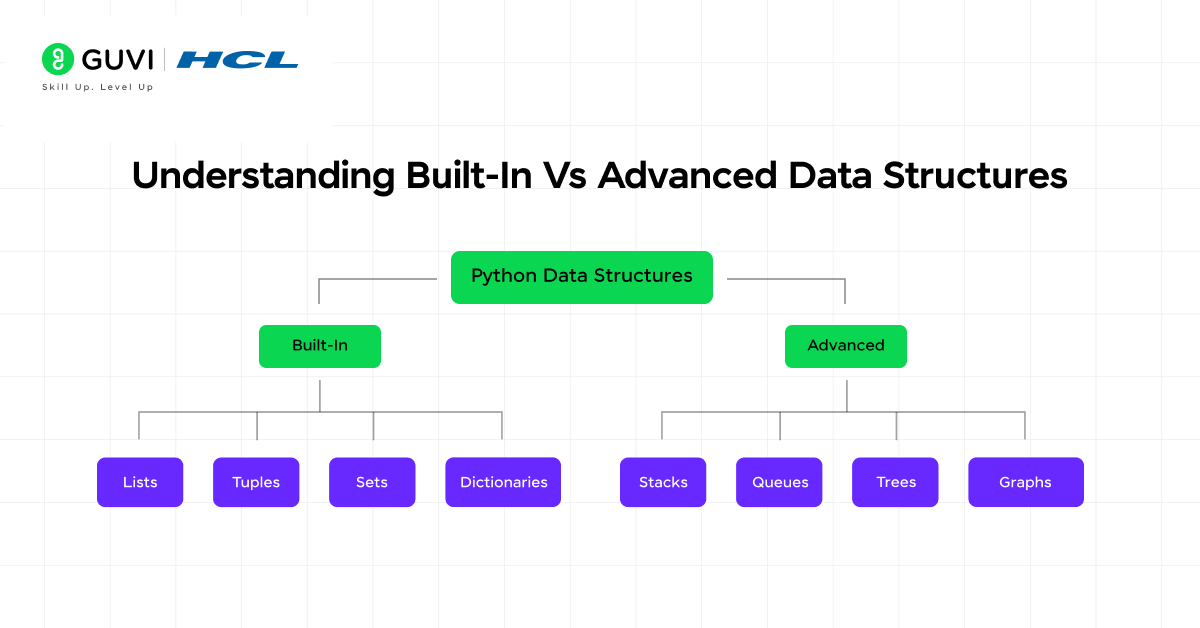
Python divides its data structures into two main categories that serve different purposes in your programs. Knowing the distinction helps you choose the right tool for each coding challenge.
1) Built-in: lists, tuples, sets, dictionaries
Python’s built-in data structures come with the language itself and are highly optimized for performance. They’re implemented in C, making them remarkably fast for their intended purposes.
These foundational structures fall into two categories:
- Mutable structures: Lists, dictionaries, and sets can be modified after creation
- Immutable structures: Tuples cannot be modified once created
Despite their simple names, these structures are surprisingly powerful. For example, Python dictionaries are sophisticated hash tables that provide O(1) time complexity for lookups, inserts, and deletes on average. Since Python 3.7, dictionaries even maintain insertion order by default and use a compact internal representation that reduces memory usage by 20-25%.
The built-in structures are battle-tested and power everything from Instagram’s backend to scientific computing at CERN. Their C implementation makes operations like appending to lists and accessing dictionary values extremely efficient.
2) Advanced: stacks, queues, trees, graphs
Advanced data structures aren’t built directly into Python but can be implemented using the built-in structures or custom classes. These structures solve specific problems that basic structures can’t handle efficiently.
While you can implement a stack using a Python list (with append() and pop()), specialized structures like collections.deque offer better performance for certain operations. For instance, removing items from the beginning of a list is an O(n) operation, whereas deque.popleft() is O(1).
# Inefficient queue using list
queue = []
queue.append(“item”) # OK
queue.pop(0) # Slow – O(n)
# Efficient queue using deque
from collections import deque
queue = deque()
queue.append(“item”) # Fast
queue.popleft() # Fast – O(1)
Trees and graphs typically require custom implementations or specialized libraries like NetworkX, as Python has no built-in graph or tree type.
3) When to use which type
Selecting the appropriate data structure depends on your specific requirements:
Choose built-in structures when:
- You need simple data organization with excellent performance
- Your operations match their strengths (appending to lists, key-value lookups)
- You want code that’s readable and idiomatic
Choose advanced structures when:
- You need specialized behavior (FIFO, LIFO, hierarchical relationships)
- Performance of specific operations is critical
- You’re dealing with complex relationships between data points
For example, use sets instead of lists when checking membership in large collections—testing membership 100,000 times in a list with 10,000 items can take seconds, while a set handles it in milliseconds.
Keep in mind that built-ins aren’t always optimal. Consider specialized structures for:
- Memory-constrained environments (use array.array instead of lists)
- Heavy numerical computing (NumPy arrays)
- True parallelism (thread-safe options like queue.Queue)
- Complex relationships (graphs for network analysis)
By understanding these distinctions, you can write more efficient code that makes the best use of Python’s data structure ecosystem.
Real-World Applications and Interview Relevance
Mastering data structures in Python unlocks countless opportunities across various domains. Their practical applications extend far beyond theoretical exercises.
1) Common use cases in web, AI, and data science
In web development, dictionaries power session management and user data storage. Lists excel at collecting user responses and managing shopping carts.
For AI applications, Python frameworks like PyTorch, TensorFlow, and Keras rely heavily on optimized data structures for machine learning model implementation. Data scientists use these structures for statistical computing, numerical analysis, and efficient data manipulation.
2) Top interview questions by structure
During interviews, hash tables (dictionaries) often appear in questions about frequency counting, anagrams, and LRU cache implementation. Tree-related questions typically cover traversal techniques and binary search trees.
Graph problems focus on pathfinding algorithms like BFS/DFS and shortest path calculations. Stack questions commonly test balanced parentheses and expression evaluation.
3) How to prepare for data structure interviews
Initially, focus on understanding time and space complexity for all operations. Practice combining different structures—dictionaries with lists or sets often solve complex problems elegantly. Stick to one interview practice platform rather than bouncing between multiple sites.
Above all, communicate your thought process clearly during interviews. When stuck, try systematically considering each data structure for potential application. Remember that choosing the right data structure for the right problem is key to interview success.
Elevate your Python prowess with the DSA Using Python Course from HCL GUVI — master essential data structures and algorithms through self-paced modules, gamified practice, and real-world coding challenges to supercharge your 2025 tech-career trajectory.
You can also become a job-ready AI software developer with HCL GUVI’s IITM-certified AI Software Development Course, master full-stack, DSA, Gen AI tools, and real-world projects.
Concluding Thoughts…
Understanding data structures stands as a critical skill for any Python programmer in 2025. Throughout this guide, you’ve learned about eight essential data structures that form the foundation of efficient coding practices. Lists, tuples, sets, and dictionaries offer built-in solutions for most common programming challenges, while stacks, queues, trees, and graphs provide specialized tools for complex problems.
As you continue your Python journey, remember that mastering data structures isn’t just about memorizing their syntax. Instead, focus on understanding when and why to use each one.
This approach will help you write cleaner, faster code and solve problems more effectively. After all, a programmer who knows their data structures can tackle complex challenges with confidence and elegance.
FAQs
Q1. What are the essential data structures every Python programmer should know?
The eight essential data structures for Python programmers are lists, tuples, sets, dictionaries, stacks, queues, trees, and graphs. Each serves different purposes and is crucial for efficient programming and problem-solving.
Q2. How do data structures impact performance and memory in Python?
Data structures significantly affect performance and memory usage. Choosing the right structure can reduce time complexity from O(n) to O(1) in some cases. For example, using a set instead of a list for membership testing can dramatically improve efficiency, especially with large datasets.
Q3. What’s the difference between built-in and advanced data structures in Python?
Built-in data structures like lists, tuples, sets, and dictionaries come with Python and are highly optimized. Advanced structures like stacks, queues, trees, and graphs are implemented using built-in structures or custom classes and are designed for specific complex problems.
Q4. How important are data structures for technical interviews?
Data structures are crucial for technical interviews. Questions about hash tables, trees, and graph algorithms are common. Understanding when and why to use each data structure is key to interview success and demonstrates problem-solving skills valued by employers.
Q5. What are some real-world applications of data structures in Python?
Data structures have numerous real-world applications. In web development, dictionaries are used for session management. In AI, optimized data structures are essential for implementing machine learning models. Data scientists use these structures for efficient data manipulation and analysis in various fields.
Success Stories

About the Author
Jaishree Tomar
A recent CS Graduate with a quirk for writing and coding, a Data Science and Machine Learning enthusiast trying to pave my own way with tech. I have worked as a freelancer with a UK-based Digital Marketing firm writing various tech blogs, articles, and code snippets. Now, working as a Technical Writer at GUVI writing to my heart’s content!
View all posts by Jaishree Tomar
Connect with me @













Did you enjoy this article?