


Interview Articles
My Full Stack Developer Interview Experience: What Nobody Tells You
My Digital Marketing Interview Experience: What They Don't Tell You [2026]
How Long Does Technical Interview Preparation Take? An Expert's Reality Check
Technical QA Interview Questions: What Top Companies Really Ask in 2026


Get In Touch For Details! Request More Information

17 Tips to Stand Out in Entry-Level Tech Interviews
Feb 13, 2026 6 Min Read 607 Views
(Last Updated)
Ever wondered why some candidates with the same qualifications somehow walk out of entry-level tech interviews with job offers while others don’t make it past the first round? Everyone has similar degrees, similar projects, similar technical foundations. So what actually helps you stand out?
The answer isn’t perfect grades or memorizing every algorithm in the book. It’s how you prepare, how you show up, and how you present the potential you already have.
This article breaks down the practical, actionable steps that help you leave a lasting impression, from the groundwork you lay beforehand to the way you handle the actual conversation and what you do after the interview ends. So, without further ado, let us get started!
Quick Answer:
You can stand out in entry-level tech interviews by showing clear problem-solving skills, communicating your thought process, and backing your answers with simple project examples that reflect real learning and curiosity. This applies whether you’re interviewing for software, data, or IT roles.
Table of contents
- 17 Tips to Stand Out in Entry-Level Tech Interviews
- Before the Interview: Lay the Groundwork
- During the Interview: Stand Out by How You Show Up
- After the Interview: Don’t Let Your Effort Fade
- Putting It All Together: A Simple Checklist
- Common Mistakes That Often Sabotage Entry-Level Candidates
- Showing Up Without Real Company Research
- Giving Generic, Template-Style Responses
- Over-Focusing on Technical Answers Only
- Rambling Instead of Explaining Clearly
- Trying to Fake Knowledge
- Skipping Questions for the Interviewer
- Neglecting Soft Skills and Professionalism
- Not Following Up
- Conclusion
- FAQs
- How can I stand out in an entry-level tech interview?
- What do interviewers look for in entry-level tech candidates?
- How do I talk about projects in a tech interview?
- How do I prepare for behavioral questions in tech interviews?
- Should I follow up after the interview?
17 Tips to Stand Out in Entry-Level Tech Interviews
Standing out isn’t about doing anything flashy, it’s about being intentional at every stage of the process. The way you prepare beforehand, the way you show up during the conversation, and the way you follow through afterward all shape the impression you leave.
Here’s how to handle each phase with clarity and confidence.
Before the Interview: Lay the Groundwork
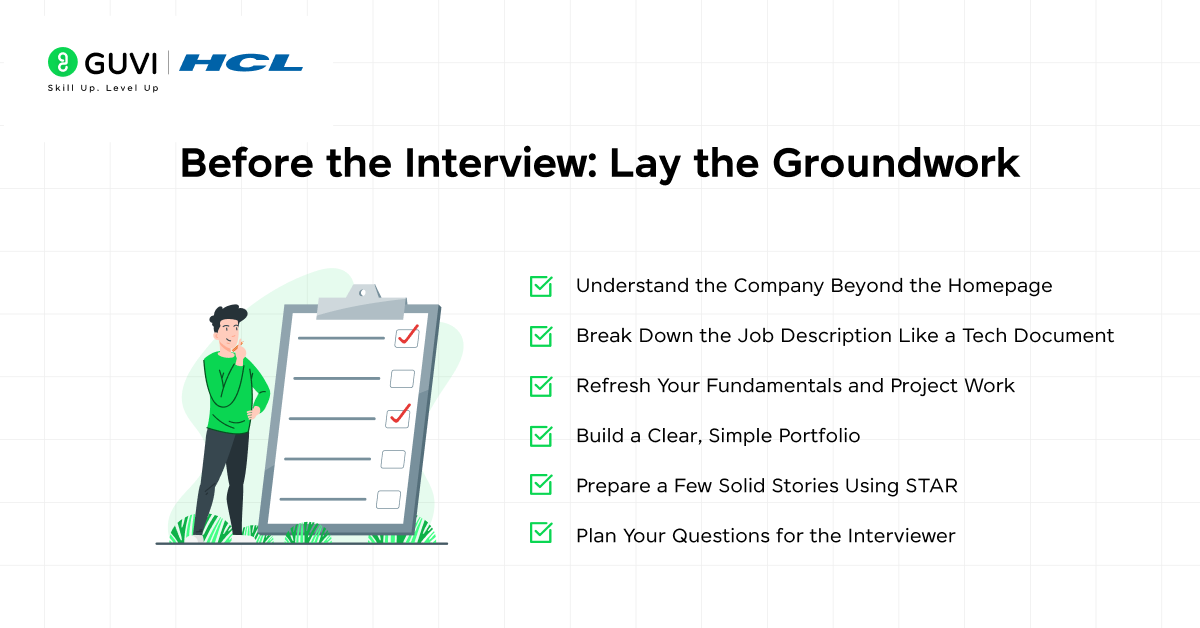
Here’s the thing: most candidates only start “preparing” once the interview invite hits their inbox. But what separates strong entry-level tech candidates from everyone else is the homework they do before they ever step into the room or log in to a video call.
1. Understand the Company Beyond the Homepage
Spend some time digging into the company’s tech stack, recent releases, engineering blog posts, and culture.
What you should look for:
- Tech stack used for backend, frontend, mobile, cloud, or data.
- Read developer or engineering blog articles to understand their problem-solving mindset.
- Recent launches or updates and how they’ve impacted users.
- Values and culture, especially how they describe collaboration and innovation.
This kind of insight helps you tailor your examples and answers. It signals that you’re applying with intention, not sending out fifty identical applications.
2. Break Down the Job Description Like a Tech Document
Think of the job description as an API spec: it outlines what the team expects, what you’ll handle, and the environment you’ll be working in.
Pay close attention to:
- Required skills vs. preferred skills
- Tools, frameworks, or languages mentioned
- Responsibilities that repeat (those are high-priority)
- Clues about the team’s workflow: Agile, DevOps, cloud-heavy, etc.
Now match each point with something you’ve done: a class project, a personal project, an open-source contribution, a hackathon, or an internship.
3. Refresh Your Fundamentals and Project Work
Entry-level tech interviews often start with the basics. Brush up on:
- Data structures
- Problem-solving patterns
- Debugging
- Version control
- CS fundamentals relevant to your field (web, mobile, ML, cloud)
At the same time, revisit your own projects. Interviewers will often ask questions like:
- Why did you choose this approach?
- What challenges did you face?
- How would you improve the project now?
Knowing your own work deeply builds confidence.
If you want to read more about DSA and want to quickly brush the topics, consider reading HCL GUVI’s Free Ebook: The Complete Data Structures and Algorithms Handbook, which covers the key concepts of Data Structures and Algorithms, including essential concepts, problem-solving techniques, and real MNC questions
4. Build a Clear, Simple Portfolio
Your portfolio doesn’t need to be fancy: it just needs to be:
- Clean
- Navigable
- Focused on your best work
Include:
- 2–4 strong projects
- Clear descriptions of what you built
- Your role and the problem you solved
- Links to GitHub repos with readable documentation
If you’re applying for software roles, make sure at least one project shows real-world thinking, like solving a daily problem or building something people can actually use.
5. Prepare a Few Solid Stories Using STAR
STAR (Situation, Task, Action, Result) is your best friend in a behavioral round.
Prepare stories for:
- A time you solved a problem
- A time you dealt with a challenge
- A time you worked in a team
- A time you learned something new quickly
These stories help you demonstrate qualities tech teams look for: curiosity, collaboration, resilience, and initiative.
6. Plan Your Questions for the Interviewer
You’ll almost always get asked: “Do you have any questions for me?” You never want to say no.
You can ask about:
- Team structure
- Tech stack decisions
- Onboarding process
- How interns or fresh graduates usually grow
- What success looks like in the role
These questions show that you’re already imagining yourself as part of the team.
If you want to learn the nuances of cracking an interview, then this blog is for you – How to Prepare for a Job Interview and Ace it? Top 8 Steps

During the Interview: Stand Out by How You Show Up
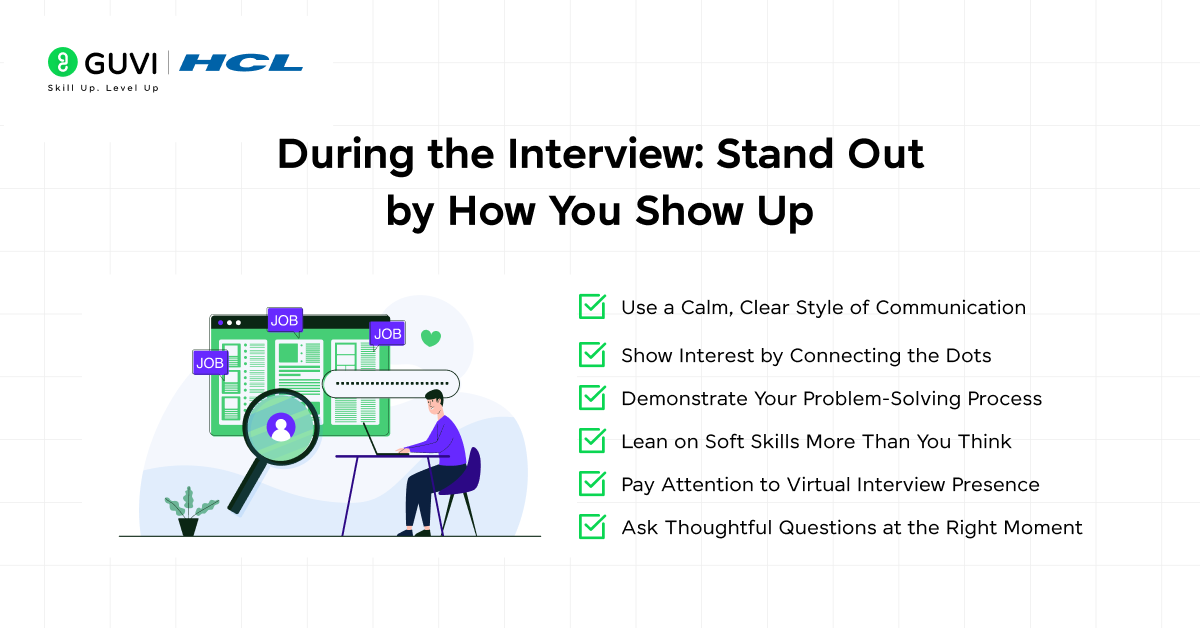
If the preparation you do before the interview is the foundation, how you show up in the actual conversation is the structure you build on top of it. This is where you turn your research, stories, and skills into a genuine impression.
7. Use a Calm, Clear Style of Communication
You don’t have to sound like a senior engineer. You just need to sound present and thoughtful.
A few things help:
- Pause before answering: think, then speak
- Explain your reasoning, not just the final answer
- If you don’t know something, admit it and talk through how you’d solve it
Tech interviewers appreciate logical thinking more than memorized answers.
8. Show Interest by Connecting the Dots
Bring your earlier research into the conversation naturally.
You might say things like:
- “When I read about your migration to microservices…”
- “I saw that your team recently launched X…”
- “I noticed you use Y stack, I’ve used it in a recent project…”
This shows you’re not treating their company generically.
9. Demonstrate Your Problem-Solving Process
In technical rounds, interviewers want to see how you think.
When solving a coding problem:
- Start by confirming your understanding
- Think aloud so they can follow your logic
- Ask clarifying questions
- Avoid jumping straight into coding, outline your approach first
This makes you appear structured and deliberate.
10. Lean on Soft Skills More Than You Think
Entry-level tech interviews aren’t just about technical skill. Teams want someone who can do these soft skills as well:
- Learn fast
- Communicate
- Adapt
- Work in a group
- Handle feedback
Let these qualities shine through your stories and tone.
11. Pay Attention to Virtual Interview Presence
If your interview is online:
- Check your internet connection
- Test your camera and mic
- Choose a quiet, well-lit space
- Keep your background distraction-free
Try to maintain eye contact and sit comfortably. Small things like these affect how you’re perceived.
12. Ask Thoughtful Questions at the Right Moment
Once the interviewer is done, this is your moment to show initiative.
Some strong options:
- What does a typical day look like for fresh grads?
- What are some current challenges the team is facing?
- What would success look like in the first 90 days?
These questions make you look engaged, mature, and curious, traits tech hiring teams value highly.
After the Interview: Don’t Let Your Effort Fade
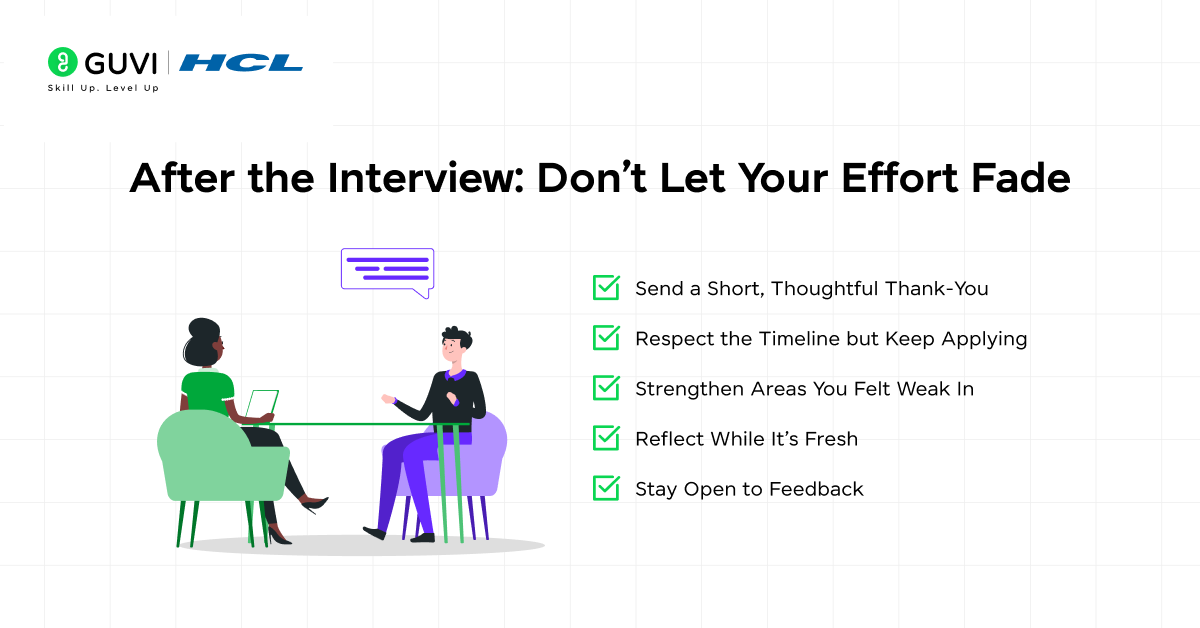
A lot of candidates walk out of the interview and assume the process is out of their hands. But you still have a chance to reinforce the impression you made.
13. Send a Short, Thoughtful Thank-You
A follow-up note isn’t old-school, it’s smart.
Keep it simple:
- Thank the interviewer for their time
- Mention one part of the conversation that resonated with you
- Reaffirm your interest in the role
This not only shows professionalism but also puts your name in front of the interviewer one more time.
14. Reflect While It’s Fresh
Once the interview ends, take a few minutes to jot down:
- Questions you struggled with
- Questions you answered well
- Topics you need to review
- Any feedback you received
This kind of reflection helps you bridge gaps before the next round.
15. Strengthen Areas You Felt Weak In
If you struggled with dynamic programming, brush it up. If you got stuck while explaining a project, rehearse it again. If you stumbled on a behavioral question, refine your stories.
Small improvements between interviews compound quickly.
16. Respect the Timeline but Keep Applying
If the company said they’ll get back in a week, give them a week. If they said two days, wait two days. But don’t pause your job search, keep applying elsewhere. It reduces stress and increases your options.
17. Stay Open to Feedback
If the company rejects you but offers feedback, take it. Most companies don’t, so when one does, it’s worth gold.
Use it to:
- Update your portfolio
- Adjust your interview style
- Strengthen technical areas
This puts you ahead of other candidates who simply move on without learning.
Putting It All Together: A Simple Checklist
Before you walk in (or log in), make sure you:
- Researched the company (mission, values, recent work)
- Re-read the job description and align your strengths accordingly
- Prepared 3–5 concrete stories (using STAR) from your background
- Listed 3–5 thoughtful questions to ask the interviewer
- Planned your outfit/setup (if remote), arrive early, mentally prepared
During the interview, you have to:
- Speak clearly, calmly, confidently and honestly
- Use your stories to demonstrate skills and attitude
- Show interest in the company and role, act like you belong there
- Ask smart, genuine questions at the end
After the interview, do:
- Send a thoughtful thank-you/follow-up note
- Reflect on what went well and what can be improved
Read More: Answers To 10 Most Common Job Interview Questions
Common Mistakes That Often Sabotage Entry-Level Candidates
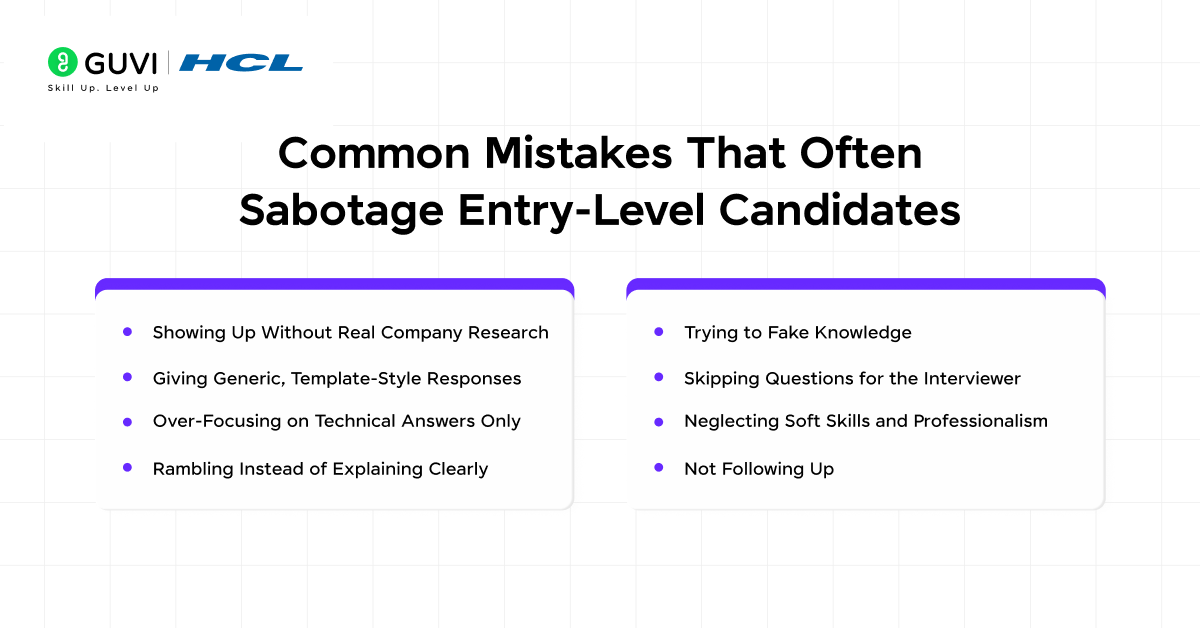
Even strong candidates slip on small things that can easily be avoided. Here are the big ones you want to stay aware of:
1. Showing Up Without Real Company Research
Many candidates only skim the About page and hope that’s enough. Interviewers can tell immediately. What this signals: low interest, low preparation, and a “spray-and-pray” approach. A little deeper research, like understanding their tech stack or recent engineering initiatives, gives you stronger, more relevant answers.
2. Giving Generic, Template-Style Responses
Statements like “I’m a team player” or “I learn fast” don’t mean much without proof. Interviewers want actual examples. That’s why having 3–5 strong STAR stories ready makes you stand out.
3. Over-Focusing on Technical Answers Only
Many entry-level candidates try to impress with pure technical jargon. But tech teams look for:
- Problem-solving,
- Communication,
- Collaboration,
- Adaptability.
If you ignore the human side, you miss a huge part of what they’re evaluating.
4. Rambling Instead of Explaining Clearly
This often happens when nerves kick in. Long, unstructured explanations can make you seem less confident even if you know the material. Take a second before answering. Think. Then speak with a simple structure.
5. Trying to Fake Knowledge
Saying “I know this” when you don’t or guessing wildly backfires fast. Interviewers appreciate honesty like: “I’m not fully sure, but here’s how I’d approach figuring it out.” This shows maturity and problem-solving ability.
6. Skipping Questions for the Interviewer
When candidates say “No, I don’t have any questions,” they unintentionally signal a lack of genuine interest. Prepared questions show that you’re thinking like a future teammate, not just a job seeker.
7. Neglecting Soft Skills and Professionalism
Being rude, dismissive, late, overly casual, or inattentive during virtual calls can instantly ruin your chances. Simple things like punctuality, active listening, and basic courtesy go further than you think.
8. Not Following Up
A short thank-you note is a small way to stand out—and many entry-level candidates skip it. It reinforces your interest and demonstrates professionalism.
If you’re serious about mastering software developer interviews along with AI and want to apply it in real-world scenarios, don’t miss the chance to enroll in HCL GUVI’s IITM Pravartak and MongoDB Certified Online AI Software Development Course. Endorsed with NSDC certification, this course adds a globally recognized credential to your resume, a powerful edge that sets you apart in the competitive job market.
Conclusion
In conclusion, standing out in an entry-level tech interview isn’t about being the smartest person in the room. It’s about showing clarity, curiosity, and the willingness to grow. When you prepare with intention, communicate your thought process, and follow through after the interview, you show recruiters exactly what they look for in early-career talent: someone who’s ready to learn, easy to collaborate with, and motivated to contribute.
Every interview becomes smoother the more you practice, reflect, and refine your approach. So treat each one as part of your learning curve, not a final verdict. With thoughtful preparation and a grounded mindset, you’ll position yourself as a candidate teams remember and the one they want to hire.
FAQs
1. How can I stand out in an entry-level tech interview?
Focus on clear communication, strong fundamentals, and real project examples. Show genuine interest in the company and explain your thought process openly.
2. What do interviewers look for in entry-level tech candidates?
They look for problem-solving ability, curiosity, collaboration skills, and a willingness to learn. Your mindset often matters more than perfect technical answers.
3. How do I talk about projects in a tech interview?
Explain the problem, your approach, tools used, and what you learned. Keep it structured and highlight the impact or improvements you’d make now.
4. How do I prepare for behavioral questions in tech interviews?
Use the STAR method and prepare 3–5 short stories that show teamwork, resilience, and initiative. Keep your answers specific and relevant.
5. Should I follow up after the interview?
Yes. A brief thank-you note reinforces your interest and leaves a positive final impression. It’s a small gesture that many candidates overlook.
Success Stories

About the Author
Lukesh S
A professional content writer who has experience in freelancing and now working as a Technical Content Writer at GUVI. Google Certified Digital Marketer. Have a sound knowledge of SQL, Data Structures and Cloud Computing.
View all posts by Lukesh S
Connect with me @












Did you enjoy this article?