


Interview Articles
My Full Stack Developer Interview Experience: What Nobody Tells You
My Digital Marketing Interview Experience: What They Don't Tell You [2026]
How Long Does Technical Interview Preparation Take? An Expert's Reality Check
Technical QA Interview Questions: What Top Companies Really Ask in 2026


Get In Touch For Details! Request More Information
Technical Interview vs HR Interview: 7 Key Differences
Dec 23, 2025 7 Min Read 1803 Views
(Last Updated)
Ever wondered why companies split software engineering interviews into a technical round and an HR round? At first, it feels like they’re testing completely different sides of you, one moment you’re solving algorithms under time pressure, and the next you’re talking about your strengths, weaknesses, and future goals.
But here’s the real question: how do these two interviews work together to help companies understand whether you’re the right fit? Understanding the difference can make your preparation far more focused and far less stressful. When you know what each round is looking for, you stop guessing and start preparing with intention.
This article lets you understand the difference between a technical interview and an HR interview: what they consist of, how to pass them, and the common mistakes to avoid. So, without further ado, let us get started!
Quick Answer
A technical interview tests your ability to solve engineering problems through coding, logic, and fundamentals, while an HR interview evaluates your personality, communication, and cultural fit to understand how well you’ll work with the team.
Table of contents
- What Makes Technical and HR Interviews Different?
- Why Companies Use Both Interviews
- Technical Interview: What You Should Expect
- Coding Assessments
- Problem-Solving Approach
- Whiteboard or Live Coding Discussions
- Technical Concepts & Fundamentals
- Debugging and Code Review
- Communication During the Technical Round
- HR Interview: What You Should Expect
- Your Career Motivation
- Understanding Your Background
- Cultural and Team Fit
- Communication Skills
- Your Thought Process During Situational Questions
- Your Values and Ethics
- Your Ambition and Future Goals
- Salary and Logistics Discussion
- Your Questions for Them
- Key Differences Between Technical and HR Interviews
- Common Mistakes Beginners Make in a Technical and HR Interview
- Technical Interview Mistakes
- HR Interview Mistakes
- Final Tips to Stand Out in an Interview
- Conclusion
- FAQs
- What is the main difference between a technical interview and an HR interview?
- How should I prepare for a technical interview as a beginner?
- What does HR look for in a software engineer interview?
- Can I fail the HR interview even if my technical round went well?
- What questions are commonly asked in HR interviews for software engineers?
What Makes Technical and HR Interviews Different?
Technical interviews test your ability to think like an engineer. HR interviews test your ability to work like a teammate.
A technical interviewer wants to see how you code, debug, and analyze problems. The HR interviewer wants to understand your values, motivation, and communication style.
Think of it this way:
- Technical interview → Can you do the job?
- HR interview → Should we hire you? Would you thrive here?
Both questions matter equally.
Why Companies Use Both Interviews
Companies don’t want just strong coders. They want people who can collaborate, handle feedback, communicate with clarity, and stay motivated. That’s why the process is split into stages.
Here’s what each interview helps the company understand:
- Technical: Are you strong in algorithms, data structures, system design, debugging, and coding structure? Can you break down complex problems?
- HR: Will you get along with the team? Are your goals aligned with the role? Do you demonstrate ownership, empathy, and professionalism?
It’s a blend of skill and attitude: a combination that makes someone not just employable, but valuable.
Technical Interview: What You Should Expect
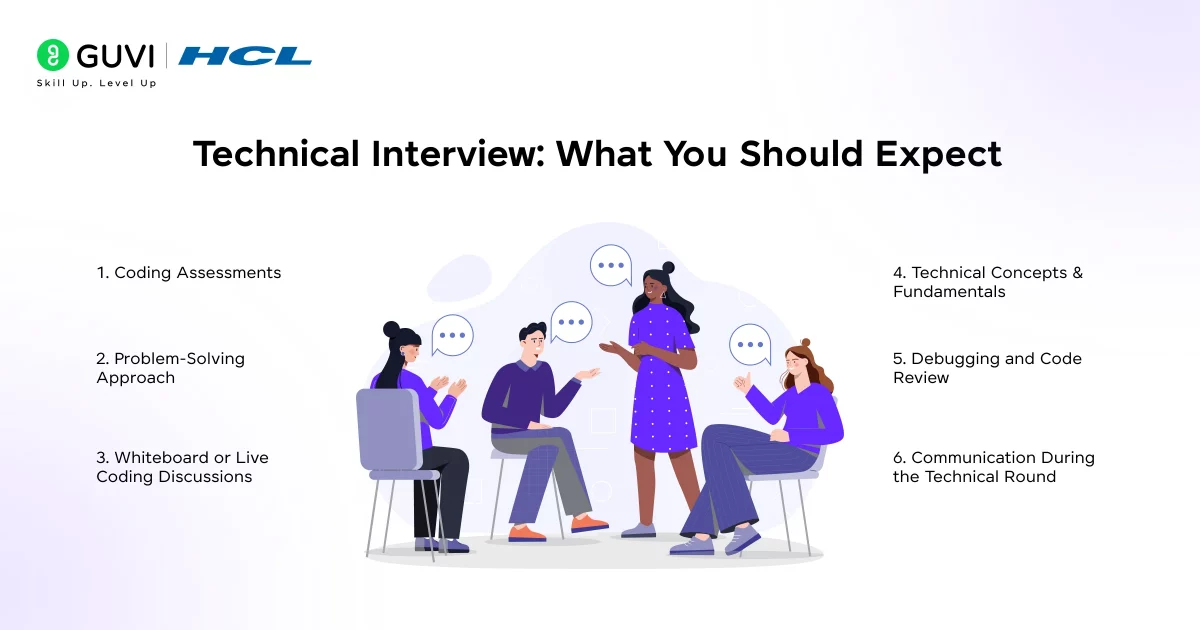
The technical interview is where your engineering skills take center stage. Even if you’re a beginner, you can walk into this round confidently once you understand what’s actually being evaluated. It’s not just about solving problems; it’s about showing how you think, how you communicate, and how you approach unfamiliar challenges.
Let’s look at the different parts of this interview and what they really mean for you.
1. Coding Assessments
Most technical interviews start with a coding round. This could be on a shared online editor or a platform like HackerRank or CodeSignal. You may get one or multiple problems related to:
- Arrays
- Strings
- Linked lists
- Sorting
- Searching
- Basic recursion
- HashMaps
- Simple dynamic programming (sometimes)
What they want to see:
- Can you break down a problem into smaller steps?
- Do you choose the right data structure?
- Is your code clear and readable?
- Do you consider edge cases?
- How do you handle pressure?
Note: Your final code isn’t the only thing that matters. Interviewers pay just as much attention to how you get there. Thinking aloud helps them follow your logic.

2. Problem-Solving Approach
Your mindset is more important than your memory. Interviewers aren’t looking for someone who has memorized solutions. They want a structured thinker.
They often check:
- Do you pause and understand the question before coding?
- Do you clarify assumptions?
- Can you figure out a brute-force solution first?
- Do you know how to optimize gradually?
Here’s a quick approach you can rely on:
- Understand the problem
- Ask clarifying questions
- Propose a simple solution
- Improve it step by step
- Start coding
- Test with sample inputs
- Fix edge cases
This shows maturity, even if your code isn’t perfect.
3. Whiteboard or Live Coding Discussions
Some companies (or college hiring teams) still use virtual whiteboards. You’ll write logic without autocomplete or syntax highlighting.
Purpose: To see your analytical thinking without relying on tools.
What matters more than syntax:
- Clear reasoning
- Diagrams
- Approaching the solution thoughtfully
- Communicating your decision-making
4. Technical Concepts & Fundamentals
For entry-level roles, expect questions around:
- Arrays
- Linked lists
- Stacks
- Queues
- Trees (basics only)
- Graph fundamentals (sometimes)
- Sorting
- Searching
- Recursion
- Hashing
Other Essentials
- OOP basics (Encapsulation, Inheritance, Polymorphism, Abstraction)
- Databases (SQL basics, joins, normalization)
- Operating systems (very basic concepts)
- Version control (Git commits, branching, merging)
They don’t expect expert-level knowledge; they expect you to understand the “why” behind concepts.
If you want to read more about DSA and want to quickly brush the topics, consider reading HCL GUVI’s Free Ebook: The Complete Data Structures and Algorithms Handbook, which covers the key concepts of Data Structures and Algorithms, including essential concepts, problem-solving techniques, and real MNC questions
5. Debugging and Code Review
Some companies give you code with bugs and ask you to fix it.
This helps interviewers judge:
- Attention to detail
- Comfort with reading unfamiliar code
- Logical reasoning
- Ability to explain problems clearly
Don’t panic, debugging is often easier than writing from scratch because you’re already given a direction.
6. Communication During the Technical Round
One of the biggest misconceptions among beginners is that you shouldn’t talk unless asked. In reality, interviewers heavily evaluate communication.
Here’s what good communication looks like:
- You repeat the problem to confirm understanding
- You talk through your thought process
- You explain why you chose a certain data structure
- You mention edge cases proactively
- You test your code verbally
Clear communication can compensate for small mistakes; silence cannot.
In short…
A technical interview checks how you think and how you approach problems, not whether you know everything. Beginners who show clarity, structure, and curiosity often perform better than those who memorize solutions.
If you want to learn the nuances of cracking an interview, then this blog is for you – How to Prepare for a Job Interview and Ace it? Top 8 Steps
HR Interview: What You Should Expect
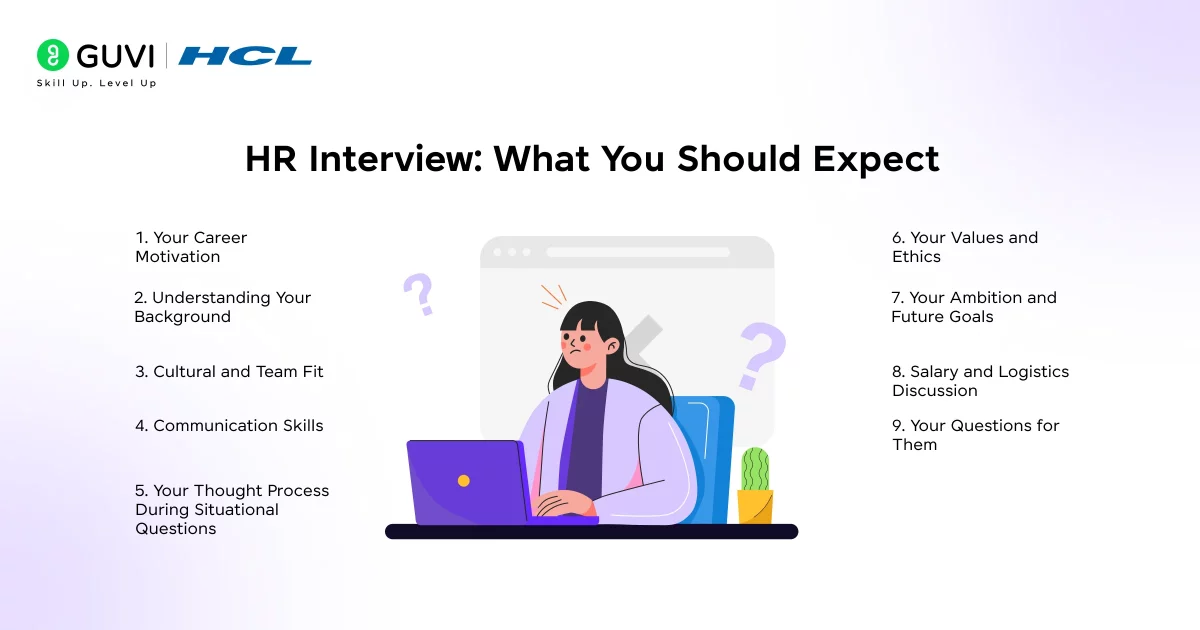
Many beginners underestimate the HR interview because they assume it’s just a casual conversation. But this round has a big influence on your final result. HR wants to know whether you’ll work well within the team, handle professional challenges, and align with the company’s values.
Let’s unpack this round with the same clarity.
1. Your Career Motivation
HR will often start with questions like:
- Why do you want to become a software engineer?
- How did you get into coding?
- What motivates you?
They want to understand:
- Whether you genuinely like tech
- Whether you’ve put effort into building skills
- Whether you’re applying because you want a career, not just a job
Your story doesn’t have to be dramatic. It just needs to be honest and structured.
2. Understanding Your Background
Whether you’re a student or a fresher, HR wants to know:
- What projects have you worked on
- What challenges have you faced
- What you learned from them
- How you contribute in groups
Even personal or academic projects matter, as long as you explain them well.
3. Cultural and Team Fit
This is a big part of the HR evaluation. They look for traits like:
- Cooperation
- Humility
- Ownership
- Empathy
- Willingness to learn
- Ethics
- Respectfulness
Even small behaviors, like being polite, listening well, or showing enthusiasm, are noticed.
4. Communication Skills
You don’t need perfect English. What HR cares about is:
- Clarity
- Confidence
- Structure
- Relevance
- Professional tone
If you drift off-topic or ramble too much, it signals weak communication.
5. Your Thought Process During Situational Questions
HR often asks scenario-based questions such as:
- Tell me about a time you disagreed with someone.
- How do you handle pressure?
- What would you do if your manager gave unclear instructions?
They’re not testing the situation itself; they’re testing your maturity and problem-solving approach.
A reliable method is the STAR technique:
- Situation
- Task
- Action
- Result
Beginners find this structure easy because it keeps the answer crisp and focused.
6. Your Values and Ethics
Companies want engineers who:
- Don’t cut corners
- Don’t blame others
- Own their mistakes
- Respect deadlines
- Respect teammates
HR checks these qualities subtly through your answers.
7. Your Ambition and Future Goals
Expect questions like:
- Where do you see yourself in 3 years?
- What do you want to learn next?
- What excites you about this role?
They aren’t expecting a perfect roadmap. They just want:
- Direction
- Curiosity
- Drive
If you sound unsure of why you applied, that’s a red flag.
8. Salary and Logistics Discussion
Toward the end, HR may talk about:
- Job location
- Notice period
- Availability
- Compensation
- Work mode (remote/hybrid/on-site)
Answer honestly and clearly. They’re simply gathering information.
9. Your Questions for Them
You’re expected to ask thoughtful questions like:
- What does growth look like in this role?
- How is performance evaluated?
- What does the team’s workflow look like?
Asking questions shows interest and confidence.
Avoid asking:
- What’s the salary? (Ask only if HR brings it up)
- How many leaves do I get?
- Anything you could easily Google
Quickly prepare for HR Interviews with this blog – Top 25 HR Interview Questions and Answers
Key Differences Between Technical and HR Interviews
Below is a detailed table that clearly explains the differences between a technical interview and an HR interview:
| Category | Technical Interview | HR Interview |
| Core Purpose | The technical round checks whether you can actually do the job. It looks at how you think through problems, how you write code, and how you break complex tasks into manageable steps. | The HR round focuses on the person behind the code. HR wants to know whether you’re dependable, self-aware, and capable of working well with others. |
| What You’ll Mostly Talk About | Algorithms, data structures, time complexity, debugging approaches, project technicalities, system basics, and the choices you make while solving a problem. | Your goals, personality, past experiences, strengths, weaknesses, teamwork, conflict handling, communication style, and what motivates you. |
| Skills Being Evaluated | Logical reasoning, structured analysis, coding proficiency, ability to handle unknown problems, and clarity of explanation. | Communication, attitude, emotional maturity, cultural fit, work ethic, professionalism, and learning mindset. |
| Level of Pressure | Usually higher because you’re actively solving problems and you know your performance is measurable. | Far more relaxed in comparison. It feels like a casual conversation but still requires thoughtfulness. |
| Type of Preparation Required | Coding practice (DSA fundamentals), mock interviews, problem-solving routines, brushing up on basics, and gaining comfort with thinking aloud. | Reviewing your experiences, preparing stories, reflecting on strengths and weaknesses, researching the company, and improving clarity in communication. |
| What Can Go Wrong | Calm reasoning, clean code, ability to discuss trade-offs, asking smar,t clarifying questions, testing your solution with examples, and staying composed when stuck. | Giving robotic or overly rehearsed answers, talking too much, underselling yourself, or sounding unsure about why you applied. HR can sense inconsistency instantly. |
| What Impresses Interviewers | Calm reasoning, clean code, ability to discuss trade-offs, asking smart clarifying questions, testing your solution with examples, and staying composed when stuck. | Honest storytelling, self-awareness, curiosity, positivity, and the ability to communicate clearly without sounding scripted. HR appreciates authenticity more than perfection. |
Common Mistakes Beginners Make in a Technical and HR Interview
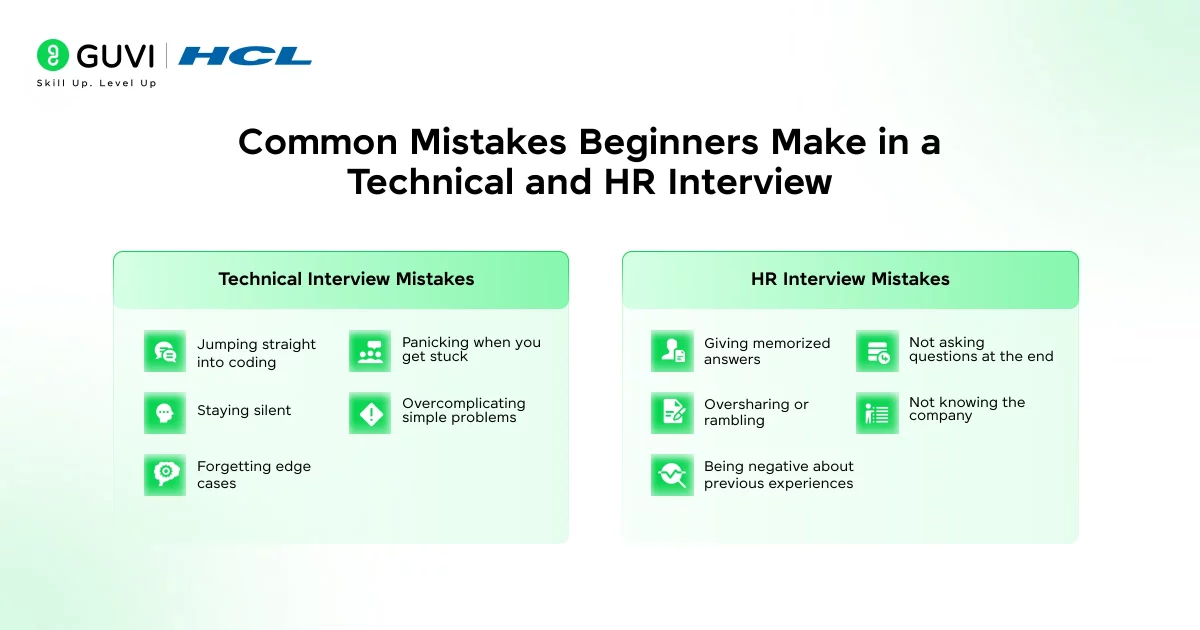
Beginners often struggle not because they lack skill, but because they aren’t aware of some very fixable habits.
Let’s break down mistakes for each round.
Technical Interview Mistakes
1. Jumping straight into coding
Many candidates get excited and start typing without fully understanding the problem. Interviewers expect you to pause, think, and clarify.
2. Staying silent
Silence makes interviewers guess what’s happening in your mind. They don’t want to guess — they want to see your reasoning.
3. Forgetting edge cases
Testing your code with sample values is essential. An easy problem can fail because you never checked empty inputs or repeated characters.
4. Panicking when you get stuck
Getting stuck is normal. What matters is how you recover. Interviewers appreciate calm thinking more than perfect logic.
5. Overcomplicating simple problems
Beginners sometimes use advanced techniques when a simple loop would do. Simplicity is always a strength.
HR Interview Mistakes
1. Giving memorized answers
HR can sense rehearsed lines instantly. Your answers should sound structured, not robotic.
2. Oversharing or rambling
It’s easy to go off track when talking about yourself. Keep answers focused and relevant.
3. Being negative about previous experiences
Complaining about teammates, professors, or past failures signals a poor attitude.
4. Not asking questions at the end
When they ask if you have questions, the answer should never be “No.” You miss a chance to show curiosity.
5. Not knowing the company
Saying “I like your company” without specifics shows a lack of preparation.
Final Tips to Stand Out in an Interview
- Stay calm and explain your logic clearly
- Be honest when you don’t know something
- Ask clarifying questions
- Show eagerness to learn
- Keep your energy positive
- Respect the interviewer’s time
The combination of skills + attitude is what moves applications forward.
If you’re serious about mastering software developer interviews along with AI and want to apply it in real-world scenarios, don’t miss the chance to enroll in HCL GUVI’s IITM Pravartak and MongoDB Certified Online AI Software Development Course. Endorsed with NSDC certification, this course adds a globally recognized credential to your resume, a powerful edge that sets you apart in the competitive job market.
Conclusion
In conclusion, a technical and an HR interview may feel worlds apart, but together they give companies a complete picture of who you are, both as an engineer and as a teammate. One round highlights your ability to think, solve problems, and write clean code, while the other reveals your willingness to collaborate, communicate, learn, and grow within the team.
When you prepare for both with equal attention, you don’t just perform better in interviews; you also understand yourself better as a candidate.
At the end of the day, interviewers aren’t looking for perfection. They’re looking for clarity, curiosity, and a genuine mindset. Do that, and every interview becomes less like a test and more like an opportunity to show what you’re capable of.
FAQs
1. What is the main difference between a technical interview and an HR interview?
A technical interview evaluates your coding skills, problem-solving, and understanding of core concepts. An HR interview checks your personality, communication, values, and cultural fit. Both rounds together decide your suitability for the role.
2. How should I prepare for a technical interview as a beginner?
Focus on DSA basics, practice easy-to-medium coding problems, and learn to explain your thought process aloud. Review common patterns and test your solutions with examples.
3. What does HR look for in a software engineer interview?
HR checks your motivation, teamwork skills, communication style, and how well your attitude aligns with the company. They want someone who learns quickly, handles feedback well, and fits the team environment.
4. Can I fail the HR interview even if my technical round went well?
Yes. If communication, attitude, or cultural fit doesn’t match the company’s expectations, it can impact the final decision. Both rounds matter independently.
5. What questions are commonly asked in HR interviews for software engineers?
Expect questions about strengths, weaknesses, career motivation, conflicts, failures, teamwork, and future goals. Each question helps HR understand how you behave in real work situations.
Success Stories

About the Author
Lukesh S
A professional content writer who has experience in freelancing and now working as a Technical Content Writer at GUVI. Google Certified Digital Marketer. Have a sound knowledge of SQL, Data Structures and Cloud Computing.
View all posts by Lukesh S
Connect with me @











Did you enjoy this article?