


Career Articles
How I Switched from Web Developer to ML Engineer (A Web Developer's Real Story)
PHP Developer Resume: Writing Guide & Key to Landing Your Dream Job
My Frontend Developer Interview at Google: What Really Happens Behind Closed Doors
Future of Electric Vehicle Course: Fast-Track Your EV Career


Get In Touch For Details! Request More Information
A Practical Guide to Choose Best Technical Certifications for IT Project Managers
Feb 25, 2026 8 Min Read 844 Views
(Last Updated)
Anyone aspiring to grow as an IT leader faces a confusing choice when selecting the technical certifications for IT project managers role. The right certification not only validates your skills but also positions you for higher responsibility and better salary prospects.
LinkedIn job reports show technical project managers have grown 30-40% faster than regular PM roles. Today’s IT project managers must speak the language of developers, understand cloud systems, and work confidently in complex technical settings. Choosing the right technical certification for IT project manager role helps prove you can operate at this higher level.
Technical certifications prove you have both leadership skills and hands-on technical knowledge. This makes you more valuable to any company.
Companies increasingly prefer professionals who hold a recognized technical certification for IT project manager role, as these credentials show the ability to bridge business goals with engineering execution.
Getting the right credentials matters more than ever.
This guide shows you the top IT project manager certifications that combine technical knowledge with project management skills. By the end, you’ll know how to select the right technical certification for IT project manager role based on your experience, industry, and career goals.
The best technical certification for an IT project manager depends on your experience level, work environment.
‣ Software development teams benefit most from Agile or Scrum certifications. ‣Infrastructure and operations roles should look at ITIL certifications.
‣ Large companies often need SAFe certifications. For broad career flexibility, PMP remains the gold standard across industries.
Table of contents
- Why Technical Certifications Matter for IT Project Managers
- How to Choose the Right Technical Certification for IT Project Managers
- Factors to Consider When Choosing the Right Technical Certification for an IT Manager
- Top Technical Certification for IT Project Manager Roles
- PMP (Project Management Professional) – PMI
- Certified Technical Project Manager (CTPM)
- Agile Certification for IT PMs (PMI-ACP / AgilePM)
- Scrum Master Certification (CSM / PSM)
- ITIL Certification for Project Management
- SAFe Certification for IT Project Managers
- PMP vs Technical PM Certifications – Which One Should You Choose?
- Entry-Level IT PMs (0-2 years experience)
- Mid-Level Technical PMs (3-5 years experience)
- Senior IT Project Managers (6-10 years experience)
- Enterprise & Transformation Leaders (10+ years experience)
- Conclusion
- Frequently Asked Questions
- What is the best technical certification for an IT project manager?
- Is PMP enough for technical project management?
- Which Agile certification is best for IT PMs?
- Do IT project managers need Scrum certification?
- How long does it take to get PMP certification?
- What's the difference between CTPM and PMP?
- Is SAFe certification worth it for project managers?
Why Technical Certifications Matter for IT Project Managers
Traditional project managers focus on timelines, budgets, and talking with stakeholders. Technical project managers must go deeper. You need to understand software development cycles, spot technical risks, and make smart decisions about systems and infrastructure. This is where a strong technical certification for IT project manager role delivers real value.
A certified technical project manager brings instant credibility to technical talks. And 81% of the organisation is willing to pay higher salaries for certified professionals.
When you can speak confidently about APIs, DevOps pipelines, cloud services, or Agile sprints, your development team respects you more. You’re not just managing schedules. You’re understanding the actual work being done. A recognized technical certification for IT project manager role proves that competence.
The benefits go beyond team relationships. You can translate technical terms into business language and business needs into technical terms, becoming a bridge between engineering and executive teams.
When you understand the technical side of choices, you can make decisions quickly without constantly asking technical leads for help. Stakeholders trust project managers who show both business sense and technical skills, which leads to more freedom in your role and better career chances.
Industry surveys consistently show that professionals with a relevant technical certification for IT project manager role earn 15–25% more than non-certified peers, especially in software, cloud, and DevOps environments.
In fields like software development, cloud infrastructure, and DevOps, technical knowledge isn’t optional. It’s required for good project management.
Looking to manage projects more efficiently in Agile environments? HCL GUVI’s JIRA Project Management course helps you learn real-world project tracking, sprint planning, and team collaboration using JIRA, skills that employers look for in modern project managers.
How to Choose the Right Technical Certification for IT Project Managers
Choosing the right technical certification for IT project manager role depends on your role, experience, and work environment.
IT project managers in software teams may benefit more from Agile or Scrum certifications, while those in enterprise or infrastructure roles may find PMP, ITIL, or SAFe more valuable. The best choice is one that aligns with your current responsibilities.
Factors to Consider When Choosing the Right Technical Certification for an IT Manager
Not all certifications are equal. Selecting the right technical certification for the IT project manager role requires evaluating several factors:
Start by considering your experience level. Entry-level IT PMs should start with basic certifications that build both PM and technical skills. Senior PMs benefit from specialized certifications that show expertise in specific methods or technologies.
Your industry focus matters too. Software development teams value Agile and Scrum certifications. Infrastructure and operations roles benefit from ITIL. Large companies often require SAFe knowledge.
Think about your methodology preference. Agile and Scrum certifications work for fast-paced environments. PMP works for traditional or mixed approaches. Specialized frameworks like SAFe work for large-scale projects.
Budget and time commitment play a role. Some certifications need extensive study, with PMP requiring 200+ hours. Others can be finished in weeks. Think about exam costs, training materials, and renewal requirements.
Ask yourself these questions: What methodology does your company use? What technical environment do you work in, whether software, infrastructure, or cloud? How much time can you spend on preparation? What career level are you targeting next? Does your company pay for certifications?

Top Technical Certification for IT Project Manager Roles
The top certifications include PMP from PMI. Certified Technical Project Manager, Agile certifications like PMI-ACP and AgilePM, Scrum Master certifications including CSM and PSM.
ITIL Certification for Project Management, and SAFe Certification for IT Project Managers.
1. PMP (Project Management Professional) – PMI
The PMP remains the top certification in project management. Industry survey shows that professionals with PMP Certification earn 20-30% more on average than non-certified peers globally.
Companies worldwide recognize it across all industries. While not only technical, you need to understand the PMP when planning your certification strategy.
The Project Management Institute offers the PMP. It tests your knowledge across starting, planning, doing, monitoring, and closing projects. The latest version includes lots of Agile content, making it more useful for IT environments.
This certification works best for mid to senior-level project managers who need global recognition and work across different project types. It’s great for those who manage both technical and non-technical projects or want to reach executive leadership.
The technical relevance is moderate. PMP covers project management basics that apply to IT projects, but doesn’t go deep into technical details like SDLC, DevOps, or software design. However, it now includes more Agile and mixed approaches useful for software teams.
The certification offers the highest recognition worldwide and shows complete PM expertise. It opens doors across many industries and is often required for senior PM jobs. You’ll also find a strong community and lots of resources. However, you need significant experience of 3-5 years and must commit to 100-200 hours of study.
It provides less technical depth than specialized IT certifications, costs $555 for PMI members, and requires ongoing PDUs to keep your certification active.
PMP holders report average salary increases of $20,000 and much better job chances. It’s particularly valuable for those who want to work across different industries or move into program or portfolio management.
Course Details:
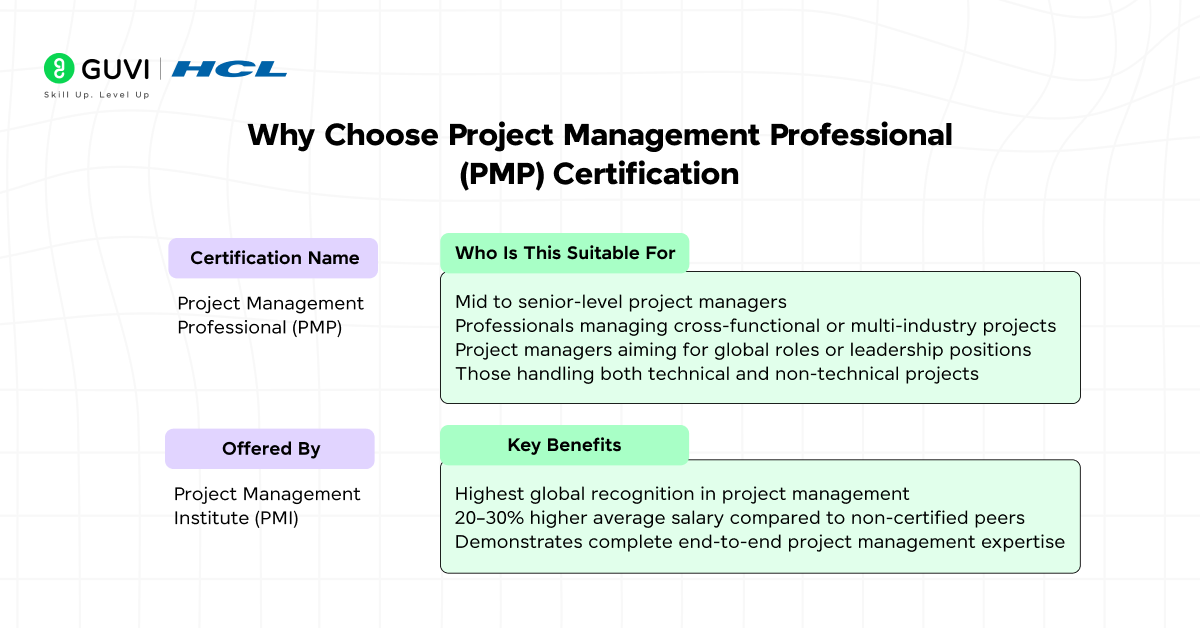
Certification Name: Project Management Professional (PMP)
Offered By: Project Management Institute (PMI)
Who Is This Suitable For: Mid to senior-level project managers. Professionals managing cross-functional or multi-industry projects. Project managers aiming for global roles or leadership positions. Those handling both technical and non-technical projects
Key Benefits: Highest global recognition in project management
20–30% higher average salary compared to non-certified peers
Demonstrates complete end-to-end project management expertise
Course Cost: ₹ 50,025 INR
2. Certified Technical Project Manager (CTPM)
The CTPM is made specifically for project managers working in technical environments. This makes it one of the best certifications for technical project managers who want specialized credentials.
This certification focuses only on managing technical projects. It emphasizes software development cycles, working with engineers, and technology-specific project challenges. Unlike broader certifications, CTPM assumes you work in a technical field.
The curriculum covers Software Development Life Cycle management, Agile and DevOps integration, technical risk assessment and reduction, engineering team dynamics, technical debt management, and cloud and infrastructure project considerations. The program places strong emphasis on working with engineering teams, understanding technical design decisions, and managing the unique challenges of software and IT projects.
This certification works best for mid-level technical PMs who have 2-5 years of experience managing software or IT infrastructure projects and want to formalize their technical project management skills. It positions you as a specialist in technical project management, particularly valuable in software companies, tech startups, and companies going through digital transformation.
Course Details:
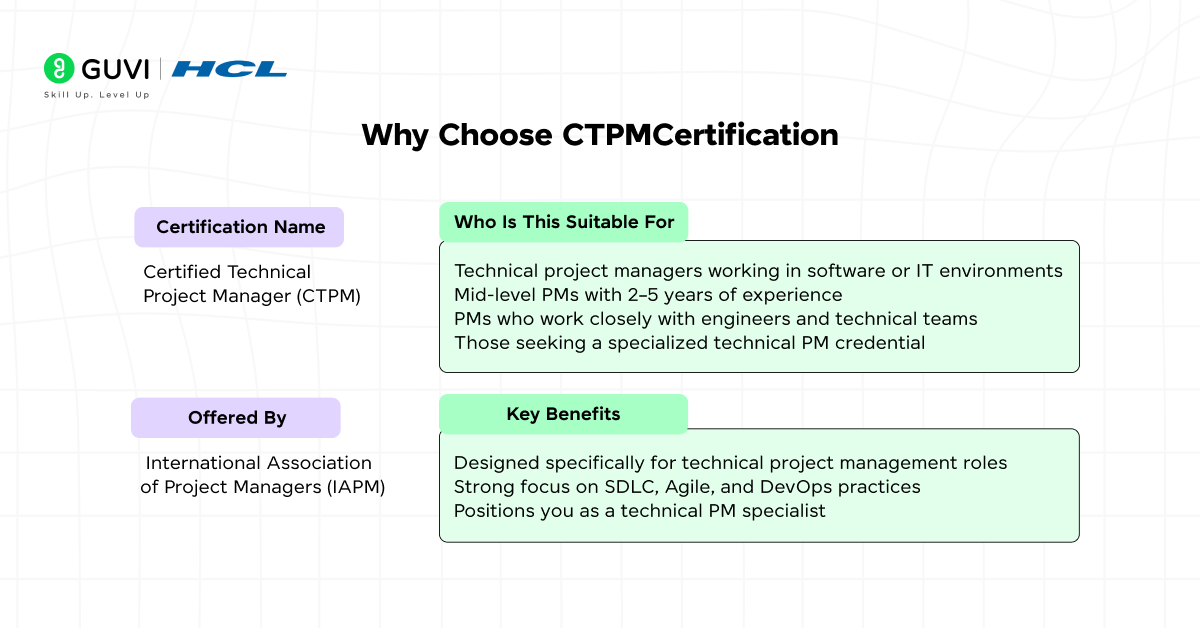
Certification Name: Certified Technical Project Manager (CTPM)
Offered By: International Association of Project Managers (IAPM)
Who Is This Suitable For: Technical project managers working in software or IT environments. Mid-level PMs with 2–5 years of experience. PMs who work closely with engineers and technical teams. Those seeking a specialized technical PM credential
Key Benefits: Designed specifically for technical project management roles
Strong focus on SDLC, Agile, and DevOps practices. Positions you as a technical PM specialist
Course Cost: ₹45,000 – ₹55,000 INR
3. Agile Certification for IT PMs (PMI-ACP / AgilePM)
As software development uses more iterative approaches, an Agile certification for IT PMs has become almost essential for anyone managing software projects.
Agile focuses on delivering value step by step through short cycles called sprints, continuous feedback, and flexible planning. Instead of detailed planning up front, Agile teams focus on flexibility and quick response to change.
Two key certifications stand out. PMI-ACP, or PMI Agile Certified Practitioner, offers complete Agile certification covering Scrum, Kanban, Lean, XP, and more. AgilePM focuses specifically on project management in Agile environments.
When you work mainly in software development, startups, or fast-paced environments where requirements change often, Agile certification may be more immediately useful than PMP. However, many IT project managers eventually get both.
Software teams use these certifications for managing product development cycles, coordinating cross-functional software teams, setting up continuous delivery pipelines, running sprint planning and retrospectives, and scaling Agile across multiple teams.
This certification works best for IT project managers working in software development, SaaS companies, mobile app development, or any environment where step-by-step development is the norm.
Course Details:
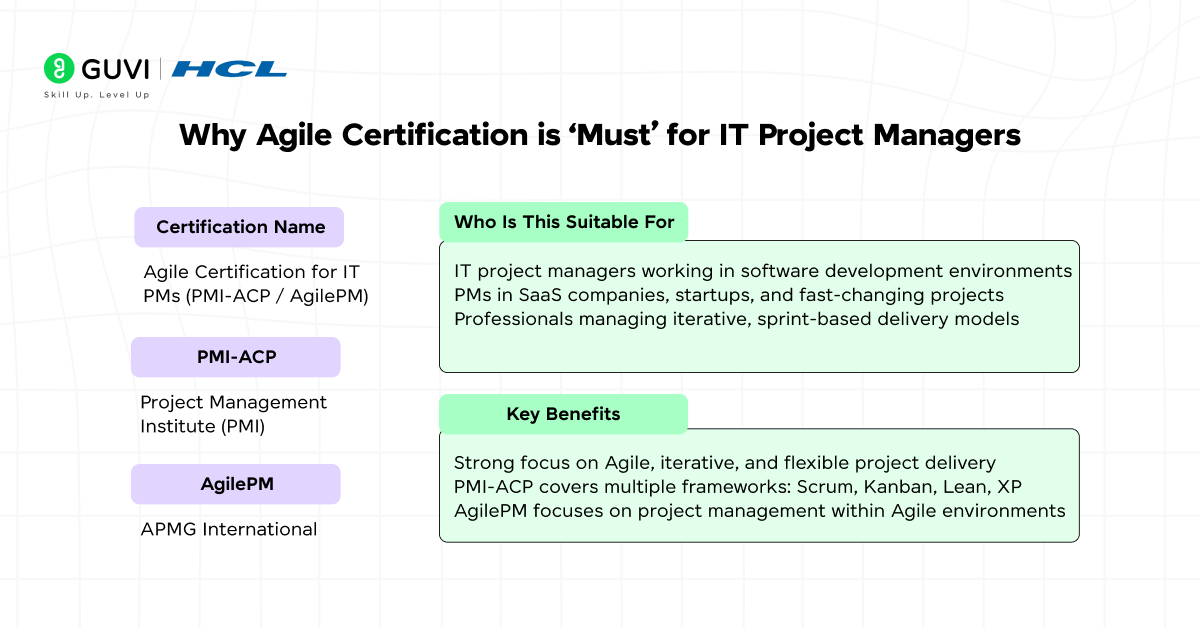
Certification Name: Agile Certification for IT PMs (PMI-ACP / AgilePM)
Offered By: PMI-ACP: Project Management Institute (PMI)
AgilePM: APMG International
Who Is This Suitable For: IT project managers working in software development environments. PMs in SaaS companies, startups, and fast-changing projects. Professionals managing iterative, sprint-based delivery models
Key Benefits
Strong focus on Agile, iterative, and flexible project delivery. PMI-ACP covers multiple frameworks: Scrum, Kanban, Lean, XP. AgilePM focuses on project management within Agile environments.
Course Cost: ₹40,000 INR
4. Scrum Master Certification (CSM / PSM)
Highly valuable in software companies, startups, digital agencies, and product teams
The Scrum Master certification for project managers is often debated. After all, Scrum Masters and Project Managers are different roles. However, understanding Scrum deeply makes you a more effective IT project manager.
Two key certifications lead the field: CSM or Certified ScrumMaster from Scrum Alliance, and PSM or Professional Scrum Master from Scrum.org.
A Scrum Master is a servant leader who helps the Scrum process and removes roadblocks for the team. A Project Manager has broader responsibility for project success, including budget, timeline, and stakeholder management. However, these roles often overlap in practice.
Even when you’re not a full-time Scrum Master, understanding the Scrum framework helps you run more effective sprint planning, better support Agile teams, communicate effectively in Scrum environments, understand team velocity and capacity planning, and navigate Agile transformations.
This certification works particularly well in software development companies, digital agencies, product development teams, startups using Agile methods, and companies transitioning to Agile. Some IT project managers hold both PM and Scrum Master certifications, allowing them to work flexibly across different company structures.
Course Details:
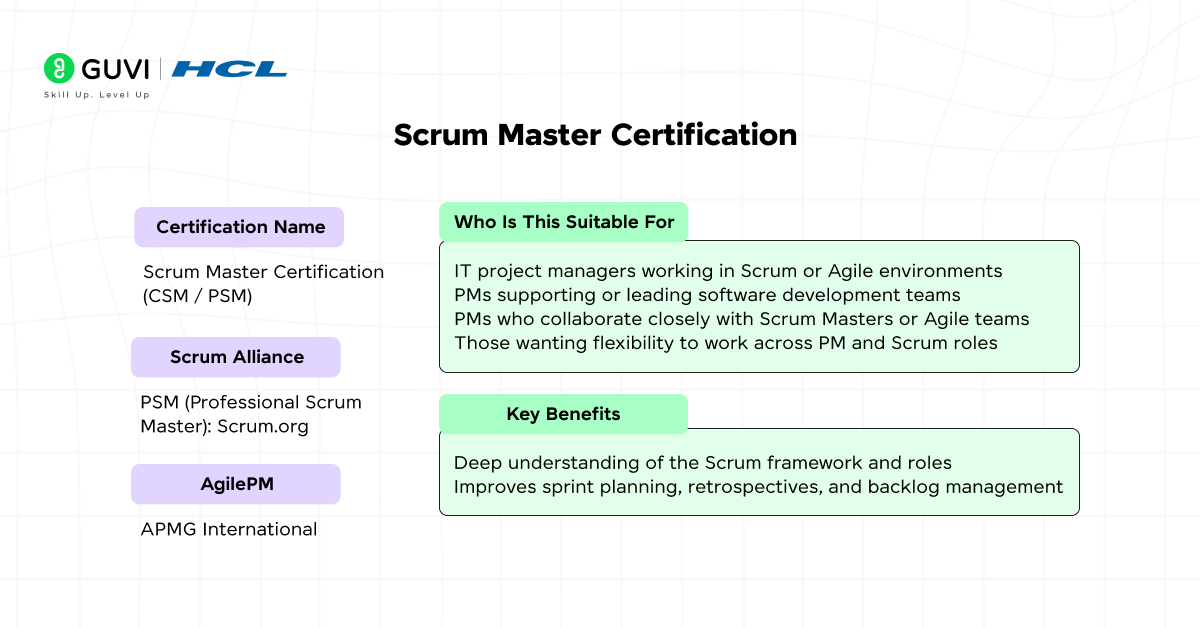
Certification Name: Scrum Master Certification (CSM / PSM)
Offered By: CSM (Certified ScrumMaster)
Who Is This Suitable For: IT project managers working in Scrum or Agile environments. PMs supporting or leading software development teams. PMs who collaborate closely with Scrum Masters or Agile teams. Those wanting flexibility to work across PM and Scrum roles.
Key Benefits: Deep understanding of the Scrum framework and roles. Improves sprint planning, retrospectives, and backlog management
Course Cost: ₹18,000 – ₹25,000 INR
5. ITIL Certification for Project Management
ITIL, or Information Technology Infrastructure Library, is a framework for IT service management. It focuses on aligning IT services with business needs. It covers incident management, change management, service delivery, and more.
This becomes especially relevant when your projects involve IT infrastructure deployments, service desk implementations, IT operations improvements, change management in production environments, or enterprise IT service delivery. ITIL provides the framework and language your company likely uses.
Three main certification levels exist. ITIL Foundation provides an entry-level understanding of ITIL concepts. ITIL Practitioner focuses on practical implementation. ITIL Intermediate and Expert offer advanced specialization.
The certification fits best for IT Operations Project Managers, Service Delivery Managers, Infrastructure Project Managers, IT Support Managers transitioning to PM roles, and Enterprise IT Project Managers.
ITIL certification shows you understand the operational side of IT, not just project delivery. This is important for roles where projects must integrate with existing IT services and operations.
Course Details:
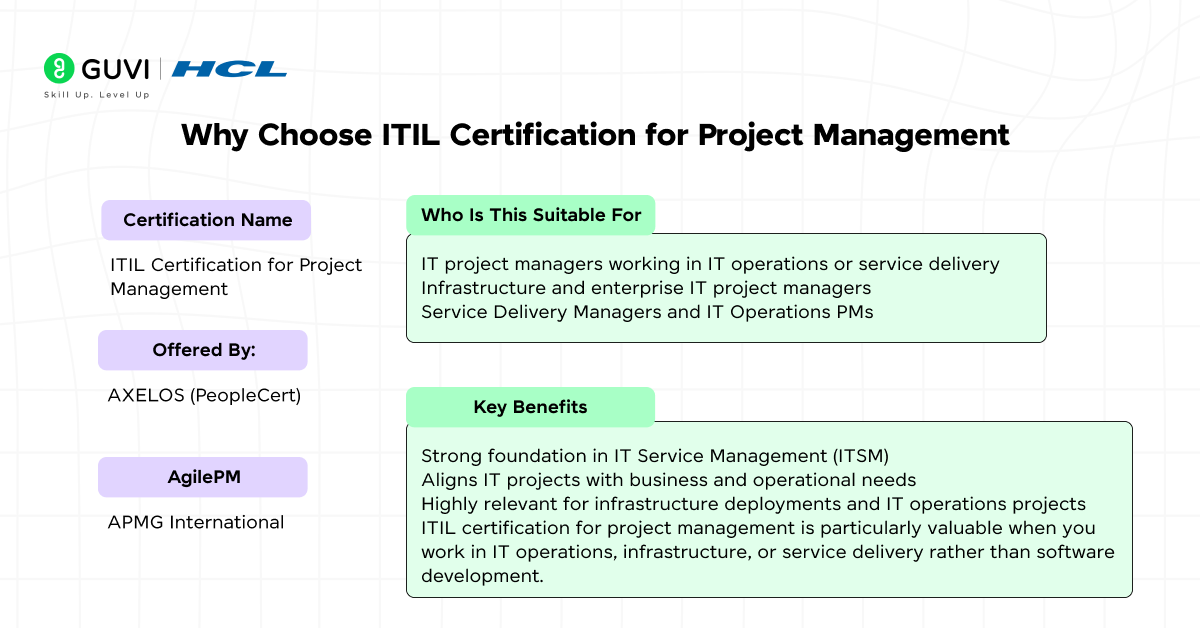
Certification Name: ITIL Certification for Project Management
Offered By: AXELOS (PeopleCert)
Who Is This Suitable For: IT project managers working in IT operations or service delivery. Infrastructure and enterprise IT project managers. Service Delivery Managers and IT Operations PMs
Key Benefits: Strong foundation in IT Service Management (ITSM). Aligns IT projects with business and operational needs. Highly relevant for infrastructure deployments and IT operations projects. ITIL certification for project management is particularly valuable when you work in IT operations, infrastructure, or service delivery rather than software development.
Course Cost: ₹30,000 – ₹50,000 INR
6. SAFe Certification for IT Project Managers
SAFe certification for IT project managers is essential when you work in large companies doing Agile across multiple teams or departments. As reports suggest, over 70% of Fortune 100 companies use SAFe certification.
SAFe, or Scaled Agile Framework, provides a structured approach to using Agile practices across large companies with multiple teams working on connected products.
While Scrum works well for small teams, SAFe addresses the challenges of coordinating 50-150+ people across multiple Agile teams, aligning technical work with business strategy, managing dependencies between teams, and planning and executing large-scale releases.
SAFe becomes more valuable than pure Scrum when your company has multiple Agile teams working on the same product, complex enterprise software with many dependencies, a need for portfolio-level planning and governance, or large-scale digital transformation projects. SAFe provides the structure needed, while pure Scrum may not be enough.
Four main certifications exist in the SAFe ecosystem. SAFe Agilist provides basic understanding. SAFe Scrum Master is for those running teams. The SAFe Program Consultant is for those leading implementations. The SAFe Release Train Engineer is for those coordinating multiple teams.
The framework offers better coordination across large technical companies, improved alignment between IT and business strategy, a structured approach to managing technical dependencies, and career advancement in enterprise environments.
This certification works best for IT project managers in Fortune 500 companies, government agencies, or large companies doing Agile transformations.
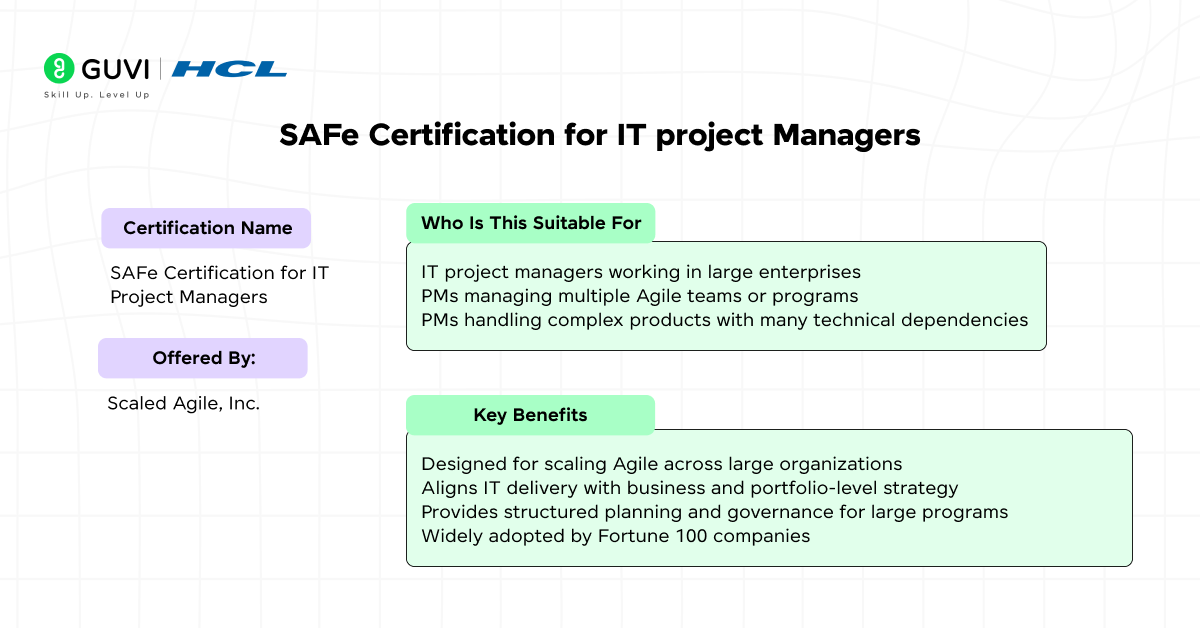
Course Details: Certification Name: SAFe Certification for IT Project Managers
Offered By: Scaled Agile, Inc.
Who Is This Suitable For: IT project managers working in large enterprises. PMs managing multiple Agile teams or programs. PMs handling complex products with many technical dependencies
Key Benefits: Designed for scaling Agile across large organizations. Aligns IT delivery with business and portfolio-level strategy. Provides structured planning and governance for large programs. Widely adopted by Fortune 100 companies
Course Cost: ₹ 40,00 INR
PMP vs Technical PM Certifications – Which One Should You Choose?
Understanding the PMP vs technical PM certification decision is important for your career strategy.
Neither is universally better. PMP offers broader recognition and flexibility, while technical PM certifications provide deeper relevance for IT roles. Many successful IT project managers eventually get both. Start with a technical certification for immediate relevance, then add PMP for long-term career flexibility.
Choose the Right Technical Certification for IT Project Manager at Different Career Levels
Choosing the best certs for technical project managers depends on where you are and where you want to go.
Entry-Level IT PMs (0-2 years experience)
Start with Certified ScrumMaster or ITIL Foundation to build basic knowledge. Then move to PMI-ACP or AgilePM to develop methodology expertise.
Entry-level certifications establish credibility without requiring lots of experience. Focus on methodology and framework knowledge before pursuing advanced credentials. This path positions you for junior PM or project coordinator roles, with a clear path to mid-level positions.
Mid-Level Technical PMs (3-5 years experience)
Get your PMP to establish broad project management expertise. Add PMI-ACP or SAFe for Agile specialization. Then consider CTPM to deepen technical PM knowledge.
At mid-level, you have the experience required for PMP and can benefit from its industry recognition. Add specialized certifications matching your work environment. This opens doors to senior PM roles, program management positions, and higher pay.
Senior IT Project Managers (6-10 years experience)
Combine PMP with PMI-ACP for complete PM credentials. Add a SAFe Program Consultant or CTPM for specialized expertise. Consider an ITIL Expert for operations-focused roles. 82% of enterprise IT service organizations use ITIL Practice. Senior PMs benefit from credentials that show both breadth through PMP and specialized depth. Focus on certifications that align with leadership goals. This positions you for program director, PMO leadership, or VP-level technical leadership roles.
Enterprise & Transformation Leaders (10+ years experience)
Maintain your PMP and relevant Agile certifications. Get the SAFe Program Consultant certification to lead company transformations. Consider business-focused MBAs or executive programs.
At this level, certifications show thought leadership and help you guide company change. Focus on credentials that position you as a strategic advisor. This leads to executive-level positions, consulting opportunities, and company transformation leadership.
Conclusion
Technical certifications for IT project managers are no longer optional. They’re essential career investments that prove your ability to lead in complex technical environments. A well-chosen technical certification for IT project manager role strengthens your credibility, increases earning potential, and prepares you to lead complex technical initiatives.
94% of hiring managers say certifications improve candidate credibility.
You might choose the broad recognition of PMP, the specialized focus of CTPM, or the methodology-specific expertise of Agile and Scrum certifications. The key is aligning your choice with your career goals and work environment
Remember, there’s no single best certification for everyone. The certified technical project manager who succeeds is the one who strategically builds credentials that match their industry, company, and goals. Start by looking at where you are today, where you want to be in 3-5 years, and which certifications will bridge that gap most effectively.
Frequently Asked Questions
What is the best technical certification for an IT project manager?
The best technical certification for IT project manager roles depends on your specific situation. For software development environments, PMI-ACP or Certified ScrumMaster offers the most immediate value.
Is PMP enough for technical project management?
PMP provides excellent basic project management knowledge, but it’s not specifically focused on technical environments. PMP is valuable and widely recognized.
However, many IT project managers add technical certifications like PMI-ACP, CSM, or CTPM to gain deeper expertise in software development, Agile methods, or IT service management. The combination of PMP plus a technical specialization is often the strongest credential portfolio.
Which Agile certification is best for IT PMs?
PMI-ACP offers the most complete Agile certification for IT PMs, covering multiple Agile frameworks including Scrum, Kanban, and Lean. However, CSM or PSM may be more directly useful when you work mainly in Scrum environments.
For enterprise-scale Agile implementations, SAFe certifications are increasingly preferred. Choose based on your company’s specific methodology and scale.
Do IT project managers need Scrum certification?
While not always required, Scrum certification significantly benefits IT project managers working in Agile environments. Even when you’re not functioning as a Scrum Master, understanding Scrum framework helps you support development teams more effectively, run sprint activities, and communicate better with technical stakeholders. Many companies using Agile methods prefer or require PM candidates to have Scrum knowledge.
How long does it take to get PMP certification?
PMP certification typically requires 100-200 hours of study preparation, depending on your experience level and learning style. The application process takes 1-2 weeks for PMI review. Most candidates prepare over 2-4 months while working full-time.
What’s the difference between CTPM and PMP?
CTPM focuses specifically on managing technical projects in IT and software environments, with emphasis on SDLC, engineering collaboration, and technology-specific challenges. PMP is a broader certification covering project management across all industries and project types.
Is SAFe certification worth it for project managers?
SAFe certification is worth it when you work in large companies doing Agile at scale. It’s particularly valuable for IT project managers coordinating multiple teams, managing complex dependencies, or involved in company Agile transformations.
Success Stories

About the Author
Salini Balasubramaniam
A curious, information-savvy writer loves to turn deep insights into authentic and engaging content that connects. With experience in writing for brands and driving audience engagement, I believe that words can make a powerful difference.
View all posts by Salini Balasubramaniam
Connect with me @














Did you enjoy this article?