


Career Articles
How I Switched from Web Developer to ML Engineer (A Web Developer's Real Story)
PHP Developer Resume: Writing Guide & Key to Landing Your Dream Job
My Frontend Developer Interview at Google: What Really Happens Behind Closed Doors
Future of Electric Vehicle Course: Fast-Track Your EV Career


Get In Touch For Details! Request More Information
From Software Engineer to Technical Project Manager: A Career Transition Guide
Feb 25, 2026 7 Min Read 860 Views
(Last Updated)
As a software engineer, You’ve been writing code for years. You understand systems, ship features, and solve technical problems. But lately, something’s shifted.
The work that once excited you feels repetitive. You see projects fail because of poor planning, not bad code. You want to influence direction, not just execute tasks.
Moving from software engineer to technical project manager isn’t just a title change. It’s a career pivot that lets you apply your technical foundation while stepping into leadership, strategy, and cross-functional collaboration.
This guide walks you through the entire transition: why engineers make this move, what skills transfer, what you need to learn, and how to land your first TPM role.
Quick Answer:
A software engineer can become a Technical Project Manager by using their technical knowledge and learning project planning, communication, and leadership skills.
The transition usually takes 6–12 months through hands-on project ownership, PM frameworks, and relevant certifications like CSM or PMP.
Table of contents
- Why Software Engineers Move to Technical Project Manager Roles
- Software Engineer vs Technical Project Manager: Key Differences
- Skills You Already Have as a Software Engineer (Transferable Skills)
- Skills You Must Learn to Become a Technical Project Manager
- Technical Skills
- Project Management Skills
- Business and Leadership Skills
- Skill Gap Checklist
- Step-by-Step Career Transition Roadmap from Software Engineer to Technical Project Manager
- Step 1: Understand the TPM Role Clearly
- Step 2: Start Managing Projects in Your Current Role
- Step 3: Learn Project Management Frameworks
- Step 4: Get Relevant Certifications
- Step 5: Build a TPM-Ready Resume
- Step 6: Apply Internally or Externally
- Common Mistakes Software Engineers Make When Switching to TPM
- Is Technical Project Manager the Right Career for You?
- Your Next 90-Day Action Plan
- Conclusion
- Frequently Asked Questions
- Can a software engineer become a technical project manager?
- Do I need to stop coding to become a TPM?
- What skills do software engineers need to become TPMs?
- Are certifications required to become a technical project manager?
- How long does it take to transition from engineer to TPM?
Why Software Engineers Move to Technical Project Manager Roles
Most engineers don’t happen to decide in one day. The transition happens gradually, driven by specific pain points and realizations.
Career growth hits a ceiling: Senior engineer roles often max out at technical influence. To grow further, you either specialize deeply or move into leadership. TPM offers a middle path: stay technical but lead projects and people.
You want to shape outcomes, not just build features: Engineers see dysfunction up close. Unclear requirements, shifting priorities, miscommunication between teams. As a TPM, you prevent these problems instead of working around them.
Pure coding burns you out: Staring at a screen for eight hours solving algorithmic puzzles loses its appeal. TPM work varies: planning sessions, stakeholder meetings, risk analysis, technical reviews. The cognitive load shifts from deep focus to strategic thinking.
The market rewards this move. Technical project managers earn competitive salaries because they’re rare. Most PMs lack deep technical knowledge. Most engineers lack project management skills. Companies pay premium rates for people who bridge both worlds.
According to recent industry data, TPM roles have grown 35% faster than traditional PM positions over the past three years. Organizations building complex technical products need leaders who understand both code and coordination.
Software Engineer vs Technical Project Manager: Key Differences
| Aspect | Software Engineer | Technical Project Manager |
| Core Responsibility | Write, test, and maintain code | Plan, coordinate, and deliver technical projects |
| Daily Work | Coding, debugging, code reviews, technical design | Roadmap planning, sprint management, stakeholder alignment, risk mitigation |
| Primary Skills | Programming languages, algorithms, system design | Project planning, communication, technical judgment, leadership |
| Success Metrics | Code quality, feature delivery, system performance | On-time delivery, scope management, team velocity, stakeholder satisfaction |
| Collaboration Focus | Other engineers, tech leads | Engineering teams, product managers, executives, external partners |
| Career Growth | Senior Engineer → Staff → Principal → Architect | TPM → Senior TPM → Director of PM → VP of Engineering |
| Salary Range | ₹20.9 Lakhs (senior roles) | ₹32.5 Lakh (varies by company size and location) |
The biggest mental shift: your performance is measured not on what you build and start being measured on what your team delivers. Your success depends on orchestrating others, not individual output.
Skills You Already Have as a Software Engineer (Transferable Skills)
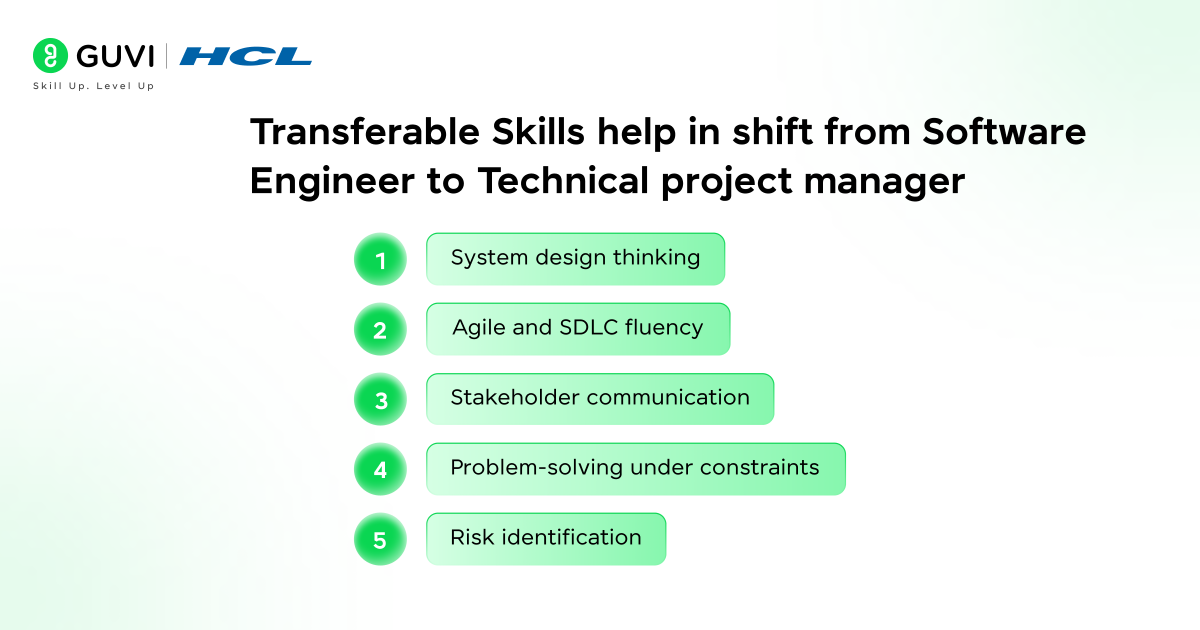
You’re not starting from zero. Years of engineering work have already built the foundation for TPM success.
System design thinking: You understand how components interact, where bottlenecks appear, and how technical decisions cascade. This translates directly to project planning. You can estimate work accurately because you know what’s actually involved.
Agile and SDLC fluency: You’ve lived through sprints, standups, retrospectives, and release cycles. You know what a good process looks like and where it breaks down. Most career PMs learn this theoretically. You learned by doing.
Stakeholder communication: Every time you’ve explained a technical issue to a non-technical teammate, debugged a production incident with support, or justified an architectural decision, you practiced TPM skills.
You already know how to translate between technical and business language.
Problem-solving under constraints: Engineers constantly balance speed, quality, and scope. You’ve made tradeoffs between ideal solutions and shipping something that works. That’s exactly what TPMs do at the project level.
Risk identification: You spot problems before they explode. You know when a dependency might slip, when an integration will cause issues, or when technical debt will slow the team. TPMs need this same pattern recognition applied to entire project lifecycles.
These skills give you an advantage over traditional PMs. You can have technical conversations with engineering teams, evaluate feasibility claims, and push back on unrealistic timelines with credibility.
Also Read: Technical Project Manager vs Project Manager: Key Difference Explained

Skills You Must Learn to Become a Technical Project Manager
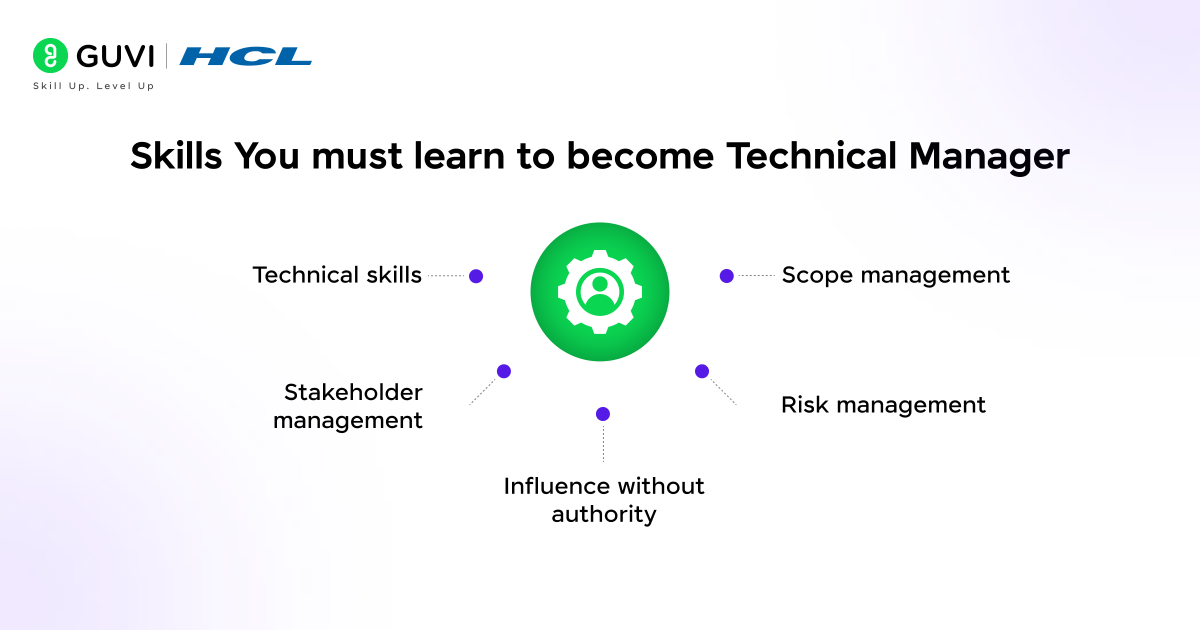
Transferable skills get you part of the way. The gap between engineer and TPM requires deliberate learning.
Technical Skills
You need to understand systems beyond what you’ve personally built. Study cloud architecture patterns, API design principles, and microservices communication. Read system design case studies from major tech companies. The goal isn’t to architect these systems yourself but to ask intelligent questions and identify risks.
Learn to read technical documentation quickly. TPMs work across multiple codebases and services. You won’t have time to dive deep into implementation, so you need to extract key information from docs, diagrams, and high-level code reviews.
Project Management Skills
Scope management means defining clear boundaries for what a project includes and defending those boundaries when stakeholders request additions. Engineers tend to say yes to feature requests. TPMs say, “That’s valuable, but it changes the timeline. Which priority should we drop?”
Timeline estimation at the project level differs from ticket estimation. You need to account for dependencies, context switching, unknown unknowns, and team velocity fluctuations. Build buffers into plans without padding individual tasks.
Risk management involves maintaining a living document of what could go wrong, probability ratings, and mitigation strategies. Review this weekly. Most projects fail because risks were identified but never actively managed.
Learn Gantt charts, critical path analysis, and resource allocation. These tools feel bureaucratic at first but become valuable when coordinating work across five teams with overlapping dependencies.
Business and Leadership Skills
Stakeholder management is a full-time job within the job. You’re constantly negotiating priorities, managing expectations, and building trust with people who don’t report to you. Learn to communicate project status clearly: what’s done, what’s at risk, what decisions you need from them.
Influence without authority separates good TPMs from mediocre ones. You can’t force engineers to work faster or tell product managers to change requirements. You persuade through data, logic, and relationship capital.
Study business metrics. Learn how your projects connect to revenue, user growth, or cost reduction. Executives care about outcomes, not features. Frame your project updates in their language.
Skill Gap Checklist
Use this to assess where you need focused learning:
- Can you create a project charter that defines success criteria and constraints?
- Do you know how to run effective meetings that end with clear action items?
- Can you build a realistic project timeline with dependencies mapped?
- Do you understand budget basics (CapEx vs OpEx, ROI calculations)?
- Can you handle conflict between team members without escalating to your manager?
- Do you know when to say no to stakeholders and how to explain why?
Looking to manage projects more efficiently in Agile environments? HCL GUVI’s JIRA Project Management course helps you learn real-world project tracking and team collaboration using JIRA, skills that employers look for in modern project managers.
Step-by-Step Career Transition Roadmap from Software Engineer to Technical Project Manager
Switching from engineer to TPM takes deliberate action over several months. Here’s the proven path.
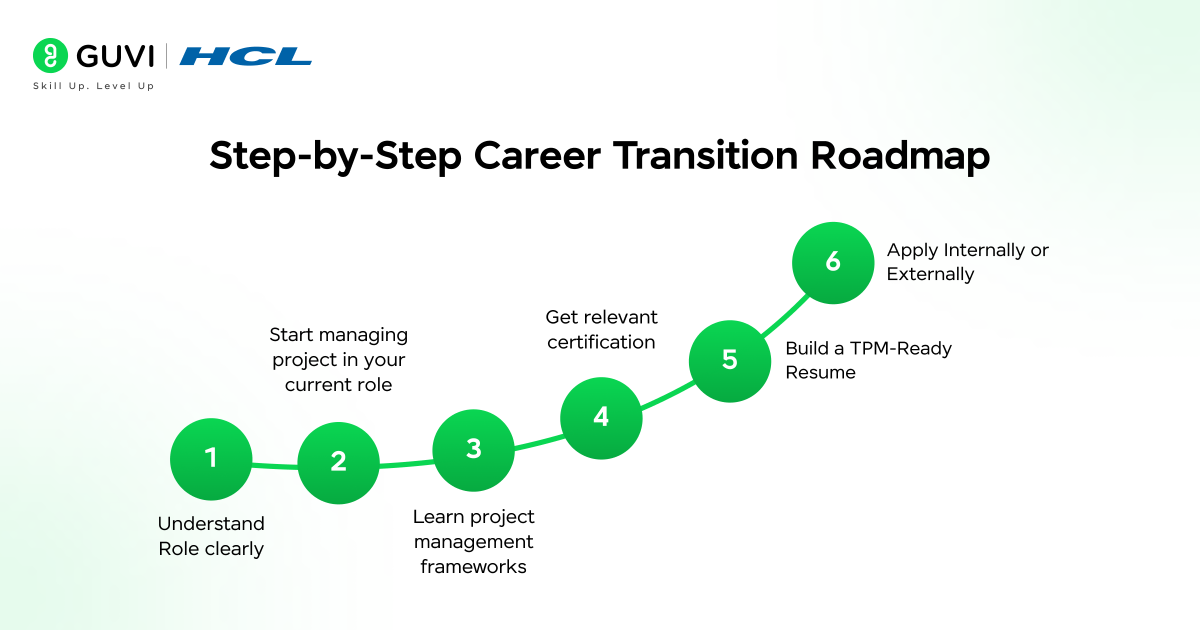
Step 1: Understand the TPM Role Clearly
Shadow TPMs at your company. Ask to attend their planning sessions, stakeholder meetings, and risk reviews. Take notes on how they spend their time, what questions they ask, and how they handle conflicts.
Interview TPMs outside your company. Most are happy to chat for 30 minutes about their career path. Ask about their biggest challenges, what surprised them about the role, and what they wish they’d known before switching.
Read case studies of project failures. Study post-mortems from major tech incidents. Notice that most failures stem from coordination problems, not technical bugs. This is what TPMs prevent.
Step 2: Start Managing Projects in Your Current Role
Volunteer to lead cross-team initiatives. Look for projects that need coordination but don’t have a clear owner. Organize the kickoff, track progress, and communicate status updates.
Run retrospectives for your team. Practice facilitation skills by guiding conversations about what went well and what needs improvement. Turn discussion into actionable changes.
Own technical documentation for a major feature. Turn this into a mini project: define scope, set a deadline, coordinate input from multiple engineers, and deliver something stakeholders actually use.
Build relationships outside engineering. Start attending product planning meetings. Have coffee chats with designers, data analysts, and customer success managers. TPMs succeed by knowing everyone and understanding their constraints.
Step 3: Learn Project Management Frameworks
Study Agile deeply, not just the ceremonies but the principles behind them. Read the Agile Manifesto. Understand why we prioritize working software over comprehensive documentation and responding to change over following a plan.
Learn Scrum and Kanban differences. Know when to use sprints versus continuous flow. Understand velocity, burn-down charts, and capacity planning.
Explore Waterfall and when it still applies. Some projects, particularly those with hardware dependencies or regulatory requirements, need sequential phases. Don’t dismiss traditional PM methods.
Read “The Mythical Man-Month” and “The Phoenix Project.” These books explain why adding people to late projects makes them later and how systems thinking applies to software delivery. They’re TPM fundamentals.
Step 4: Get Relevant Certifications
Certifications signal commitment and provide structured learning. The right ones depend on your target companies.
Certified Scrum Master (CSM) gives you facilitation skills and Agile credibility. The course takes two days and the exam is straightforward. Useful for startups and mid-sized tech companies.
PMP (Project Management Professional) requires more experience and study but carries weight at large enterprises. You need 4,500 hours of project leadership to qualify. Start tracking your project hours now even as an engineer.
SAFe certifications matter if targeting companies using the Scaled Agile Framework. Large organizations with 50+ person engineering teams often standardize on SAFe.
Google Project Management Certificate provides modern PM fundamentals in six months. Strong theoretical foundation but less recognized than CSM or PMP.
Choose based on job descriptions you’re targeting. Search “Technical Project Manager” plus your target company names. Notice which certifications appear repeatedly.
Step 5: Build a TPM-Ready Resume
Your engineer resume won’t work. Recruiters and hiring managers look for different signals.
Restructure your experience to highlight coordination over coding. Instead of “Implemented authentication service using OAuth 2.0,” write “Led authentication service project across three teams, coordinating backend, frontend, and security reviews to deliver on schedule.”
Quantify project impact. Track metrics like project timeline (planned vs actual), team size coordinated, stakeholders managed, and business outcomes. “Delivered API integration project 2 weeks ahead of schedule, enabling sales team to close $1.2M deal” beats any technical detail.
Add a project management section separate from technical skills. List: Agile methodologies, risk management, stakeholder communication, cross-functional leadership, sprint planning, roadmap development.
Remove low-level coding details. Your React component optimization story doesn’t matter. Your coordination of frontend/backend API contract negotiation does.
Include leadership examples. Mentored junior engineers, led technical design reviews, organized team offsites. TPMs lead without direct reports, so demonstrate this capability.
Step 6: Apply Internally or Externally
Internal transfers have advantages: proven track record, existing relationships, company knowledge. Talk to your manager early. Express interest in TPM work and ask about transition paths. Some companies let engineers do rotations or take on PM responsibilities before formally switching.
External applications let you start fresh. You’re not fighting perceptions of “you’re the React expert, why would you do PM?” Target companies one level up from your current role. Moving to a larger company often makes the title change easier.
Apply to TPM roles even before you feel ready. You learn what skills hiring managers prioritize through interviews. Early rejection teaches you what to improve.
Network aggressively. Attend PM meetups, join Slack communities, comment on LinkedIn posts from TPMs at target companies. Many TPM roles never get posted publicly because they’re filled through referrals.
Common Mistakes Software Engineers Make When Switching to TPM
Staying too deep in the code. You attend every implementation discussion, review most pull requests, and suggest technical solutions constantly. This signals you don’t trust your team and prevents you from doing actual PM work. TPMs need technical judgment, not implementation expertise.
Ignoring relationship building. Engineers get promoted for technical excellence. TPMs get promoted for making others successful. You need to invest time in 1-on-1 conversations, understanding people’s motivations, and building trust. Skip this and you’ll struggle to influence anyone.
Underestimating communication overhead. As an engineer, you could go heads-down for days. As a TPM, your calendar fills with status updates, planning sessions, and stakeholder check-ins. You’ll spend 60% of your time communicating. Resenting this dooms you.
Avoiding conflict. When timelines slip or priorities clash, you need to have hard conversations immediately. Engineers often defer to tech leads or managers. TPMs own project outcomes, which means addressing problems head-on, not hoping someone else handles them.
Focusing on the perfect process instead of results. You implement every Agile ceremony, demand detailed documentation, and create elaborate tracking systems. Process should serve delivery, not become the goal. Stakeholders care whether you shipped on time, not whether you had pristine sprint retrospectives.
Neglecting business context. You treat all projects equally important because they’re all technically interesting. TPMs need to understand revenue impact, strategic priorities, and competitive pressure. The technically elegant solution that misses market timing fails.
Not learning to say no. Engineers pride themselves on solving problems. TPMs need to push back on unrealistic requests, cut scope to meet deadlines, and protect their teams from constant interruptions. Saying yes to everything leads to burnout and missed commitments.
Is Technical Project Manager the Right Career for You?
Not every engineer should become a TPM. The role fits specific personality types and career goals.
Work-style considerations:
TPMs balance multiple projects simultaneously. Engineers often work deeply on one thing. Can you context switch effectively?
TPMs work across time zones. Early morning calls with offshore teams and late evening syncs with coast-to-coast stakeholders happen regularly.
TPMs handle stress from missed deadlines and unhappy stakeholders. The pressure comes from external expectations, not technical complexity. Which type of stress suits you better?
Take a month and track what energizes versus drains you. More energy from cross-team coordination meetings than coding sessions? TPM might be right. More energy from solving a gnarly algorithm than explaining project status to executives? Stay in engineering.
Your Next 90-Day Action Plan
You have the information. Now commit to action.
Month 1: Learn and observe
Read two books: “The Mythical Man-Month” and “Escaping the Build Trap.” These cover foundational PM thinking.
Shadow a TPM for at least 4 hours. Watch how they run meetings, handle conflicts, and communicate with stakeholders.
Start a learning document tracking project management concepts. Write definitions in your own words. Capture examples from your current work.
Audit your calendar. How much time do you spend coordinating versus coding? Begin shifting the balance by volunteering for organizational tasks.
Month 2: Practice and lead
Take ownership of one cross-team initiative. Doesn’t need a formal PM title. Organize a working group, track progress, report status.
Start running team retrospectives or planning sessions. Practice facilitation skills in a safe environment.
Build your first real project plan. Pick an upcoming feature, map dependencies, estimate timeline, identify risks. Review it with a TPM or engineering manager.
Begin rewriting your resume. Convert at least 5 bullets from technical to project-focused language.
Month 3: Apply and interview
Talk to your manager about TPM opportunities. Ask for specific feedback on what you’d need to demonstrate to be considered for project management work.
Apply to 5 TPM roles, even if you don’t meet all requirements. Get interview practice early.
Attend PM meetups or join online communities. Start building your network outside pure engineering circles.
Choose one certification to pursue and register for it. Set a concrete exam date to force accountability.
Schedule monthly check-ins with yourself to review progress. What worked? What stalled? What needs adjustment?
Conclusion
Moving from a software engineer to a technical project manager is not about leaving coding behind. It is about growing your impact. If you enjoy planning, coordinating teams, and solving delivery problems, the TPM role may be right for you. Your technical background already gives you a strong advantage. By learning project management and communication skills, you can move from building features to delivering results. Start by leading small projects today. Each step brings you closer to a successful TPM career.
Frequently Asked Questions
1. Can a software engineer become a technical project manager?
Yes. Many software engineers successfully move into TPM roles. Your technical knowledge helps you understand systems, risks, and timelines better than non-technical project managers.
2. Do I need to stop coding to become a TPM?
Not completely. While TPMs code less, your technical background is still important for making decisions, reviewing designs, and working closely with engineering teams.
3. What skills do software engineers need to become TPMs?
Engineers need to learn project planning, communication, stakeholder management, and risk handling, along with basic business understanding.
4. Are certifications required to become a technical project manager?
Certifications are not mandatory, but courses like CSM or PMP can help you learn project management basics and improve job opportunities.
5. How long does it take to transition from engineer to TPM?
Most engineers take 6 to 12 months to transition. The timeline depends on learning speed, hands-on project experience, and internal or external opportunities.
Success Stories

About the Author
Salini Balasubramaniam
A curious, information-savvy writer loves to turn deep insights into authentic and engaging content that connects. With experience in writing for brands and driving audience engagement, I believe that words can make a powerful difference.
View all posts by Salini Balasubramaniam
Connect with me @











Did you enjoy this article?