


Digital Marketing Articles
What is Performance Marketing? Complete Guide for 2026
What is the Voice of the Customer and Why Does it Matter
What is A/B Testing in Marketing? A Beginner’s Guide to Smarter Campaign Optimization
What is Lead Nurturing in Marketing? A Practical Guide for Beginners


Get In Touch For Details! Request More Information

Skills Required for Influencer Marketing Strategy
Sep 02, 2026 4 Min Read 649 Views
(Last Updated)
Influencer marketing helps brands reach people through creators they already trust. Customers today watch reviews, compare real experiences, and follow recommendations before buying anything.
That is why a strong influencer marketing strategy matters. It helps brands choose the right creators, plan relevant content, connect with the right audience, and track campaign results.
In this blog, we will cover the key skills required for influencer marketing strategy and how they help build authentic, result-driven campaigns.
Read the full blog to learn more.
TL;DR
- Influencer marketing strategy needs audience research, creator selection, content planning, and analytics.
- The right influencer depends on niche fit, engagement quality, credibility, and brand alignment.
- Strong briefs, clear communication, and budget planning keep campaigns organized.
- Performance tracking helps measure reach, traffic, leads, conversions, and ROI.
- Brand safety, long-term creator relationships, and SEO improve campaign trust and visibility
Table of contents
- What Is Influencer Marketing?
- Why Is Influencer Marketing Important?
- Key Skills Required for Influencer Marketing Strategy
- Audience Research Skills
- Influencer Selection Skills
- Content Strategy and Storytelling Skills
- Social Media Platform Knowledge
- Outreach and Communication Skills
- Negotiation and Budget Management Skills
- Data Analytics and Performance Tracking Skills
- Campaign Planning Skills
- Trend Awareness
- Basic SEO and Social Search Skills
- Case Study: McDonald’s Famous Orders Campaign with Travis Scott
- Conclusion
- FAQs
- What skills are needed for influencer marketing?
- How do I become an influencer marketing strategist?
- Is influencer marketing a good career?
- What does an influencer marketing manager do?
- Why is influencer marketing important for brands?
What Is Influencer Marketing?
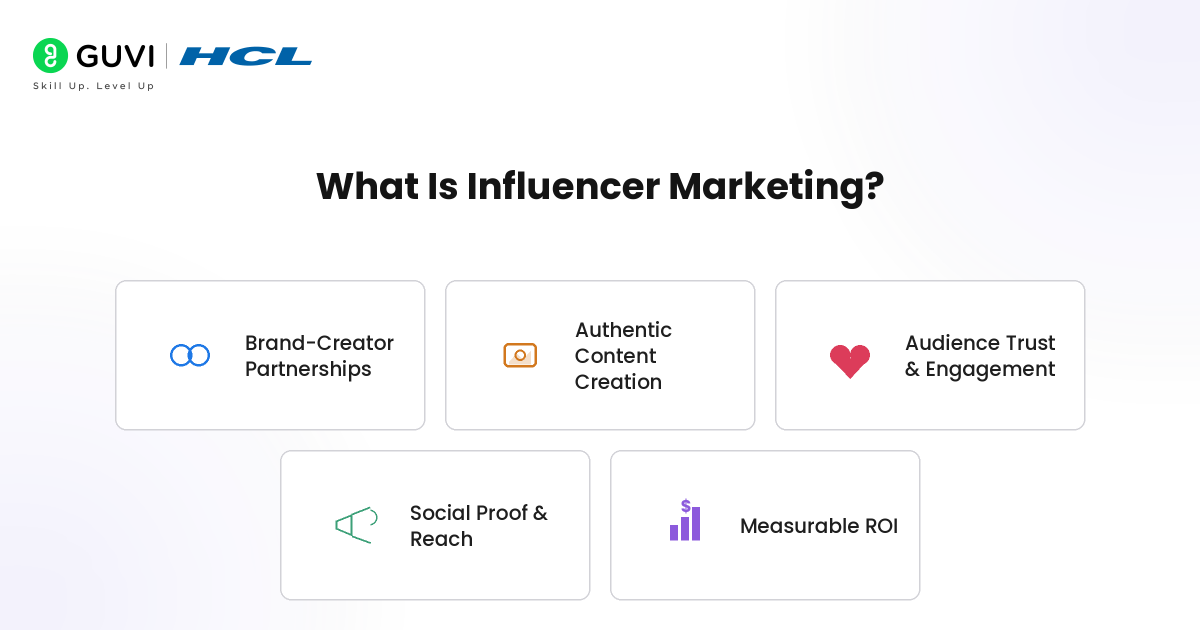
Influencer marketing is a digital marketing strategy where brands collaborate with content creators to promote their products, services, or campaigns. These creators already have an audience that trusts their opinions, recommendations, reviews, or lifestyle content.
Instead of directly advertising to people, brands use influencer marketing to reach customers through voices they already follow. For example, a skincare brand may work with a beauty creator to show a product routine. An edtech brand may work with a career creator to explain how a course helps learners build job-ready skills.
Here are three correct, SEO-rich “Did You Know?” boxes with powerful verified stats:
Influencer marketing can happen through:
- Instagram Reels and Stories
- YouTube reviews and tutorials
- LinkedIn thought-leadership posts
- Short-form videos
- Product unboxing videos
- Brand collaborations
- Affiliate links
Why Is Influencer Marketing Important?
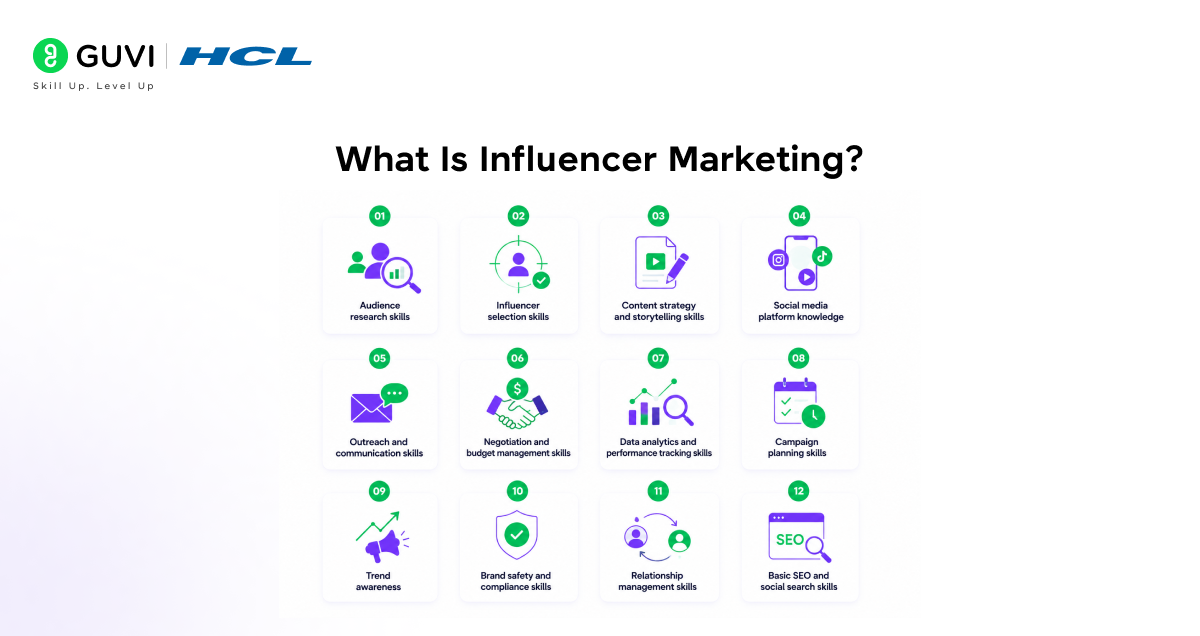
Influencer marketing is important because customers trust real people more than traditional ads. A creator can explain a product in a relatable way, show how it works, and answer the audience’s actual doubts through content.
Key reasons influencer marketing matters:
- It helps brands reach a highly targeted audience.
- It supports brand awareness among active online communities.
- It helps brands promote products without sounding too sales-heavy.
- It can drive website traffic, app installs, leads, and sales.
- It gives brands user-friendly content for social media campaigns.
- It supports niche marketing through micro and nano influencers.
- It improves social proof because audiences see real creators using the product.
- It can strengthen SEO and social search visibility through reviews, captions, keywords, and YouTube content.
- It helps brands track performance through clicks, coupon codes, engagement, conversions, and ROI.
- 86% of consumers make at least one influencer-inspired purchase every year, highlighting the growing impact of influencer marketing on buying decisions.
Key Skills Required for Influencer Marketing Strategy
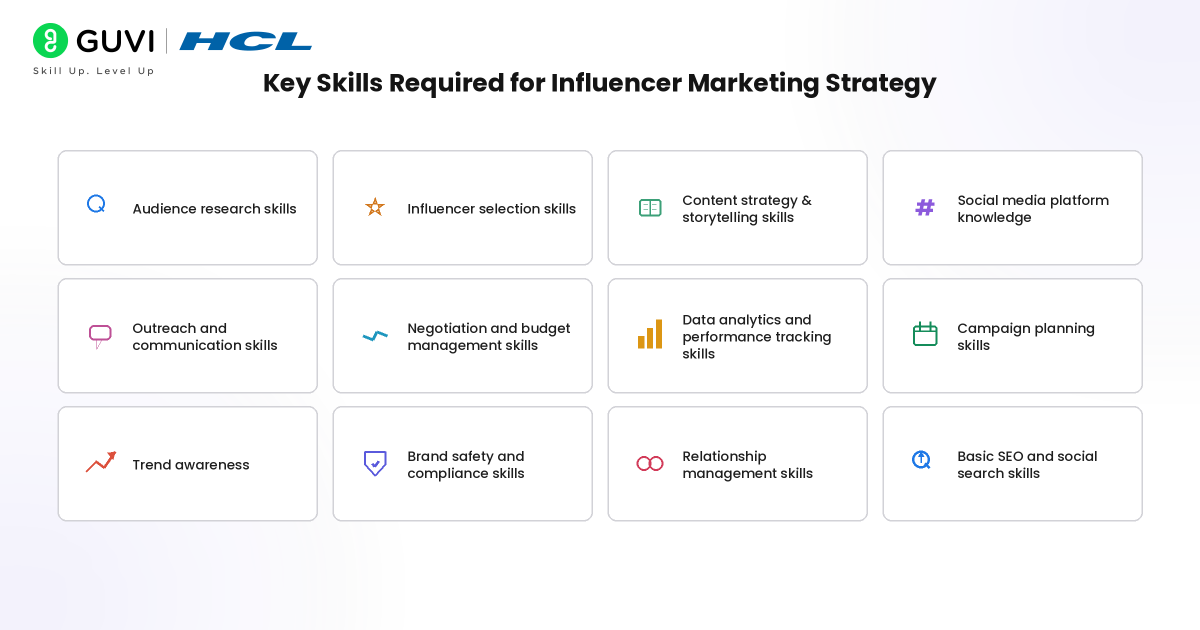
1. Audience Research Skills
Audience research is the first step in any influencer marketing strategy. Marketers need to know who the brand wants to reach, what content they consume, and which platforms they trust.
For example, a skincare brand targeting college students may perform better on Instagram Reels. A B2B SaaS brand may need LinkedIn creators who speak to founders or marketing teams.
Key areas to focus on:
- Target customer profile
- Audience age, location, and interests
- Platform usage patterns
- Content preferences
- Buying behavior
- Pain points and motivations
2. Influencer Selection Skills
The right influencer is not always the one with the largest audience. A micro-influencer with strong trust in a niche can perform better than a celebrity creator with weak audience fit.
Marketers must evaluate creators based on relevance, credibility, engagement, and brand alignment.
Key areas to check:
- Engagement rate
- Comment quality
- Follower authenticity
- Niche relevance
- Content quality
- Past brand collaborations
- Audience-brand fit
- LinkedIn’s creator-led advertising program generated over $20 million in revenue between May 2025 and May 2026.
3. Content Strategy and Storytelling Skills
Influencer content should feel natural, not like a forced advertisement. Marketers need to guide creators with clear messaging while still allowing their original voice to come through.
A good content strategy connects the brand goal with the creator’s style. For example, an edtech brand can use career tips, learner stories, tutorials, and course walkthroughs.
Key areas to plan:
- Campaign theme
- Key talking points
- Content formats
- Storytelling angle
- Product benefits
- Posting timeline
- Approval process
4. Social Media Platform Knowledge
Each platform has a different content style. Instagram works well for reels, stories, and visual discovery. YouTube supports reviews, tutorials, and long-term search visibility. LinkedIn is better for B2B influence and expert-led content.
Marketers need to match the platform with the campaign goal.
Key areas to understand:
- Instagram Reels and Stories
- YouTube videos and Shorts
- LinkedIn creator content
- Short-form video trends
- Platform algorithms
- Platform-specific KPIs
5. Outreach and Communication Skills
Influencer marketing depends on clear communication. Marketers need to contact creators, explain campaign goals, share briefs, manage approvals, and follow up without sounding robotic.
A good creator brief reduces confusion and helps the influencer create better content.
Key areas to include:
- Brand introduction
- Campaign goal
- Target audience
- Key message
- Deliverables
- Posting deadline
- Do’s and don’ts
- Tracking links or coupon codes
6. Negotiation and Budget Management Skills
Influencer pricing depends on audience size, engagement, content format, usage rights, exclusivity, and campaign duration. Marketers need negotiation skills to get fair value without damaging creator relationships.
A smart budget plan also helps brands choose between nano, micro, macro, or celebrity creators.
Key areas to manage:
- Cost per post
- Cost per reel or video
- Product barter
- Usage rights
- Paid amplification
- Exclusivity fees
- Performance-based payment
- Total campaign budget
Build the skills needed for today’s digital-first world with HCL GUVI’s Digital Marketing Course. Learn influencer marketing, SEO, social media marketing, content strategy, analytics, and performance marketing through industry-focused training and hands-on projects designed for real-world careers.

7. Data Analytics and Performance Tracking Skills
Influencer marketing must be measurable. Views and likes are useful, but they do not always show business impact. Marketers need to connect campaign data with goals like traffic, leads, app installs, or sales.
A smaller creator may bring better conversions if the audience trusts them more.
Key metrics to track:
- Reach
- Impressions
- Engagement rate
- Saves and shares
- Link clicks
- Website traffic
- Coupon code usage
- Cost per engagement
- Conversion rate
- ROI
8. Campaign Planning Skills
Influencer campaigns have many moving parts. Marketers need to manage creator lists, outreach, product dispatch, content approvals, posting schedules, tracking links, and reporting.
A clear campaign plan keeps the work organized from the first message to the final report.
Key areas to plan:
- Campaign objective
- Influencer shortlist
- Content calendar
- Budget allocation
- Timeline
- Approval workflow
- Tracking setup
- Final performance report
9. Trend Awareness
Influencer marketing moves with internet culture. Marketers need to understand current trends, creator formats, meme behavior, platform updates, and audience conversations.
Trend awareness helps brands stay relevant without blindly copying every viral format.
Key areas to monitor:
- Social media trends
- Viral content formats
- Creator economy updates
- Meme culture
- Competitor campaigns
- Platform changes
- Audience conversations
10. Basic SEO and Social Search Skills
Influencer marketing is now closely linked with search. People search for reviews, tutorials, comparisons, and recommendations on YouTube, Instagram, Google, and other platforms.
Basic SEO skills help influencer content stay discoverable beyond the first few days.
Key areas to optimize:
- Video titles
- Captions
- Hashtags
- Keywords
- Descriptions
- Review topics
- Comparison content
- Search-friendly creator briefs
Also, Explore: 15 Outstanding Marketing Management Case Studies from India
Case Study: McDonald’s Famous Orders Campaign with Travis Scott
McDonald’s created one of the most powerful influencer marketing campaigns with its Famous Orders campaign featuring Travis Scott. The idea was simple but culturally strong. Instead of creating a new product, McDonald’s turned Travis Scott’s real McDonald’s order into a limited-time meal.
The campaign worked because it connected celebrity influence with everyday customer behavior. Fans were not just watching an ad. They could walk into McDonald’s and order the same meal as Travis Scott.
Key campaign moves included:
- McDonald’s selected a celebrity with strong youth and pop culture influence.
- The brand used a real personal order instead of a forced product placement.
- The meal was simple, affordable, and easy for fans to buy.
- The campaign created excitement through limited-time availability.
- Social media turned the meal into a cultural moment.
- The brand connected influencer marketing with store visits and app engagement.
- The campaign helped McDonald’s reach younger audiences in a more natural way.
This case study shows that influencer marketing becomes powerful when the creator, product, audience, and cultural timing fit together. McDonald’s “Famous Orders: The Travis Scott Meal” campaign reported 850 million PR impressions and 2.1 billion social reach during the campaign window, according to the Shorty Awards case study
The biggest lesson is simple: a strong influencer marketing strategy should not feel like a random celebrity endorsement. It should make the audience feel involved, excited, and ready to take action.
Conclusion
Influencer marketing works best when it is planned with purpose. The right strategy helps brands choose suitable creators, build content that feels natural, and measure what actually works. For marketers, skills like audience research, creator selection, content planning, communication, budgeting, analytics, and brand safety can make influencer campaigns more effective and trusted.
As more brands invest in creator-led marketing, learning these influencer marketing strategy skills can open strong career opportunities in digital marketing.
FAQs
What skills are needed for influencer marketing?
Key skills include audience research, influencer selection, content planning, communication, negotiation, analytics, and campaign management.
How do I become an influencer marketing strategist?
Start by learning social media marketing, creator research, campaign planning, content strategy, analytics, and brand collaboration basics.
Is influencer marketing a good career?
Yes, influencer marketing is a good career because brands are spending more on creator-led campaigns to build trust and reach niche audiences.
What does an influencer marketing manager do?
An influencer marketing manager finds creators, plans campaigns, manages budgets, coordinates content, tracks performance, and reports campaign results.
Why is influencer marketing important for brands?
Influencer marketing helps brands build trust, reach targeted audiences, increase visibility, and drive traffic, leads, or sales through creator content.
Success Stories

About the Author
Vaishali
I'm a seasoned writer with four years of experience across technical, non-technical, and just about every genre or niche you can imagine. Adaptable and curious, I enjoy exploring new topics and making information engaging and easy to understand. Fueled by a steady stream of tea, I approach each project with creativity, reliability, and genuine enthusiasm for storytelling.
View all posts by Vaishali
Connect with me @










Did you enjoy this article?