


Java Articles
How to Run Java in Visual Studio Code?
Why Large Enterprises Still Rely on Java: Legacy Systems, Stability & Scale
Java + Spring Boot in 2026: What You Need to Know to Get Hired


Get In Touch For Details! Request More Information

Is Java Still Worth Learning in 2026 for Web Developers?
Feb 21, 2026 4 Min Read 1664 Views
(Last Updated)
Is Java still worth learning in 2026 ? is one of the most popularly asked questions among aspiring and working web developers today. Learning web development in 2026 can feel overwhelming, especially with so many languages competing for attention. With JavaScript, Python, and modern frameworks everywhere, many developers wonder whether Java still matters for building web applications today.
This blog explains where Java truly fits in modern web development, how it is used in real companies, and whether it is still worth adding to your skillset. It’s written for beginners, students, and developers deciding which language to invest their time in next.
Quick Answer
Is Java still worth learning in 2026 ? Yes ! Java is still worth learning in 2026 because it powers many secure and large-scale web backends used by companies worldwide. It remains stable, highly reliable, and works well with modern frameworks used in web development. If you want strong backend fundamentals and long-term career opportunities, Java is still a smart choice.
Table of contents
- Where Java Is Used In Web Development
- Backend APIs
- Enterprise Web Applications
- Microservices And Cloud
- Secure Financial And Banking Systems
- Is Java Still Worth Learning In 2026 For Web Developers
- Career Stability
- Enterprise Demand
- Reliability
- Where Else Java Is Being Used (And Why It Still Matters In 2026)
- Android Development
- Big Data And Analytics
- Embedded And IoT Systems
- Cloud Platforms
- 💡 Did You Know?
- Conclusion
- FAQs
- Is Java still relevant for web developers in 2026?
- Can learning Java help me in mobile development?
- Do I need to learn Java frameworks to be job-ready?
- How does Java compare to newer languages like Kotlin or Go?
- What’s the best way to take my Java skills to the next level?
Where Java Is Used In Web Development
Java powers many critical parts of the modern web, especially wherever stability, security, and high performance are required. Before deciding whether Java is still worth learning, it is important to understand where it actually fits and why companies continue relying on it today. Seeing these real uses helps you judge its true relevance instead of assuming it is outdated.
1. Backend APIs
Java is heavily used to build backend APIs that process user requests and manage the core logic behind websites. Frameworks like Spring Boot make it easier to handle authentication, data processing, and communication between services. Because of its reliability, many long-running applications still depend on Java for their main backend systems.
2. Enterprise Web Applications
Large organizations build internal tools, dashboards, and business portals using Java because they expect them to last for years. These applications handle sensitive information and large user bases, so companies choose languages that are proven and predictable. Java suits this environment because it remains stable even when systems grow or new features are added.
3. Microservices And Cloud
Java is widely used when applications are broken into smaller, independent services instead of one large system. Each service can run separately, communicate with others, and scale when more users join. With strong ecosystem support, Java continues to be a reliable option for building microservices that run across cloud platforms.
4. Secure Financial And Banking Systems
Banks and financial companies rely on Java because accuracy and security are critical in every transaction. Java’s predictable behavior reduces risks, and its mature libraries support encrypted communication and secure data handling. As a result, many payment systems, trading platforms, and banking portals continue to run on Java.
Is Java Still Worth Learning In 2026 For Web Developers
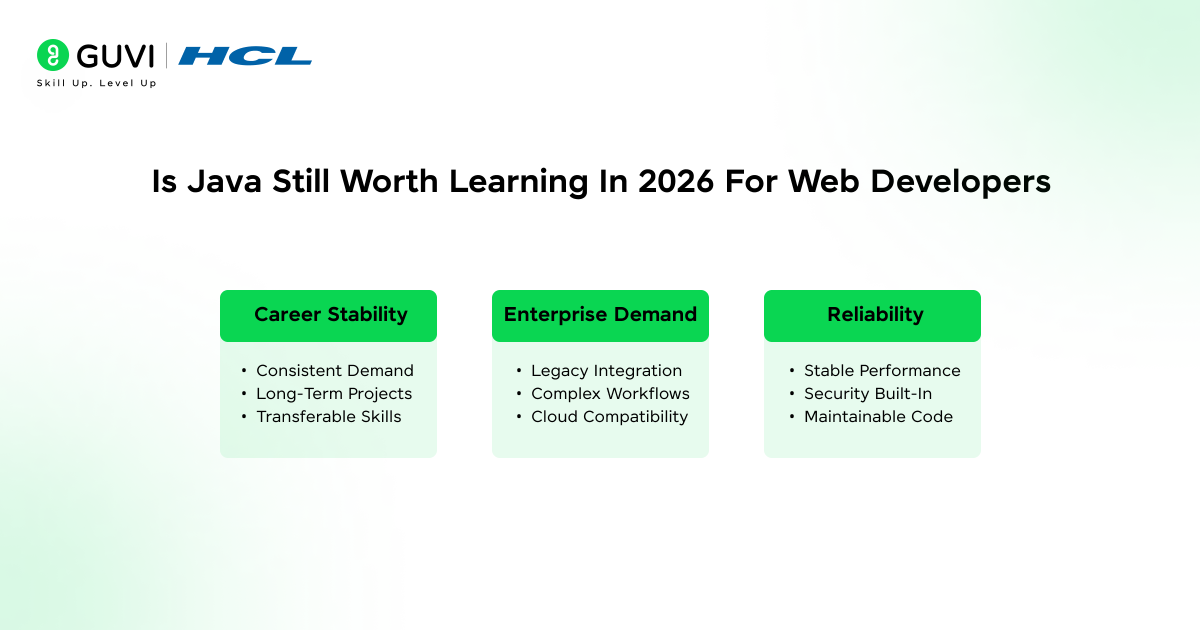
Before deciding whether to invest time in Java, it’s important to understand its relevance in today’s tech landscape. In this section, we’ll explore why Java continues to be valuable for career growth, enterprise projects, and reliable backend development, helping you see why it is still worth learning in 2026.
1. Career Stability
Java remains a cornerstone language for many long-term projects across enterprises. Its consistent demand ensures Java developers with skills have stable job opportunities, especially in backend and full-stack roles that require a mature and reliable language.
Key Points:
- Consistent Demand: Companies continue hiring Java developers worldwide
- Long-Term Projects: Many enterprise applications rely on Java for years
- Transferable Skills: Concepts learned in Java help with other languages

2. Enterprise Demand
Large organizations continue to choose Java for critical applications, including internal systems, customer portals, and cloud-based services. Java integrates seamlessly with legacy systems and handles complex workflows, keeping it highly relevant for enterprise-level development.
Key Points:
- Legacy Integration: Works with older systems without major rewrites
- Complex Workflows: Suitable for enterprise-scale business processes
- Cloud Compatibility: Supports scalable, distributed applications
3. Reliability
Java’s performance, security features, and predictable behavior make it a trusted choice for applications that cannot afford frequent downtime or errors. Developers who learn Java gain experience in writing maintainable and robust code that can support high-traffic and sensitive applications.
Key Points:
- Stable Performance: Runs reliably under heavy load
- Security Built-In: Protects applications from common vulnerabilities
- Maintainable Code: Encourages clean and scalable development practices
Java continues to prove its relevance because of its stability, reliability, and consistent demand in enterprise development. So yes, it is important and worth learning Java in 2026, especially if you want strong backend skills, long-term career opportunities, and the ability to work on large-scale, secure, and high-performing web applications.
If you want to master Java efficiently, check out the HCL GUVI Master Java Course. It covers core and advanced Java concepts, object-oriented programming, data structures, exception handling, and collections. With real-time projects and mentorship from industry experts, this course helps you apply your skills practically and prepares you for backend or software development roles.
Where Else Java Is Being Used (And Why It Still Matters In 2026)
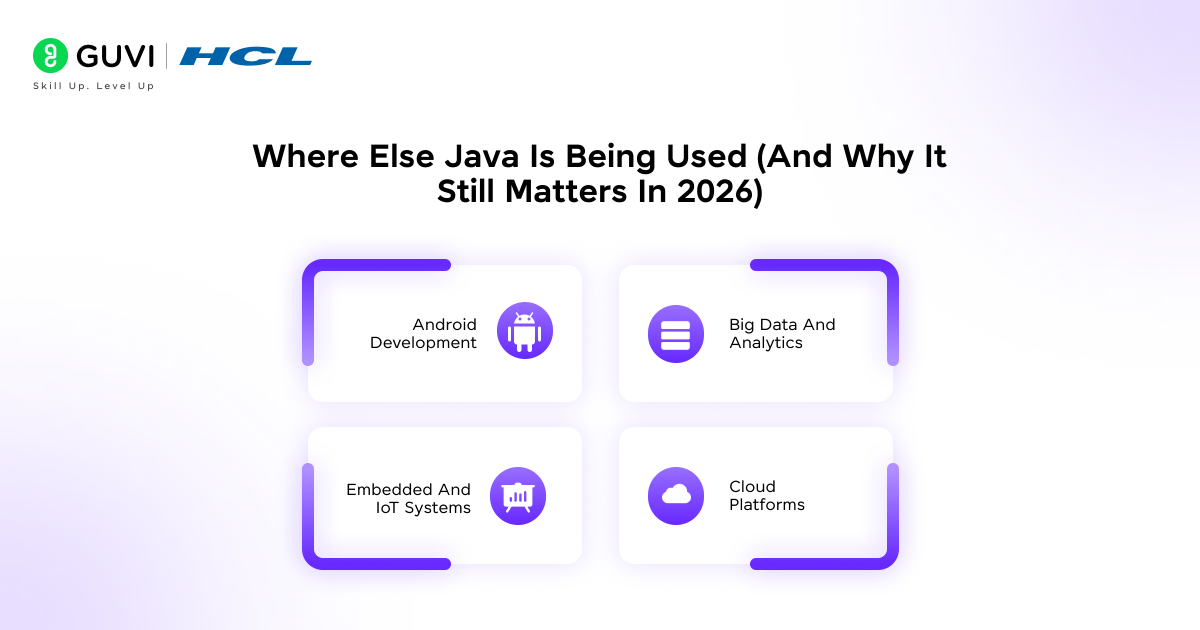
Java’s influence goes far beyond web development, making it a versatile language for multiple domains in 2026. Understanding these areas helps developers see why Java remains relevant and valuable. In this section, we’ll explore its use in Android development, big data, embedded and IoT systems, and cloud platforms.
1. Android Development
Java continues to be widely used for building and maintaining Android projects and applications. Many apps, including legacy projects, rely on Java for core functionality, background services, and user interface logic. Its reliability ensures that applications run smoothly across multiple devices.
Key Points:
- Core App Development: Java is used to write the main application code
- Legacy App Maintenance: Many existing apps are maintained using Java
- Background Services: Handles tasks like notifications, data sync, and processing
2. Big Data And Analytics
Java is a primary language for big data frameworks such as Hadoop and Apache Spark. It is used to write data processing jobs, integrate with distributed storage, and handle large-scale analytics pipelines efficiently.
Key Points:
- Data Processing: Java runs jobs that process large datasets
- Framework Integration: Powers Hadoop, Spark, and related tools
- Analytics Pipelines: Handles the extraction, transformation, and loading of data
3. Embedded And IoT Systems
Java is used to develop software that runs on embedded devices and IoT systems. Its portability, security features, and ability to manage operations reliably make it suitable for devices that require stable performance and cross-platform compatibility.
Key Points:
- Device Software: Java runs applications directly on IoT devices
- Cross-Platform Portability: Allows code to work on multiple hardware systems
- Operational Reliability: Ensures continuous and safe device functioning
4. Cloud Platforms
Java is widely used for building scalable cloud applications and microservices. It powers enterprise-level cloud solutions, APIs, and backend services that require high availability, robustness, and easy integration with other services.
Key Points:
- Scalable Cloud Services: Java handles high-traffic applications efficiently
- Microservices Development: Powers independent, maintainable services
- Enterprise Cloud Solutions: Supports APIs and backend systems across platforms
Java’s presence in these high-demand areas demonstrates that it is more than a web language. Its practical usage across mobile, big data, IoT, and cloud systems reinforces why learning Java in 2026 remains a strategic and valuable choice for developers.
If you want a hands-on place to practice Java coding, do check out HCL GUVI’s online IDE. You can write, run, and test programs directly in your browser while practicing concepts like variables, loops, and classes. Regular practice helps reinforce your learning and builds confidence before moving on to real-world projects.
💡 Did You Know?
- Java was released in 1995 and remains one of the most widely used programming languages in 2026.
- Enterprise applications, banking systems, and Android apps continue to rely heavily on Java today.
- Java’s “write once, run anywhere” philosophy allows code to run across web, mobile, IoT, and cloud platforms without modification.
Conclusion
Java continues to be a powerful and versatile language in 2026, powering web applications, Android apps, cloud platforms, and big data systems. Its reliability and wide adoption make it a must-learn skill for developers aiming to build real-world, high-performing applications.
By applying Java through projects, APIs, or cloud services, you can take your knowledge to the next level and gain practical experience. Mastering it opens doors to enterprise systems, mobile apps, and emerging tech, ensuring long-term career growth.
FAQs
1. Is Java still relevant for web developers in 2026?
Yes, Java remains relevant due to its stability, use in enterprise applications, backend APIs, and its integration with modern frameworks like Spring Boot.
2. Can learning Java help me in mobile development?
Absolutely. Java is widely used for Android app development, including maintaining legacy apps and building new applications.
3. Do I need to learn Java frameworks to be job-ready?
Yes, learning frameworks like Spring and Spring Boot is essential for backend development and building scalable, real-world applications.
4. How does Java compare to newer languages like Kotlin or Go?
While languages like Kotlin and Go are gaining popularity, Java’s stability, enterprise adoption, and vast ecosystem make it a valuable long-term skill.
5. What’s the best way to take my Java skills to the next level?
Work on projects, APIs, microservices, cloud deployments, and explore advanced topics like concurrency, security, and performance optimization.
Success Stories

About the Author
Jebasta
I translate the language of data into stories that anyone can understand. As a writer with a data science background, I simplify analytics, AI, and decision-making so beginners and enthusiasts can confidently explore the world of data.
View all posts by Jebasta
Connect with me @











Did you enjoy this article?