


Artificial Intelligence and Machine Learning Articles
Finance Manager to Data Analytics: Career Growth, Salary and Seniority
How to Evaluate LLM Outputs in Production Deployments
AI/ML Skills Gap 2026: Why Companies Can't Find Job-Ready Talent
20 AI/ML Interview Questions Recruiters Can Use Without a Tech Background - Best Guide

Get In Touch For Details! Request More Information

Inference in AI: What It Is, Types and How It Works (2026 Guide)
Sep 02, 2026 8 Min Read 3744 Views
(Last Updated)
What really makes artificial intelligence feel “intelligent”? The answer lies in inference, the ability of AI systems to take what they’ve learned and apply it to new, unseen situations.
Just like you might see storm clouds and guess it’s going to rain, AI looks at new data and draws conclusions based on its training. This process is what turns raw machine learning models into useful tools that can recognize faces, answer questions, or recommend your next movie.
This inference in artificial intelligence is what we are going to see in-depth in this article, starting from its definition, to its types, to its applications. By the end of this article, you’ll have a clear understanding of what inference is. So, without further ado, let us get started!
Quick Answer: Inference in AI refers to the process of using a trained model, learned parameters or logical rules to make predictions, decisions or generate outputs from new data. Unlike training, inference applies what the AI has already learned without normally updating the model.
- Training learns; inference applies the learned knowledge to new inputs.
- Main types include: ML inference, deep learning inference, forward inference, backward inference, probabilistic inference and LLM inference.
- In production: Teams balance accuracy with latency, throughput, memory usage and cost.
- In LLMs: Inference converts prompts into tokens and generates output token by token.
- Common applications: ChatGPT, recommendation systems, fraud detection, computer vision and autonomous systems.
Table of contents
- What is Inference in AI?
- AI Training vs. Inference: Two Stages of Learning
- Inference Types in AI at a Glance
- Types of Inference in AI
- Inference in Machine Learning Models
- Inference in Deep Learning
- Inference in Rule-Based (Symbolic) AI Systems
- Probabilistic Inference
- How Does AI Inference Work?
- Components of AI Inference
- Forward inference vs Backward inference- Key differences
- Forward Inference
- Backward Inference
- Model inference in production- Latency vs accuracy tradeoff
- Model Compression
- Quantisation
- Batching
- Caching
- Model Routing
- Inference in LLMs- How ChatGPT generates responses
- Step 1: The Input Is Converted Into Tokens
- Step 2: The Model Processes the Context
- Step 3: The Model Generates the Next Token
- Step 4: Generation Continues Token by Token
- Step 5: Output Tokens Become Readable Text
- Applications of AI Inference
- Conclusion
- FAQs
- What does inference mean in artificial intelligence?
- How is inference different from training in AI?
- What are some real-world examples of AI inference?
- Why is inference important in AI?
What is Inference in AI?
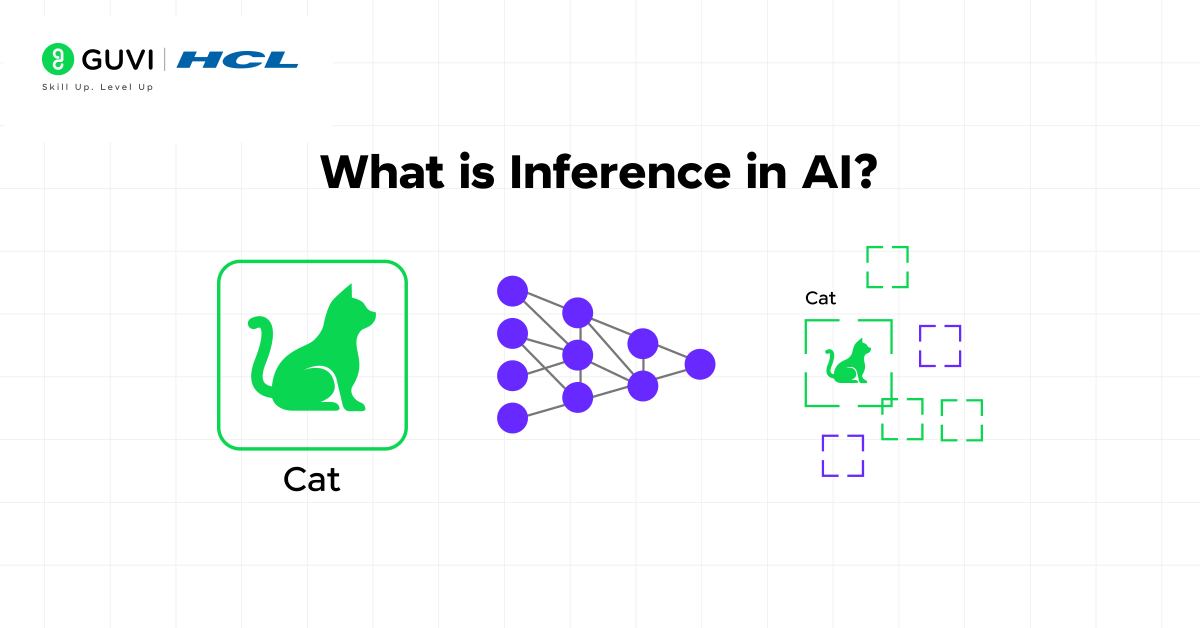
Inference in Artificial Intelligence refers to the process of deriving logical conclusions, predictions, or decisions from available information, using the knowledge an AI system has learned. In practice, this means an AI system takes known data or facts and infers new insights, much like how you might observe dark clouds and infer that it’s likely to rain.
To put it another way, inference is essentially AI in action; it’s when a trained model or programmed logic is actually employed to solve problems or answer questions using new inputs.
For example, imagine an AI that has been trained on thousands of photos of cats. When you show it a brand new picture and it identifies the cat in the image, that identification is the result of inference. The AI is applying what it learned during training (the patterns of what cats look like) to new data (the unseen image) and coming to a conclusion (recognizing the cat).
Key point: It is not about learning new knowledge (that’s the job of training, which we’ll discuss next); instead, it’s about applying existing knowledge to new situations.
AI Training vs. Inference: Two Stages of Learning
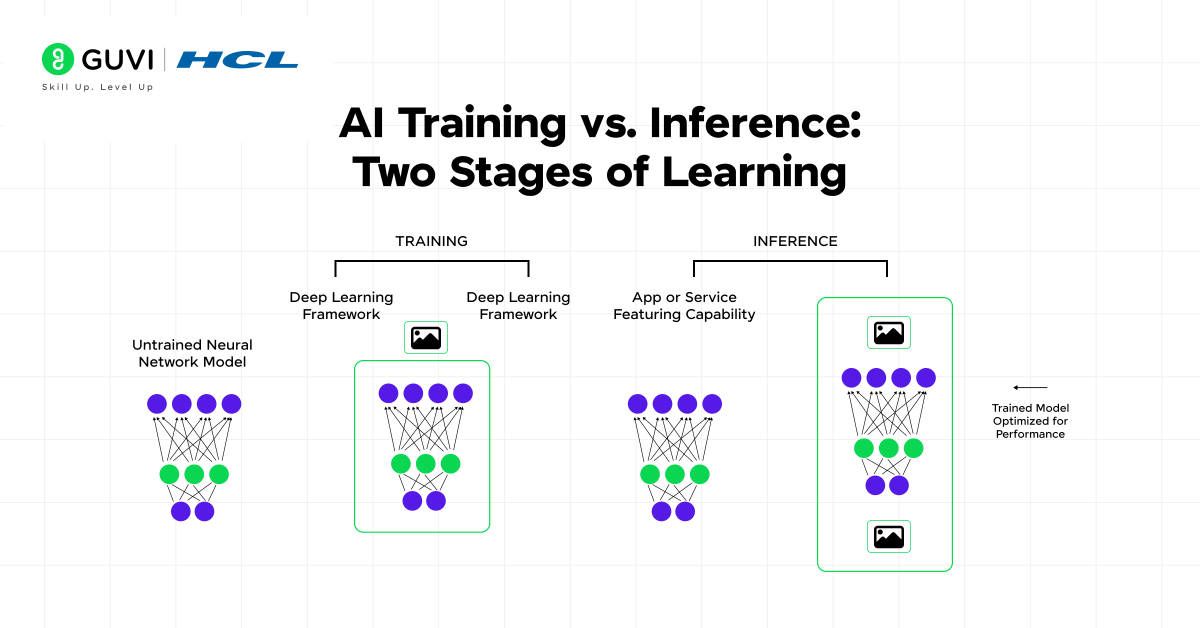
It’s important to understand the distinction between training and inference in the context of AI, especially in machine learning. These are two critical stages in an AI model’s life cycle:
- Training (Learning Phase): This is the first stage where an AI model is built and educated. The model is fed a large dataset and adjusts its internal parameters (or follows algorithms, in the case of symbolic AI) to learn patterns. Think of this as “learning from examples.” For instance, a machine learning algorithm might process thousands of labeled emails to learn how to detect spam.
- Inference (Application Phase): This is the stage where the trained model is deployed to make actual decisions or predictions on new, unseen data. It’s the execution of the model’s knowledge. Using the previous example, once the email-filter model is trained, it is when the model is given a new email and it predicts whether that email is spam or not.
The difference between these two stages can’t be overstated. In other words, first you train the model, then you use the model to infer.
Inference Types in AI at a Glance
| Inference Type | Definition | Example | Used In |
|---|---|---|---|
| Machine Learning Inference | Uses a trained ML model to make predictions on new data | Predicting a house price | Regression, classification |
| Deep Learning Inference | Runs new input through a trained neural network | Detecting objects in an image | Computer vision, speech recognition |
| Forward Inference | Starts with known facts and applies rules to reach conclusions | Symptoms → possible diagnosis | Expert systems, rule-based AI |
| Backward Inference | Starts with a goal and works backward to find supporting facts | Checking whether evidence supports a diagnosis | Expert systems, troubleshooting |
| Probabilistic Inference | Calculates the probability of an outcome based on available evidence | Estimating an 80% fraud probability | Bayesian networks, risk analysis |
| LLM Inference | Processes input context and generates output tokens | ChatGPT answering a prompt | Generative AI, chatbots, coding assistants |
Types of Inference in AI
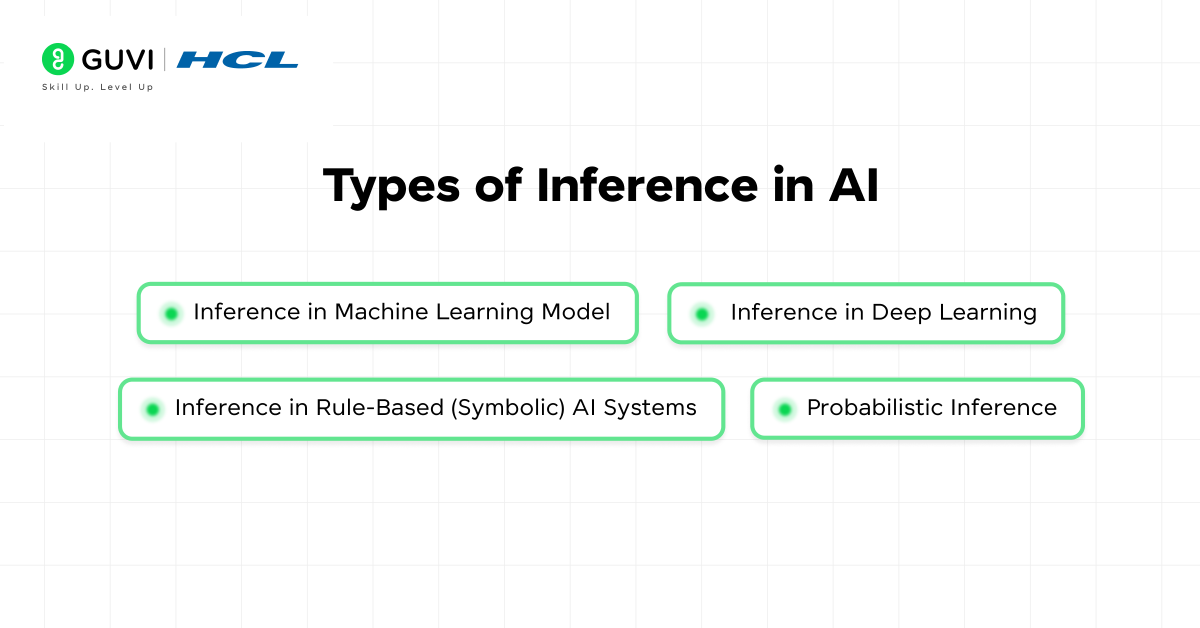
Not all AI systems infer knowledge in the same way. Broadly speaking, “inference in AI” can happen through different approaches or types of models. Here are some of the main categories of inference in AI, each with a slightly different flavor:
1. Inference in Machine Learning Models
In the context of machine learning (ML), inference means using a trained ML model to make a prediction or classification on new data. The model could be anything from a simple linear regression to a complex decision tree or a neural network.
During inference, the model takes the input data, runs it through the mathematical patterns it learned during training, and outputs a result.
Example: Suppose you trained a model to recognize handwritten digits. During inference, you present a new handwritten digit image to the model, and it outputs the digit it thinks the image represents (0-9). The model doesn’t update its knowledge at this time – it simply applies what it already learned to the new image and gives an answer.
2. Inference in Deep Learning
Deep learning is a subset of machine learning that uses multi-layered neural networks. Inference in deep learning follows the same idea as in general ML: it’s the forward execution of a trained neural network on new inputs. What’s special here is the scale and sometimes the need for specialized hardware.
Example: Think of a convolutional neural network (CNN) trained to detect objects in photos. During inference, you feed a new photo into the CNN, and it outputs labels and positions of objects (like “cat at center, car on the left”). The network’s millions (or billions) of parameters are fixed from training; inference is just crunching the numbers through each layer to get a result.
3. Inference in Rule-Based (Symbolic) AI Systems
Not all AI inference is statistical or based on neural networks. In classic rule-based AI or expert systems, inference refers to applying logical rules to a knowledge base to deduce new facts. This is sometimes called symbolic AI because it manipulates symbols and logical relationships rather than numeric patterns.
How it works: These systems have an inference engine, which is a component that takes known facts and a set of IF-THEN rules (the knowledge base) and uses logic to derive new facts or reach conclusions. The inference engine can work in two main modes:
- Forward chaining: start from known facts and apply rules to infer all consequences (moving forward).
- Backward chaining: start from a goal (a hypothesis to prove) and work backwards, checking which facts and rules would support that goal.
Example: A classic example comes from an expert system in medicine. Suppose we have rules like “IF a patient has fever AND cough THEN illness could be flu.” The system’s knowledge base might contain facts about a specific patient (e.g., Patient has fever, Patient has cough). The inference engine will apply the rule and infer a new fact: Illness could be flu. This is logical inference at work in AI.
4. Probabilistic Inference
Another angle on inference in AI involves probabilistic reasoning. This is used in models like Bayesian networks or Markov models, where inference means computing the probabilities of certain hypotheses given the evidence.
What it means: In probabilistic inference, the AI is not deducing a definite true/false fact, but rather updating beliefs or calculating how likely different outcomes are.
Example: Imagine an AI that monitors network security. It might use probabilistic models to infer the likelihood that unusual network activity is a cyberattack. Based on patterns (like multiple login attempts, odd hours of access, etc.), it infers, say, “There is an 80% chance this is an intrusion.” The system can then alert humans or take precautionary measures.
Each of these types of inference is fundamentally about applying existing knowledge to deduce new information.
How Does AI Inference Work?
At its core, AI inference works by taking input data and running it through a pre-trained model or a set of rules to produce an output. Unlike training, where the model’s parameters are adjusted, inference simply applies the already-learned parameters to solve new problems.
- In machine learning models, inference is often just a forward pass of data through the network layers, producing a prediction or classification.
- In rule-based systems, inference engines apply logical IF-THEN rules to known facts to derive new conclusions.
- In probabilistic models, inference means calculating the likelihood of outcomes given new evidence (e.g., Bayesian updating).
Put simply, inference is the bridge between what the model knows and how it acts on fresh information.
Components of AI Inference
AI inference doesn’t happen in isolation; it relies on several key components working together:
- Model – The trained algorithm that contains the knowledge (neural network weights, decision trees, rule sets, etc.)
- Inference Engine – The system that executes the model or rules on new inputs, applying logic or math to reach a decision.
- Input Data – The fresh, real-world information the AI is asked to analyze (an image, a sentence, a medical scan, etc.).
- Output/Prediction – The result produced, such as a classification, recommendation, probability, or generated text.
- Hardware/Runtime Environment – Specialized processors (like GPUs, TPUs, or edge AI chips) that speed up inference, especially for large or real-time tasks.
These components work in harmony: the input flows into the model via the inference engine, computations happen, and the system outputs an actionable result, often within milliseconds in real-world applications.
Forward inference vs Backward inference- Key differences
Forward inference and backward inference are reasoning approaches primarily used in rule-based or symbolic AI systems. They are also commonly known as forward chaining and backward chaining.
| Factor | Forward Inference | Backward Inference |
|---|---|---|
| Starting point | Known facts | Goal or hypothesis |
| Direction | Facts → Conclusion | Goal → Supporting facts |
| Main question | What can be concluded from this information? | What evidence is needed to prove this conclusion? |
| Approach | Data-driven | Goal-driven |
| Common use | Monitoring, prediction, expert systems | Diagnosis, troubleshooting, decision support |
1. Forward Inference
Forward inference begins with available facts and repeatedly applies rules until it reaches one or more conclusions.
For example:
Facts:
Patient has fever
Patient has cough

Rule:
IF fever AND cough
THEN possible flu
The reasoning process becomes:
Fever + Cough
→ Apply rule
→ Possible flu
This approach is useful when an AI system has a collection of facts and needs to determine what conclusions can be derived from them.
2. Backward Inference
Backward inference starts with a particular goal or hypothesis and works backward to determine whether supporting evidence exists.

For example:
Goal:
Does the patient possibly have flu?

Required evidence:
← Fever
← Cough
The system checks whether those supporting facts are available before accepting the conclusion.
Backward inference is useful when the system needs to verify a specific hypothesis instead of exploring every possible conclusion.
Importantly, forward inference should not be confused with a neural network’s forward pass. Forward and backward chaining belong primarily to symbolic reasoning, while a forward pass refers to moving input through the layers of a trained neural network.
Model inference in production- Latency vs accuracy tradeoff
Model inference becomes more complex once an AI system moves from experimentation into production.
A production model may need to process thousands or millions of requests while maintaining acceptable:
- Accuracy
- Latency
- Throughput
- Cost
- Memory usage
- Reliability
Inference latency is the time between receiving an input and returning the model’s output.
For example:
Request
→ Model inference
→ Prediction

Total latency = 120 milliseconds
A larger or more computationally intensive model may provide better accuracy on difficult tasks, but it can also require more processing time, memory and expensive hardware.
A smaller model may respond faster and cost less but may sacrifice prediction quality.
The tradeoff can therefore be represented as:
Larger model
→ Potentially higher accuracy
→ More computation
→ Higher latency and cost

Smaller model
→ Faster inference
→ Lower cost
→ Potentially lower accuracy
Production teams use several techniques to balance these requirements.
Model Compression
Techniques such as pruning or distillation can reduce model size while attempting to preserve useful performance.
Quantisation
Quantisation reduces the numerical precision used for model parameters.
For example:
FP32 → FP16 → INT8Lower precision can reduce memory consumption and improve inference speed, although aggressive quantisation may affect model quality.
Batching
Multiple requests can be processed together to improve hardware utilisation and throughput.
However, waiting to form a larger batch can increase the latency experienced by an individual request.
Caching
Repeated inputs or reusable computations can sometimes be cached instead of calculated again. This can reduce both latency and inference cost.
Model Routing
Production systems can also route different requests to different models.
Simple request
→ Smaller and faster model

Complex request
→ Larger and more capable model
The right balance depends on the application. Fraud detection and autonomous systems may require extremely low latency, while complex research or medical-analysis workflows may tolerate additional processing time when higher model quality is more important.
Inference in LLMs- How ChatGPT generates responses
Large Language Models perform inference whenever they process a prompt and generate a response.
At a simplified level, ChatGPT’s language-model inference process can be represented as:
User prompt
→ Tokenisation
→ Process input context
→ Generate output token
→ Add token to context
→ Generate next token
→ Repeat
→ Final response
Step 1: The Input Is Converted Into Tokens
The text you enter is divided into smaller units called tokens.
A token may represent a whole word, part of a word, punctuation or another text fragment. OpenAI explains that its models process input as tokens and generate output as a sequence of tokens.
Step 2: The Model Processes the Context
The model processes the available input context. Depending on the interaction, this can include instructions, the user’s request, relevant conversation context and information supplied by tools.
The model uses the parameters learned during training to calculate representations of that context.
Step 3: The Model Generates the Next Token
GPT-style language models generate text incrementally.
Conceptually:
Prompt:
"Machine learning is"

Possible next tokens:
"a"
"the"
"used"
...
The model calculates probabilities for possible next tokens and generates an output token based on its learned patterns and generation settings.
OpenAI describes response generation as using learned model weights to predict and create new content rather than retrieving a stored copy of a training example.
Step 4: Generation Continues Token by Token
Each generated token becomes part of the context used to generate the following token.
Token 1
→ Token 2
→ Token 3
→ Token 4
→ ...
This continues until the response is complete.
Because tokens are generated incrementally, applications can display the answer as it is produced rather than waiting for the entire response to finish.
Step 5: Output Tokens Become Readable Text
The generated tokens are converted back into readable text and shown as the response.
The overall process is therefore:
Training
→ Model learns patterns and parameters

Inference
→ Model receives new context
→ Processes tokens
→ Generates new output tokens
→ Produces the response
This means that when ChatGPT answers a new prompt, it is performing inference using previously learned model parameters, rather than retraining the underlying model on that prompt in real time.
Applications of AI Inference
Inference is the step that actually delivers the useful output of AI, so almost every practical AI application you’ve heard of relies on inference. Let’s explore a few key areas where AI inference comes into play:
- Image and Video Recognition: When your phone’s camera identifies a face for autofocus, or an app like Google Photos groups pictures by the people in them, that’s AI inference.
- Natural Language Processing: Every time you use a digital assistant like Siri, Alexa, or Google Assistant, inference is happening in multiple stages. The system’s speech recognition model infers the words you spoke from the audio. Then a language model infers the intent behind your request and generates a useful response.
- Generative AI: Inference is the engine behind creative AI systems like ChatGPT or DALL·E. After these models are trained on massive datasets (text for ChatGPT, images for DALL·E), using them to generate content is a pure inference task.
- Recommendation Systems: Ever wonder how Netflix suggests what to watch next, or how Amazon seems to know what product you might like? That’s AI inference through recommendation algorithms.
- Autonomous Vehicles: Self-driving cars like those from Tesla or Waymo rely on inference for split-second decisions. The car’s AI models continuously infer the environment around the car – detecting lanes, other vehicles, pedestrians, traffic signs and lights, etc.
These are just a few examples. The common thread is that during inference, the AI is taking what it already knows and applying it to make a judgment or prediction about new data or a new situation. Without inference, AI would just be a brain that never actually does anything useful!
Did you know that you probably use AI inference dozens of times a day without realizing it? For example, when you unlock your phone using face recognition, a tiny AI model is inferencing your device – checking if your face matches the one it learned before. When you’re typing an email or a text message and your smartphone suggests the next word (predictive text), that’s another AI inference happening in real time based on a language model that is learned from lots of typing data. And if you say “Hey Google” or “Hey Alexa” to wake your smart assistant, the device’s AI is constantly listening and inferencing on the audio to detect that wake word.
If you’re serious about mastering artificial intelligence and want to apply it in real-world scenarios, don’t miss the chance to enroll in HCL GUVI’s Intel & IITM Pravartak Certified Artificial Intelligence & Machine Learning course. Endorsed with Intel certification, this course adds a globally recognized credential to your resume, a powerful edge that sets you apart in the competitive AI job market.
Conclusion
In conclusion, inference in artificial intelligence is the bridge between learning and action. It’s the phase where all the training and encoded knowledge actually get used to produce results.
For beginners and AI enthusiasts, understanding inference is key to grasping what makes an AI appear intelligent. You now know that when someone says “the AI inferred X,” it means the AI took what it knows and figured something out about new data, much like you would use your experience to handle a new situation.
As AI continues to evolve, making inference more efficient and more powerful will be a major focus, because that’s how AI delivers its “intelligence” to every new challenge it encounters.
FAQs
1. What does inference mean in artificial intelligence?
Inference in AI is the process of using a trained model or a set of rules to make predictions, decisions, or conclusions from new input data. It’s the stage where AI applies what it has already learned to real-world scenarios – like identifying an object in an image or predicting the next word in a sentence.
2. How is inference different from training in AI?
Training is when the AI model learns from large amounts of data by adjusting its internal parameters. Inference, on the other hand, is when the model takes that learned knowledge and applies it to new, unseen data. Put simply: training is learning, inference is using what’s learned.
3. What are some real-world examples of AI inference?
– Voice assistants like Siri or Alexa infer meaning from your spoken words.
– Self-driving cars infer road signs, pedestrians, and other vehicles in real time.
– Healthcare AI tools infer possible diagnoses from scans or symptoms.
– Recommendation systems (Netflix, YouTube, Amazon) infer what content you’re likely to enjoy next.
4. Why is inference important in AI?
Without inference, AI models would just “learn” but never be useful. Inference is what turns AI into a practical tool, allowing it to recognize faces, detect fraud, answer questions, or generate new content. It’s the step that makes AI actionable in everyday life, from unlocking your phone with Face ID to getting accurate product recommendations.
Success Stories

About the Author
Vaishali
I'm a seasoned writer with four years of experience across technical, non-technical, and just about every genre or niche you can imagine. Adaptable and curious, I enjoy exploring new topics and making information engaging and easy to understand. Fueled by a steady stream of tea, I approach each project with creativity, reliability, and genuine enthusiasm for storytelling.
View all posts by Vaishali
Connect with me @









Did you enjoy this article?