


Uncategorised Articles
Q-Learning Explained: A Beginner's Guide
Claude for Code Documentation with JSDoc


Get In Touch For Details! Request More Information
How to Use Claude to Analyze Survey Results
Aug 05, 2026 3 Min Read 240 Views
(Last Updated)
Surveys provide valuable insights into customer satisfaction, employee engagement, market research, and product performance. Whether you’re a business analyst, researcher, HR professional, marketer, or product manager, learning how to use Claude to Analyze Survey Results can improve reporting efficiency and support data-driven decision-making.
Table of contents
- TL;DR
- 📊 Data Point
- Why Use Claude to Analyze Survey Results?
- How to Use Claude to Analyze Survey Results
- Step 1: Collect Survey Responses
- Step 2: Upload the Survey Data
- Step 3: Categorize Responses
- Step 4: Identify Key Themes
- Step 5: Summarize Open-Ended Feedback
- Step 6: Generate Actionable Insights
- Step 7: Verify the Results
- Step 8: Share Findings with Stakeholders
- Survey Analysis Tasks Claude Can Assist With
- Survey Analysis Tasks Claude Cannot Replace
- ⚠️ Warning
- Best Practice
- Conclusion
- FAQs
- What is Claude's survey analysis?
- Can Claude analyze open-ended survey responses?
- How does Claude improve survey analysis?
- Can Claude analyze customer and employee surveys?
- Can Claude replace data analysts?
- Is Claude suitable for large survey datasets?
- What are the best practices for using Claude for survey analysis?
TL;DR
- Claude helps professionals analyze survey responses, identify trends, and generate meaningful insights from qualitative and quantitative feedback.
- It can summarize open-ended responses, categorize feedback, detect recurring themes, and create structured reports.
- Businesses, researchers, and analysts can use Claude as an AI-powered survey analysis assistant to improve decision-making.
- AI accelerates survey analysis, but human review is essential for validating findings and interpreting business context.
- Always verify AI-generated insights before making strategic decisions based on survey results.
HCL GUVI’s Data Science Course equips learners with statistical analysis, data visualization, machine learning, and AI skills that complement modern survey analysis and business intelligence workflows.
📊 Data Point
According to Qualtrics, organizations that effectively analyze customer and employee feedback are better positioned to improve customer experiences, increase employee engagement, and make informed business decisions using data-driven insights.
Why Use Claude to Analyze Survey Results?
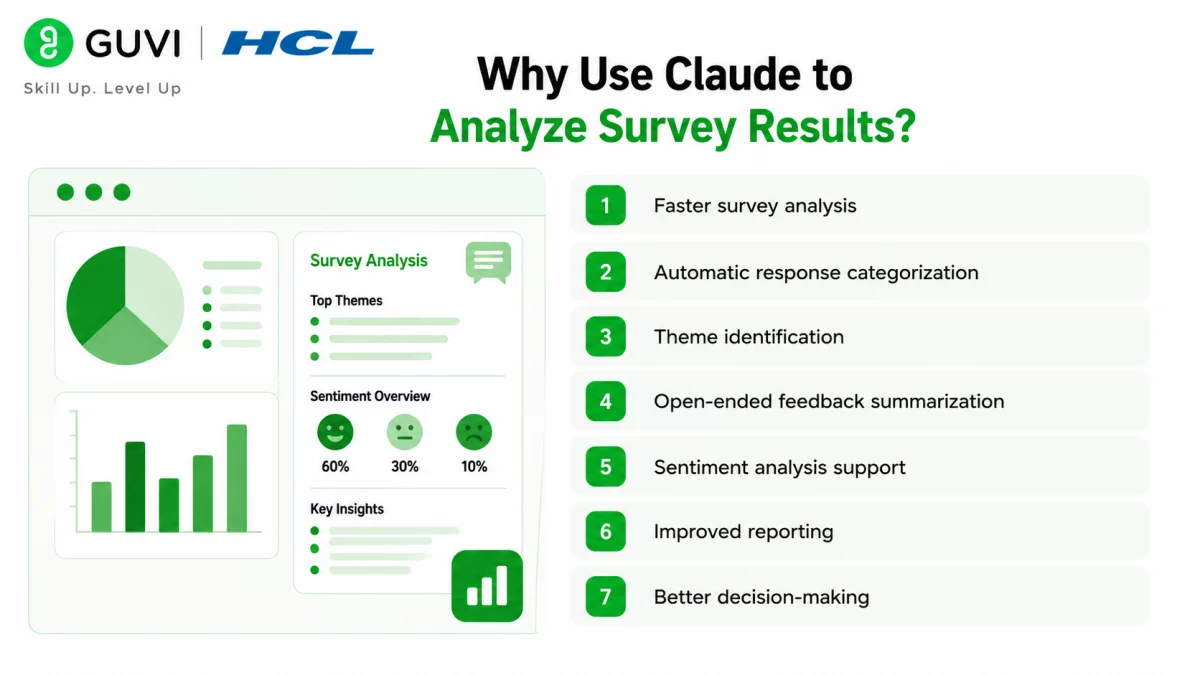
Survey data often includes both numerical ratings and detailed written responses. While quantitative data analysis can be analyzed using spreadsheets, interpreting qualitative feedback requires significant effort. Claude simplifies this process by organizing responses into meaningful categories and highlighting the insights that matter most.
Some major advantages include:
- Faster survey analysis
- Automatic response categorization
- Theme identification
- Open-ended feedback summarization
- Sentiment analysis support
- Improved reporting
- Better decision-making
- Increased productivity
Claude helps organizations spend less time reviewing survey responses and more time implementing improvements based on customer and employee feedback.
How to Use Claude to Analyze Survey Results
Step 1: Collect Survey Responses
Gather responses from your survey platform, ensuring the dataset includes both quantitative ratings and qualitative feedback. Export the responses in a structured format before uploading them to Claude.
Step 2: Upload the Survey Data
Paste the survey responses or upload the exported dataset into Claude. Clearly specify the objective, such as identifying trends, summarizing feedback, or analyzing customer satisfaction.
Step 3: Categorize Responses
Ask Claude to group similar responses into categories based on recurring topics, products, services, customer experiences, or employee concerns. This makes large datasets easier to interpret.
Step 4: Identify Key Themes
Claude can detect common patterns, recurring issues, frequently mentioned suggestions, and positive feedback across hundreds of responses, helping you understand what matters most to respondents.
Step 5: Summarize Open-Ended Feedback
Instead of reading every individual comment, ask Claude to generate concise summaries that highlight customer opinions, employee feedback, recurring challenges, and improvement opportunities.
Step 6: Generate Actionable Insights
Request Claude to convert survey findings into practical recommendations by identifying areas that require improvement, strengths to maintain, and opportunities for future growth.
Step 7: Verify the Results
Review Claude’s analysis alongside the original survey responses to ensure the generated insights accurately reflect participant feedback and business context.
Step 8: Share Findings with Stakeholders
Create clear reports, presentations, or executive summaries based on Claude’s analysis to help teams make informed, data-driven decisions.
Professionals looking to strengthen their analytical skills can also benefit from HCL GUVI’s Data Science Course, which covers statistics, machine learning, data visualization, predictive analytics, and AI-driven data analysis techniques that complement modern survey analytics and business intelligence.
Open-ended survey responses often contain valuable insights that are difficult and time-consuming to analyze manually. By using Claude for survey analysis, organizations can quickly group similar feedback, identify recurring themes, summarize thousands of responses, and uncover actionable insights that support faster, data-driven decision-making.
Survey Analysis Tasks Claude Can Assist With
Claude supports professionals throughout the survey analysis process.
It can help with:

- Survey response summarization
- Open-ended feedback analysis
- Theme identification
- Response categorization
- Customer feedback analysis
- Employee engagement survey analysis
- Sentiment identification
- Trend detection
- Executive summary generation
- Report preparation
- Survey insight extraction
- Recommendation generation
The HCL GUVI AI eBook also introduces practical AI concepts, prompt engineering techniques, and real-world AI applications that help professionals automate repetitive analysis tasks, organize large datasets, and use generative AI more effectively across business, research, and decision-making workflows.
Survey Analysis Tasks Claude Cannot Replace
While Claude is a powerful AI assistant for survey analysis, certain responsibilities require human expertise, domain knowledge, and strategic judgment. AI can identify patterns and summarize feedback, but interpreting results within the proper business context remains a human responsibility.
Claude should not replace:
- Making strategic business decisions
- Designing unbiased survey questionnaires
- Validating survey methodology
- Interpreting complex statistical findings
- Ensuring data accuracy and integrity
- Drawing final business conclusions without expert review
- Making policy or organizational decisions
- Protecting sensitive respondent information
Using Claude alongside experienced analysts allows organizations to accelerate survey analysis while maintaining accuracy, reliability, and meaningful business insights.
⚠️ Warning
Claude should support survey analysis, not replace professional judgment. Always verify AI-generated summaries, themes, and recommendations against the original survey data before making strategic decisions. Human review is essential for interpreting business context, validating findings, and ensuring accurate reporting.
Best Practice
To maximize the benefits of claude survey analysis:
- Use clean and well-organized survey data.
- Review AI-generated insights carefully.
- Verify recurring themes with the original responses.
- Combine qualitative and quantitative analysis.
- Remove duplicate or incomplete responses before analysis.
- Protect confidential respondent information.
- Use AI insights alongside human expertise for better decision-making.
Conclusion
Claude is transforming survey analysis by helping organizations summarize responses, identify recurring themes, categorize feedback, and generate actionable insights within minutes. Instead of manually reviewing hundreds of survey responses, professionals can use Claude to organize information efficiently and focus on making informed, data-driven decisions.
However, effective survey analysis depends on more than automation. Business context, statistical interpretation, and strategic thinking remain essential for drawing accurate conclusions. When combined with careful human review and responsible AI usage, Claude survey analysis can significantly improve productivity while enabling organizations to extract greater value from customer, employee, and market research surveys.
FAQs
1. What is Claude’s survey analysis?
Claude survey analysis uses Claude to summarize survey responses, identify recurring themes, categorize feedback, and generate actionable insights from qualitative and quantitative survey data.
2. Can Claude analyze open-ended survey responses?
Yes. Claude can summarize lengthy text responses, group similar feedback, identify recurring themes, and highlight common opinions or concerns across large datasets.
3. How does Claude improve survey analysis?
Claude speeds up analysis by organizing responses, detecting trends, generating summaries, identifying key themes, and creating structured reports that help organizations make informed decisions.
4. Can Claude analyze customer and employee surveys?
Yes. Claude can assist with customer satisfaction surveys, employee engagement surveys, market research questionnaires, product feedback surveys, and many other types of survey data.
5. Can Claude replace data analysts?
No. Claude assists with organizing and summarizing survey data, but data analysts remain responsible for statistical interpretation, business recommendations, and strategic decision-making.
6. Is Claude suitable for large survey datasets?
Yes. Claude can efficiently process and summarize large volumes of survey responses, making it easier to identify patterns and extract meaningful insights.
7. What are the best practices for using Claude for survey analysis?
Use high-quality survey data, verify AI-generated findings, validate recurring themes against the original responses, protect respondent privacy, and combine AI assistance with human expertise to produce accurate and reliable insights.
Success Stories

About the Author
Vishalini Devarajan
An Aerospace Engineer turned content writer, I focus on making complex concepts easy to understand through well-structured, reader-friendly blogs. Whether it’s a technical topic or a non-technical one, I love creating content that is clear, engaging, and impactful.
View all posts by Vishalini Devarajan
Connect with me @












Did you enjoy this article?